
Lecture
The main sources of environmental pollution include biological, chemical, physical, and mechanical factors. The ecological crisis triggered by human activity threatens wildlife and causes serious changes in the global ecosystem.
According to this classification, all sources of pollution can be divided into 4 classes.
Environmental pollution poses a threat both to an individual ecosystem and to the entire biosphere as a whole. Now let us examine their impact on the environment in more detail.
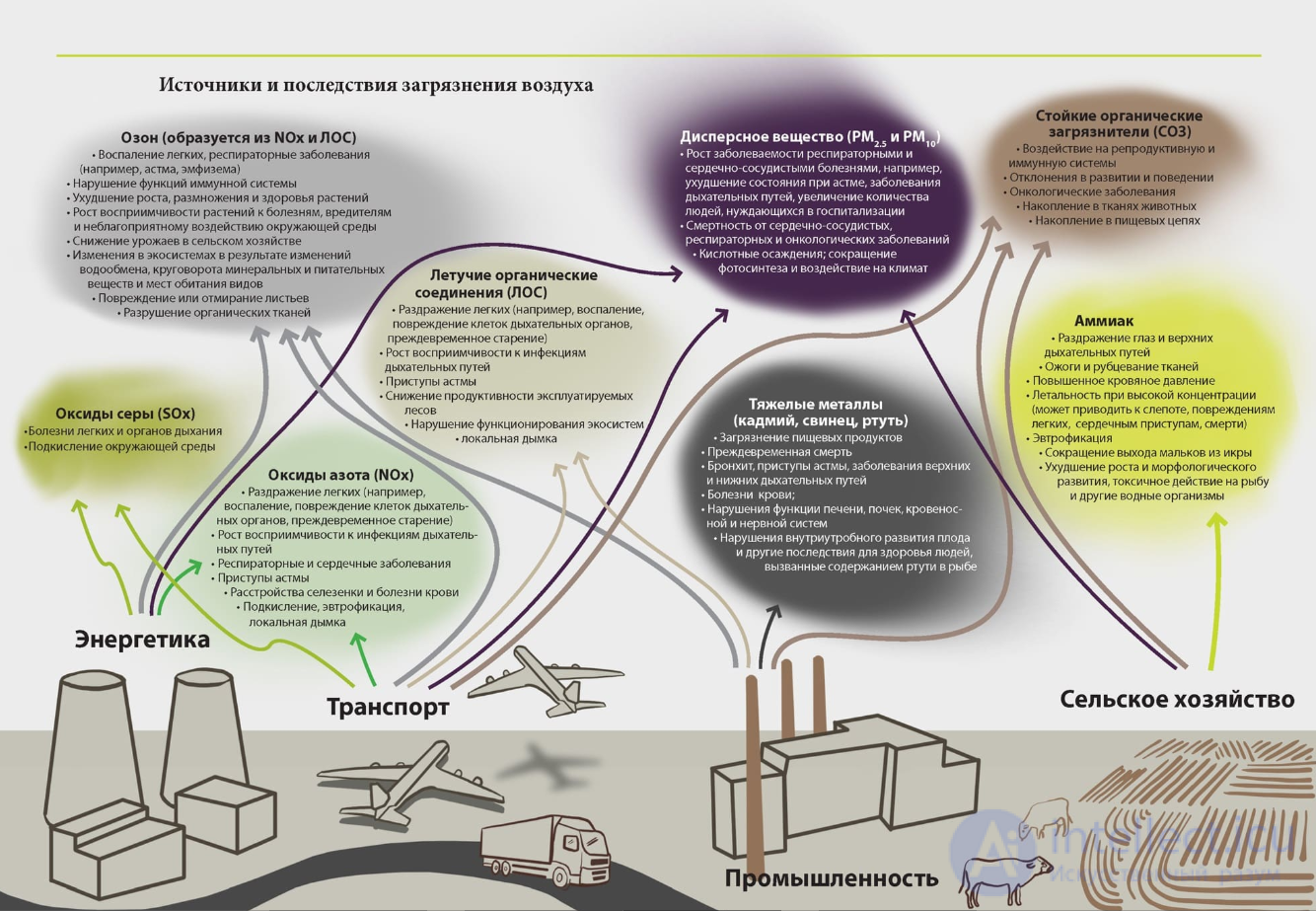
Advances in science and technology have made it possible to create comfortable living conditions for people. However, unjustifiably high rates of growth in consumption have led to excessive strain on the environment, to its pollution, and to the depletion of natural resources.
The main types of pollution affecting the natural environment include:
Pollution affects the state of the environment, is dangerous for people, and is a cause of various diseases and genetic mutations. Nevertheless, modern civilization cannot do without the chemical industry. The problem is not that chemists create "harmful substances," but that people do not always use synthesized substances and chemical technologies rationally. Consequently, it is chemists who must find ways to reduce the harm caused by industrial enterprises and other sources of pollution of our planet. In this regard, two paths are possible:
Following the first path, analytical chemists and ecologists develop effective methods for monitoring water bodies, soils, and air. Scientists and design engineers invent, and the chemical industry produces, numerous sorbents, absorbers, and ion-exchange resins for purifying industrial and waste water, and for absorbing harmful gases and dust released by enterprises. Chemists develop methods for the disposal of industrial and household waste through its safe destruction or processing for reuse. D. I. Mendeleev once wrote: "In chemistry there is no waste, only unused raw material."
As examples of the recycling of various types of waste in the Republic of Belarus, one can cite the processing of scrap metal at the Belarusian Metallurgical Plant. Today, waste paper and articles made of plastic and glass are recycled on an industrial scale. Foundry slag is used to make building materials (brick, tile). At Belarusian oil-refining enterprises there are units for converting hydrogen sulfide, released into the atmosphere during oil refining, into a useful product — sulfuric acid.
At the Gomel Chemical Plant, hydrogen fluoride, arising during the decomposition of apatite (phosphorite) concentrate, is converted into H2SiF6, AlF3, and Nа3AlF6.
Chemists, sharing humanity's concern over the deterioration of the environment, have developed a new strategy for organizing chemical production, which has come to be known as "green chemistry."
"Green chemistry" is a strategy for the production and use of chemical products and processes aimed at reducing or eliminating the use and generation of hazardous substances.
Let us consider how "green chemistry" proposes to solve environmental problems.
1. To avoid the release of chemicals into the environment and to reduce losses of natural resources, it is necessary to develop chemical processes that eliminate the formation of by-products. For example, in the traditional laboratory method known to you for the synthesis of hydrogen chloride by the reaction
NaCl(solid) + H2SO4(conc.) = HCl↑ + NaHSO4
theoretically only 2 of the 9 atoms of the reactants end up in the desired product. The so-called atom efficiency of this process is 22%.
At the Belaruskali OJSC, hydrogen chloride is obtained by the direct reaction of chlorine and hydrogen, in which all the atoms of the reactants end up in the product:
H2 + Cl2 = 2HCl.
Hence, the efficiency of the process is 100%.
2. It is necessary to use technological processes in which both the starting materials and the products or wastes are harmless to the environment and to plant personnel. For example, bleaching cellulose with chlorine in paper production leads to the formation and release of toxic substances — dioxins — into the environment. To avoid this, it is preferable to bleach cellulose with hydrogen peroxide, which does not pose such a hazard. When released into the environment, it decomposes quickly:
2Н2О2 = 2Н2О + О2↑.
The harm caused to all living things by discarded polymer packaging, bags, and plastic bottles is well known. However, a complete switch to paper packaging would require an increase in paper production, and consequently additional deforestation. Therefore, it is proposed to switch to producing packaging material from biodegradable materials made, for example, from lactic acid or cellulose derivatives. For making bottles, it is better to use glass, which can be reused or remelted to produce new items.
3. Most chemical-technological processes take place in solutions. Used aqueous or non-aqueous solvents containing impurities must undergo a purification process. This is an expensive process. Moreover, complete purification generally does not occur. Solvents containing hazardous chemical reagents are discharged into rivers as wastewater. The way out of this situation is to refrain from using solvents, or to choose ones that do not pollute the environment.
For example, it has been proposed to use carbon dioxide as a solvent, compressed to a state in which its density approaches that of a liquid. Such a solvent is already used today for extracting caffeine from coffee beans, essential oils from plants, and in some other chemical reactions. After extraction is carried out, it is enough to heat the solution and all the СО2 will evaporate.
4. To prevent the depletion of natural resources, it is necessary to create production facilities or carry out processes that use renewable types of raw materials — vegetable oils, cellulose, household waste, carbon dioxide.
This approach underlies the production of fatty acid methyl esters — biodiesel from rapeseed oil.
Chemists are working on creating materials for solar cells that convert the Sun's inexhaustible energy into electrical energy (Fig. 131).
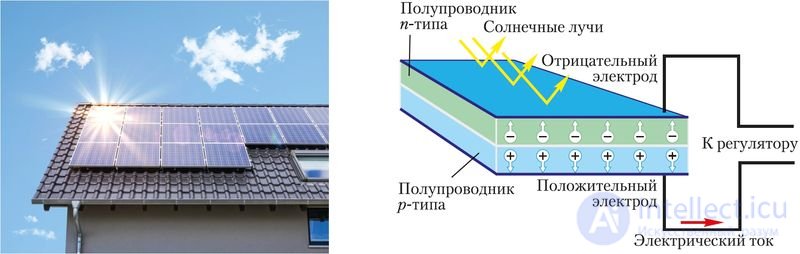
Fig. 131. A solar panel on the roof of a house and a diagram of a solar cell's construction
5. It is possible to reduce the release of vehicle exhaust gases into the atmosphere and reduce the greenhouse effect by replacing hydrocarbon internal combustion engines with electric motors. To this end, chemists are working on creating new chemical current sources, in particular on developing efficient fuel cells that convert the energy of the flameless oxidation of hydrogen by oxygen into electrical energy.
A major step in reducing atmospheric pollution is the use of automotive catalytic converters — devices in a vehicle's exhaust system. They are designed to reduce toxic emissions into the atmosphere by reducing nitrogen oxides and oxidizing carbon monoxide, as well as unburned hydrocarbons.
At present, for the sustainable development of civilization, humanity must direct its activities not only toward eliminating harmful consequences, but also toward preventing their occurrence, acting on the principle of "do no harm to yourself, to society, or to nature." Such activity is possible under conditions of the development of chemical science and, on its basis, the development of resource- and energy-saving, environmentally safe technologies, new materials, and substances.
The tasks of environmental chemistry are to track the entry of harmful substances into the environment, to neutralize or destroy them, and to limit their spread.
"Green chemistry" is a strategy for the production and use of chemical products and processes aimed at reducing or eliminating the use and generation of hazardous substances.
Chemical substances are not only sources of benefit for people, but also pose a danger to life and health. Upon entering the natural environment, and then the human body, they can cause severe pathological effects, as well as changes at the genetic level.
The main sources of chemical pollution are various industrial enterprises. The waste from their production pollutes the air, water, and soil, and from there enters the human body. However, it cannot be said that only substances obtained from the operation of enterprises pose a hazard, since household waste such as plastic bottles, cosmetics, various aerosols, and the like can also, to some extent, be classified as chemical waste, and when improperly processed, harmful chemical substances likewise enter the environment.
There are quite a number of different harmful substances, and they affect the natural environment and the human body in different ways. Therefore, all substances are differentiated with attention to their concentration, duration of exposure, and much more.
At present, hazardous chemical substances are divided into 6 groups:
General toxic substances cause poisoning of the entire organism (arsenic, benzene, mercury, lead, carbon monoxide, and others)
Irritant substances affect the mucous membranes and the upper and deep respiratory tracts (acetone vapors, ammonia, chlorine, nitrogen oxides, and others)
Sensitizing substances increase the body's sensitivity to chemical substances and, under industrial conditions, lead to allergic diseases (formaldehyde, hexachlorane, and others)
Carcinogenic substances cause the development of all types of cancer (asbestos, beryllium and its compounds, benzopyrene, and others)
Mutagenic substances affect the somatic cells that make up all human organs and tissues, as well as the germ cells (radioactive substances, lead, manganese, and others)
Substances affecting reproductive function cause congenital developmental defects and deviations from normal structure in offspring, and affect fetal development in the womb and the postnatal development and health of offspring (mercury, lead, radioactive substances, styrene, manganese)
1. What are the causes of environmental problems? How do you understand the expression: "The emergence of environmental problems is a consequence of excessive consumption"?
2. Name the substances that are the main air pollutants and their sources.
3. What inorganic substances might be found in well water if:
4. Assess the pros and cons of using polyethylene and paper as packaging.
5. Name possible ways to reduce environmental pollution by chemical enterprises. How does "green chemistry" propose to solve these problems?
6. It is recognized that it is cheaper to prevent the formation of pollution than to eliminate its consequences. Give examples of the implementation of this idea in the organization of modern chemical production.
7. Propose methods for absorbing, when released in a production process:
8. Based on reactions involving metals known to you, propose a method for extracting copper from a spent copper electroplating solution containing copper sulfate.
9. Near transport routes with heavy vehicle traffic, the smell of nitrogen dioxide is noticeable. Explain the source of its formation. Take into account that gasoline does not contain nitrogen compounds, while high pressure and temperature are reached in an automobile engine cylinder. The sensation of the smell of NO2 begins at a content of 8 mg/m3 in air. Calculate the volume fraction of NO2 corresponding to this concentration.
10. According to zoohygiene standards, the maximum permissible concentration (MPC) of harmful gases at a pig farm, in volume fractions, is: NH3 — 0.026% and H2S — 0.01%. It is known that the smell of ammonia is perceptible to a person at a concentration of 35 mg/m3, and the smell of hydrogen sulfide at a concentration of 1.4–2.8 mg/m3. Is it possible to determine the MPC of these gases at a pig farm by smell? Justify your answer with a calculation.
1. What is the main goal of green chemistry?
2. Which principle of green chemistry involves the use of renewable raw materials?
3. Which substances most often cause water pollution as a result of chemical production?
4. Which of the following is NOT a principle of green chemistry?
5. Which term denotes the ability of a substance to decompose naturally in nature?
6. What does the term "atom economy" mean in green chemistry?
7. Which waste disposal method is considered the least safe?
8. Which of the following is most often used as a safe solvent in green chemistry?
9. Which principle of green chemistry helps reduce energy costs in production?
10. Which substances destroy the ozone layer?
11. Why is it important to reduce the use of organic solvents?
12. Which of the following contributes to "green" synthesis?
13. What is the name of the process of restoring polluted soil with the help of plants?
14. Which fuel is considered the least environmentally friendly?
15. What is "ecotoxicology"?
16. Which gas is released during the decomposition of plastic in a landfill and harms the atmosphere?
17. Which strategy is most effective for reducing chemical pollution?
18. Which of the following is NOT an example of a "green" product?
19. Which technology can help reduce the release of harmful substances into the atmosphere?
20. Which of the following contributes to safer storage of chemical substances?

Comments