
Lecture
The properties of substances in the solid aggregate state are determined not only by the composition of atoms, ions, and molecules, but also by their mutual arrangement.
The arrangement of structural units can be ordered or disordered. Accordingly, solids exist in crystalline and amorphous states.
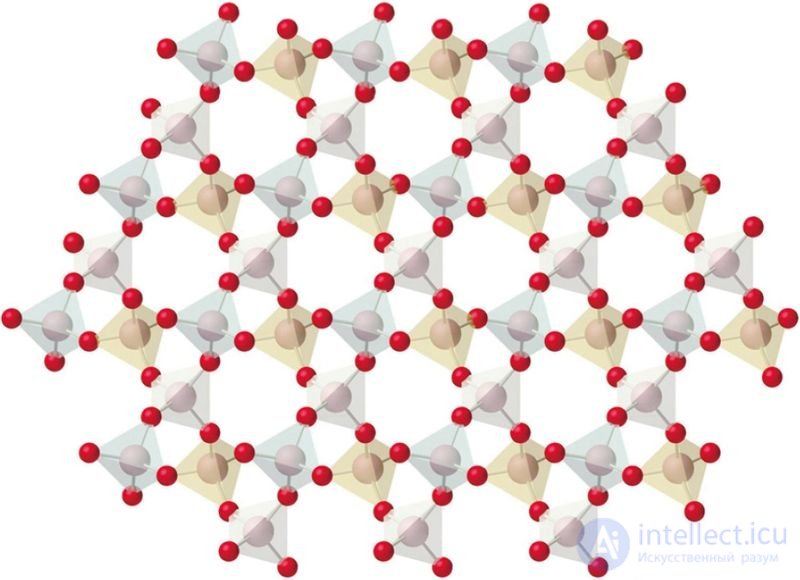
Fig. 35. Structure of silicon(IV) oxide
Crystals are solids with an ordered arrangement of structural units (atoms, ions, molecules). Crystals have the natural shape of polyhedra, and the arrangement of structural units is symmetric and repeats many times (fig. 35).
The structural units of substances with a molecular structure are molecules. For example, the structural unit of water is a molecule with the composition H2O, which is found in the solid, liquid, and gaseous states. However, only in ice crystals are water molecules arranged in an ordered manner, that is, at a specific distance, at a defined angle, forming a regular crystal structure.
In substances with a non-molecular structure, the smallest structural units are atoms or ions. Such substances include metals (Na, Cu, Fe) and non-metals (B and Si, diamond and graphite, red phosphorus), compounds of metals with non-metals (NaCl, NaH, Na2SO4, CuCl2, Fe2O3), and non-metals with non-metals (SiC, SiO2).
In the amorphous state there is no ordering in the arrangement of structural units. Glass, resin, paraffin, polyethylene, and soot, for example, are in the amorphous state.
The structure, properties, and methods of preparation of crystalline substances are studied by crystal chemistry. Each crystalline substance has its own crystal structure and a corresponding crystal shape (fig. 36). Crystals of halite (NaCl) have the shape of a cube, while crystals of quartz (SiO2) have the shape of a hexagonal prism.
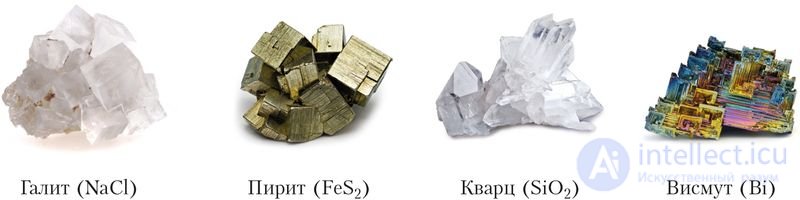
Fig. 36. Shapes of crystals of various substances
The structure of molecules is shown by means of structural formulas, while the spatial arrangement of atoms, ions, and molecules in crystals is depicted using a crystal lattice.
If the particles making up a crystal are connected by imaginary lines, a spatial framework is obtained, called a crystal lattice. The points of intersection of such lines are called the nodes (lattice points) of the crystal lattice. The position of the lattice points models the arrangement of the structural units of the crystal — atoms, ions, or molecules.
Table 13 summarizes the main characteristics of crystalline substances with different types of chemical bonding.
Table 13. Types of crystals and their properties
| Structural units, properties | Types of crystals, structural units | |||
| Atomic | Ionic | Metallic | Molecular | |
| Non-metal atoms | Ions | Metal atoms | Molecules | |
| Type of bond and its strength | Covalent, strong | Ionic, strong | Metallic, strength over a wide range | Weak intermolecular interaction |
| Electrical and thermal conductivity | From dielectrics to semiconductors | Solutions and melts conduct current | Good electrical and thermal conductivity | Low thermal conductivity, generally dielectrics |
| Plasticity | Brittle | Brittle | Mostly ductile (malleable) | Inorganic substances are generally brittle |
| Hardness | High | High | Varies over a wide range | Generally low, exception — fullerite |
| Melting and boiling points | Very high | From medium to high | Wide range | Low |
| Solubility | Insoluble | May dissolve in water and other polar solvents | Insoluble or may react with water | May dissolve in polar or non-polar solvents |
| Examples of substances | Diamond, graphite, silicon, SiO2, SiC | Oxides, hydroxides, and salts of alkali and alkaline earth metals | Metals, metal alloys | Acids, oxides of non-metals (except silicon), non-metals (for example, P4, S8, I2), organic substances |
A distinction is made between atomic (covalent bond), ionic (ionic bond), metallic (metallic bond), and molecular crystals. Molecular crystals are built from individual molecules, within which atoms are joined by covalent bonds, while weaker intermolecular forces act between the molecules. Molecular crystals are formed by substances you already know — sugar, aspirin, carbon dioxide ("dry ice"), and water (ice) (fig. 37).
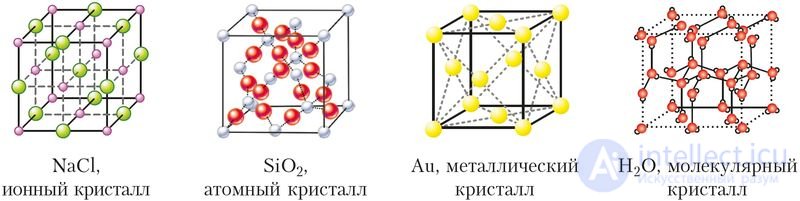
Fig. 37. Crystal lattices of substances with different types of chemical bonding
Dependence of the properties of substances on the type of crystal structure
The properties of solids depend on the structure of the crystals and the strength of the chemical bonds within them. For example, carbon forms several varieties of crystal structures. One of them is the structure of diamond, in which each carbon atom forms four covalent bonds of equal strength with four neighboring carbon atoms located at the vertices of a tetrahedron (fig. 38). Thanks to its structure, diamond is the hardest natural substance (Appendix 2). Carborundum SiC and borazon BN have similar crystal structures and a hardness close to that of diamond.
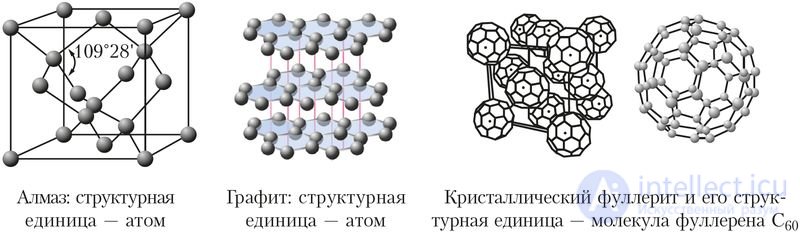
Fig. 38. Crystal lattices of allotropic modifications of carbon
Another variety of crystalline carbon is graphite. In graphite, carbon atoms are arranged in layers. Within the layers, each carbon atom uses three of its electrons to form three covalent bonds with neighboring atoms. The fourth electron participates in the formation of delocalized π-bonds and can move freely along the layer. Therefore, graphite has electrical conductivity and is used for making electrical contacts, conductive lubricants, electrodes, and so on.
The distance between the layers of graphite is considerably greater than that between atoms within a layer. Therefore, graphite easily delaminates. Owing to this property, graphite is used to make pencil leads, it is included in various lubricants that reduce friction, and it also serves as a solid lubricant in molds for casting metals.
The third crystalline modification of carbon — fullerite — is formed by fullerene C60 molecules, consisting of 60 carbon atoms.
Atomic, ionic, and metallic crystals differ in their resistance to mechanical deformation, in which a displacement of individual layers of the crystal structure occurs (fig. 39). In this case, the cohesion between layers in atomic crystals (a) is broken due to the rupture of chemical bonds between atoms, while in ionic crystals (b) it is broken due to the repulsion of like-charged ions. In metallic crystals, owing to the features of metallic bonding, the crystals do not fracture but deform. This is why metals are ductile (malleable), while atomic and ionic crystals are brittle.
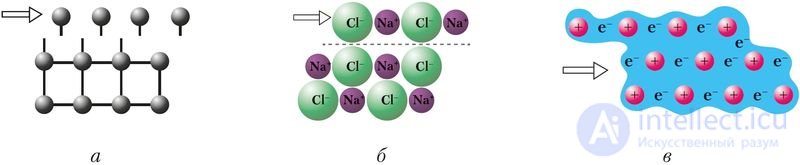
Fig. 39. Displacement of atomic layers during deformation of crystals:
a — atomic, b — ionic, c — metallic
Crystals are solids with an ordered arrangement of structural units (atoms, ions, molecules).
Four types of crystals are distinguished by structure: atomic, ionic, molecular, and metallic. They differ in their properties.
1. What are the main differences between substances of molecular and non-molecular structure? Give examples.
2. Compare the properties of atomic, molecular, ionic, and metallic crystals.
3. Explain why ionic and molecular crystals practically do not conduct electric current. What accounts for the good electrical and thermal conductivity of metallic crystals?
4. Can substances conduct current:
Give examples and the conditions under which these substances exhibit electrical conductivity.
5. Determine the types of chemical bonding and the types of crystals of the substances whose formulas are: SO2, SiC, CsF, K2SO4, Cu6Sn5.
6. A designer needed a very hard substance resistant to the action of high temperatures and solvents. Which of the compounds listed in problem 5 can he use in his tests?
7. Explain why graphite has electrical conductivity, while diamond does not.
8. Rose's alloy (tmelt. +94 °C) is used in fusible electrical fuses, as well as in radio engineering as a solder. Composition of the alloy (by mass): lead (25%), bismuth (50%), tin (25%). Indicate the type of its crystals. Calculate the mass of each component needed to obtain 5 kg of the alloy.
9. Calculate the molar ratio of the components in Wood's alloy. Wood's alloy is a heavy, low-melting alloy invented in 1860 by the American dentist Wood. Its melting point is 68.5 °C. Composition (mass fractions): tin — 12.5%, lead — 25%, bismuth — 50%, cadmium — 12.5%. What other physical properties do you think this alloy might have?
10. Determine the number of atoms in a 1 g portion of one of the hardest synthetic substances, which is a binary compound of boron and nitrogen, BN.
1. The following types of crystals are distinguished:
2. Ionic crystals are formed by a substance with the composition:
3. Atomic crystals are formed by:
4. Molecular crystals are formed by:
5. Ductile and brittle substances, respectively, are found in the pair:

Comments