
Lecture
The chemical industry plays a key role in achieving the goals of sustainable development for humanity. It provides for the production of essential materials and substances needed for medicine, agriculture, energy, construction and other sectors. At the same time, this industry bears significant responsibility for the environmental and social consequences of its activities.
In today's world, the chemical industry is striving to move from a traditional production model toward a more sustainable one, based on the principles of "green chemistry." This includes the development of environmentally safe technologies, reducing emissions of harmful substances, and the use of renewable resources and energy-efficient processes.
Of particular importance is the transition to closed production cycles, in which the waste of one process becomes the raw material for another. This reduces the burden on the environment and decreases the consumption of natural resources.
In addition, the chemical industry is actively involved in addressing global problems such as climate change, freshwater scarcity and food security. For example, the development of new catalysts can substantially reduce greenhouse gas emissions, while the creation of innovative fertilizers can increase crop yields without harming soils and water resources.
Thus, the development of the chemical industry on the basis of sustainability principles is becoming an important factor in ensuring a prosperous future for all inhabitants of the planet.
The chemical industry comprises companies and other organizations that develop and produce industrial, specialty and other chemicals. As a central part of the modern global economy, the chemical industry converts raw materials (petroleum, natural gas, air, water, metals and minerals) into commodity chemicals for industrial and consumer goods. It includes petrochemical branches, such as polymers for plastics and synthetic fibers; inorganic chemicals, such as acids and alkalis; agricultural chemicals, such as fertilizers, pesticides and herbicides; and other categories, such as industrial gases, specialty chemicals and pharmaceuticals.
The chemical industry employs a variety of specialists, including chemical engineers, chemists and laboratory technicians.
Although chemicals have been produced and used throughout history, the emergence of heavy chemical industry (the production of chemicals in large quantities for various purposes) coincided with the start of the industrial revolution.
One of the first chemicals to be produced in large quantities through industrial processes was sulfuric acid. In 1736, the pharmacist Joshua Ward developed a process for producing it, which involved heating sulfur with saltpeter, allowing the sulfur to oxidize and combine with water. This was the first practical large-scale production of sulfuric acid. John Roebuck and Samuel Garbett were the first to establish a large-scale factory at Prestonpans, Scotland, in 1749, which used lead condensation chambers to produce sulfuric acid.
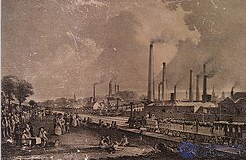
Charles Tennant's St Rollox chemical works in 1831, at that time the largest chemical enterprise in the world.
In the early 18th century, fabric was bleached by treating it with stale urine or sour milk and exposing it to sunlight for a prolonged period, which created a serious bottleneck in production. Sulfuric acid began to be used as a more effective agent, along with lime, by the mid-century, but it was the discovery of bleaching powder by Charles Tennant that spurred the creation of the first major chemical industrial enterprise. His powder was obtained by reacting chlorine with dry slaked lime and proved to be a cheap and successful product. He opened the St Rollox chemical works, north of Glasgow, and production grew from just 52 tons in 1799 to almost 10,000 tons only five years later.
Soda ash has been used since ancient times in the production of glass, textiles, soap and paper, and the traditional source of potash in Western Europe was wood ash. By the 18th century this source had become uneconomical due to deforestation, and the French Academy of Sciences offered a prize of 2,400 livres for a method of obtaining alkali from sea salt (sodium chloride). The Leblanc process was patented in 1791 by Nicolas Leblanc, who then built the Leblanc plant at Saint-Denis. He was refused the prize money because of the French Revolution.
In Britain, the Leblanc process became popular. William Losh built the first soda plant in Britain at the Losh, Wilson and Bell works on the River Tyne in 1816, but it remained small-scale because of high tariffs on salt production until 1824. When these tariffs were abolished, the British soda industry was able to expand rapidly. James Muspratt's chemical works in Liverpool and Charles Tennant's complex near Glasgow became the largest centers of chemical production in the world. By the 1870s, British soda output of 200,000 tons a year exceeded the combined output of all other countries in the world.

Ernest Solvay patented an improved industrial method for producing soda ash.
These enormous factories began producing a greater variety of chemicals as the industrial revolution matured. Initially, large volumes of alkaline waste were dumped into the environment during soda production, which prompted the adoption of one of the first environmental protection laws in 1863. It provided for thorough inspection of factories and imposed heavy fines on those exceeding pollution limits. Methods were developed for obtaining useful by-products from the alkali waste.
The Solvay process was developed by the Belgian industrial chemist Ernest Solvay in 1861. In 1864, Solvay and his brother Alfred built a plant at Charleroi, Belgium. In 1874, they expanded to a larger plant at Nancy, France. The new process proved more economical and less polluting than the Leblanc method, and its use spread. That same year, Ludwig Mond visited Solvay to acquire rights to use his process, and he and John Brunner founded Brunner, Mond & Co. and built a Solvay plant at Winnington, England. Mond played an important role in making the Solvay process commercially successful. He introduced several improvements between 1873 and 1880 that removed by-products which could have hindered the production of sodium carbonate in the process.
The production of chemical products from fossil fuel began on a large scale in the early 19th century. Coal tar and ammoniacal residues from coal gas production for gas lighting began to be processed in 1822 at the Boninngton chemical works in Edinburgh to produce naphtha, pitch oil (later called creosote), pitch, lamp black (soot) and sal ammoniac (ammonium chloride). Ammonium sulfate fertilizer, asphalt road paving, coke oil and coke were later added to the product line.
At the end of the 19th century there was an explosion both in the volume of production and in the variety of chemicals produced. Major chemical industries emerged in Germany and then in the United States.
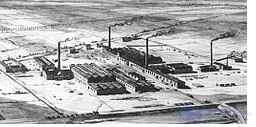
Plants of the German firm BASF, 1866.
The production of artificial fertilizers for agriculture was first begun by Sir John Lawes at his specially built research station at Rothamsted. In the 1840s he established large factories near London for the production of superphosphate of lime. Rubber vulcanization processes were patented by Charles Goodyear in the United States and Thomas Hancock in England in the 1840s. The first synthetic dye was discovered by William Henry Perkin in London. He partially converted aniline into a crude mixture which, upon extraction with alcohol, yielded a substance of intense purple color. He also developed the first synthetic perfumes. German industry quickly began to dominate the field of synthetic dyes. The three major firms BASF, Bayer and Hoechst produced several hundred different dyes. By 1913, German industry produced almost 90% of the world's dye supply and sold about 80% of its output abroad. In the United States, Herbert Henry Dow's use of electrochemistry to produce chemicals from brine achieved commercial success that helped advance the country's chemical industry.
The petrochemical industry traces its origins to the oil works of the Scottish chemist James Young and the Canadian Abraham Pineo Gesner. The first plastic was invented by Alexander Parkes, an English metallurgist. In 1856 he patented Parkesine, a nitrocellulose-based celluloid treated with various solvents. This material, displayed at the 1862 London International Exhibition, anticipated many modern aesthetic and practical uses of plastic. Industrial production of soap from vegetable oils was begun by William Lever and his brother James in 1885 in Lancashire, based on a modern chemical process invented by William Hough Watson, which used glycerin and vegetable oils.
By the 1920s, chemical firms had merged into large conglomerates: IG Farben in Germany, Rhône-Poulenc in France, and Imperial Chemical Industries in the United Kingdom. DuPont became a major chemical firm in America in the early 20th century.
Polymers and plastics such as polyethylene, polypropylene, polyvinyl chloride, polyethylene terephthalate, polystyrene and polycarbonate account for about 80% of the industry's global production volume. Chemicals are used in many different consumer goods, as well as across many different sectors. This includes agriculture, manufacturing, construction and services. Major industrial consumers include rubber and plastic products, textiles, apparel, oil refining, pulp and paper, and primary metals. Chemicals represent an almost $5 trillion global enterprise, and EU and US chemical companies are the world's largest producers.
Chemical business sales can be divided into several broad categories, including basic chemicals (about 35%–37% of dollar sales volume), life sciences (30%), specialty chemicals (20%–25%) and consumer products (about 10%).
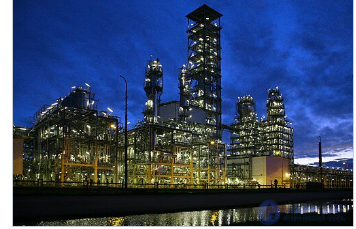
The new PP3 polypropylene plant at the Slovnaft refinery (Bratislava, Slovakia)
Basic chemicals, or "commodity chemicals," represent a broad chemical category that includes polymers, bulk petrochemicals and intermediates, other derivatives and basic industrial products, inorganic chemicals, and fertilizers.
Polymers are the largest revenue segment and include all categories of plastics and man-made fibers. The main markets for plastics are packaging, followed by home construction, containers, appliances, piping, transportation, toys and games.
The main raw materials for polymers are petroleum products such as ethylene, propylene and benzene.
Petrochemicals and intermediates are produced mainly from liquefied petroleum gas (LPG), natural gas and crude oil fractions. High-volume products include ethylene, propylene, benzene, toluene, xylenes, methanol, vinyl chloride monomer (VCM), styrene, butadiene and ethylene oxide. These basic or commodity chemicals are the starting materials used to produce many polymers and other more complex organic chemicals, particularly those produced for use in the specialty chemicals category.
Other derivatives and basic industrial products include synthetic rubber, surfactants, dyes and pigments, turpentine, resins, carbon black, explosives and rubber products, and make up about 20 percent of external sales of basic chemicals.
Inorganic chemicals (about 12% of total revenue) make up the oldest of the chemical categories. Products include salt, chlorine, caustic soda, soda ash, acids (such as nitric acid, phosphoric acid and sulfuric acid), titanium dioxide and hydrogen peroxide.
Fertilizers make up the smallest category (about 6 percent) and include phosphates, ammonia and potash chemicals.
Life sciences (about 30% of dollar volume of chemical business production) include differentiated chemical and biological substances, pharmaceuticals, diagnostics, animal health products, vitamins and pesticides. Although their volumes are much smaller than those of other chemical sectors, their products tend to command high prices — more than ten dollars per pound — growth rates 1.5 to 6 times greater than GDP, and R&D spending of 15 to 25% of sales. Life sciences products are usually manufactured to high specifications and are thoroughly reviewed by government agencies such as the Food and Drug Administration. Pesticides, also called "crop protection chemicals," make up about 10% of this category and include herbicides, insecticides and fungicides.
The branch of chemistry concerned with the synthesis of new or predetermined substances is called synthetic chemistry (or chemical synthesis).
In a narrower and more precise sense, the following terms may be used:
Organic synthesis — when it concerns the synthesis of organic compounds.
Inorganic synthesis — when inorganic substances are synthesized.
Medicinal chemistry (or medicinal-chemical synthesis) — when synthesis is carried out for the purpose of obtaining drugs.
Supramolecular chemistry — the synthesis and construction of complex molecular structures and assemblies.
Combinatorial chemistry — the synthesis of a large number of different compounds for the purpose of selecting the most active ones.
The main methods for synthesizing target substances depend on the type of substance (organic, inorganic, coordination, polymers, etc.), but there are a number of universal approaches and strategies applicable in many areas of chemistry. Here are the key methods and strategies:
Direct interaction of substances — combining reagents to form a new compound.
Example:
H2+Cl2→2HCl, Fe+S→FeS Obtaining iron sulfide from the elements.
Substitution — one group of atoms is replaced by another.
Example:
CH3Br+OH−→CH3OH+Br−  Zinc displaces hydrogen from an acid.
Addition — a reagent is added to a multiple bond.
Example:
CH2=CH2+HBr→CH3CH2Br  Addition of hydrogen chloride to ethylene.
Elimination — removal of a group of atoms, formation of a multiple bond.
Example:
 Dehydration of ethanol to ethylene.
Used in organic synthesis.
Begins with the target molecule and analyzes which intermediate compounds could be used to build it.
Follows the logic of "large fragments first, details later."
Example: synthesis of aspirin (acetylsalicylic acid)
Final goal:
Aspirin→Salicylic acid+Acetic anhydride\text{Aspirin} \rightarrow \text{Salicylic acid} + \text{Acetic anhydride}Aspirin→Salicylic acid+Acetic anhydride
Reaction:

(Salicylic acid + acetic anhydride = aspirin + acetic acid)
Use of catalysts to accelerate or selectively direct reactions:
Homogeneous catalysis — the catalyst is in the same phase as the reactants.
Heterogeneous catalysis — the catalyst is in a different phase (for example, a solid + a gas).
Heterogeneous catalysis:
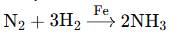
(The Haber–Bosch process: ammonia production)
Homogeneous catalysis:

(Hydroformylation: production of propionic acid from ethylene)
Rapid production of libraries of compounds with different groups.
Often used in pharmaceutics.
Example: creating a peptide library
Automated synthesis of short peptide chains with variable amino acids, for example:
Gly-Ala,Gly-Val,Gly-Leu,Gly-Ile...
Used in the search for new drugs.
Synthesis is carried out with control of conditions (temperature, pressure, solvent) to obtain exactly the desired product, especially when several possible isomers exist.
Example: obtaining the desired isomer
In aldol condensation, the choice of temperature and solvent affects whether the cis- or trans-isomer is obtained.

Use of electric current or light to activate molecules and carry out reactions.
Example: electrolysis to obtain metals, photosynthesis of organic compounds.
Electrochemical synthesis:

Production of alkali, chlorine and hydrogen.
Photochemical synthesis:
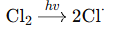
(Light causes decomposition of the chlorine molecule, used in the photochlorination of alkanes)
Polymerization: radical, ionic, step-growth, and others.
The goal is to obtain high-molecular-weight compounds.
Radical polymerization:

Production of polyvinyl chloride (PVC).
Step-growth polymerization:
Adipic acid+Hexamethylenediamine→Nylon-6,6
Non-covalent interactions (hydrogen bonds, ionic and π-interactions).
Self-organization of molecules into more complex structures.
Example: synthesis of "cages" from cyclodextrins
Sugar molecules (cyclodextrins) assemble themselves into "rings" into which other molecules can enter — used in drug carriers.
Example: self-assembly of DNA origami
Complementary DNA strands assemble into predetermined shapes: boxes, nanotubes, lattices.
Specialty chemicals are a category of relatively high-value, fast-growing chemicals with diverse end-product markets. Typical growth rates are one to three times GDP, with prices above a dollar per pound. They tend to be characterized by their innovative aspects. Products are sold for what they can do rather than for what chemicals they contain. Products include electronic chemicals, industrial gases, adhesives and sealants, as well as coatings, industrial and institutional cleaning chemicals and catalysts. In 2012, excluding fine chemicals, the global specialty chemicals market, worth $546 billion, was made up of 33% paints, coatings and surface treatment, 27% advanced polymers, 14% adhesives and sealants, 13% additives, and 13% pigments and inks.
Specialty chemicals are sold as effect or performance chemicals. Sometimes they are mixtures of formulas, unlike "fine chemicals," which are almost always single-molecule products.
Consumer products include direct sales of chemicals such as soap, detergents and cosmetics. Typical growth rates range from 0.8 to 1.0 times GDP.
Consumers rarely come into contact with basic chemicals. Polymers and specialty chemicals are the materials they encounter everywhere on a daily basis. Examples include plastics, cleaning agents, cosmetics, paints and coatings, electronics, automobiles and materials used in home construction. [ 14 ] These specialty products are sold by chemical companies to downstream manufacturing industries as pesticides, specialty polymers, electronic chemicals, surfactants, construction chemicals, industrial cleaners, flavors and fragrances, specialty coatings, printing inks, water-soluble polymers, food additives, paper chemicals, oilfield chemicals, plastic adhesives, adhesives and sealants, cosmetic chemicals, water treatment chemicals, catalysts and textile chemicals. Chemical companies rarely supply these products directly to the consumer.
Each year the American Chemistry Council compiles a table of production volumes for the top 100 chemicals in the US. In 2000, the combined production volume of the top 100 chemicals was 502 million tons, up from 397 million tons in 1990. Inorganic chemicals tend to have the largest volume but much lower dollar value because of their low prices. The top 11 of the 100 chemicals in 2000 were sulfuric acid (44 million tons), nitrogen (34), ethylene (28), oxygen (27), lime (22), ammonia (17), propylene (16), polyethylene (15), chlorine (13), phosphoric acid (13) and diammonium phosphates (12). [ citation needed ]
The largest chemical producers today are global companies with international operations and plants in many countries. Below is a list of the 25 largest chemical companies by chemical sales volume in 2015. (Note: chemical sales represent only a portion of some companies' total sales.)
Leading chemical companies by chemical product sales volume in 2015.
| Rank | Company | Chemical product sales in 2015 (billion USD) | Headquarters |
|---|---|---|---|
| 1 | BASF | $63.7 |  Ludwigshafen, Germany Ludwigshafen, Germany |
| 2 | The Dow Chemical Company | $48.8 |  Midland, Michigan, USA Midland, Michigan, USA |
| 3 | China Petrochemical Corporation | $43.8 |  Beijing, China Beijing, China |
| 4 | SABIC | $34.3 |  Riyadh, Saudi Arabia Riyadh, Saudi Arabia |
| 5 | Formosa Plastics | $29.2 |  Kaohsiung City, Taiwan Kaohsiung City, Taiwan |
| 6 | INEOS | $28.5 |  London, United Kingdom London, United Kingdom |
| 7 | ExxonMobil | $28.1 | Irving, Texas, USA |
| 8 | LyondellBasell | $26.7 | Houston, Texas, USA, and
|
| 9 | Mitsubishi Chemical | $24.3 |  Tokyo, Japan Tokyo, Japan |
| 10 | DuPont | $20.7 | Wilmington, Delaware, USA |
| 11 | LG Chem | $18.2 |  Seoul, South Korea Seoul, South Korea |
| 12 | Air Liquide | $17.3 |  Paris, France Paris, France |
| 13 | Linde Group | $16.8 | Munich, Germany and New Jersey, USA |
| 14 | AkzoNobel | $16.5 |  Amsterdam, Netherlands Amsterdam, Netherlands |
| 15 | PTT Global Chemical | $16.2 |  Bangkok, Thailand Bangkok, Thailand |
| 16 | Toray Industries | $15.5 | Tokyo, Japan |
| 17 | Evonik Industries | $15.0 | Essen, Germany |
| 18 | PPG Industries | $14.2 | Pittsburgh, Pennsylvania, USA |
| 19 | Braskem | $14.2 |  São Paulo, Brazil São Paulo, Brazil |
| 20 | Yara International | $13.9 |  Oslo, Norway Oslo, Norway |
| 21 | Covestro | $13.4 | Leverkusen, Germany |
| 22 | Sumitomo Chemical | $13.3 | Tokyo, Japan |
| 23 | Reliance Industries | $12.9 |  Mumbai, India Mumbai, India |
| 24 | Solvay | $12.3 |  Brussels, Belgium Brussels, Belgium |
| 25 | Bayer | $11.5 | Leverkusen, Germany |
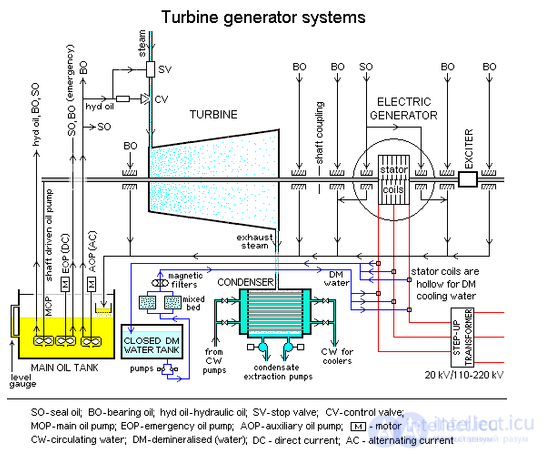
This is a diagram of a turbogenerator process. Engineers working to create a sustainable process for use in the chemical industry must know how to design a sustainable process in which the system can withstand or manage process upset conditions such as heat, friction, pressure, emissions and pollutants.
From the perspective of chemical engineers, the chemical industry involves the use of chemical processes, such as chemical reactions and purification methods, to produce a wide range of solid, liquid and gaseous materials. Most of these products serve to manufacture other items, though a smaller number go directly to consumers. Solvents, pesticides, lye, laundry detergent and Portland cement are a few examples of products used by consumers.
The industry includes producers of inorganic and organic industrial chemicals, ceramics, petrochemical products, agrochemical products, polymers and rubber (elastomers), oleochemical products (oils, fats and waxes), explosives, and flavors and fragrances. Examples of these products are given in the table below.
| Product type | Examples |
|---|---|
| inorganic industrial | ammonia, chlorine, sodium hydroxide, sulfuric acid, nitric acid |
| organic industrial | acrylonitrile, phenol, ethylene oxide, urea |
| ceramics | silicate brick, frit |
| petrochemicals | ethylene, propylene, benzene, styrene |
| agrochemicals | fertilizers, insecticides, herbicides |
| polymers | polyethylene, bakelite, polyester |
| elastomers | polyisoprene, neoprene, polyurethane |
| oleochemicals | tallow, soybean oil, stearic acid |
| explosives | nitroglycerin, ammonium nitrate, nitrocellulose |
| flavors and fragrances | benzyl benzoate, coumarin, vanillin |
| industrial gases | nitrogen, oxygen, acetylene, nitrous oxide |
Related industries include petroleum, glass, paint, ink, sealant, adhesive, pharmaceutical and food industries.
Chemical processes, such as chemical reactions, take place at chemical plants to form new substances in various types of reaction vessels. In many cases, reactions occur in specialized corrosion-resistant equipment at elevated temperatures and pressures using catalysts. The products of these reactions are separated using various methods, including distillation, especially fractional distillation, precipitation, crystallization, adsorption, filtration, sublimation and drying.
Processes and products are typically tested during and after manufacturing using specialized instruments and on-site quality control laboratories to ensure safe operation and that the product meets required specifications. An increasing number of organizations in the industry are implementing chemical compliance software to maintain product quality and manufacturing standards. Products are packaged and shipped in many ways, including pipelines, tank cars and tank trucks (for both solids and liquids), cylinders, drums, bottles and boxes. Chemical companies often have research and development laboratories to develop and test products and processes. These facilities may include pilot plants, and such research facilities may be located separately from the manufacturing plants.
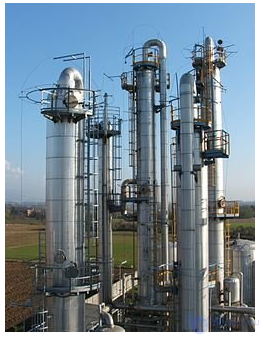
Distillation columns
The scale of chemical production is generally organized from the largest by volume (petrochemicals and commodity chemicals) down to specialty chemicals and the smallest — fine chemicals.
Petrochemical and commodity chemical production units are generally continuous single-product processing plants. Not all petrochemical or commodity chemical materials are produced at a single site, but groups of related materials often need to drive industrial symbiosis, as well as efficiencies in materials, energy and utilities and other economies of scale.
These chemicals, produced on the largest scale, are manufactured at a limited number of production sites around the world, for example in Texas and Louisiana along the Gulf Coast in the United States, in Teesside (UK) and in Rotterdam in the Netherlands. Large-scale production sites often have clusters of production units that share utilities and large-scale infrastructure such as power plants, port facilities, and road and rail terminals. To illustrate the clustering and integration mentioned above, about 50% of the United Kingdom's petrochemical and commodity chemicals are produced in the North East industrial cluster of England at Teesside.
Specialty chemical and fine chemical production is mostly carried out through discrete batch processes. These producers are often located in similar areas, but in many cases can be found in multi-industry business parks.
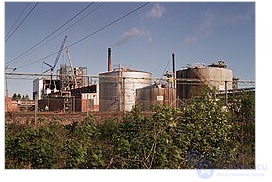
The Kemira chemical plant in Oulu, Finland.
There are 170 major chemical companies in the US. [ 17 ] They operate internationally, with more than 2,800 facilities outside the US and 1,700 foreign subsidiaries or affiliates. The volume of chemical production in the US is $750 billion per year. American industry records a large trade surplus and provides employment for more than a million people in the United States alone. The chemical industry is also the second-largest consumer of energy in manufacturing and spends more than $5 billion annually on pollution control.
In Europe, the chemical, plastics and rubber sectors are among the largest industrial sectors. [ 18 ] Together they create about 3.2 million jobs across more than 60,000 companies. Since 2000, the chemical sector alone has represented 2/3 of the EU's entire manufactured goods trade surplus.
In 2012, the chemical sector accounted for 12% of the value added of EU manufacturing. Europe remains the world's largest chemical trading region, with 43% of world exports and 37% of world imports, although recent data show Asia catching up with 34% of exports and 37% of imports. [ 19 ] Nevertheless, Europe still maintains a trade surplus with all regions of the world except Japan and China, where there was a chemical trade balance in 2011. Europe's trade surplus with the rest of the world today stands at €41.7 billion. [ 20 ]
Over the 20 years from 1991 to 2011, the sales of the European chemical industry increased from €295 billion to €539 billion, an example of steady growth. Nevertheless, the European industry's share of the world chemical market fell from 36% to 20%. This was due to the enormous growth in production and sales in emerging markets such as India and China. [ 21 ] Data show that 95% of this effect is due to China alone. Data from the European Chemical Industry Council for 2012 show that five European countries account for 71% of chemical sales in the EU. These are Germany, France, the United Kingdom, Italy and the Netherlands.
The chemical industry has shown growth in China, India, Korea, the Middle East, Southeast Asia, Nigeria and Brazil. Growth is driven by changes in the availability and price of raw materials, labor and energy costs, differing rates of economic growth, and environmental pressures.
Just as companies become major producers within the chemical industry, we can also look at a more global scale at how industrialized countries rank in terms of the billions of dollars of output a country or region can export. Although the chemical business is global in scale, most of the world's $3.7 trillion in chemical production volume is concentrated in just a few industrialized countries. The United States alone produced $689 billion, 18.6 percent of total world chemical production, in 2008.
| World chemical supply by country/region (billions of dollars) | 1998 | 1999 | 2000 | 2001 | 2002 | 2003 | 2004 | 2005 | 2006 | 2008 | 2009 |
|---|---|---|---|---|---|---|---|---|---|---|---|
| United States of America | 416.7 | 420.3 | 449.2 | 438.4 | 462.5 | 487.7 | 540.9 | 610.9 | 657.7 | 664.1 | 689.3 |
| Canada | 21.1 | 21.8 | 25.0 | 24.8 | 25.8 | 30.5 | 36.2 | 40.2 | 43.7 | 45.4 | 47.4 |
| Mexico | 19.1 | 21.0 | 23.8 | 24.4 | 24.3 | 23.5 | 25.6 | 29.2 | 32.0 | 33.4 | 37.8 |
| North America | 456.9 | 463.1 | 498.0 | 487.6 | 512.6 | 541.7 | 602.7 | 680.3 | 733.4 | 742.8 | 774.6 |
| Brazil | 46.5 | 40.0 | 45.7 | 41.5 | 39.6 | 47.4 | 60.2 | 71.1 | 82.8 | 96.4 | 126.7 |
| Other | 59.2 | 58.1 | 60.8 | 63.4 | 58.6 | 62.9 | 69.9 | 77.2 | 84.6 | 89.5 | 102.1 |
| Latin America | 105.7 | 98.1 | 106.5 | 104.9 | 98.2 | 110.3 | 130.0 | 148.3 | 167.4 | 185.9 | 228.8 |
| Germany | 124.9 | 123.2 | 118.9 | 116.1 | 120.1 | 148.1 | 168.6 | 178.6 | 192.5 | 229.5 | 263.2 |
| France | 79.1 | 78.5 | 76.5 | 76.8 | 80.5 | 99.6 | 111.1 | 117.5 | 121.3 | 138.4 | 158.9 |
| United Kingdom | 70.3 | 70.1 | 66.8 | 66.4 | 69.9 | 77.3 | 91.3 | 95.2 | 107.8 | 118.2 | 123.4 |
| Italy | 63.9 | 64.6 | 59.5 | 58.6 | 64.5 | 75.8 | 86.6 | 89.8 | 95.3 | 105.9 | 122.9 |
| Spain | 31.0 | 30.8 | 30.8 | 31.9 | 33.4 | 42.0 | 48.9 | 52.7 | 56.7 | 63.7 | 74.8 |
| Netherlands | 29.7 | 29.4 | 31.3 | 30.6 | 32.2 | 40.1 | 49.0 | 52.7 | 59.2 | 67.9 | 81.7 |
| Belgium | 27.1 | 27.0 | 27.5 | 27.1 | 28.7 | 36.1 | 41.8 | 43.5 | 46.9 | 51.6 | 62.6 |
| Switzerland | 22.1 | 22.2 | 19.4 | 21.1 | 25.5 | 30.3 | 33.8 | 35.4 | 37.8 | 42.7 | 53.1 |
| Ireland | 16.9 | 20.1 | 22.6 | 22.9 | 29.1 | 32.3 | 33.9 | 34.9 | 37.5 | 46.0 | 54.8 |
| Sweden | 11.1 | 11.4 | 11.2 | 11.0 | 12.5 | 15.9 | 18.2 | 19.3 | 21.2 | 21.2 | 22.6 |
| Other | 27.1 | 26.8 | 25.9 | 26.4 | 27.9 | 33.5 | 38.6 | 42.9 | 46.2 | 50.3 | 58.9 |
| Western Europe | 503.1 | 504.0 | 490.4 | 488.8 | 524.4 | 630.9 | 721.9 | 762.7 | 822.4 | 935.4 | 1,076.8 |
| Russia | 23.8 | 24.6 | 27.4 | 29.1 | 30.3 | 33.4 | 37.5 | 40.9 | 53.1 | 63.0 | 77.6 |
| Other | 22.3 | 20.3 | 21.9 | 23.4 | 25.3 | 31.4 | 39.6 | 46.2 | 55.0 | 68.4 | 87.5 |
| Central/Eastern Europe | 46.1 | 44.9 | 49.3 | 52.5 | 55.6 | 64.8 | 77.1 | 87.1 | 108.0 | 131.3 | 165.1 |
| Africa and the Middle East | 52.7 | 53.2 | 59.2 | 57.4 | 60.4 | 73.0 | 86.4 | 99.3 | 109.6 | 124.2 | 160.4 |
| Japan | 193.8 | 220.4 | 239.7 | 208.3 | 197.2 | 218.8 | 243.6 | 251.3 | 248.5 | 245.4 | 298.0 |
| Asia-Pacific, excluding Japan | 215.2 | 241.9 | 276.1 | 271.5 | 300.5 | 369.1 | 463.9 | 567.5 | 668.8 | 795.5 | 993.2 |
| China | 80.9 | 87.8 | 103.6 | 111.0 | 126.5 | 159.9 | 205.0 | 269.0 | 331.4 | 406.4 | 549.4 |
| India | 30.7 | 35.3 | 35.3 | 32.5 | 33.5 | 40.8 | 53.3 | 63.6 | 72.5 | 91.1 | 98.2 |
| Australia | 11.3 | 12.1 | 11.2 | 10.8 | 11.3 | 14.9 | 17.0 | 18.7 | 19.1 | 22.8 | 27.1 |
| Korea | 39.3 | 45.5 | 56.3 | 50.4 | 54.9 | 64.4 | 78.7 | 91.9 | 103.4 | 116.7 | 133.2 |
| Singapore | 6.3 | 8.5 | 9.5 | 9.4 | 12.5 | 16.1 | 20.0 | 22.0 | 25.8 | 28.9 | 31.6 |
| Taiwan | 21.9 | 23.7 | 29.2 | 26.8 | 28.4 | 34.3 | 44.5 | 49.5 | 53.8 | 57.4 | 62.9 |
| Other Asia-Pacific countries | 24.8 | 29.1 | 30.9 | 30.8 | 33.3 | 38.8 | 45.5 | 52.9 | 62.9 | 72.2 | 90.8 |
| Asia-Pacific | 409.0 | 462.3 | 515.7 | 479.7 | 497.7 | 587.8 | 707.5 | 818.8 | 917.3 | 1041.0 | 1291.2 |
| Total world supply | 1573.5 | 1625.5 | 1719.0 | 1670.9 | 1748.8 | 2008.5 | 2325.6 | 2596.4 | 2858.1 | 3160.7 | 3696.8 |

Comments