
Laboratory Experiment 7. Reaction of Metals with Acid Solutions

Lecture


Reaction of Metals with Acid Solutions

Reagents: magnesium, zinc, iron, copper, sulfuric acid solution.

Place the metals — magnesium, zinc, iron, copper — into four test tubes and add sulfuric acid solution to them (1 cm3 each).

Note the intensity of gas evolution.

Draw a conclusion about the chemical activity of the metals with respect to acids.

Procedure

  1. One metal was placed in each of four test tubes: magnesium, zinc, iron, copper.
  2. 1 cm³ of sulfuric acid solution was added to each test tube.
  3. Gas evolution and the rate of reaction were observed.

Observations

  • Magnesium — vigorous gas evolution, the metal dissolves quickly.
  • Zinc — active gas evolution, the reaction proceeds more slowly than with magnesium.
  • Iron — weak gas evolution, the reaction proceeds slowly.
  • Copper — no changes observed, no gas is evolved.

The gas evolved is hydrogen.

Reaction Equations (Molecular Form)

Mg + H₂SO₄ → MgSO₄ + H₂↑
Zn + H₂SO₄ → ZnSO₄ + H₂↑
Fe + H₂SO₄ → FeSO₄ + H₂↑
Cu + H₂SO₄ → no reaction occurs

Laboratory Experiment 7. Reaction of Metals with Acid Solutions

Conclusion

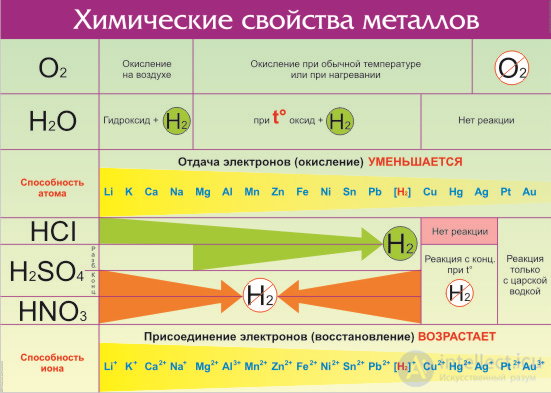
The intensity of hydrogen evolution decreases in the series:

Mg > Zn > Fe > Cu

Consequently, the chemical activity of the metals with respect to acids decreases in the same order.
Metals located above hydrogen in the activity series displace it from acids, while copper does not react with dilute sulfuric acid.
Laboratory Experiment 7. Reaction of Metals with Acid Solutions

See also

  • [[b13103]]
  • [[b13104]]
  • [[b13087]]
  • [[b13086]]

Comments

To leave a comment

If you have any suggestion, idea, thanks or comment, feel free to write. We really value feedback and are glad to hear your opinion.
To reply

Lectures and tutorial on "Неорганическая химия"

Terms: Неорганическая химия