
Lecture
The development of quantum mechanics in the 1920s led to a fundamental revision of the basic concepts of atomic structure theory. Study of the properties of the electron showed that it possesses the properties of both a particle and a wave. As a particle, the electron is characterized by mass and electric charge; as a wave, by a wavelength, which depends on the electron's speed of motion. This duality of the electron's properties was called wave-particle duality.
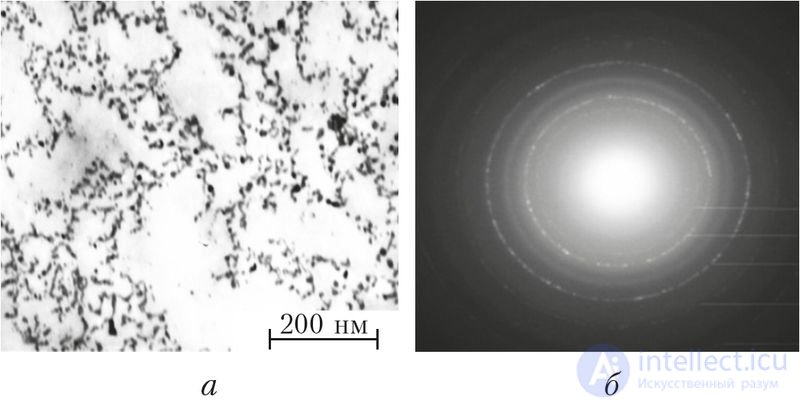
Fig. 15. A film consisting of Au and SnO2 nanoparticles:
а — image, б — diffraction pattern.
The photographs were obtained using methods
based on the wave properties of electrons
At present, the wave properties of the electron are used in electron and atomic-force microscopy, which makes it possible to examine various objects (of a size on the order of 10–9 m) at magnifications of hundreds of thousands of times (Fig. 15). Without these methods, the emergence of nanotechnology would have been impossible.
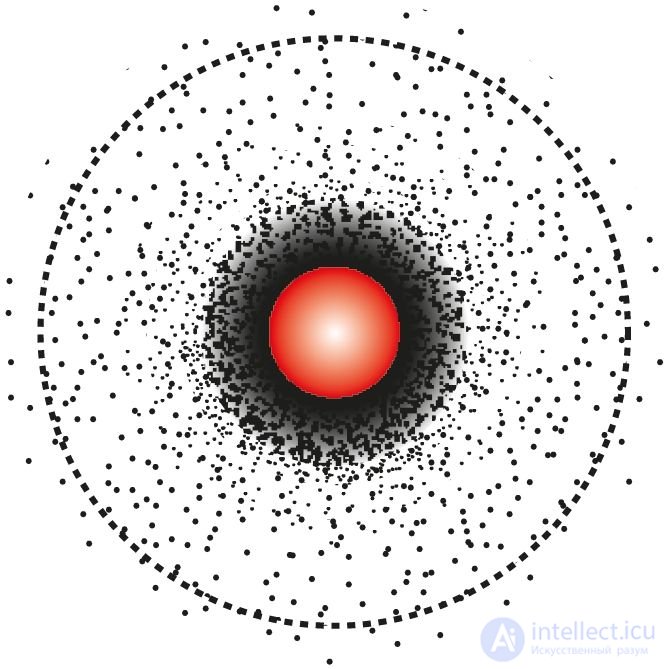
Fig. 16.
The electron
cloud of the hydrogen
atom
From the standpoint of quantum mechanics, it is impossible to determine simultaneously and precisely both the coordinate and the speed of an electron, and consequently it is impossible to trace the trajectory of the electron's motion in an atom; therefore one speaks of the probability of finding the electron in a given region of space near the nucleus. This is bounded by a conventional surface enclosing approximately 90% of the volume in which the probability of finding the given electron is greatest (Fig. 16). Such a region of space near the nucleus is called an atomic electron orbital, or simply an atomic orbital.
Each electron in an atom corresponds to its own atomic orbital, which is characterized by definite values of energy, shape, and size of the electron cloud.
The conventional size of an atomic s-orbital is taken to be the diameter of the cloud in which the probability of finding the given electron is approximately 90% (see the dashed line in Fig. 16).
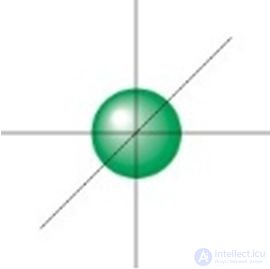
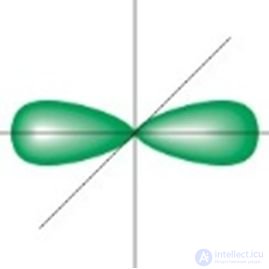
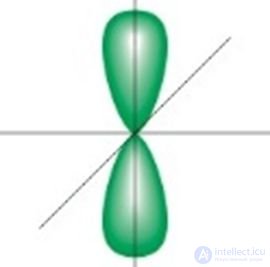
According to the shape of the electron cloud, s-, p-, d-, and f-orbitals are distinguished. s-Orbitals have the shape of a sphere, р — the shape of a dumbbell, d and f — a more complex shape (Fig. 17).
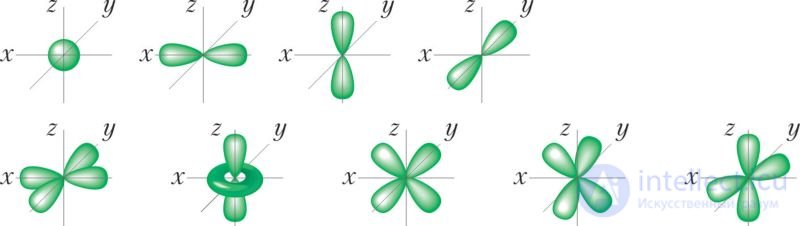
Fig. 17. The shape of the electron clouds of s-, p-orbitals (top row)
and d-orbitals (bottom row)
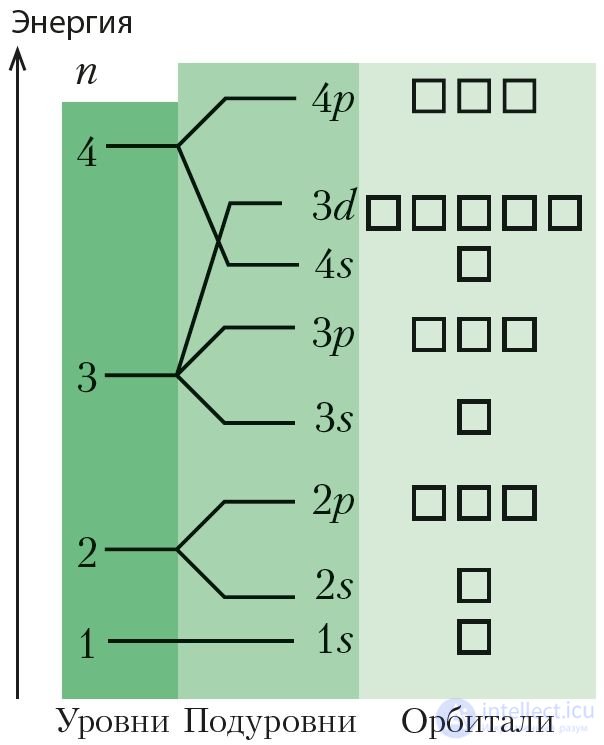
Fig. 18. Diagram of the distribution
of atomic orbitals by energy
(energy diagram)
According to the fundamental principle of quantum mechanics, an electron in an atom can take on only certain values of energy, while other values are forbidden. In this case one says that the energy of the electron is quantized, that is, it has a discrete set of values. To visually represent the states of electrons in an atom, an energy diagram is used (Fig. 18). Let us analyze this figure. It follows from the figure that the electrons in an atom are distributed among energy levels and sublevels.
Energy levels (or electron shells, with which you became familiar while studying chemistry in grade 9) are denoted by the number n. This number has only integer values: 1, 2, 3, … Each value of n corresponds to a definite value of the electron's energy. Energy can change only in jumps. The lowest energy level (n = 1) corresponds to the minimum possible energy of the electron. Electrons located at this level are most strongly bound to the nucleus. The greater n is, the weaker its bond with the nucleus, the larger the size of the electron cloud, and the greater the energy of the electron. At n = ∞ the electron loses its bond with the nucleus and is considered free.
You already know that the number of electrons at energy levels differs. Thus, at the first energy level there can be no more than 2, at the second — no more than 8, at the third — no more than 18 electrons.
The number of electrons that a given level can hold can be calculated by the formula:
N(e–) = 2n2.
Electrons located at the same energy level form an electron shell, or layer. The electron shell of highest energy is called the outer shell. It contains the electrons that are least strongly bound to the nucleus and are therefore able to participate in the formation of chemical bonds. They are called valence electrons.
In multi-electron atoms, energy levels split into energy sublevels (Table 5). At the first level (n = 1) there is only one sublevel — 1s; at the second (n = 2) there are two sublevels (2s and 2p); at the third there are three of them (3s, 3p, and 3d).
Table 5. Distribution of electrons in an atom among levels, sublevels, orbitals
| Energy level, n | Sublevel | Number of atomic orbitals | Maximum number of electrons at the sublevel | Maximum number of electrons at the energy level (N(e–) = 2n2) |
| 1 | 1s | 1 | 2 | 2 |
| 2 |
2s 2p |
1 3 |
2 6 |
8 |
| 3 |
3s 3p 3d |
1 3 5 |
2 6 10 |
18 |
*f-Electron clouds

There are 7 f-atomic orbitals, which can hold 14 electrons. They correspond to 7 electron clouds, whose shape is shown in Figure 17.1.
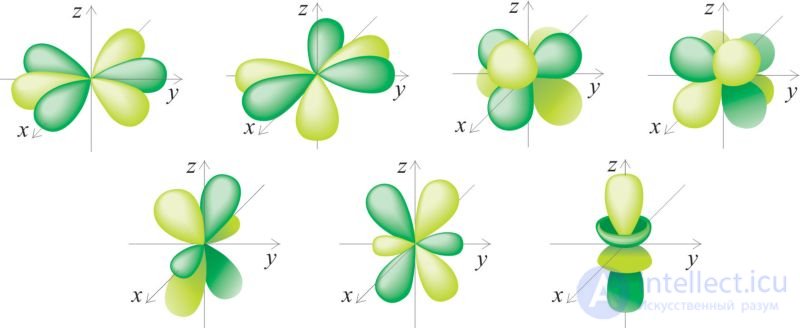
Fig. 17.1. The shape of the electron clouds of f-orbitals
Atomic orbitals, the order of their filling with electrons
On the energy diagram, atomic orbitals are depicted as boxes (cells):  (Fig. 18). At each energy sublevel there can be only a certain number of atomic orbitals of equal energy: at any s-sublevel — one , at a p-sublevel — three
  , at a d-sublevel — five
  .
.
As you already know, no more than two electrons can occupy a given atomic orbital:  , and the electrons must differ in their spins. Spin conventionally characterizes the rotation of an electron about its own axis, clockwise or counterclockwise. These differences between electrons are depicted in the diagram by arrows pointing in opposite directions. If there is a single electron in an orbital
  , it is called unpaired, and the atomic orbital is called half-filled. If there are two electrons in an orbital , the electrons are called paired, and the orbital is called filled. An atomic orbital without electrons is called vacant, or empty
  .
.
The capacity of the energy levels is shown in Table 5.
You know three ways of depicting the distribution of electrons in an atom:
1) in the form of electron schemes (showing the distribution of electrons only among energy levels), for example, for carbon 6С 2е–, 4е–;
2) in the form of an electron configuration formula (showing the distribution of electrons among orbitals), for example 6С 1s22s22p2, where the numbers before the letters s and p indicate the number of the energy level, the letters s and p indicate the shape of the electron cloud, and the superscript above the letters indicates the number of electrons located at the sublevel;
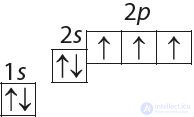
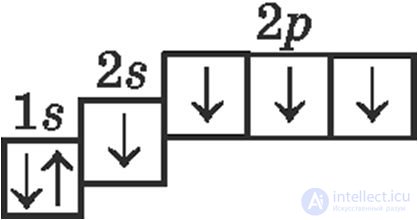
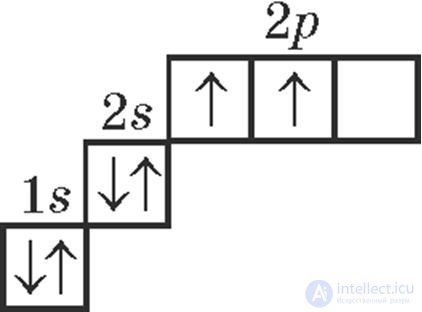
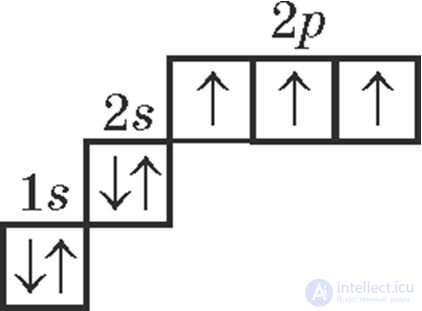
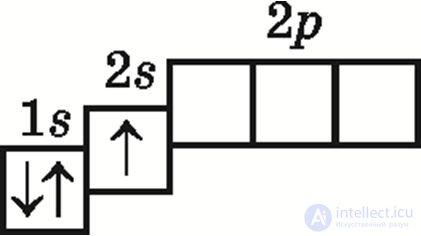
3) using electron-graphic schemes (showing the distribution of electrons among orbitals taking into account electron spin), for example:
6C 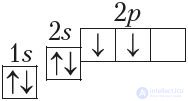
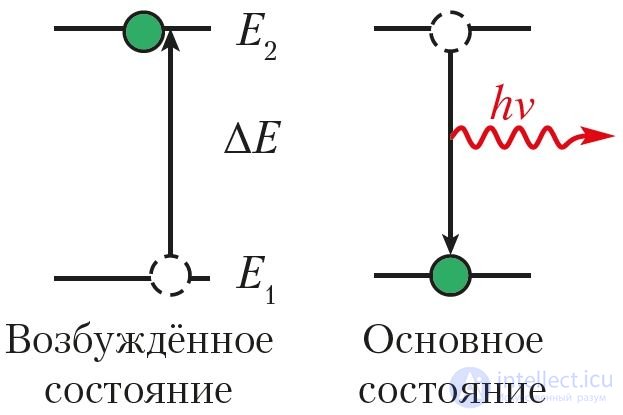
Fig. 19. Diagram of the transition of an electron
from the ground to an excited
state
An electron-graphic scheme is the same energy diagram, but with the filling of atomic orbitals by electrons shown.
The state of an atom with the lowest possible energy of electrons is called the ground, or unexcited, state. All other energy states of this atom, which correspond to a higher electron energy than in the ground state, are called excited.
In order to transfer an atom to an excited state, it must be given energy — the excitation energy (ΔE) (Fig. 19). It is transferred when the atom is exposed to electromagnetic radiation (for example, sunlight), on heating, or under the action of fast electrons on the atom. An atom can remain in the ground state indefinitely, while in the excited state it remains for about 10–15 s, after which the excited electrons return to the ground state. The transition of an atom from an excited state to the ground state is accompanied by electromagnetic radiation.

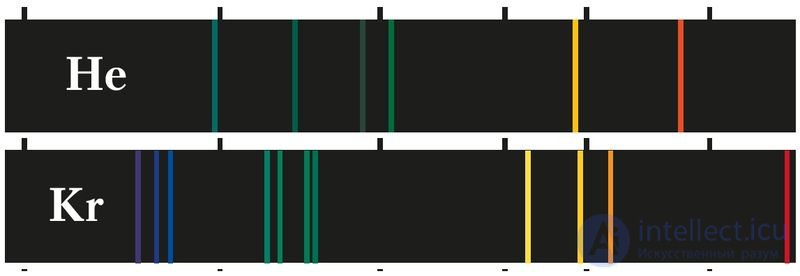
The property of atoms, after their energy excitation, to emit light of certain wavelengths underlies the method of spectral analysis — one of the main methods of qualitative and quantitative analysis of substances. The spectrum consists of individual lines, each of which appears as a result of the transition of an atom from an excited to the ground state. A line emission spectrum is evidence of different specific values of electron energy in the atom.
The electron possesses the properties of both a particle and a wave.
An atomic orbital is a characteristic of the state of an electron in an atom, which includes a definite value of energy, shape, and size of the electron cloud.
The electronic structure of an atom is characterized using an electron scheme, an electron configuration formula, and an electron-graphic scheme.
Questions, tasks, problems
1. Name the characteristics of the electron:
2. Name the ways of depicting the distribution of electrons in the nitrogen atom:
3. How will the energy of an electron change if it is transferred from a state with n = 2 to a state with n = 3? What happens to the energy of the electron if it returns to its previous state?
4. Using Fig. 18, arrange the following atomic orbitals in order of increasing energy: 3p, 2p, 3d, 1s.
5. In which state is the electron energy higher: 2s or 2p; 3p or 2p?
6. How do the atomic orbitals 1s and 3s differ?
7. How many electrons in total can be at the third energy level, at the 1s-sublevel, at the 2р-sublevel, at the 3d-sublevel?
8. During excitation, an electron moved from the 2s- to the 2р-orbital. What changed as a result: the energy of the electron, the shape of the electron cloud, the charge of the atom, the energy of the atom?
9. Calculate the number of electrons in a portion of phosphorus with a mass of 1.24 g.
10. A portion of a divalent metal nitrate in an amount of 0.2 mol contains 16.4 mol of electrons. Determine the element.

*Self-check
1. Wave-particle duality regards the electron only as:
2. Indicate the depictions of a р-orbital:

3. The electron-graphic scheme of the carbon atom in the ground state is:
4. The correct statements are:
5. In order of increasing energy, the atomic orbitals are given correctly in the series:

Comments