
Lecture
Bases — complex substances consisting of metal atoms and hydroxo groups OH.
Ammonia hydrate NH3 ∙ H2O is also classified as a base, since hydroxide anions OH− are present in aqueous solutions of ammonia.
Nomenclature and classification of bases
The names of bases consist of the word "hydroxide" and the name of the metal, indicating its oxidation state if it is variable: NaOH — sodium hydroxide, Fe(OH)2 — iron(II) hydroxide.
The classification of bases is based on various characteristics.
1. Number of OH groups. According to the number of OH groups per metal atom, bases are divided into monoacidic (NaOH, KOH, LiOH) and polyacidic (Mg(OH)2, Ca(OH)2, Fe(OH)2) bases.
2. Solubility in water. Inorganic bases are solid substances, with the exception of ammonia hydrate NH3 ∙ H2O (fig. 6.3). By solubility, solid bases are divided into soluble (alkalis) and insoluble. Alkalis include bases formed by group IA metals (LiOH, NaOH, and others) and alkaline earth metals (Ca(OH)2, Sr(OH)2, Ba(OH)2). Information on the solubility of bases in water is given in the "Solubility table of acids, bases, and salts" (see the textbook's endpaper).
3. Electrolyte strength. Having studied chemistry in grade 9, you already know that, according to their ability to dissociate into ions in solutions, strong and weak electrolytes are distinguished. Bases dissociate into metal ions (or ammonium  ) and hydroxyl groups OH−. All alkalis are strong electrolytes. Even the sparingly soluble Ca(OH)2 is classified as a strong electrolyte.
Weak electrolytes include all insoluble bases, for example, Mg(OH)2, Cu(OH)2, Fe(OH)3, and soluble NH3 ∙ H2O. Weak electrolytes also include hydroxides that exhibit amphoteric properties: Zn(OH)2, Be(OH)2, Cr(OH)3, Al(OH)3).
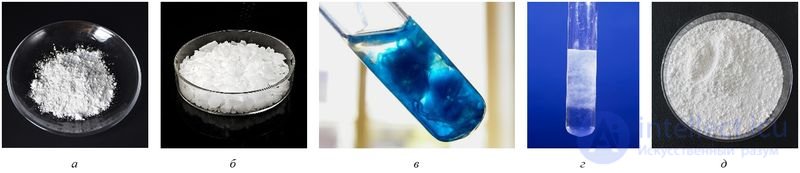
Fig. 6.3. Samples of bases: a — calcium hydroxide, b — sodium hydroxide, c — copper(II) hydroxide, d — zinc hydroxide, e — aluminum hydroxide
Chemical properties and preparation of alkalis
The general chemical properties of alkalis include their action on indicators and the formation of salts in reactions with acids, acidic and amphoteric oxides, amphoteric hydroxides, and a number of salts. In addition, some alkalis can decompose on heating.
The general chemical properties of alkalis are due to the presence of the OH– ion in their aqueous solutions: KOH → K+ + OH–, Ca(OH)2 → Ca2+ + 2OH–.
As examples, we present the following reactions:
1) with acids:
NaOH + HCl = NaCl + H2O (neutralization reaction);
2) with acidic and amphoteric oxides:
2NaOH + SiO2 = Na2SiO3 + H2O,
2NaOH + ZnO  Na2ZnO2 + H2O;
3) with amphoteric hydroxides:
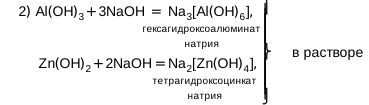
Al(OH)3 + 3NaOH(soln.) = Na3[Al(OH)6],
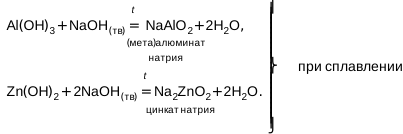
Al(OH)3 + NaOH(solid)  NaAlO2 + 2H2O;
4) with salts:
FeCl3 + 3NaOH = Fe(OH)3↓ + 3NaCl (exchange reaction);
5) decomposition of some alkalis on heating:
Ca(OH)2 CaO + H2O,
Ba(OH)2 BaO + H2O.
Alkalis are most often obtained by the following methods:
1) the reaction of active (alkali and alkaline earth) metals with water:
2Na + 2H2O = 2NaOH + H2↑,
Ca + 2H2O = Ca(OH)2 + H2↑;
2) the reaction of oxides of alkali and alkaline earth metals with water:
Na2O + H2O = 2NaOH,
CaO + H2O = Ca(OH)2;
3) electrolysis of aqueous salt solutions, with which you will become acquainted while studying the material in § 45.1.
Chemical properties and preparation of insoluble bases
Let us note two most important chemical properties of insoluble bases:
1) on heating they decompose into an oxide and water:
Fe(OH)2 FeO + H2O;
2) they react with acids, forming a salt and water:
Mg(OH)2 + 2HNO3 = Mg(NO3)2 + 2H2O.
To obtain insoluble bases, solutions of alkalis are used to act on solutions of metal salts:
2NaOH + FeSO4 = Fe(OH)2↓ + Na2SO4.
Chemical properties and preparation of amphoteric hydroxides (using zinc and aluminum hydroxides as examples)
Some insoluble metal hydroxides enter into reactions not only with acids but also with alkalis. Such hydroxides are called amphoteric. These include Al(OH)3, Cr(OH)3, Zn(OH)2, Be(OH)2, and others. Reacting with acids, they exhibit the properties of bases (1), while reacting with alkalis, they exhibit the properties of acids (2):
1) Al(OH)3 + 3HCl = AlCl3 + 3H2O,
Zn(OH)2 + 2HCl = ZnCl2 + 2H2O;
Amphoteric hydroxides decompose on heating, forming amphoteric oxides and water:
Zn(OH)2 ZnO + H2O;
2Al(OH)3 Al2O3 + 3H2O.
Amphoteric hydroxides are obtained by adding an alkali solution to a salt solution:
2NaOH + ZnCl2 = Zn(OH)2↓ + 2NaCl;
3NaOH + AlCl3 = Al(OH)3↓ + 3NaCl.
In this case, an excess of the salt is required, since in an excess of alkali the resulting amphoteric hydroxide dissolves.

It should be noted that amphoteric properties are also exhibited by organic compounds — amino acids and proteins.
Bases are complex substances consisting of metal atoms and hydroxo groups OH. Ammonia hydrate NH3 ∙ H2O is also a base.
Alkalis are bases that are soluble in water; they are strong electrolytes, and only hydroxide ions form as anions during their dissociation.
The general properties of alkalis are their action on indicators and the formation of salts in reactions with acids, acidic and amphoteric oxides, amphoteric hydroxides, and salts.
Insoluble bases react with acids and decompose on heating into an oxide and water.
Amphoteric bases are insoluble in water and react with acids and alkali solutions.
Alkalis are obtained by electrolysis of aqueous salt solutions, as well as by the reaction of alkali and alkaline earth metals and their oxides with water.
Bases that are insoluble in water are obtained by the action of alkalis on solutions of metal salts.
Questions, tasks, problems
1. Name the bases: KOH, Ca(OH)2, Cu(OH)2, Ni(OH)2, Fe(OH)2, Fe(OH)3. Which of them are insoluble, sparingly soluble, or soluble?
2. Give an example of an equation for the reaction of an alkali with an amphoteric hydroxide in:
3. Prove that ammonia hydrate NH3 ∙ H2O is classified as a base.
4. List the chemical properties of:
5. Write the equations of reactions between sodium hydroxide and the substances whose formulas are CO2, H2SO3, FeSO4, Mg(NO3)2. Name the salts formed.
6. Choose a reagent (or reagents) to accomplish the following transformations.
| Transformation | Reagents |
| a) K → KOH; b) CuCl2 → Cu(OH)2; c) Fe2O3 → Fe(OH)3; d) BaO → Ba(OH)2 |
1) Mg(OH)2; 2) NaOH; 3) NaCl; 4) HCl; 5) H2O |
7. Write the dissociation equations for the substances Zn(OH)Cl and LiOH. Which of them is not classified as an alkali? Why?
8. Write the equations of the reactions according to the scheme:
 CuSO4
CuSO4  Cu(OH)2
  CuOH
CuOH  …; NaOH Fe(OH)3 Fe2O3
  ….
….9. Indicate the color of litmus in the solution obtained when a solution containing sulfuric acid of the same mass is added to a solution containing 10 g of sodium hydroxide.
10. To a solution of sodium hydroxide with a mass of 150 g and an alkali mass fraction of 3%, sodium with a mass of 2.3 g was added. Determine the mass fraction of the substance in the final solution (to four significant figures).
Self-check
1. Alkalis are:
2. Zinc hydroxide, when reacting with an alkali, can form:
3. Sodium hydroxide reacts with:
4. Fe(OH)3 can be obtained by the reaction of:
5. By the action of water, the following transformation can be accomplished:

Comments