
Lecture
Gaseous substances, unlike solids and liquids, occupy the entire volume made available to them. Therefore, the same vessel may contain different amounts of gas. The pressure in the system will depend on this amount.
Determining the amount of a gas and its share in a gas mixture is important for various practical purposes. For example, one may need to find out whether the level of methane or carbon monoxide in the air is dangerous to life, whether the air in a room with a large amount of carbon dioxide is fit for breathing, or the air at an altitude of 10 km, whether a given mixture of air with hydrogen is explosive, or in what ratio gasoline vapor should be mixed with air in an internal combustion engine.
To solve such problems, the molar concentration of a gaseous substance is used as a quantitative characteristic, which shows the amount of a given gaseous substance per unit volume.
The molar concentration of a gaseous substance is a quantity equal to the ratio of its amount to the volume that this gas occupies:
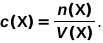
The molar concentration of gases is measured in mol/dm3.
For example, the molar concentration of СО2 under standard conditions is:

From the formula above it follows that the amount of a gaseous substance in a vessel is the product of the molar concentration of the gas and the volume of the vessel, since the gas fills the entire volume:

The concept of the molar concentration of a gaseous substance is similar to the concept of the molar concentration of a dissolved substance, which you became acquainted with in the 8th-grade chemistry course:
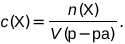
The reason for the similarity is that a dissolved substance is distributed uniformly throughout the entire volume of the solution, just as a gaseous substance is distributed throughout the entire volume of the vessel.
Example 1. Determine the molar concentration of carbon dioxide with a mass of 3 g, located in a vessel with a volume of 4 dm3.
Given:
m(CO2) = 3 g
V(vessel) = 4 dm3
с(СО2) — ?
Solution
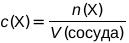



Answer: с(СО2) = 0.017 mol/dm3.
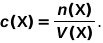
The molar concentration of a gaseous substance is a quantity equal to the ratio of its amount to the volume that this gas occupies:
Questions, exercises, problems
1. Establish a correspondence between the quantities.
|
1. Volume of gas. 2. Molar concentration of gas. 3. Amount of substance. 4. Molar concentration of a substance in solution |
А. с(NО2) = 0.15 mol/dm3. Б. с(NaOH) = 0.15 mol/dm3. В. V(H2S) = 4 dm3. Г. n(СО2) = 2 mol |
2. Determine the molar concentration of ammonia in an amount of 0.7 mol in a vessel with a volume of 14 dm3.
3. Determine the mass of sulfur dioxide in a vessel with a volume of 400 cm3, if the molar concentration of SO2 is 0.5 mol/dm3.
4. Determine and compare the molar concentrations of three gases — hydrogen, nitrogen, and oxygen — if it is known that they are located in vessels with a volume of 5 dm3 each, and the mass of each gas is equal to 7 g.
5. A vessel with a volume of 50 dm3 contains helium with a mass of 10 g. Helium with a mass of 8 g was added to this vessel. By how many times did the molar concentration of the gas change? How will the addition of argon with a mass of 8 g affect the initial concentration of helium?
6. During the gasification of coal, a mixture of gases was formed, in which for every 1 dm3 of СО there are 4 dm3 of Н2, 1 dm3 of СН4, and 3 dm3 of СО2. Calculate the molar concentration of each gas in the mixture.
7. Ozone belongs to the class of substances of high hazard. Its maximum permissible concentration (MPC) in the air of the working area is 0.1 mg/m3. At the same time, the threshold of human smell perception is approximately 0.01 mg/m3. Calculate the molar concentration of ozone in air at a content of 0.01 mg/m3.
8. Calculate the molar concentration of oxygen in air (the volume fraction of oxygen is 21%).
9. When hydrochloric acid acted on a solid substance, a gas was released whose relative density with respect to air is 1.172. Which of the substances did the experimenter use: СаС2, СаСО3, CaS, СаСl2?
10. Determine the volume of carbon dioxide released when hydrochloric acid with a volume of 0.5 dm3 acts on marble (calcium carbonate). The molar concentration of the acid is 2.7 mol/dm3.
Self-check
1. The molar concentration can be calculated using the formulas:
a) 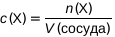 ;
;
b) 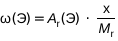 ;
;
c) 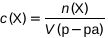 ;
;
d)  .
.
2. The molar concentration of a gaseous substance has the dimension:
3. Under standard conditions, a volume of 22.4 dm3 is occupied by 1 mol of substances whose formulas are:
4. The molar concentration of nitrogen with a mass of 5.6 g, located in a vessel with a volume of 20 dm3, is equal to (mol/dm3):
5. Under standard conditions, a vessel with a volume of 5 dm3 contains a gas with a mass of 5.6 g. Its molar concentration is 0.04 mol/dm3. This gas could be:

Comments