
Lecture
Fertilizers are substances introduced into soil or another nutrient medium to grow plants. They provide plants with complete nutrition, and thereby improve their growth, development, and fruiting, and increase the yield of agricultural crops.
Fertilizers contain chemical elements that are necessary for plant nutrition but are present in the plant's environment in insufficient amounts. Most often plants lack such biologically significant elements as nitrogen, potassium, and phosphorus. By the number of nutrient elements, fertilizers are divided into simple and complex ones. Simple fertilizers — nitrogen, phosphorus, potassium — contain one nutrient element. Complex fertilizers contain several, for example potassium nitrate KNO3 contains both nitrogen and potassium.
Observations show that even with an optimal amount and ratio of nitrogen, phosphorus, and potassium, normal plant development is not always ensured. It turns out that it is also important to have a sufficient amount of substances containing magnesium, manganese, iron, molybdenum, copper, boron, sulfur, selenium, and others. Their deficiency is made up for by applying micronutrient fertilizers containing the elements listed (Fig. 97).
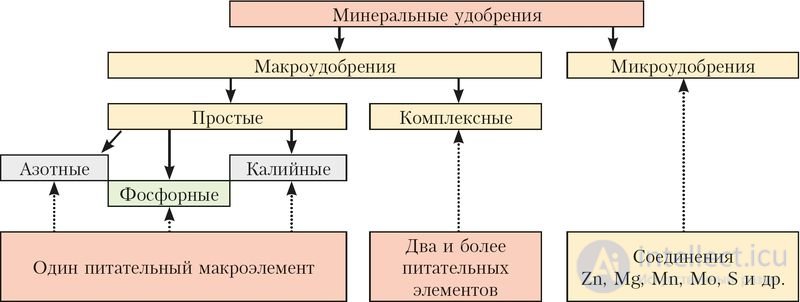
Fig. 97. Types of mineral fertilizers
Soil fertility is increased not only by the "direct" fertilizers listed above. For example, the fertility of acidic soils (pH < 5.5) is increased by lowering acidity through the application of slaked lime Ca(OH)2 (liming), chalk CaCO3, or dolomite flour CaMg(CO3)2. Try to explain why acidity decreases in this process.
In studying the elements of Group VA, we constantly noted the use of many of their compounds as fertilizers. Let us systematize the information on fertilizers and supplement it with brief information from the biology course.
The first sign of nitrogen deficiency is leaf color ranging from pale green to yellow, which is explained by a lack of chlorophyll. Plants lag significantly behind in growth and development.
Nitrogen fertilizers include: aqueous ammonia, ammonium nitrate (ammonium saltpeter) NH4NO3, potassium nitrate (potassium saltpeter) KNO3, sodium nitrate (sodium, or Chilean, saltpeter) NaNO3, calcium nitrate (calcium saltpeter) Ca(NO3)2, ammonium sulfate (NH4)2SO4, urea (carbamide) (NH2)2CO.
Organic nitrogen fertilizers are also widely used: manure, poultry droppings, compost, peat, which contain, besides nitrogen, many other components important for plants.
Nitrogen fertilizers are applied in the first half of the growing season.
Plants are able to accumulate nitrates. Their excessive accumulation is provoked not only by an excess of applied nitrogen fertilizers, but also by an imbalance with phosphorus and potassium.
An excess of nitrates in food has a negative effect on health: nitrates, both in food and in the human body, are converted into toxic nitrites and nitrosamines.
The producer of nitrogen fertilizers in the Republic of Belarus is OJSC "Grodno Azot". As fertilizers, the enterprise produces urea, ammonium sulfate, and liquid nitrogen fertilizers. Most solid nitrogen fertilizers are produced in granular form, which prevents caking by reducing the surface area that absorbs atmospheric moisture.
With a phosphorus deficiency, leaves become dark, with blue-violet tints, and flowering and fruit development slow down. Plants can absorb nutrient elements only in soluble form. This is why natural minerals containing calcium phosphate are processed into a more soluble acid salt — calcium dihydrogen phosphate. It is the basis of single and double superphosphate.
Nevertheless, the medium salt — calcium phosphate as part of phosphate rock flour — still finds use as a fertilizer. It is applied to acidic soils either "for winter" or in early spring before sowing. Phosphate rock flour is not hygroscopic, does not cake, is well retained in the soil, and therefore can be applied once every several years. Another attractive feature is its relatively low price, since no chemical transformations are used in its production. The mineral mined in quarries undergoes only enrichment (removal of some impurities) and fine grinding.
The most important phosphorus fertilizers include: phosphate rock flour — main component Ca3(PO4)2, double superphosphate Ca(H2PO4)2 · H2O, single superphosphate Ca(H2PO4)2 + 2CaSO4 · H2O, precipitate CaHPO4 · 2H2O.
Complex fertilizers containing phosphorus include: ammophos — a mixture of two salts, NH4H2PO4 and (NH4)2HPO4, containing nitrogen and phosphorus; ammophoska — a mixture of ammophos with potassium chloride — NH4H2PO4, (NH4)2HPO4, KCl, containing nitrogen, phosphorus, and potassium.
Phosphorus fertilizers in the Republic of Belarus are produced by OJSC "Gomel Chemical Plant" based on imported phosphates.
With a potassium deficiency, leaves are dull and bluish-green, and become brown and die off at the tips and edges ("leaf margin scorch").
Potassium stimulates photosynthesis processes and enhances the outflow of carbohydrates from leaves to other parts of the plant, for example promoting starch accumulation in potato tubers and sucrose accumulation in beet root crops. All potassium fertilizers are highly soluble. Feeding with potassium fertilizers is important during the period of ovary and root crop formation. The most important potassium fertilizers: potassium chloride KCl, potassium sulfate K2SO4, plant ash (in the form of potassium carbonate — potash K2CO3).
Potassium nitrate (potassium saltpeter) KNO3 is a complex fertilizer, since it contains two nutrient elements — potassium and nitrogen.
Belarus is the largest producer of potassium fertilizers.
Every sixth ton of potassium fertilizers in the world is produced by RUE PA "Belaruskali", which operates on the basis of the Starobin deposit of sylvinite, a deposit of potassium and rock salts.
The nutritional value of fertilizers must be indicated on the commercial packaging of packaged fertilizers. What exactly is it?
Nutritional value is determined by the mass fraction of nutrient elements in them. By convention, the nutritional value of nitrogen fertilizers is expressed as the mass fraction of the chemical element nitrogen N in them, that of phosphorus fertilizers — as the mass fraction of phosphorus(V) oxide P2O5, and that of potassium fertilizers — through the mass fraction of potassium oxide K2O. Let us solve a simple problem.
Example. Determine the theoretical nutritional value of precipitate.
Given:
CaHPO4 · 2H2O
ω(P2O5) — ?
Solution
M(CaHPO4 · 2H2O) = 172 g/mol;
M(P2O5) = 142 g/mol.
The nutritional value of precipitate, like that of any other phosphorus fertilizer, is determined by the mass fraction of phosphorus(V) oxide P2O5. Let us set up a scheme, placing the coefficients relative to phosphorus:
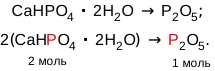
The scheme shows that a fertilizer amount of 2 mol corresponds to 1 mol of the nutrient element in the form of P2O5.
m(CaHPO4 · 2H2O) = 2 mol ∙ 172 g/mol = 344 g;
m(P2O5) = 1 mol ∙ 142 g/mol = 142 g.
Let us find the mass fraction of the nutrient element:

Answer: ω(P2O5) = 41.3 %.
It should be noted that the nutritional value is determined for each specific commercial batch of fertilizer, taking impurities into account. This means that the theoretical value we found in the example is higher than that of a real fertilizer. Thus, for commercial precipitate the nutritional value must not be lower than 27 % (compare with the theoretically calculated value).
Similar (or other) schemes and theoretical calculations can be used for potassium and nitrogen fertilizers, for example:

Fertilizers with a high content of the nutrient element are called concentrated. The use of all types of fertilizers makes it possible to significantly increase the yields of agricultural crops, so the production of mineral fertilizers is a most important task of the chemical industry. At the same time, the use of fertilizers must be competent and rational.
Fertilizers are substances introduced into soil or another nutrient medium to improve the growth, development, and fruiting of plants. Among mineral fertilizers, simple ones (nitrogen, phosphorus, potassium), complex ones, and micronutrient fertilizers are distinguished. Complex fertilizers contain two, three, or more nutrient elements.
1. Write the chemical formulas and names of the most important phosphorus, potassium, and nitrogen fertilizers.
2. List the fertilizer-producing enterprises in the Republic of Belarus, their location, and the types of fertilizers they produce.
3. Name the signs indicating a deficiency in plant nutrition of:
4. Cucumbers and tomatoes do not tolerate an excess of chlorine in the soil well. Name fertilizers suitable for feeding these crops with potassium.
5. Compare the nutritional value of two fertilizers:
6. Calculate the nutritional value of one of the components of the complex fertilizer ammophos — ammonium dihydrogen phosphate.
7. Nodule bacteria living in the soil in symbiosis with legumes accumulate up to 400 kg/ha of fixed nitrogen in the soil per year. Calculate the mass of ammonium nitrate that the nitrogen accumulated in this way over an area of 1 ha in one year could replace.
8. Phosphorus fertilizers are obtained by processing phosphorites. The most common impurities in them are calcium fluoride and carbonate, and oxides of aluminum and iron(III). Write equations for the possible reactions that may occur when such phosphorite is treated with sulfuric acid.
9. One method of obtaining calcium saltpeter consists of treating limestone with nitric acid. Calculate the mass of calcium nitrate obtained by treating with nitric acid 50 kg of limestone with a mass fraction of impurities of 6 %.
10. Determine the chemical formula of a fertilizer in which the mass fraction of calcium is 23.256 %, phosphorus 18.023 %, and oxygen 55.814 %.
*Hold a meeting of the discussion club "For and Against"
1. The following are used as potassium fertilizers:
2. Complex fertilizers are:
4. Soil acidity is lowered by applying:
5. The mass fraction of nitrogen as a nutrient element in carbamide equals (%):

Comments