
Lecture
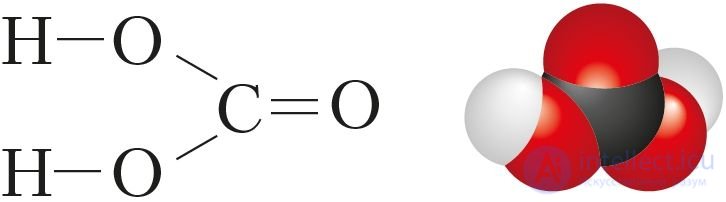
Fig. 100. Structural formula and scale model of carbonic acid
Carbonic acid H2CO3 is dibasic and belongs to the weak acids (Fig. 100). In the free state, in the form of crystals, it was isolated at temperatures below ‒30 °C only in the second decade of the 21st century.
In aqueous solution, carbonic acid dissociates stepwise:
 ;
; .
.Under normal conditions it decomposes into carbon dioxide and water:
 .
.
Carbonic acid corresponds to two series of salts: carbonates (normal salts) and bicarbonates (acid salts). Let us note two of the most important properties of the salts of carbonic acid.
1. Reaction with acids. A common property of carbonates and bicarbonates is "effervescence" when a stronger acid acts on either the solid salt or its solution. Evolution of a colorless, odorless gas occurs:
 ;
; ;
; ;
; .
.Reaction of carbonates and bicarbonates with hydrochloric acid
The reaction of these salts with strong acids is used as a test (qualitative reaction) for the presence of salts of carbonic acid — carbonates and bicarbonates (Appendix 3).
In addition, such reactions can be used to obtain carbon dioxide in the laboratory, for example, from marble CaCO3:
 .
.
2. Thermal decomposition. The second characteristic feature of the salts of carbonic acid is their relatively low thermal stability (except for the carbonates of sodium, potassium, rubidium, and cesium). On heating they decompose:
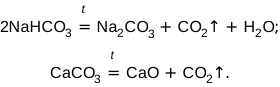
Analyzing the above along with the equations of the chemical reactions from the previous section, one can conclude that carbonates and bicarbonates are capable of mutual conversion, which can be conventionally expressed by the scheme:
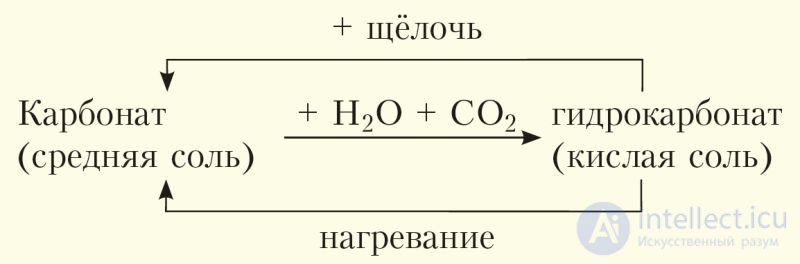
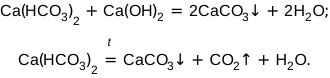
Using calcium carbonate as an example, the reaction equations corresponding to this scheme look as follows:

Carbonates and bicarbonates are widely used in construction, everyday life, optics, medicine, as well as in the production of soap, glass, and paper, and serve as fire extinguisher fillers.
Table 30.1. Uses of the salts of carbonic acid
| Chemical formula and systematic name | Common name, natural minerals | Field of use |
| Na2СO3 Sodium carbonate |
Soda ash | Production of detergents, glass, dyes; pulp-and-paper, textile, and petrochemical industries |
| Na2СO3 ∙ 10H2O Sodium carbonate decahydrate |
Washing soda — mineral | |
| NaHCO3 Sodium bicarbonate |
Baking soda | Cooking, oral disinfection, remedy for heartburn. Fire extinguishing. Safe dishwashing |
| СаСО3 Calcium carbonate |
Chalk — rock | Whitewashing, production of glass and rubber |
| Calcite — mineral | Chemical production, construction, optics, ornamental stone | |
| Shell rock — rock | Building material | |
| Limestone — rock | Facing and architectural-construction material | |
| Marble — rock | Facing and architectural-construction material | |
| Pearl — a precious stone of biological origin, formed in the shells of certain mollusks | Jewelry | |
| (СuOH)2CO3 Copper(II) hydroxide carbonate |
Malachite — mineral | Ornamental stone. Previously used for copper extraction |
| MgСO3 Magnesium carbonate |
Magnesite — mineral | Production of refractory materials |
| CaMg(CO3)2 Double carbonate of calcium and magnesium |
Dolomite — mineral | Manufacture of cement, plaster, refractory materials, use in the glass industry, and in agriculture for soil deacidification |
Silicic acid H2SiO3 is dibasic and weaker than carbonic acid. It is obtained by the reaction of silicates (Na2SiO3 or K2SiO3) with stronger acids, for example H2SO4, HCl:
 ;
; .
.Silicic acid is released as a gelatinous precipitate, whose composition is often expressed by the formula nSiO2 · mH2O. In reality, silicic acid has a polymeric nature:
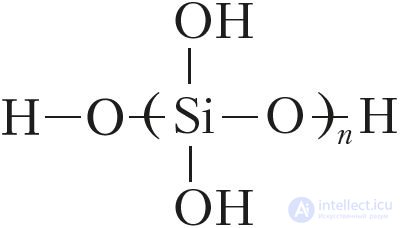
Even with slight heating or prolonged storage, the acid decomposes into the oxide and water:
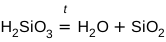 .
.
The resulting oxide SiO2 has a porous structure and a large surface area (up to 1000 m2/g), which allows it to adsorb molecules of various substances, including water. It is precisely because of its adsorption properties that the oxide SiO2, under the name "silica gel," is used as an air desiccant in packaging for electronics and footwear, and under the name "White Coal," as an adsorbent in medicine (Fig. 101).
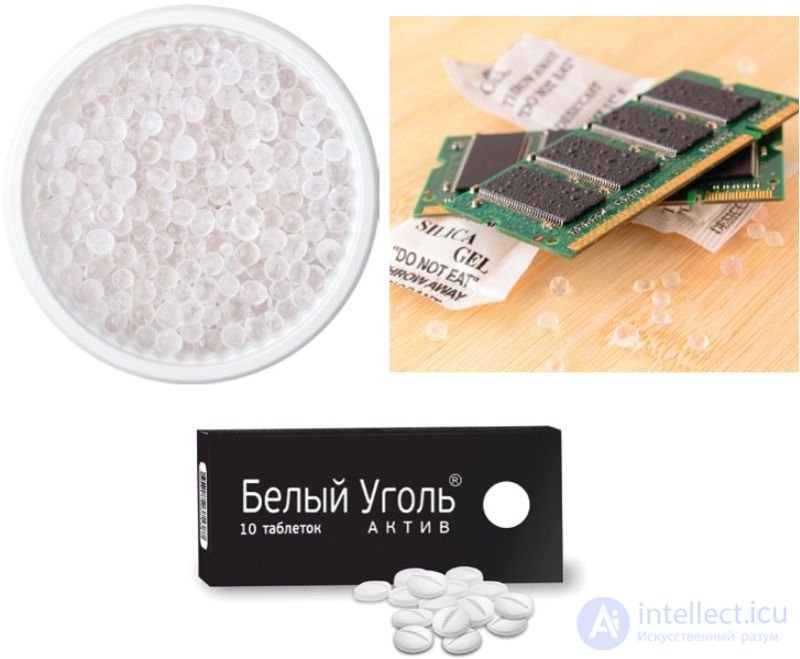
Fig. 101. Silica gel
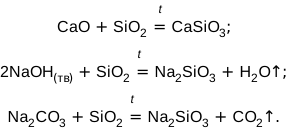
Only normal salts — silicates — are known for silicic acid. Most of them are poorly soluble in water. The soluble salts sodium silicate and potassium silicate are called "soluble glasses" and are used as "office glue." Silicates can be obtained by fusing silicon(IV) oxide, as an acidic oxide, with alkalis, metal oxides, and also with carbonates:
Natural silicates and carbonates serve as the basis for the production of cement, concrete, and glass.
Cement is obtained by sintering limestone CaCO3 and clay, one of whose constituent parts — kaolinite — includes the oxides SiO2 and Al2O3.
During the sintering of a mixture of limestone СаСО3 and kaolinite Al2[Si2O5](OH)4 a complex mixture of anhydrous salts — calcium silicates and aluminates — is formed. Recall that when such a finely ground mixture is mixed with water, hydration occurs, crystalline hydrates form, individual particles fuse together (setting), and a solid, strong material — cement stone — is obtained.
Concrete is made from a mixture of sand, cement, and water. By adding slag to such a mixture, slag concrete is obtained. If a freshly prepared mixture is poured over a metal frame, reinforced concrete structures are obtained upon hardening. When gaseous substances are used as a filler, foam concrete is obtained.
Glass is used in construction (window glazing, stained-glass windows, doors, greenhouses), in the optical industry, medicine, mechanical engineering, instrument making, modern architecture, electronics, and everyday life. As noted above in this section, the raw materials for glass production ("glass melting") are sodium and calcium carbonates, as well as silicon(IV) oxide — that is, crystalline soda, chalk or limestone, and quartz sand (Na2CO3, CaCO3, SiO2). As already noted in § 41, glass contains the oxides of sodium, calcium, and silicon in a molar ratio of 1 : 1 : 6.
To impart special properties to glass, additives are introduced into the starting mixture. For instance, various oxides are used for coloring it: СuO gives a blue color, FeO — green, СоО — from blue to blue-violet. Opacifiers reduce the transparency of glass, making it matte. Laminating with polymer films increases strength. Reinforcement with metal wire imparts decorative properties and prevents the formation of large fragments upon cracking. It is worth noting the possibility of repeated recycling of glass.
Silicic and carbonic acids are unstable substances that decompose to form an oxide and water: silicic acid — upon slight heating or prolonged storage, and carbonic acid — immediately upon formation.
Carbonates and bicarbonates are capable of mutual conversion.
The most important building materials based on natural silicates and carbonates are cement, concrete, and glass.
1. List the characteristics that apply to:
2. Write, in molecular and ionic form, the equations of reactions that illustrate the chemical properties of a) carbonic and b) silicic acids named in assignment 1.
3. Fill in the table "Building Materials" (cement, concrete, reinforced concrete, glass):
| Building material | Raw materials for production |
4. Fill in the table "Uses of carbonates and bicarbonates"
| № | Chemical formulas and names | Fields of use |
5. Write the equations of the possible reactions:

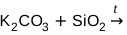



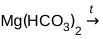

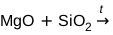




6. Calculate the mass of soda ash, limestone, and quartz sand needed to obtain 100 kg of glass, assuming the starting materials contain no impurities.
7. Write the equations of the reactions according to the scheme:

8. On prolonged storage of alkali solutions in glass containers, turbidity appears in the solutions. Explain which reactions are the cause of this phenomenon.
9. Propose methods for obtaining at least eight complex substances, having available potassium silicate and calcium bicarbonate. Write the reaction equations and the list of substances obtained.
10. Determine the volume of carbon dioxide (at STP) released from a fire extinguisher containing sulfuric acid and a solution with a volume of 10 dm3 with a mass fraction of sodium bicarbonate of 8% (solution density — 1.058 g/cm3).
1. Carbonic acid forms the salts:
2. The main raw materials for glass production are:
3. The salt of composition Са(НСО3)2:
4. A thermally stable substance is:
5. The reaction that does not proceed is:
 ;;;.
;;;.
Comments