
Lecture
Studying the material of the second chapter, you will deepen your knowledge of the composition of the atomic nucleus and the phenomenon of radioactivity, and of the state of electrons in the atom, and broaden your understanding of atomic orbitals, energy levels, and sublevels. Mastering this material will let you explain and characterize the regularities in how the properties of the atoms of chemical elements, and the substances they form, change across the groups and periods of the periodic system.
The most important concepts of the topic: relative atomic mass, isotopes, radioactivity, orbital, energy level, sublevel, electron configuration formula, electron-graphical diagram, atomic radius, electronegativity, amphotericity, periodic system of chemical elements (period, group).
One of the earliest statements about atoms as indivisible particles of matter is found in the works of the ancient Greek scholar Democritus (5th–4th centuries BC). It was only at the end of the 19th century, thanks to a series of scientific discoveries in physics, that it became clear that the atom has a complex structure.
In 1911, E. Rutherford, based on experimental data, proposed a nuclear (planetary) model of atomic structure. In this model the atom was regarded as a kind of "solar system," at the center of which lies a positively charged nucleus, with electrons moving around the nucleus along their own orbits.
Further research by physicists showed that atomic nuclei consist of protons and neutrons. A neutron carries no charge, while a proton carries a positive charge equal in magnitude to the charge of the electron. The number of protons in the nucleus determines its charge in absolute value and the element's atomic number (Fig. 11).
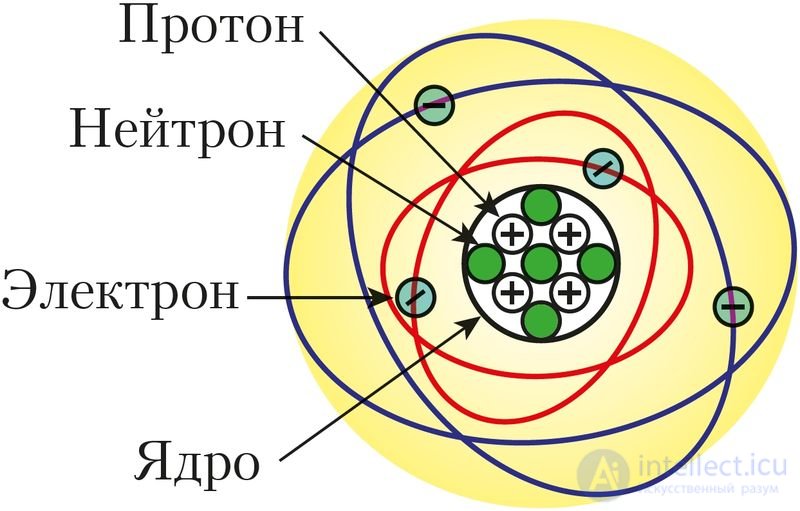
Fig. 11. Planetary model
of the beryllium atom

The discoveries that provided evidence of the complex structure of the atom were the photoelectric effect (A. G. Stoletov, 1889), radioactivity (A. Becquerel, M. Skłodowska-Curie, 1896–1899), cathode rays (J. Thomson, 1897), and experiments to determine the nature of α-particles (E. Rutherford, 1899–1900).
Research into the nature of the particles making up atoms was supplemented by the ideas of quantum mechanics, developed by M. Planck, A. Einstein, N. Bohr, Louis de Broglie, W. Heisenberg, and E. Schrödinger.
If the charge of the electron, equal to 1.6 ∙ 10–19 C, is taken as 1, then the charge of the nucleus of any atom is numerically equal to the atomic number Z of the corresponding chemical element, or the number of protons in the nucleus. In this case the nuclear charge is expressed in units of elementary charge. This is a dimensionless quantity, just like relative atomic mass. For example, uranium is a chemical element with atomic number 92. The charge of its nucleus in relative units equals 92.
The total number of protons (Z) and neutrons (N) in the nucleus is called the mass number (A):
A = Z + N.
The mass number A takes only integer values.
An atom in the free state is an electrically neutral particle. Consequently, the number of protons in the nucleus of an atom equals the number of electrons. The most important characteristics of protons, neutrons, and electrons are given in Table 4.
Table 4. The most important characteristics of protons, neutrons, and electrons
| Characteristics | Nucleus | Shell | |
| Proton | Neutron | Electron | |
| Symbol | p | n | e– |
| Mass, kg | ≈ 1.673 ∙ 10–27 | ≈ 1.675 ∙ 10–27 | ≈ 9.109 ∙ 10–31 |
| Mass, amu | 1.0073 ≈ 1 | 1.0087 ≈ 1 | 0.0005 ≈ 0 |
| Electric charge, C | ≈ 1.602 ∙ 10–19 | 0 | ≈ –1.602 ∙ 10–19 |
| Electric charge in units of elementary charge | +1 | 0 | –1 |
| Notation in nuclear reaction equations |  |
 |
 |
The mass of the nucleus (mz) can be approximately determined by summing the masses of all the protons (Zmp) and neutrons (Nmn) it consists of.
The exact value of the mass of the nucleus is slightly less than this sum:
mz < Zmp + Nmn.
For example, the mass of the nucleus of the oxygen-16 nuclide equals 15.995. The difference is explained by the huge amount of energy released when the nucleus forms from protons and neutrons. It is precisely because of the release of this energy, called the binding energy (∆E), that a loss of total mass occurs. The binding energy in the nucleus exceeds the strength of a chemical bond by millions of times, which is why atomic nuclei are not destroyed in chemical reactions.
In the 11th-grade physics course you will learn to calculate the "mass defect" and binding energy based on the equality  , where c is the speed of light in vacuum.
When 1 mole of helium atoms forms from protons and neutrons, with nuclei containing two protons and two neutrons each, 2.73 · 1012 J of energy is released. For comparison: when the very strong triple chemical bond in the nitrogen molecule  forms, the energy released is 9.45 · 105 J/mol, that is, almost 3 million times less.
The number of neutrons in the nuclei of atoms of one and the same chemical element can vary within small limits.
For a long time it was believed that a chemical element was a type of atom with a definite mass. However, in 1913 it was established that atoms of one and the same chemical element could differ in mass. Such varieties of atoms were called isotopes.
Isotopes are atoms belonging to the same chemical element but differing in mass. Their nuclei consist of the same number of protons but a different number of neutrons.
Besides the concept of an isotope, there is also the concept of a nuclide.
A type of atom with a definite number of protons and neutrons in the nucleus is called a nuclide (from the Latin nucleus — nucleus). The set of atoms whose nuclei contain the same number of protons is assigned to one chemical element, that is, all atoms of one chemical element have the same nuclear charge.
Nuclides are conventionally denoted  , where E is the symbol of the chemical element, Z is the number of protons in the nucleus (the element's atomic number), and A is the mass number, equal to the total number of protons and neutrons in the nucleus. For example,
  ,
,  ,
,  .
.
Most chemical elements exist in nature as several nuclides. For instance, silicon has three stable nuclides, while tin has ten.
At present, more than 3400 nuclides are known for 118 elements.
For example, the naturally occurring nuclides  ,
,  , and
, and  are isotopes of hydrogen, since they belong to the same chemical element but differ in the number of neutrons in the atomic nucleus (Fig. 12). They are called hydrogen-1, or protium (H), hydrogen-2, or deuterium (D), hydrogen-3, or tritium (T). The masses of hydrogen-1, hydrogen-2, and hydrogen-3 atoms equal 1.008, 2.014, and 3.016 amu, or approximately 1, 2, and 3 amu.
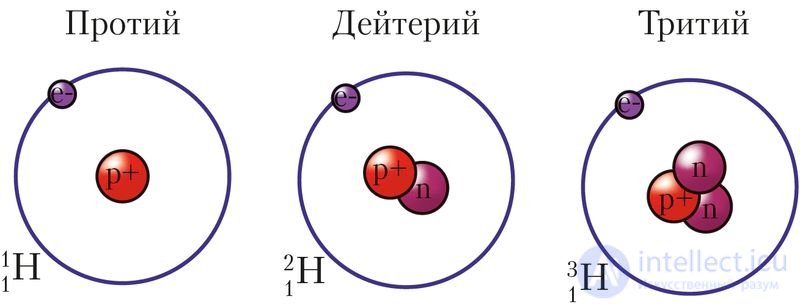
Fig. 12. Diagram of the structure of hydrogen isotopes
Substances containing different isotopes practically do not differ in their chemical properties but do show differences in certain physical properties. For example, water H2O, whose molecules contain protium, freezes at 0 °C. At the same time, water made up of D2O molecules freezes at 3.81 °C, and water made up of T2O molecules freezes at 4.48 °C.
The values of the atomic masses of isotopes and their relative abundance are determined by mass spectroscopy. It is precisely by taking into account the values of the atomic masses of isotopes and their share in nature that the relative atomic mass of chemical elements is calculated.
Let us refine the definition given earlier on p. 7. The relative atomic mass of a chemical element is a physical quantity equal to the ratio of the averaged mass of the atoms of the element to  of the mass of a carbon-12 atom (12C). It should now be clear what is meant by the term "averaged mass" of the atoms of an element. It can be calculated given the exact mass values and abundance of the element's isotopes. Let us illustrate this calculation with the following example.
Example 1. It is known that the chemical element oxygen occurs in nature as three isotopes:  ,
,  , and
, and  . Their relative atomic masses are, respectively, 15.995, 16.999, and 17.999. In the isotopic mixture, oxygen-16 atoms account for 99.757%, oxygen-17 for 0.038%, and oxygen-18 for 0.205%. Calculate the relative atomic mass of the element oxygen.
Solution. For clarity of calculation, let us take 100,000 atoms of this isotopic mixture. Then it will contain 99,757 atoms of oxygen-16, only 38 atoms of oxygen-17, and 205 atoms of oxygen-18. To determine the average value of the relative atomic mass of oxygen, we obviously need to add up the masses of all the atoms and divide by the number of these atoms:

The value obtained matches the one given in the periodic system.
The relative atomic mass of a chemical element is the averaged value of the relative atomic masses of its isotopes, taking into account their abundance.
It should be remembered that every nuclide has a definite mass number. One cannot speak of the mass number of a chemical element, since in nature one and the same chemical element can have several isotopes.
The small differences in the physical properties of substances containing different isotopes of the same element mean that the isotopic composition of a substance depends on how it was produced and how it exists. For example, sucrose from sugar beet contains less of the 13C nuclide than sucrose extracted from sugar cane. Such differences often make it possible to determine the origin of a substance. Information about the isotopic composition of substances is used in geology, medical diagnostics, forensic science, and environmental monitoring.
In nature, 21 chemical elements exist as only a single stable nuclide. These include Be, F, Na, Al, P, Sc, Mn, Co, As, Y, Nb, Rh, I, Cs, Pr, Tb, Ho, Tm, Au, Bi, Pa. Their relative atomic masses in the periodic system are given with much greater precision than for elements that exist as a mixture of isotopes.
Atomic nuclei consist of protons and neutrons. The relative charge of the nucleus is determined by the number of protons it contains and equals the atomic number of the corresponding chemical element.
Isotopes are atoms of one and the same chemical element whose nuclei consist of the same number of protons but a different number of neutrons.
The relative atomic mass of a chemical element is the averaged value of the relative atomic masses of its isotopes, taking into account the abundance of the element's isotopes.
1. Name:
2. Give the notations for the nuclides chlorine-35 and chlorine-37, iodine-127 and iodine-131 in the form  .
.
3. Using the data in Table 4, compare the characteristics of:
4. Answer the questions:
5. Determine the number of protons and neutrons in the nuclei of the carbon isotopes with mass numbers 12, 13, and 14.
6. Indicate the number of electrons in the following atoms and ions: H–, H+, He, Au, Ca2+.
7. Determine how many varieties of water molecules can form from oxygen and hydrogen, if there is a mixture of hydrogen and oxygen atoms including the nuclides: , , , , .
8. Compare the composition of the nuclides 40Ar, 40K, 40Ca, as well as 3H, 3He and 14C, 14N. Can one unambiguously establish which element an atom belongs to solely on the basis of its mass number?
9. Calculate the relative atomic mass of natural copper, given that it consists of two isotopes, 63Cu (69%) and 65Cu (31%), where Ar(63Cu) = 62.93 and Ar(65Cu) = 64.93. Check your answer against the periodic system of Mendeleev.
10. It is known that the chemical element carbon occurs in nature as two stable isotopes, carbon-12 and carbon-13, whose relative atomic masses are 12.000000 and 13.003355, respectively. Carbon-12 atoms account for 98.90%, and carbon-13 atoms for 1.10%. Calculate the relative atomic mass of carbon and compare the value obtained with the one given in the periodic system.
*Self-check
1. The number of protons in the nucleus of an atom equals:
2. The isotopes of carbon correspond to the notations:
 ;
; ;
; ;
; .
.3. In the notation  , the number 27 is:
4. The same number of nucleons (nucleons being protons and neutrons) is contained in the nuclides:
 ;
; ;
; ;
; .
.5. The nucleus of the nuclide  contains:

Comments