
Lecture
The chemical elements of Group B are located in the periodic system between the s- and p-elements, which is why they are called transition elements.
The simple substances formed by these elements are metals.
The outer electron shell of atoms of Group B elements contains 1–2 s-electrons. Across a period, with increasing atomic number, the d-orbitals of the second-outer electron shell are filled with electrons in sequence. This is why Group B elements are classified as d-elements. Since there are five d-orbitals, each period contains ten d-elements.
When moving from one d-element to the next within period 4, the ns-orbitals of the outer shell are filled with electrons first, and only afterward are the (n – 1)d-orbitals filled. Filling the ns-orbitals raises their energy, so on the energy scale they rise above the (n – 1)d-orbitals. This is why, in the electron configuration formulas of d-elements, the (n – 1)d-orbitals are written before the ns-orbitals. For example, in Sc an electron appears in the 3d-orbital only after the 4s-orbital has been filled with two electrons, yet the electron configuration formula of Sc is written as [Ar]3d14s2.
The valence-shell electron configuration of period-4 d-elements can be represented by the general formula (n – 1)dxnsy, where x can take values from 1 to 10, and y equals 1 or 2. The electron configuration formulas of the atoms of period-4 d-elements are given in Table 34.1.
Electrons fill the d-orbitals according to the same rules as the s- and p-orbitals. However, in the elements Cr and Cu, one 4s-electron transitions, or "drops," to the 3d-orbital of the preceding energy level. This is explained by the fact that the electron configurations 3d5 (for Cr) and 3d10 (for Cu) are more stable, and the energies of the 4s- and 3d-sublevels differ only slightly, so the transition of an outer s-electron to the d-orbital of the preceding electron shell does not require much energy.
Electrons are removed from atoms in the reverse order: the ns-electrons are removed first, and only then the (n – 1)d-electrons. For example, the formation of the Fe3+ ion can be represented by the scheme:
Fe0 – 3e– → Fe3+;
[Ar]3d64s2 – 3e– → [Ar]3d54s0.
Unlike s- and p-elements, in d-elements not only the outer s-electrons but also the d-electrons of the second-outer shell can take part in forming chemical bonds. This increases the number of possible oxidation states. Except for the d-elements of Groups IIIB and IIB, the atoms of all other d-elements have several oxidation states (Table 34.1).
As the atomic number of the element increases across a period, the maximum (highest) oxidation state increases from Group IIIB up to the first element of Group VIIIB, and then decreases. The highest oxidation state of most d-elements generally corresponds to the number of the group to which they belong. The exceptions are Fe and the elements of the cobalt, nickel, and copper subgroups (Table 34.1).
For atoms of Group IB elements (Cu, Ag, Au), not only the oxidation state +1 is possible (for example, in the compounds Cu2O, AgCl, Au2S), but also higher ones (for example, in the compounds  ,
,  ).
).
Compounds of elements in which atoms can be in the +8 oxidation state are known only for ruthenium and osmium (for example,  ). The other elements of Group VIIIB are characterized by lower oxidation states.
The maximum oxidation state of iron is +6 (for example, in the compound K2FeO4). In this state iron is a strong oxidizing agent.
Table 34.1. Electron configuration formulas, number of valence electrons, and characteristic oxidation states* of the atoms of 3d-elements
| Group | IIIB | IVB | VB | VIB | VIIB | VIIIB | IB | IIB | ||
| Elements | Sc | Ti | V | Cr | Mn | Fe | Co | Ni | Cu | Zn |
| Oxidation states | +7 | |||||||||
| +6 | +6 | +6 | ||||||||
| +5 | ||||||||||
| +4 | +4 | +4 | ||||||||
| +3 | +3 | +3 | +3 | +3 | +3 | +3 | +3 | |||
| +2 | +2 | +2 | +2 | +2 | +2 | +2 | +2 | +2 | ||
| +1 | ||||||||||
| Valence-shell electron configuration | 3d14s2 | 3d24s2 | 3d34s2 | 3d54s1 | 3d54s2 | 3d64s2 | 3d74s2 | 3d84s2 | 3d104s1 | 3d104s2 |
*The most stable oxidation states are highlighted in color
Whereas for A-group elements, as the atomic number increases down a group, the stability of compounds in which the element exhibits its highest oxidation state decreases, for B-group elements the opposite trend is observed: going down a group, the stability of compounds with the element in its highest oxidation state generally increases. The highest oxidation states in compounds are characteristic of gold (+3), platinum (+4), osmium (+8), and tungsten (+6).
In low oxidation states, the atoms of d-elements form chemical bonds that are close to the ionic type, and in solutions they exist as cations, for example Mn2+, Fe2+, Ag+:
MnCl2 → Mn2+ + 2Cl–.
In their highest oxidation states, d-elements typically form anionic species of compounds with a covalent type of chemical bond, for example in the ion  .
.
The structural formulas of sulfuric acid and chromic acid, in which the atoms are in the same oxidation state, are of the same type:
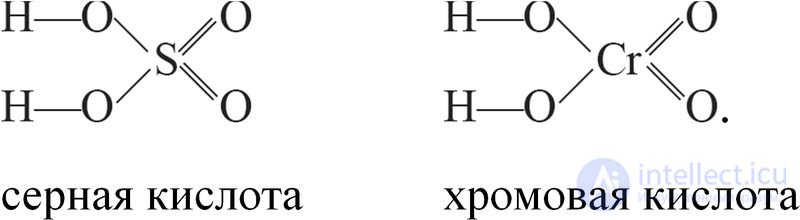
Compounds of Group B elements in their highest oxidation states show similarities in properties to compounds of Group A elements in the same oxidation states. They have analogous formulas of oxides, hydroxides, acids, and salts. For example, chromium, an element of Group VIB, in the +6 oxidation state forms the acidic oxide CrO3 and the acid H2CrO4, which in composition and redox properties are analogous to the compounds of sulfur, an element of Group VIA, in the same +6 oxidation state: SO3 and H2SO4.
A similar resemblance is characteristic of manganese, an element of Group VIIB, and chlorine, an element of Group VIIA. In the +7 oxidation state, manganese forms the oxide Mn2O7 (a molecular liquid) and the corresponding acid HMnO4. Chlorine in the same oxidation state (+7) forms the acidic oxide Cl2O7 (also a molecular liquid) and the acid HClO4.
The similarity in the properties of these elements can be explained by the equal number of unpaired electrons that take part in forming chemical bonds with oxygen.
| Group | VIA | VIB | VIIA | VIIB |
| Element | S | Cr | Cl | Mn |
| Number of unpaired electrons | 6 | 6 | 7 | 7 |
| Electron configuration in the excited state corresponding to the highest oxidation state | [Ne]3s13p33d2 | [Ar]3d54s1 | [Ne]3s13p33d3 | [Ar]3d54s14p1 |
The distinctive properties of the compounds formed by d-elements are determined by the electronic structure of the outer and second-outer electron shells of their atoms.
Atoms of the d-elements of the B-groups are smaller in size than the atoms of neighboring ns-elements in the same period, because electrons fill the inner (n – 1)d-sublevel. If we further take into account that the atoms of d-elements have roughly the same outer-shell structure (ns1 or ns2), it becomes clear why the properties of d-elements change less sharply across a period compared with s- and p-elements.
The simple substances of d-elements are typical metals, which is explained by the comparatively weak bond between the outer electrons and the nucleus.
The participation of d-electrons in forming the metallic bond in simple substances strengthens it compared with the bond in metals of s- and p-elements. As a result, a number of metals of d-elements (for example, chromium, tungsten) have a high melting point (except mercury), high density (except titanium), and hardness. Some d-elements (Co, Ni) are ferromagnetic.
Group IIIB elements, having only one d-electron, are close in chemical properties to the neighboring alkaline earth metals.
Metals of the Group IVB–VIB elements have a lower reducing capacity, and in a number of cases chemical passivity. They are more resistant to corrosion.
On the surface of the passive metals of most d-elements a dense oxide film forms, which hinders various chemical reactions. This property allows these metals to be used as anticorrosion coatings (chromium plating, nickel plating, copper plating).
Most d-metals stand in the activity series of metals above hydrogen and displace hydrogen from acids, for example:
Cr + 2HCl = CrCl2 + H2↑.
The metals Cu, Hg, Ag, Au, and the platinum-family metals (Ru, Rh, Pd, Os, Ir, Pt) stand in the activity series after hydrogen, and therefore do not displace hydrogen from acids. To bring Cu, Hg, and Ag into solution, they are oxidized with nitric acid. Au and Pt can dissolve only in aqua regia (a mixture of concentrated nitric and hydrochloric acids) (Table 34.2).
Table 34.2. Comparison of the chemical properties of metals of s- and d-elements based on their position in the activity series of metals
| Metals | Li | K | Ca | Na | Mg | Al | Mn | Zn | Cr | Fe | Co | Ni | Sn | Pb | H2 | Cu | Hg | Ag | Pt | Au |
| Characteristics |  Reducing activity of the metals increases Reducing activity of the metals increases |
|||||||||||||||||||
| Ability to displace metals standing ahead of them from solutions of their salts increases |
||||||||||||||||||||
| Occurrence in nature | Mainly as compounds | Both in the free state and as compounds | Mainly in the free state | |||||||||||||||||
| Reactions with oxygen | Fast | Slow | Not oxidized | |||||||||||||||||
| Reactions with water | Form alkalis and H2 | With water vapor form metal oxides and H2 | Do not react | |||||||||||||||||
| Corrosion | Corrosion resistance increases  |
|||||||||||||||||||
| Reactions with acids | Displace hydrogen from solutions of non-oxidizing acids (HCl, H2SO4(dilute), H3PO4, H2S, RCOOH) (Pb is passivated in dilute HCl, H2SO4) |
Do not displace H2 from acids | ||||||||||||||||||
| With dilute and concentrated HNO3 form a salt, water, and nitrogen(V) reduction products With concentrated H2SO4 form a salt, water, and sulfur(VI) reduction products In concentrated HNO3 and H2SO4 the metals Al, Fe, Cr, Ni are passivated |
Dissolve in aqua regia HNO3 + 3HCl | |||||||||||||||||||
| Production | Electrolysis of melts | Reduction of metal oxides with H2, CO, Al; electrolysis of salt solutions; displacement from salt solutions by active metals | ||||||||||||||||||
| Compounds | Oxides dissolve in H2O to form hydroxides | Oxides do not dissolve in water | ||||||||||||||||||
| Hydroxides are basic | Hydroxides and oxides are amphoteric | Hydroxides and oxides can be basic, amphoteric, or acidic |
Unlike s-elements, most compounds of d-elements have a specific color that depends on the oxidation state of their atoms (Fig. 112.3). For example, compounds formed by copper atoms in the +2 oxidation state are colored blue. Compounds of Ni(II) have a green color, Co(II) — pink, Mn(II) — pale pink, Mn(VI) — green, Mn(VII) — violet, Cr(VI) — yellow (K2CrO4) or orange (K2Cr2O7), Cr(II) — blue, Fe(III) — yellow, and Fe(II) — green.
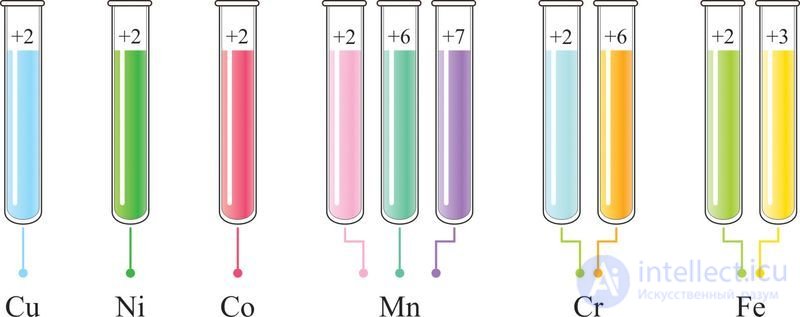
Fig. 112.3. Color of aqueous solutions containing compounds of d-elements in different oxidation states
Group B metals are classified as d-elements with the general valence-shell electron configuration (n – 1)dxnsy, where x can take values from 1 to 10.
In forming chemical bonds, the atoms of d-elements involve not only the outer s-electrons but also the d-electrons of the second-outer shell.
Except for the d-elements of Groups IIIB and IIB, the atoms of all other d-elements have several oxidation states. The highest oxidation state of the atoms generally corresponds to the group number of the d-element.
In low oxidation states, the atoms of d-elements form chemical bonds close to the ionic type and exist in solutions as cations.
In their highest oxidation states, d-elements are characterized by anionic forms of compounds.
Questions, exercises, problems
1. Give the formulas and electron configuration schemes of the manganese atom in the following oxidation states: 0, +2, +4, +6, +7.
2. Explain the "electron drop" effect in the electron configurations of copper and chromium.
3. Using internet resources, compile a table of atomic radii of the period-4 elements and explain the nature of their variation.
4. Electrons of which energy level are considered to be the valence electrons of d-elements?
5. Compare the electronic structure of atoms of A- and B-group elements:
6. Why do the properties of d-elements change less sharply across a period than those of s- and p-elements?
7. Indicate the relationship between the oxidation state of d-elements and their ability to form cationic and anionic forms of compounds?
8. There is a certain resemblance between chlorine and manganese in their highest oxidation state: in the +7 oxidation state, chlorine and manganese form acids of identical composition: HClO4 and HMnO4, respectively. Draw the structural formulas of these acids.
9. Write the equations of the reactions according to the scheme:
Cu → Cu(NO3)2 → CuS → Cu(NO3)2 → CuO → CH3CHO.
10. Through 1 dm3 of a copper(II) sulfate solution with a mass fraction of the salt of 18% (ρ = 1.2 g/cm3), 23.3 dm3 of hydrogen sulfide (at STP) was passed. Determine the mass of the precipitate and the mass fractions of the substances in the solution.
1. The valence-shell electron configuration of d-elements can be represented by the general formula:
2. The correct statements are:
3. One s-electron in the outer shell in the ground state is contained in the atoms of:
4. The electron configuration of the iron atom is:
5. Both compounds in the pair correspond to manganese in its highest oxidation state:

Comments