
Lecture
General notes
When performing this work, use the information given in Table 30.2.
In your report, present the reaction equations in molecular, full ionic, and net ionic forms.
Table 30.2. Mineral fertilizers
| Fertilizer | Appearance | Solubility | |
|---|---|---|---|
|
Ammonium nitrate Ammonium nitrate (ammonium (ammonia) saltpeter) NH4NO3 |
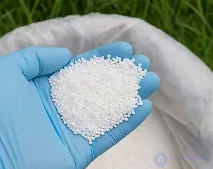 |
White crystals or granules | Good |
|
Ammonium sulfate (ammonium sulfate, Lat. ammonii sulfas), (NH4)2SO4 |
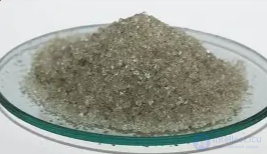 |
Colorless or gray-green crystals (due to impurities) | Good |
|
Ammonium chloride (ammonium chloride; technical name — sal ammoniac, NH4Cl |
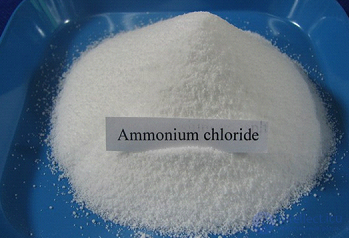 |
White crystals | Good |
|
Calcium saltpeter Calcium nitrate, calcium saltpeter, calcium nitrate Са(NО3)2 |
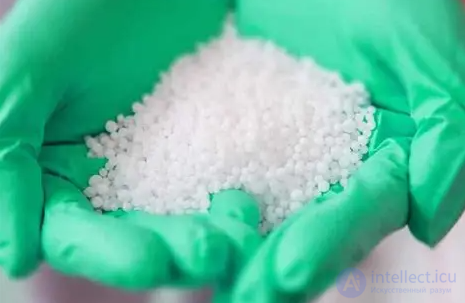 |
White crystals or flakes | Good |
|
Potassium saltpeter Potassium nitrate (potassium nitrate, potassium saltpeter, potash saltpeter, Indian saltpeter, etc.) KNO3 |
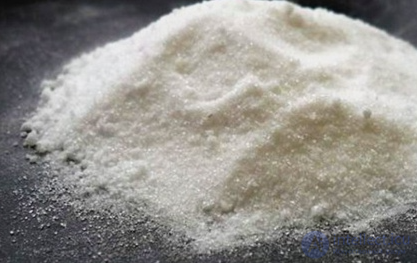 |
White crystals | Good |
|
Potash Рotassium carbonate (carbonate of potash, calcined potash) K2CO3 |
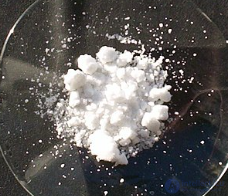 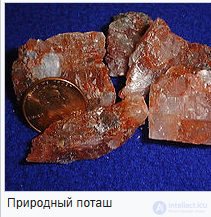 |
White crystals | Good |
|
Potassium salt Sylvite (КCl) 52% of the substance. carnallite (35%), kainite (14%), polyhalite (12%), langbeinite (18%); others — leonite (21%), schoenite (19%); syngenite (23%). |
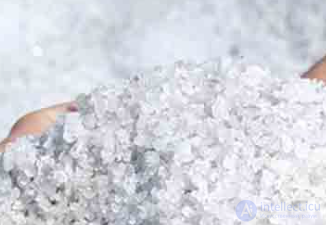 |
Heterogeneous white and pink crystals | Good |
|
Potassium chloride KCl |
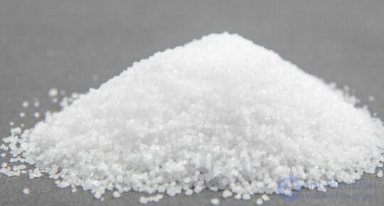 |
White crystals | Good |
|
Simple superphosphate a mixture of Ca(H2PO4)2*H2O and CaSO4 |
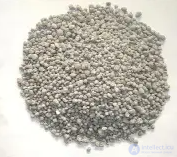 |
Light-gray granules or powder |
Low |
Check the solubility of each sample provided, describe their appearance. Based on the investigation carried out, state the contents of each bag.
1. Ammonium nitrate (NH₄NO₃):
white or slightly grayish granules
odorless
uniform structure
2. Superphosphate:
gray or grayish-brown powder
may contain lumps
sometimes slightly damp
3. Potash (potassium carbonate, K₂CO₃):
white powder or fine crystals
resembles salt
dry and free-flowing
Let us carry out a simple test — adding water:
Ammonium nitrate → dissolves very well (the solution is clear)
Superphosphate → dissolves poorly (a cloudy residue remains)
Potash → dissolves well (clear solution)
Add water to both samples:
one dissolved completely → this is ammonium nitrate
the other produced a precipitate → this is superphosphate
Conclusion:
clear solution → ammonium nitrate
cloudy/precipitate → superphosphate
Check solubility:
dissolved completely → potash
precipitate remained → superphosphate
Additionally, one can check:
the potash solution has an alkaline medium (can be checked with an indicator)
Conclusion:
dissolves well → potash
dissolves poorly → superphosphate
| Fertilizer | Appearance | Solubility |
|---|---|---|
| Ammonium nitrate | White granules | Good |
| Superphosphate | Gray powder | Poor |
| Potash | White powder | Good |
Reaction equations in molecular, full ionic, and net ionic forms.
1. Ammonium nitrate (NH₄NO₃)
This is a highly soluble fertilizer → it dissociates in water:
NH₄NO₃ → NH₄⁺ + NO₃⁻
(the same, since the substance is completely soluble)
NH₄NO₃ → NH₄⁺ + NO₃⁻
coincides:
NH₄⁺ + NO₃⁻
2. Potash (K₂CO₃)
Also dissolves well and dissociates:
K₂CO₃ → 2K⁺ + CO₃²⁻
Full ionic form:
K₂CO₃ → 2K⁺ + CO₃²⁻
2K⁺ + CO₃²⁻
3. Superphosphate
Superphosphate mainly contains:
Ca(H₂PO₄)₂ (the soluble part)
CaSO₄ (the poorly soluble part)
Therefore a precipitate is observed.
Reaction of the soluble part:
Ca(H₂PO₄)₂ → Ca²⁺ + 2H₂PO₄⁻
Ca(H₂PO₄)₂ → Ca²⁺ + 2H₂PO₄⁻
Ca²⁺ + 2H₂PO₄⁻
Insoluble part:
CaSO₄ ↓ (precipitate)
4. (Additionally, to confirm potash — reaction with an acid)
The reaction with an acid (for example, HCl) can be written:
K₂CO₃ + 2HCl → 2KCl + H₂O + CO₂↑
Full ionic:
2K⁺ + CO₃²⁻ + 2H⁺ + 2Cl⁻ → 2K⁺ + 2Cl⁻ + H₂O + CO₂↑
CO₃²⁻ + 2H⁺ → H₂O + CO₂↑
General conclusion
Ammonium nitrate and potash → dissolve completely (electrolytes)
Superphosphate → produces a precipitate (insoluble Ca salts)
A qualitative indicator of potash → the evolution of CO₂ upon reaction with an acid
The main distinguishing feature — solubility:
if the substance does not dissolve → it is superphosphate
if it dissolves:
within pair (a) → saltpeter
within pair (b) → potash
Prepare solutions of these fertilizers and test them using a universal indicator. State the contents of each test tube.
Identifying fertilizers using a universal indicator
1. Preparing the solutions
Dissolve small amounts of the substance from each test tube in water.
2. Testing with a universal indicator
Observations:
a) Ammonium nitrate and potash
Ammonium nitrate (NH₄NO₃)
→ the solution is weakly acidic (indicator: yellow-green)
Potash (K₂CO₃)
→ the solution is alkaline (indicator: blue/violet)
Therefore:
acidic medium → NH₄NO₃
alkaline medium → K₂CO₃
b) Ammonium sulfate and potassium chloride
Ammonium sulfate ((NH₄)₂SO₄)
→ the solution is acidic
Potassium chloride (KCl)
→ the solution is neutral (indicator green)
Therefore:
acidic → (NH₄)₂SO₄
neutral → KCl
Explanation (salt hydrolysis)
1. Ammonium nitrate
NH₄NO₃ + H₂O ⇄ NH₄OH + HNO₃
NH₄⁺ + NO₃⁻ + H₂O ⇄ NH₄OH + H⁺ + NO₃⁻
NH₄⁺ + H₂O ⇄ NH₃ + H₃O⁺
Acidic medium due to NH₄⁺
2. Potash (potassium carbonate)
K₂CO₃ + H₂O ⇄ KHCO₃ + KOH
2K⁺ + CO₃²⁻ + H₂O ⇄ K⁺ + HCO₃⁻ + K⁺ + OH⁻
CO₃²⁻ + H₂O ⇄ HCO₃⁻ + OH⁻
Alkaline medium
3. Ammonium sulfate
(NH₄)₂SO₄ + H₂O ⇄ NH₄OH + H₂SO₄
2NH₄⁺ + SO₄²⁻ + H₂O ⇄ NH₄OH + NH₄⁺ + H⁺ + SO₄²⁻
NH₄⁺ + H₂O ⇄ NH₃ + H₃O⁺
Acidic medium
4. Potassium chloride
KCl → K⁺ + Cl⁻
K⁺ + Cl⁻
(no reaction)
Neutral medium (no hydrolysis occurs)
Summary
| Test tube | Observation | Substance |
|---|---|---|
| Acidic | yellow-green | NH₄NO₃ or (NH₄)₂SO₄ |
| Alkaline | blue | K₂CO₃ |
| Neutral | green | KCl |
Conclusion:
All ammonium salts produce an acidic medium
Carbonates → an alkaline medium
Salts of a strong acid and a strong base → a neutral medium
Prepare solutions of these fertilizers and determine the contents of each test tube using the reagents provided.
Identifying fertilizers in the test tubes
a) Ammonium sulfate and ammonium chloride
Formulas:
ammonium sulfate → (NH₄)₂SO₄
ammonium chloride → NH₄Cl
How to distinguish
Use a solution of BaCl₂ (barium chloride)
Indication:
if a white precipitate appears → this is the sulfate (SO₄²⁻)
if there is no precipitate → this is the chloride
Reactions
1. Ammonium sulfate + barium chloride
Molecular equation:
Full ionic:
Net ionic:
2. Ammonium chloride + barium chloride
No reaction (no precipitate forms)
b) Potassium chloride and potash
Formulas:
potassium chloride → KCl
potash (potassium carbonate) → K₂CO₃
How to distinguish
Use hydrochloric acid (HCl)
Indication:
if gas evolution (CO₂) occurs → this is the carbonate (potash)
if there is no reaction → this is KCl
Reactions
1. Potash + hydrochloric acid
Molecular equation:
Full ionic:
Net ionic:
2. Potassium chloride + hydrochloric acid
No reaction
Summary (what is in which test tube)
|
Substance |
Reagent |
Indication |
|---|---|---|
|
(NH₄)₂SO₄ |
BaCl₂ |
white precipitate |
|
NH₄Cl |
BaCl₂ |
no reaction |
|
K₂CO₃ (potash) |
HCl |
gas is evolved |
|
KCl |
HCl |
no reaction |
b) calcium saltpeter, superphosphate, ammonium sulfate, ammonium nitrate.
a) Superphosphate, potash, NH₄Cl, KCl
1. Solubility in water
Superphosphate → dissolves partially, the solution may be cloudy (contains CaSO₄ impurities)
The others (K₂CO₃, NH₄Cl, KCl) → highly soluble
Cloudy solution = superphosphate
2. Identifying potash (K₂CO₃)
Add an acid (for example, HCl):
Indication: CO₂ is evolved (fizzing)
Molecular:
Full ionic:
Net:
Fizzes = potash
3. Identifying NH₄Cl
Add alkali (NaOH), heat:
Indication: smell of ammonia (NH₃)
Molecular:
Full ionic:
Net:
Smell of ammonia = ammonium chloride
4. Remaining substance
Potassium chloride (KCl) — gives no characteristic reactions
b) Ca(NO₃)₂, superphosphate, (NH₄)₂SO₄, NH₄NO₃
1. Superphosphate
Again identified by poor solubility / cloudiness
2. Ammonium sulfate ((NH₄)₂SO₄)
Add BaCl₂:
Indication: white precipitate BaSO₄
Molecular:
Full ionic:
Net:
Precipitate = ammonium sulfate
3. Ammonium salts (NH₄NO₃ and (NH₄)₂SO₄)
Checked with alkali → release NH₃ (as above)
4. Calcium saltpeter Ca(NO₃)₂
Add Na₂CO₃:
Indication: white precipitate CaCO₃
Molecular:
Full ionic:
Net:
Precipitate = calcium saltpeter
5. Ammonium nitrate NH₄NO₃
Remains:
highly soluble
gives NH₃ with alkali
does NOT give a precipitate with BaCl₂
Summary (brief)
a)
cloudy → superphosphate
fizzes with acid → potash
NH₃ with alkali → NH₄Cl
remainder → KCl
b)
cloudy → superphosphate
BaSO₄↓ → (NH₄)₂SO₄
CaCO₃↓ → Ca(NO₃)₂
remainder → NH₄NO₃
| K2CO3 |

Comments