
Lecture
Water is a weak electrolyte and dissociates into H+ and OH– ions only to a small extent:

At 25 °C the degree of dissociation α of water is approximately 2 ∙ 10–9. This means that out of a billion water molecules, only two molecules exist in the form of H+ and OH– ions.
The concentration of hydrogen ions c(H+) is equal to 10–7 mol/dm3. The concentration of hydroxide ions c(OH–) is the same.
The product of the concentrations of H+ and OH– ions in water and aqueous solutions is a constant value at a given temperature. Thus, at 25 °C:

Solutions in which the concentration of hydrogen cations equals the concentration of hydroxide anions are called neutral. If the concentration of hydrogen cations in a solution is greater than the concentration of hydroxide anions, that is, c(H+) > c(OH–), the medium of the solution is acidic. If, on the other hand, hydroxide anions predominate in the solution, that is, c(OH–) > c(H+), the medium of the solution is alkaline.
Quantitatively, the acidity and the related basicity (alkalinity) of solution media are expressed using the hydrogen index pH (read as "pee-aitch"). The hydrogen index is the decimal logarithm of the concentration of hydrogen ions in a solution, taken with a "minus" sign:
pH = –lgc(H+).
The hydrogen index pH is a measure of the concentration of hydrogen cations H+ in a solution, quantitatively expressing the acidity of the solution.
The hydrogen index is a dimensionless quantity.
For example, at a molar concentration of H+ cations c(H+) = 10–5 mol/dm3, the pH equals 5, while at c(H+) = 10–3 mol/dm3, the pH equals 3.
Example 1. Determine the pH of a sulfuric acid solution whose molar concentration is 0.005 mol/dm3.
Given:
c(H2SO4) = 0.005 mol/dm3
pH — ?
Solution
Let V(solution) = 1 dm3.
Then
n(H2SO4) = 0.005 mol/dm3 · 1 dm3 = 0.005 mol.
Let us determine the amount of hydrogen ions from the dissociation equation of the acid:
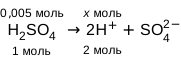 , hence x = 0.01 mol, that is, n(H+) = 0.01 mol.
The molar concentration of hydrogen ions is equal to:

Let us calculate the hydrogen index:
pH = –lgc(H+) = –lg10–2 = 2.
Answer: pH = 2.
Let us calculate the hydrogen index in an alkaline solution.
Example 2. Determine the pH of an NaOH solution with a molar concentration of 0.01 mol/dm3.
Given:
c(NaOH) = 0.01 mol/dm3
pH — ?
Solution
The concentration of OH– anions in such a solution is 10–2 mol/dm3. Let us calculate the concentration of hydrogen ions, knowing that c(H+) ∙ c(OH)– = 10–14 (mol/dm3)2. , hence

therefore,
pH = –lgc(H+) = –lg10–12 = 12 (alkaline medium).
Answer: pH = 12.
Note that H+ cations continue to be present in the aqueous solution even in an alkaline medium.
Since in water at 20–25 °C the concentrations of H+ and OH– ions are equal and amount to 10–7 mol/dm3, for pure water pH = –lgc(H+) = –lg10–7 = 7. This value of pH corresponds to a neutral medium. A value of pH < 7 corresponds to greater acidity of the solution, and pH > 7 corresponds to greater alkalinity of the solution (Fig. 59).
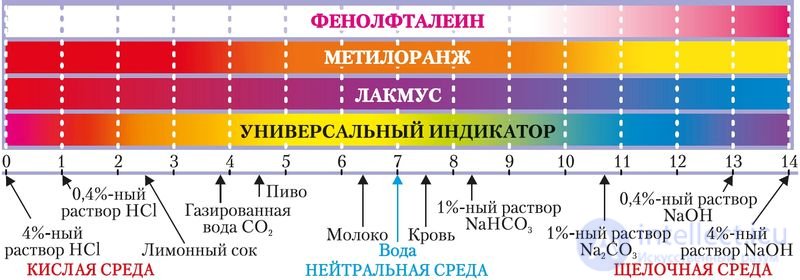
Fig. 59. Scale of pH values of the medium in an aqueous solution

Thus, the pH value can be calculated, and it can also be estimated using individual indicators (litmus, phenolphthalein, methyl orange), a universal indicator with a pH scale, and instruments — pH meters (Fig. 59, 60).
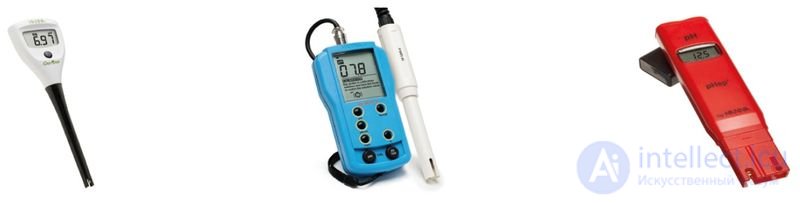
Fig. 60. pH meters
Measuring pH is necessary in medicine, agriculture, science, and industry. In a healthy person's body, the pH of blood is 7.4, of gastric juice — 1.7, of saliva — 6.9, of tears — 7.3–7.5. When preserving food, adding acetic acid to marinade to reach pH < 4.5 suppresses the activity of most bacteria. For a similar purpose, citric acid is added to soft drinks to lower the pH value to 3. For the normal development of plants, it is most often necessary to reduce elevated soil acidity by liming with chalk CaCO3, dolomite flour CaMg(CO3)2, or certain fertilizers to reach pH = 6.0–6.5 (Table 16).
Table 16. Classification of soil pH ranges
| Soil acidity | pH range |
| Acidic | 3.5–6.0 |
| Neutral and close to neutral | 6.1–7.8 |
| Alkaline | 7.9–9.0 and above |
The reversible dissociation reaction of water obeys Le Chatelier's principle, and the concentrations of H+ and OH– ions in aqueous solutions are interrelated. For example, doubling the concentration of H+ cations shifts the equilibrium to the left and decreases the concentration of OH– anions by a factor of 2. Conversely, an increase in the concentration of OH– anions leads to a proportional decrease in the concentration of H+ cations.
The dissociation of water is a strongly endothermic reaction and proceeds with the absorption of heat in the amount of 57 kJ/mol. At 10 °C the degree of dissociation of water α is approximately 1 · 10–9, and at 100 °C — 1.4 · 10–8. This dependence of α on temperature is a consequence of the equilibrium of the endothermic dissociation reaction shifting to the right as the temperature rises.
The product of the concentrations of H+ and OH– ions in water and aqueous solutions is called the ion product of water and is denoted Kw. At 25 °C its value is:
Kw = c(H+) · c(OH−) = 10−14 (mol/dm3)2.
The ion product of water Kw — is the product of the concentrations of hydrogen cations H+ and hydroxide anions OH− in water or in aqueous solutions. At a given temperature, Kw is a constant value not only for pure water but also for dilute aqueous solutions of substances.
The concept of the hydrogen index was introduced in 1909 by the Danish chemist S. P. L. Sørensen. In the symbol pH (from Latin pondus Hydrogenii — "weight of hydrogen"), p is the initial letter of the word pondus or potenz (German) — "power." Nowadays the letter p has lost its original meaning as an abbreviation of that word and is now a chemical symbol replacing the operation –lg, while the letter H still refers to the concentration of the hydrogen cation c(H+).
The pH interval from 4 to 7 corresponds to a weakly acidic medium, and the interval from 7 to 10 — to a weakly alkaline one. Values of pH < 4 correspond to a strongly acidic medium, and pH > 10 — to a strongly alkaline one (Table 16.2).
In alkaline solutions, pH is determined using the numerical value of Kw = [H+] · [OH–] = c(H+) · c(OH−) = 10−14 (mol/dm3)2 at 25 °C.
Table 16.2. Color of universal indicator paper and pH in solutions of HCl and NaOH of various concentrations
| ω(HCl), % | c(H+), mol/dm3 | pH | Color of universal indicator | pH | c(OH–), mol/dm3 | ω(NaOH), % | ||
| 4 | 1 | 0 | ↑ Acidity of the medium |
0 | 10–14 | – | ||
| 0.4 | 10–1 | 1 | 1 | 10–13 | – | |||
| 0.04 | 10–2 | 2 | 2 | 10–12 | – | |||
| 0.004 | 10–3 | 3 | 3 | 10–11 | – | |||
| 0.0004 | 10–4 | 4 | 4 | 10–10 | – | |||
| 0.00004 | 10–5 | 5 | 5 | 10–9 | – | |||
| 0.000004 | 10–6 | 6 | 6 | 10–8 | – | |||
| Water | 10–7 | 7 | 7 | 10–7 | Water | |||
| – | 10–8 | 8 | Alkalinity of the medium ↓ |
8 | 10–6 | 0.000004 | ||
| – | 10–9 | 9 | 9 | 10–5 | 0.00004 | |||
| – | 10–10 | 10 | 10 | 10–4 | 0.0004 | |||
| – | 10–11 | 11 | 11 | 10–3 | 0.004 | |||
| – | 10–12 | 12 | 12 | 10–2 | 0.04 | |||
| – | 10–13 | 13 | 13 | 10–1 | 0.4 | |||
| – | 10–14 | 14 | 14 | 1 | 4 |
pH is approximately measured using universal indicator paper, whose color, after being moistened in the solution under study, is compared with a special pH scale given in Table 16.2.
At dairy plants, the freshness of milk is determined by its pH value. In fresh milk, pH = 6.7, that is, milk has an essentially neutral medium.
In unrefrigerated milk, acidity increases rapidly owing to the multiplication of lactic acid bacteria, which ferment milk sugar (lactose) into lactic acid. Lactic acid curdles the main protein of milk — casein. If milk is not cooled or is stored for a long time, then as lactic acid accumulates it will curdle on boiling, or will sour so strongly that it curdles even without heating.
Many chemical and biological processes depend on the pH value. Most of them proceed at the required rate and in the required direction only at a particular acidity of the medium. The tissues of the human body are very sensitive to fluctuations in the pH value: outside the permissible range of 7.34–7.45, cell destruction and loss of the ability of protein catalysts (enzymes) to perform their functions are possible, which leads to the death of the organism. Therefore, the acid-base balance in a healthy organism is tightly regulated. Deviation from the normal physiological pH value of blood (pH = 7.4), gastric juice (1.5–2.0), urine (6.0), skin (4.7–5.5), pancreatic secretion (8.1), cerebrospinal fluid (7.5), saliva (6.2–7.4), tears (7.3–7.5), and others is a symptom of a number of diseases.
Pickling, as a method of preserving vegetables, is based on lactic acid fermentation, in the course of which lactic acid is formed, which has a preservative effect on the food.
Dental plaque, formed by microorganisms that release lactic acid, creates a local acidic environment that leads to tooth decay as a result of the dissolution of hydroxyapatite Ca10(PO4)6(OH)2 crystals in tooth enamel at pH < 4.5.
The hydrogen index pH is a measure of the concentration of hydrogen cations H+ in a solution. The hydrogen index is calculated using the formula pH = –lgc(H+).
1. Indicate the acidity of the medium (acidic, neutral, alkaline), as well as the corresponding color of the universal indicator:
2. Will the pH of the solution obtained by mixing equal volumes of potassium hydroxide and sulfuric acid solutions, each with a molar concentration of 0.1 mol/dm3, be greater or less than seven?
3. Write the dissociation equations for substances in whose solutions litmus turns red: LiOH, HCOOH, HNO3, Ca(OH)2, HCl, H2SO4.
4. Given solutions of the compounds: NaOH, HCl, NaCl, KOH, HNO3, Ca(OH)2, NH3, CO2, SO2, CH3COOH, HNO2, HF. Assuming equal molar concentration, which of the solutions have a neutral medium, pH > 7, pH < 7?
5. Calculate the pH value in a solution of:
6. Determine the pH of a KOH solution with a molar concentration of 0.001 mol/dm3.
7. Based on the value of the product c(H+) · c(OH−) = 10−14 (mol/dm3)2 at 25 °C, find the value of the molar concentration c(OH−) at pH 2, 5, 8, 12, and 14. How can solutions with pH = 2 and pH = 14 be prepared?
8. What is the molar concentration (mol/dm3) of hydrogen ions in a solution with pH = 4?
9. What will the medium be in a solution obtained by mixing equal volumes of solutions containing 3 mol of sodium hydroxide and 2 mol of sulfuric acid?
10. In a solution of nitrous acid, the number of undissociated molecules is 2.5 times greater than the number of dissociated ones. Indicate the degree of dissociation α (in percent) and the pH of the solution if the initial concentration of the acid in it was 0.0035 mol/dm3.
1. Why is water a weak electrolyte?
2. Why does the degree of dissociation of water increase on heating?
3. What is the ion product of water?
4. What chemical properties of solutions does the hydrogen index pH characterize?
5. Will the pH of the solution obtained by mixing equal volumes of potassium hydroxide and sulfuric acid solutions, each with a molar concentration of 0.1 mol/dm3, be greater or less than 7?
6. How will the concentration of H+ cations in an aqueous solution change if the concentration of OH– anions in it is increased threefold?
7. Find the value of the molar concentration c(OH−) at pH 0, 4, 7, 11, and 14.
9. At 10 °C the degree of dissociation of water α equals 9.7 · 10–10 (ρ10water = 0.9997 g/cm3), and at 100 °C — 1.39 · 10–8 (ρ100water = 0.9584 g/cm3). Calculate Kw for these temperatures.
10. In a solution of nitrous acid, the number of undissociated molecules is 2.5 times greater than the number of dissociated ones. Indicate the degree of dissociation α (in percent) and the pH of the solution if the initial concentration of the acid in it was 0.0035 mol/dm3.
1. Indicate the incorrect statements:
2. In a neutral solution at 25 °C:
3. In a hydrogen chloride solution, the concentration of hydrogen ions is 0.001 mol/dm3. For this solution, pH equals:
4. In a Ba(OH)2 solution, the concentration of Ba2+ ions is 0.005 mol/dm3. For this solution, pH equals:
5. pH < 7 is found in solutions of:

Comments