
Lecture
The most important hydrogen compounds of oxygen and sulfur are water H2O and hydrogen sulfide H2S. In addition, there are other binary compounds of oxygen and sulfur, for example hydrogen peroxide Н2О2.
Water is the second most abundant chemical compound on Earth. The reserves of water on Earth are estimated at 1.4 billion km3. It makes up from 50 to 99% of the mass of plants, animals, and humans.
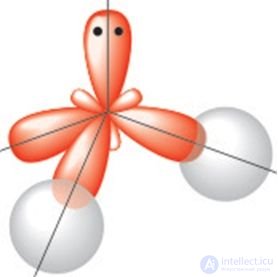
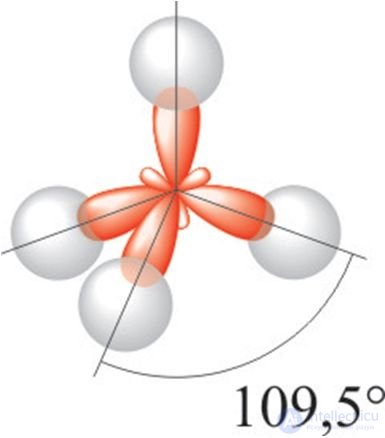
Structure of the molecule. The water molecule has a bent (angular) structure, determined by the four electron orbitals of the outer electron shell of the oxygen atom: two of them form polar covalent bonds with hydrogen atoms, while the other two contain lone electron pairs (Fig. 77). As you know, the angle between the H—O bond directions in a water vapor molecule is 104.5°, and the molecules are dipoles (§ 14, Fig. 33).

Fig. 77. Structure of the water molecule: a — electron-graphical scheme of bond formation, b — electron formula and angular structure, c — scale and ball-and-stick models
Features of the physical properties. Water is colorless, tasteless, and odorless, and has a high heat capacity. Water exists in nature in three states of matter (liquid, solid, gaseous). Its melting point is 0 °C, and boiling point is 100 °C at p = 101.325 kPa. Strong hydrogen bonds (25 kJ/mol) exist between water molecules in the liquid and solid states (§ 17, Fig. 43).
Water, being a very weak electrolyte, practically does not conduct electric current. Approximately two molecules out of a billion dissociate into ions (at 25 °C):  .
.
Chemical properties of water. Water reacts with many substances both at room temperature and on heating: with metals, basic and acidic oxides, and organic substances. Let us consider some features of these reactions.
1. The nature of the reaction of water with metals depends on the activity of the metal. Thus, alkali and alkaline earth metals (Са, Ва, Sr, Ra) react at room temperature to form hydrogen and an alkali:
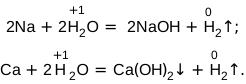

Most metals located in the activity series between aluminum and hydrogen react with water vapor to form hydrogen and metal oxides. Metals located after hydrogen do not react with water under any conditions. You will study the reactions of metals with water in more detail in Chapter 7.
2. The reaction of water with acidic oxides leads to the formation of acids:
SO3 + H2O = H2SO4.
3. Basic oxides of alkali and alkaline earth metals form alkalis in reactions with water:
СаО + Н2О = Са(ОН)2↓.
4. With organic substances, water enters into reactions of hydration (of unsaturated compounds) and hydrolysis (of esters, carbohydrates, proteins). For example:
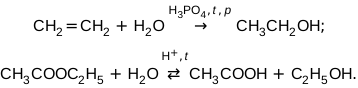
The hydrolysis of proteins, di- and polysaccharides, and fats is the first stage of the assimilation (digestion) of food.
5. Water reacts with halogens. Fluorine oxidizes the oxygen in the water molecule:
2H2O + 2F2 = 4HF + O2↑.
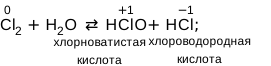
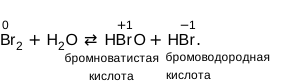
Reactions with chlorine and bromine proceed reversibly to form two acids, in one of which the oxidation state of the halogen atom is raised, and in the other lowered:
6. With ionic metal hydrides, water acts as an oxidizing agent:
NaH + H2O = NaOH + H2↑.
7. Salts of weak acids and salts of inactive metals, as well as ammonium salts, undergo hydrolysis in an aqueous medium (see § 27.1.):
СН3СОО– + НОН  СН3СООН + ОН–;

 .
.
Structure of the molecule. The structure of the hydrogen sulfide molecule can be explained by the overlap of the atomic 3p-orbitals of sulfur and the 1s-orbitals of the hydrogen atoms (§ 14, Fig. 32). This causes repulsion of the regions of increased electron density that arise upon formation of the σ-bond. As a result, the bond angle increases slightly — from 90° to 92° (Fig. 78).
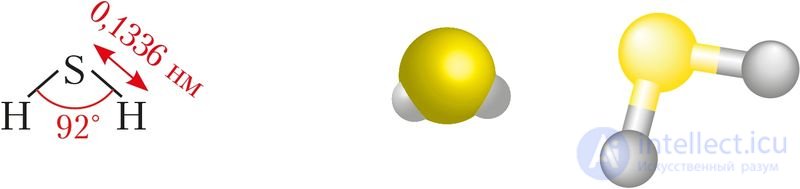
Fig. 78. Structural formula, scale and ball-and-stick models of the hydrogen sulfide molecule
Physical properties. Hydrogen sulfide is a colorless gas with the odor of rotten eggs. It is heavier than air and has lower boiling (–60 °C) and melting (–86 °C) points compared to water. Three volumes of hydrogen sulfide dissolve in one volume of water. This forms a solution of a very weak acid — hydrosulfuric acid:
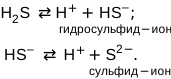
From the dissociation equations it follows that the acid corresponds to two series of salts — acid salts (hydrosulfides, for example NaHS, Ca(HS)2) and normal salts (sulfides, for example Na2S, CaS).
Effect on the human body. Hydrogen sulfide is highly toxic. On inhaling it, paralysis of the respiratory nerves quickly sets in, and a person loses the ability to sense odors, which poses a deadly danger. On entering the blood, hydrogen sulfide destroys hemoglobin and forms black iron sulfide — "the blood turns black." Work with hydrogen sulfide in laboratories may only be carried out in a fume hood.
In nature, hydrogen sulfide is formed in small quantities during the putrefaction of proteins, and is present in volcanic gases and in the atmosphere of industrial regions. Hydrogen sulfide is heavier than air, so it accumulates in sewer manholes and pits. There have been quite a few cases in which workers servicing pipelines have become victims.
In the body, hydrogen sulfide is formed from the amino acid cysteine. Endogenous (produced within the body) hydrogen sulfide is an antispasmodic — it relaxes smooth muscles, and is also considered one of the important factors protecting the body from cardiovascular disease.
Uses of hydrogen sulfide and sulfides. Hydrogen sulfide has limited application. Hydrosulfuric water and gaseous hydrogen sulfide are used in analytical chemistry for the detection (precipitation) of metal cations whose sulfides are sparingly soluble or insoluble.
The sulfides of many metals are brightly colored: HgS, Ag2S, PbS, CuS are black, Sb2S3 is orange, CdS is yellow, MnS is pink, ZnS is white. The sulfides of alkali and alkaline earth metals are colorless.
One of the main reasons for the darkening of old masters' paintings is their use of lead white. On reacting with even a trace amount of hydrogen sulfide in the air, lead white turns into black lead(II) sulfide PbS over the course of several centuries. During restoration it is oxidized with hydrogen peroxide: PbS(black) + 4H2O2 = PbSO4(white) + 4H2O.
In engineering, sulfides are used as sources of non-thermal radiation — phosphors (CdS, ZnS), lubricants (МоS2), semiconductors (CuS, CdS, PbS, and others).
In medicine, artificial and natural hydrogen sulfide baths and hydrogen sulfide mineral water are used.
In the chemical industry, hydrogen sulfide serves as a raw material for obtaining sulfur, sulfuric acid, sulfides, and sulfur-containing organic compounds. For example, mercaptans, as some of the most foul-smelling substances, are added to natural gas to detect its leakage in pipelines.
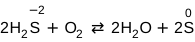
Reducing properties are most characteristic of hydrogen sulfide, owing to the sulfur atoms being in the –2 oxidation state. An example is the reaction of hydrogen sulfide with oxygen and sulfur(IV) oxide.
1. On reacting with oxygen (combustion), sulfur(IV) oxide is formed in excess oxygen, while sulfur is formed when oxygen is deficient:
 ;
;
 .
.
2. On reacting with sulfur(IV) oxide, free sulfur is formed:
 .
.
These processes form the basis of the industrial production of sulfur during oil refining, as well as from the waste gases of metallurgical and coking furnaces.
The weak dibasic hydrosulfuric acid exhibits all the general properties of acids: it reacts with metals, basic oxides, bases, and salts. Through exchange reactions, it forms two series of salts — sulfides and hydrosulfides:
2NaOH + H2S = Na2S + 2H2O (sodium sulfide, normal salt);
NaOH + H2S = NaHS + H2O (sodium hydrosulfide, acid salt).
The sulfides and hydrosulfides of alkali and alkaline earth metals (NaHS, KНS, Ba(HS)2) are readily soluble in water. The sulfides of other metals are, for the most part, insoluble. The sulfides of lead, copper, mercury, silver, and certain other metals do not dissolve even in hydrochloric and sulfuric acids. For this reason, sulfides can be precipitated with hydrogen sulfide from solutions of salts:
CuSO4 + H2S = CuS↓ + H2SO4.
Sulfide ions are easily detected using a qualitative reaction for hydrosulfuric acid and its salts. Reagents for hydrosulfuric acid and its water-soluble salts can be, for example, copper(II) sulfate or lead(II) nitrate, upon reaction with which a black precipitate of copper(II) or lead sulfide falls out of the solution:
Pb(NO3)2 + Na2S = PbS↓ + 2NaNO3;
Pb2+ + S2– = PbS↓.
The sulfides of most metals, even those insoluble in water, are detected by their reaction with an acid, which releases hydrogen sulfide with its characteristic unpleasant odor.
The molecules of water and hydrogen sulfide have a bent (angular) structure.
Water reacts at room temperature with active metals and with acidic and basic oxides.
An aqueous solution of hydrogen sulfide is a weak acid.
1. Name the chemical formulas of the hydrogen compounds of oxygen and sulfur.
2. List the physical properties of:
What is the physiological effect of hydrogen sulfide on the body?
3. Describe the spatial structure of:
Compare the bond angles in these molecules.
4. Name the substances and indicate the oxidation states of the atoms:
Н2S, H2O2, ZnS, FeS, Al2S3, NaHS.
5. Write the equations of the reactions:
Based on the equations you wrote, draw a conclusion about the chemical properties of the hydrogen compound.
6. Draw a scheme for the formation of hydrogen bonds:
Explain why benzene and hexane do not dissolve in water.
7. Using the data from Figure 44 in § 17, explain:
8. Calculate the mass fraction of hydrogen sulfide in hydrosulfuric water obtained by dissolving a volume of 3 dm3 of the gas (at STP) in a volume of 1 dm3 of water (4 °C).
9. A volume of 11.2 dm3 (at STP) of hydrogen sulfide was passed through a solution containing 20 g of sodium hydroxide. Determine the molar concentration of the salt in the resulting solution, given that the volume of the solution is 2.5 dm3.
10. A volume of 1.12 dm3 (at STP) of hydrogen sulfide was passed through a solution weighing 125 g with a mass fraction of copper(II) sulfate of 10%. Calculate the mass fraction of the salt in the resulting solution.
1. The hydrogen compounds of the Group VIA elements include:
2. Name the substance that destroys hemoglobin when it enters the blood:
3. At room temperature, the following react:
4. Reacts with water to form a hydroxide:
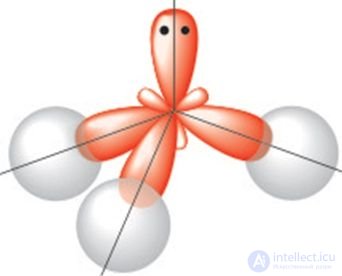
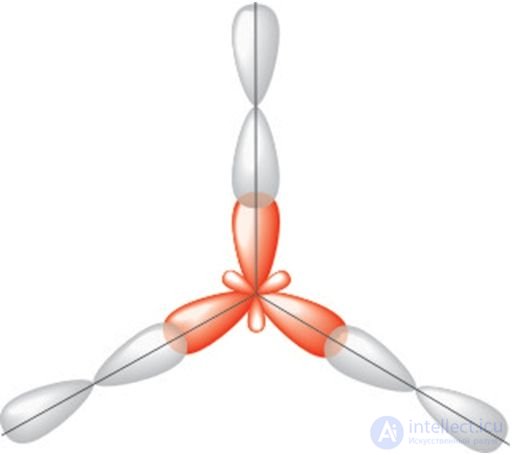
5. The scheme corresponding to the overlap of electron orbitals in the water molecule is:

Comments