
Lecture
Food chemistry studies the chemical processes and interactions of all biological and non-biological components of food products. Biological substances include such items as meat, poultry, lettuce, beer, and milk, among others. It resembles biochemistry in its main components, such as carbohydrates, lipids, and proteins, but also covers areas such as water, vitamins, minerals, enzymes, food additives, flavorings, and colorants. This discipline also covers how foods change under specific food processing methods, and ways to either enhance or prevent these changes. An example of enhancing a process would be promoting the fermentation of dairy products with microorganisms that convert lactose into lactic acid; an example of preventing a process would be stopping browning on the surface of freshly cut apples using lemon juice or other acidified water.
Food chemistry is a branch of applied chemistry concerned with studying the properties of food products at the molecular level and finding ways to improve them.
Objects of study can include: milk, meat, eggs, plant parts, and the like.
The main tasks of food chemistry include: in food chemistry there are 3 concepts, theoretical
practical
The scientific approach to food and nutrition emerged with attention to agricultural chemistry in the works of J. G. Wallerius, Humphry Davy, and others. For example, Davy published Elements of Agricultural Chemistry, in a Course of Lectures for the Board of Agriculture (1813) in the United Kingdom, which became a foundation for the profession worldwide, going through a fifth edition. Earlier work included that of Carl Wilhelm Scheele, who isolated malic acid from apples in 1785.
Some of Liebig's discoveries in food chemistry were translated and published by Eben Horsford in Lowell, Massachusetts, in 1848.
In 1874 the Society of Public Analysts was founded to apply analytical methods for the public benefit. Its early experiments were based on bread, milk, and wine.
This was also linked to concerns about the quality of food supplies, mainly issues of adulteration and contamination of food products, which initially arose from deliberate contamination and later from chemical food additives by the 1950s. The development of colleges and universities around the world, especially in the United States, expanded food chemistry as well as research into dietary substances, in particular the single-grain experiment of 1907-11. Additional research by Harvey W. Wiley at the US Department of Agriculture in the late 19th century played a key role in establishing the US Food and Drug Administration in 1906. The American Chemical Society founded its Division of Agricultural and Food Chemistry in 1908, and the Institute of Food Technologists founded its Food Chemistry Division in 1995.
Concepts of food chemistry often originate in rheology, theories of transport phenomena, physical and chemical thermodynamics, chemical bonds and interaction forces, quantum mechanics and reaction kinetics, biopolymer science, colloidal interactions, nucleation, vitrification and freezing/disordered or non-crystalline solids, and thus use the physical chemistry of food as a basic field.
The food industry is a group of industrial branches that produce food products in finished or semi-finished form, as well as beverages, tobacco products, and, in some classifications, also soap and detergents (from fat-processing operations). The industry is oriented toward producing goods to meet the population's basic need for food. Food industry enterprises are engaged in collecting raw materials, processing them, and bringing them to a form in which delivery to the end consumer can best be organized.
Within the agro-industrial complex system, the food industry is closely linked with agriculture as a supplier of raw materials and with trade. Some branches of the food industry gravitate toward raw-material regions, others toward consumption regions.
The food industry is found wherever people live. This contributes to a wide distribution of the raw materials used, as does the constant consumption of food products. But this type of industry has its own patterns, and the placement of enterprises in this industry is based on accounting for their features. Taking into account the report of research staff from the country's leading research institutes and their tables, this production sector is strongly influenced by the development of agriculture: it determines the characteristics of the sectoral composition of the region's food industry, its capacity, and other important qualities.

Modern food processing plants are often highly automated and require few workers.
In the International Standard Industrial Classification, food production is assigned to the manufacturing industry section, within which separate subsections are designated for the manufacture of food products (code 10), manufacture of beverages (11), and manufacture of tobacco products (12). In total, 13 branches are identified within the food production subsection:
A branch that uses as raw material the meat of cattle, pigs, poultry, rabbits, and others. The initial processing step is the slaughter of animals, followed by boning of the meat, i.e., separating it from the bones.
Part of the output is intended for direct consumption, while the other is sent for the production of sausages, smoked products, canned goods, animal feed, medicines (insulin, heparin), down and feather products, glue, and gelatin.
If one takes into account the use of energy, pesticides, feed, land, and non-renewable resources, poultry meat production is the most efficient, while beef is the most economically disadvantageous.
A branch that includes the harvesting of fish and seafood, their farming (fish farming), and the production of food products and other components from them.
The output of fishing industry enterprises includes fresh, salted, and smoked fish, canned goods, caviar, and seafood (frozen and canned). Another area of activity for fishing companies is the production of raw materials for agricultural feed and components for pharmaceutical firms.
Specializes in producing a wide range of fruit and vegetable ingredients for all fields of application. These can include canned and frozen fruits and vegetables, semi-finished products for the baking industry, baby food products, juices, and so on.
The main types of processing for vegetables and their percentage share:
For fruits:
The fats and oils industry processes plant-based raw materials. The output includes oils (sunflower, rapeseed, linseed, and others) and margarine for food consumption, as well as components for producing industrial lubricants, plastic fillers, household chemical products, cosmetics, and personal hygiene products (creams, soaps, etc.)
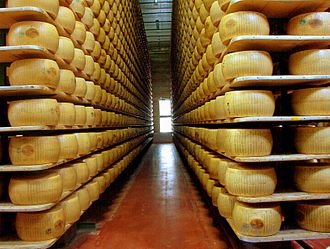
Parmigiano Reggiano cheese at a modern factory
In the dairy industry, milk is the raw material for production. Enterprises produce a wide range of products: non-fermented (butter, ice cream, etc.) and fermented products (cheeses, kefir, yogurt, etc.), canned and powdered milk, casein, and so on.
Almost every country in the world has its own dairy production. Most plants in foreign countries that process large volumes specialize in a limited range of products. In Eastern Europe and Russia, however, large-scale operations producing many types of dairy products are common.
The flour-milling industry is one of the basic branches of the food industry, engaged in producing flour (see flour mill) from cereal crops (rye, wheat, barley, etc.) and legumes. The production technology has three stages:
Flour goes to sale or is sent as raw material to bakeries and confectionery factories.
Flour-milling enterprises depend on grain crop yields, since 80% of the cost of the final product is the price of raw materials.
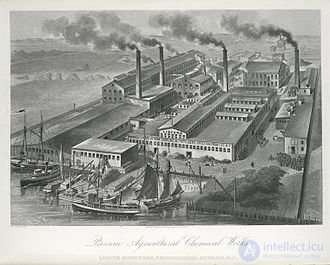
Passaic Agricultural Chemical Works, Newark (New Jersey, USA), 1876.
The main product of this branch is starch, produced from plant raw materials (potatoes, wheat, corn, and cassava). Additional types of output are molasses and fruit syrups.
Compared with other types of starch, potato starch has reduced caloric content and an increased mineral content. Starch is sold at retail and is used in the production of sausages (18.2%) and fruit jellies (12.3%).
Other uses include paper manufacturing (3.7%), dextrin, and pharmaceutical applications (an ingredient in tablets and powders).
Bread production is engaged in manufacturing bakery products, one of the oldest activities.
The diet should contain nutrients: proteins, fats, carbohydrates. Proteins are needed to build the proteins of the human body (muscles); they are found in meat, fish, milk, eggs, and some vegetables (potatoes, beans, and so on). Fats are a source of energy; they can be of plant origin (cocoa butter, olive oil) and animal origin (butter from milk, pork fat). Carbohydrates perform structural, plastic, energy, and other functions; their sources are cereals, vegetables, and fruits, where they occur in the form of starch or various sugars.
Food should also contain vitamins and trace elements; to maintain their levels in the body, the diet should be varied. The most important are vitamins A, B, C, D, and E, as well as the trace elements calcium, magnesium, phosphorus, iron, sodium, and potassium.
Water is of great importance for human life activity and is widely used in culinary techniques: products are boiled, stewed, marinated, and fermented
The main component of food is water, which can make up from 50% in meat products to 95% in lettuce, cabbage, and tomato products. It is also an excellent place for bacterial growth and food spoilage if not handled properly. One way of measuring this in food is water activity, which is very important for the shelf life of many products during processing. One of the keys to preserving food in most cases is reducing the amount of water or altering the characteristics of the water to extend shelf life. Such methods include dehydration, freezing, and refrigeration. This field covers "the physicochemical principles of the reactions and transformations that occur during the production, processing, and storage of food products".

Sucrose: ordinary table sugar and probably the best-known carbohydrate.
Making up 75% of the biological world and 80% of all food consumed by humans, sucrose is the most common known human carbohydrate. The simplest version of a carbohydrate is a monosaccharide, which contains carbon, hydrogen, and oxygen in a ratio of 1:2:1, with the general formula CnH2nOn, where n is at least 3. Glucose and fructose are examples of monosaccharides. When combined as shown in the image on the right, sucrose is formed, one of the most common sugar products found in plants.
A chain of monosaccharides forms to make a polysaccharide. Such polysaccharides include pectin, dextran, agar, and xanthan. Some of these carbohydrate polysaccharides are available for digestion by human enzymes and are mostly absorbed in the small intestine, while dietary fiber passes into the large intestine, where some of these polysaccharides are fermented by the gastrointestinal microbiota.
Sugar content is usually measured in degrees Brix.
The term "lipid" covers a wide range of molecules and is, to some extent, a general term for compounds of biological origin that are relatively insoluble in water or non-polar, including waxes, fatty acids (including essential fatty acids), phospholipids derived from fatty acids, sphingolipids, glycolipids, and terpenoids such as retinoids and steroids. Some lipids are linear aliphatic molecules, while others have a ring structure. Some are aromatic, while others are not. Some are flexible, others rigid.
Most lipids have some polar character in addition to being largely non-polar. As a rule, the bulk of their structure is non-polar or hydrophobic ("fears water"), meaning it interacts poorly with polar solvents such as water. Another part of their structure is polar or hydrophilic ("loves water") and tends to associate with polar solvents such as water. This makes them amphiphilic molecules (having both hydrophobic and hydrophilic parts). In the case of cholesterol, the polar group is a simple -OH group (hydroxyl or alcohol).
Lipids in food include the oils of cereals such as corn and soy, from animal fats, and are part of many products, such as milk, cheese, and meat. They also act as carriers of vitamins.
Proteins make up more than 50% of the dry weight of an average living cell and are very complex macromolecules. They also play a fundamental role in the structure and functioning of cells. Consisting mainly of carbon, nitrogen, hydrogen, oxygen, and some sulfur, they may also contain iron, copper, phosphorus, or zinc.
In food, proteins are necessary for growth and survival, and requirements vary depending on a person's age and physiology (for example, pregnancy). Protein is usually obtained from animal sources: eggs, milk, and meat. Nuts, cereals, and legumes are plant sources of protein, and combining proteins from plant sources is used to achieve a complete protein food quota from vegetables.
Sensitivity to proteins, like food allergy, is determined using an ELISA test.
Enzymes are biochemical catalysts used in processes that convert one substance into another. They are also involved in reducing the time and energy required to complete a chemical process. Many aspects of the food industry use catalysts, including baking, brewing, dairy products, and fruit juices, for producing cheese, beer, and bread.

Riboflavin (vitamin B2), water-soluble
Vitamins are nutrients required in small amounts for essential metabolic reactions in the body. They are classified in nutrition as water-soluble (vitamin C) or fat-soluble (vitamin E). Sufficient amounts of vitamins can prevent diseases such as beriberi, anemia, and scurvy, while vitamin overdose can cause nausea and vomiting or even death.
Dietary minerals in food are numerous and diverse; many are essential for functioning, while other trace elements can be dangerous if consumed in excessive amounts. The major minerals with a recommended daily allowance (RDA, formerly recommended daily intake (RDI)) of more than 200 mg/day are calcium, magnesium, and potassium, and the important trace elements (RDA less than 200 mg/day) are copper, iron, and zinc. They are found in many foods but can also be taken as dietary supplements.
Food coloring is added to change the color of any food substance. It is mainly used for sensory analysis purposes. It can be used to mimic the natural color of a product as perceived by the buyer, for example, a red dye (such as FD&C Red No.40 Allura Red AC) for ketchup, or to add unnatural colors to a product, such as Kellogg's Froot Loops. Caramel is a natural food coloring; its industrial form, caramel coloring, is the most widely used food coloring and is found in products ranging from soft drinks to soy sauce, bread, and pickles.
Flavor in food is important for how food smells and tastes to the consumer, especially in sensory analysis. Some of these are found in nature, like salt and sugar, but flavor chemists (called "flavorists") develop many of these flavorings for food products. Such artificial flavorings include methyl salicylate, which creates the smell of wintergreen, and lactic acid, which gives milk a tart taste.
How we perceive the taste of food determines our eating behavior. For example, the attitude toward sweet and bitter tastes is innate and shaped by evolution. For our ancestors, survival was more important than a tasty meal, so we distinguish bitter taste more finely. However, taste preferences developed over thousands of years of evolution have pushed modern humans to the edge of a precipice. The variety of tasty food, far greater than we actually need for survival, leads to harmful eating habits, overeating, and food abuse. Is it possible that studying the mechanisms responsible for taste perception could help humanity overcome its unhealthy preoccupation with food? Flavor chemistry helps determine what is missing from our dish.
Food additives are substances added to food to preserve or improve taste, appearance, smell, and freshness. These processes are as old as adding vinegar for pickling or as an emulsifier for emulsion mixtures such as mayonnaise. They are typically listed under an "E number" in the European Union or as GRAS ("generally recognized as safe") by the US Food and Drug Administration.
The chemistry of food additives governs their introduction into food products to improve production technology as well as structure and organoleptic properties. Such additives include:
Food odors are very diverse and can be caused by a large number of classes of substances. The main ones are:
Culinary processing techniques for food can be divided into several groups.
By preparation stage:
By method of action:
In turn, within each group corresponding subgroups can be identified, in which related processing techniques aimed at achieving a similar result should be grouped together; for example, pounding and scoring, which fall under mechanical processing methods, serve to soften the product during the preliminary processing stage. The same processing technique can fall into either group: for example, singeing (a type of thermal treatment) is part of the preliminary processing stage, and conversely, flambéing, performed at the final stage of preparation, also falls under the group of thermal processing of products. The chemical processing method deserves separate discussion. It includes those processing methods that are wholly or predominantly based on chemical and biological processes, such as salting or fermenting. This remark is necessary because chemical reactions also occur during thermal preparation methods. In addition, some culinary processing methods are complex, for example whipping over fire (mechanical and thermal). Some types of culinary processing of products can be either main or preliminary, depending on what is obtained at the end of the operation. For example, marinating can be a preliminary operation (marinating shashlik) or a main operation (marinating mushrooms), resulting in a ready-to-eat product.
A division into main and auxiliary operations can also be made.
Preliminary processing of food products is a very important stage that is often underestimated. This stage is considered especially important in Japanese and Chinese cuisine. A common method for almost all products is washing them. Almost all products can also be chopped or ground. If we consider individual types of products, preliminary processing includes, in particular:
Main processing is the stage of product processing after which the product becomes an independent dish, ready for consumption. The completion of the main processing of a product should be considered the completion of preparation of the intended dish. For example, if the result of preparation is meant to be mashed potatoes, then obtaining unmashed boiled potatoes, despite being edible, cannot be considered the completion of the main processing. Since all main processing methods can be defined by the method of action, see below.
Final processing of a product can have various purposes. These include:
Processing of products during food preparation, by method of action on the product, is divided into two main types:
Creating artificial food is one of the tasks of food chemistry. These are products obtained from proteins, amino acids, lipids, and carbohydrates that have been previously isolated from natural raw materials or obtained by directed synthesis from mineral raw materials. Food additives are added to them — vitamins, mineral acids, trace elements — which give the product not only nutritional value but also color, smell, and the necessary structure. Secondary raw materials from the meat and dairy industries, seeds, green plant mass, aquatic organisms, and the biomass of microorganisms, such as yeast, are used as natural raw materials. From these, chemical methods are used to isolate high-molecular-weight substances (proteins, polysaccharides) and low-molecular-weight substances (lipids, sugars, amino acids, and others). Low-molecular-weight food substances are also obtained by microbiological synthesis from sucrose, acetic acid, methanol, and hydrocarbons, by enzymatic synthesis from precursors, and by organic synthesis (including asymmetric synthesis for optically active compounds). A distinction is made between synthetic food, obtained from synthesized substances, for example diets for therapeutic nutrition; combined products made from natural products with artificial food additives, for example sausages and frankfurters, minced meat, pâtés; and food analogs that imitate certain natural products, for example black caviar.

Comments