
Lecture
In an aqueous solution, particles of the dissolved substance interact with water molecules. Such interaction often leads to a hydrolysis reaction (from Ancient Greek hydro — water + lysis — decomposition).
Hydrolysis is a chemical reaction of a substance with water, in which the molecules of that substance and of water decompose, forming new compounds.
The hydrolysis of compounds of various classes — salts, carbohydrates, haloalkanes, proteins, esters (including fats), etc. — differs substantially. You became acquainted with the hydrolysis of haloalkanes, proteins (polypeptides), di- and polysaccharides (using sucrose, starch and cellulose as examples), and esters in your organic chemistry course. In this section we will examine the hydrolysis of inorganic substances — salts.
Hydrolysis of salts is an exchange interaction between water molecules and the cations or anions of a salt, leading to the formation of weak electrolytes.
Anions of weak acids, interacting with hydrogen cations, can form weakly dissociating acid molecules. Cations of weak bases, interacting with hydroxide ions, can form weakly dissociating bases.
The medium in aqueous solutions of hydrolyzing salts can be acidic (pH < 7.0) or alkaline (pH > 7.0) because an excess of H+ or ОН– ions appears in the salt solution as a result of hydrolysis.
The difference between the medium of a salt solution and a neutral one is one of the signs of salt hydrolysis. How large this difference is, and whether the salt solution is acidic or alkaline, depends on the strength of the base and acid from which the salt is formed by the neutralization reaction.
Classification of salts by their susceptibility to hydrolysis
Any salt can be represented as the product of a neutralization reaction (from Latin neuter — neither one nor the other) between an acid and a base. Acids and bases can be either strong or weak electrolytes.
The neutralization reaction is an exchange reaction between an acid and a base forming a salt and water:
KOH + HF = KF + H2O.
Acids and bases as electrolytes differ in their strength. For example, ammonium salts can be regarded as formed in a reaction involving a weak base — ammonia hydrate NH3 · H2O. The salt KF is formed by the strong base KОН and the weak acid HF, while ammonium sulfide is formed by a weak base and a weak acid.
Depending on the strength of the base and the acid, four types of salts can be distinguished (Fig. 60.1).
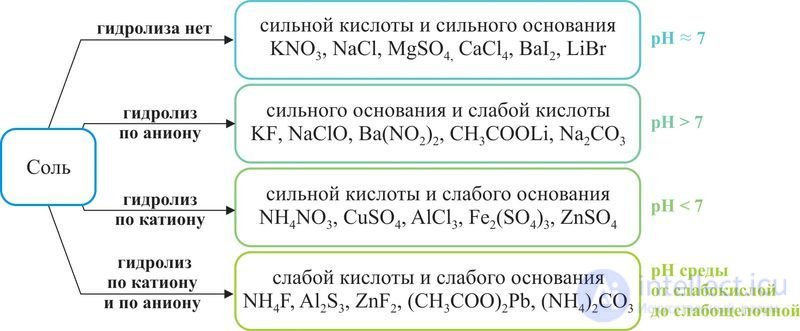
Fig. 60.1. Classification of salts by their susceptibility to hydrolysis
Let us examine the hydrolysis of salts of all four types.
Salts formed by a strong base and a weak acid. An example is sodium acetate CH3COONa. This salt is formed by the strong base NaОН and the weak acid CH3COOH:
NaОН + CH3COOH = CH3COONa + H2O.
In an aqueous solution of sodium acetate, two processes occur:
a) complete dissociation of the strong electrolyte — the salt CH3COONa — into a cation and an anion:
CH3COONa → Na+ + CH3COO–;
b) interaction of acetate ions with water molecules forming the weak electrolyte — acetic acid:
CH3COO– + H2О  CH3COOH + ОН–.
An excess of ОН– anions accumulates in the solution and creates a weakly alkaline medium, which indicates that hydrolysis proceeds at the anion CH3COO–.
The equation for the hydrolysis of sodium acetate shows that:
The hydrolysis equilibrium in this example is strongly shifted to the left — toward the formation of the starting substances — because water is a considerably weaker electrolyte than acetic acid СH3COOH.
Hydrolysis is the reverse of neutralization.
Examples of anions of weak acids whose salts are hydrolyzed by water:
 , F–;
, F–; ,
,  ,
,  ,
,  .
.Let us examine the hydrolysis of sodium carbonate Na2СO3 — a salt of the strong base NaOH and the weak dibasic acid H2CO3. Hydrolysis proceeds at the anion  according to the equation in full ionic form:
2Na+ + + H2O 2Na+ +  + OH–.
The equation in reduced ionic form is:
+ H2O + OH–.
In a solution of Na2СO3 an excess of hydroxide anions forms, creating an alkaline medium. A solution of Na2CO3 with a concentration of 0.1 mol/dm3 has a pH of about 11.5.
Salts formed by a strong acid and a weak base. Let us examine the hydrolysis of ammonium chloride NH4Cl. This is a salt of the strong acid — HCl — and the weak base — ammonia hydrate NH3 · H2O.
In an aqueous solution of the salt, two processes occur:
a) complete dissociation of the strong electrolyte — the salt NH4Cl:
NH4Cl →  + Cl–;
b) interaction of ammonium ions with water molecules forming the weak electrolyte — ammonia hydrate NH3 · H2O:
+ H2O NH3 · H2O + H+.
This equation shows that:
participate in the exchange reaction with water forming the weak base, which is why it is said that hydrolysis proceeds at the cation.Multiply charged cations can also enter into reaction with water: the doubly charged Ni2+, Cu2+, Zn2+, Mn2+, Fe2+, Co2+, Pb2+ (except for the cations Mg2+, Ca2+, Sr2+, Ba2+), and the triply charged Fe3+, Al3+, Сr3+.
Let us examine the hydrolysis of copper(II) nitrate Сu(NO3)2. This is a salt of the strong acid — HNO3 — and the weak base — Cu(OH)2.
In this case it is customary to say that hydrolysis proceeds at the cation Cu2+. The hydrolysis equation in full ionic form:
Cu2+ +  + H2O Cu(OH)+ + + H+.
The hydrolysis equation in reduced ionic form:
Cu2+ + H2O Cu(OH)+ + H+.
The products of hydrolysis are the basic salt Cu(OH)NO3 and nitric acid HNO3.
The medium of an aqueous solution of copper(II) nitrate is acidic (pH ≈ 4.5), since the solution contains an excess of Н+ cations.
Salts formed by a weak base and a weak acid. Such salts undergo hydrolysis at both the cation and the anion. In this case, the Н+ ions that appear from hydrolysis at the cation are bound by the ОН– ions that form from hydrolysis at the anion, which intensifies the hydrolysis. This reaction is often irreversible. For example, aluminum sulfide Al2S3 undergoes irreversible hydrolysis in water, forming insoluble aluminum hydroxide and gaseous hydrogen sulfide:
Al2S3 + 6H2O = 2Al(OH)3↓ + 3H2S↑.
Therefore aluminum sulfide Al2S3 cannot be obtained by an exchange reaction between aqueous solutions of two salts, for example, aluminum nitrate Al(NO3)3 and potassium sulfide K2S.
Other cases of irreversible hydrolysis are also possible. They are not hard to predict, since for a process to be irreversible it is necessary that at least one of the hydrolysis products leave the reaction sphere. Let us give an example of the combined irreversible hydrolysis of Al3+ cations and anions:
2Al(NO3)3 + 3Na2CO3 + 3H2O = 2Al(OH)3↓ + 6NaNO3 + 3CO2↑.
For salts that undergo irreversible hydrolysis, you will find a note in the table "Solubility of Acids, Bases and Salts in Water": "does not exist in aqueous solution."
Let us summarize what you have learned about hydrolysis at both the cation and the anion:
Let us summarize information about the hydrolysis of various cations and anions in the composition of normal salts, by cation and anion, in Table 19.1.
Table 19.1. Hydrolysis of cations and anions
| Salt composition | Ions for which hydrolysis does not occur | Ions for which hydrolysis occurs, in order of increasing strength | Ions for which strong hydrolysis occurs |
| Cations | K+, Na+, Li+, Ba2+, Sr2+, Ca2+, Mg2+, Ag+ | Mn2+, Co2+, Zn2+, Ni2+, Fe2+, Pb2+, Cu2+, Be2+ | Al3+, Cr3+, Sn2+, Fe3+ |
| Anions | Cl–, Br–, I–,  , ,  , ,  , ,  |
F–,  , HCOO–, CH3COO–, , HCOO–, CH3COO–,  , ClO– , ClO– |
,  , ,  , S2– , S2– |
Not hydrolyzed: soluble halides (except fluorides), nitrates, perchlorates, sulfates and permanganates of alkali and alkaline-earth metals.
Note that reversible hydrolysis reactions obey Le Chatelier's principle, so the hydrolysis of a salt can be either intensified or weakened.
Hydrolysis of salts is caused by ion-exchange reactions involving water molecules and the ions of the salt, forming a weak electrolyte.
Hydrolysis at the anion, as a rule, is reversible and proceeds to a small extent. On dilution of salt solutions, the hydrolysis equilibrium shifts to the right; the reaction of the medium in solutions of salts of weak acids is weakly alkaline, occasionally strongly alkaline.
Hydrolysis at the cation, as a rule, is reversible and proceeds to a small extent. On dilution of salt solutions, the hydrolysis equilibrium shifts to the right; the reaction of the medium in solutions of salts of weak bases is weakly acidic, occasionally strongly acidic.
Hydrolysis at both the cation and the anion simultaneously proceeds to a considerably greater extent than the hydrolysis of these ions separately. The position of the hydrolysis equilibrium at the cation and anion does not depend on the salt concentration, and the reaction of the medium of the solution does not deviate greatly from neutral.
Salts of weak acids and bases undergo irreversible hydrolysis at the cation and anion when one of the reaction products is removed from the solution as a gas.
1. Which types of salts are susceptible to hydrolysis?
2. Which of the salts with the formulas: K3PO4, Al2(SO4)3, MgSO4, NH4NO3, Pb(NO3)2, Na2CO3, undergo hydrolysis at the cation? Write the hydrolysis equations for these salts and indicate the reaction of the medium.
3. Which of the salts with the formulas: Na2S, AlCl3, K2SO3, Cr2(SO4)3, (CH3COO)2Ba, AgF, Mg(NO3)2, Na2SiO3, KMnO4, Na3PO4, undergo hydrolysis at the anion? Write the hydrolysis equations for these salts, indicate the reaction of the medium and the color of litmus in the solution.
4. The neutralization reaction of strong acids or bases proceeds with the release of heat. Using Le Chatelier's principle, explain why on heating the hydrolysis equilibrium shifts to the right.
5. The degree of dissociation of water increases by a factor of 7.5 on heating from 25 °С to 100 °С and decreases by a factor of 3 on cooling water from 25 °С to 0 °С. Explain these facts, given that the dissociation of water is an endothermic reaction. In which direction does the hydrolysis equilibrium shift on raising and lowering the temperature, and how does it depend on the degree of dissociation of water?
6. Which of the given salts undergo hydrolysis at both the cation and the anion: NH4F, (CH3COO)3Al, (CH3COO)2Cu, (NH4)2CO3, KNO2, AgNO3, Na3PO4, CrCl3? Write the hydrolysis equations for these salts (all reactions are reversible) in full ionic form.
7. Adding which of the listed substances to a solution of iron(III) sulfate will intensify the hydrolysis of the salt: НСl, NH3, HNO3, Н2O, K2CO3? Give an explanation.
8. Sodium stearate C17H35COONа (bar soap) is hydrolyzed in water at the anion. Write the hydrolysis equation in full and reduced ionic form and indicate what medium the solution has. How do temperature and dilution of the soap solution affect the hydrolysis equilibrium? Why does soda Na2CO3 prevent the hydrolysis of soap?
9. Purification of drinking water from suspended insoluble impurities is carried out by the method of coagulation — the clumping of small particles to form larger flakes, which settle out as a precipitate. Coagulation includes three stages: mixing the reagents with the water being purified, formation of flakes, and settling of the flakes together with the contaminant. To carry out coagulation, the water is made alkaline with soda and a soluble aluminum salt is added. In the water, the aluminum salt is converted into Al(OH)3 via a scheme of simultaneous hydrolysis at the cation Al3+ and the anion . The resulting Al(OH)3 is a white flocculent precipitate with a large surface area. The flakes capture suspended particles, bacteria, and heavy-metal ions, then grow larger and settle together with the contaminants at the bottom of the settling tank. Write the equation for the reaction between aluminum sulfate and sodium carbonate in molecular, full ionic, and reduced ionic forms.
10. When solutions of FeCl3 and Na2CO3 are mixed, a brown precipitate forms and gas evolution is observed. Which substance precipitates and which gas is evolved? Write the equation for the reaction taking place and calculate the volume (at STP) of gas evolved if an excess of FeCl3 solution is added to 100 cm3 of Na2CO3 solution with a mass fraction of dissolved substance of 7.85 % and a density of 1.080 g/cm3.
1. An alkaline medium is exhibited by solutions of the salts:
2. рН >7 is exhibited by aqueous solutions of:
3. Litmus will turn red in a solution of:
4. The equilibrium of the hydrolysis reaction in a solution of copper sulfate (blue vitriol)
Cu2+ + H2O Cu(OH)+ + H+
can be shifted to the left ("suppressing hydrolysis") by:
5. No salt is formed when the following solutions are mixed:

Comments