
Lecture
Three numbered test tubes contain aqueous solutions of water-soluble volatile hydrogen compounds of nitrogen and chlorine, as well as distilled water. Using an indicator, determine the contents of each test tube, explaining your answer with the corresponding dissociation equations of the substances.
Aim of the experiment:
To determine the composition of three unknown solutions (aqueous solutions of hydrogen compounds of nonmetals and distilled water) using an acid-base indicator. To explain the observed phenomena from the standpoint of electrolytic dissociation.
Description of the experiment:
Three numbered test tubes contain:
An aqueous solution of a volatile hydrogen compound of nitrogen (for example, ammonia — NH3);
An aqueous solution of a volatile hydrogen compound of chlorine (for example, hydrogen chloride — HCl );
Distilled water.
To determine the contents of each test tube, a drop of an acid-base indicator (for example, universal indicator or litmus) is added to each.
Observations:
In one test tube the indicator turns red — the solution has an acidic medium.
In the second test tube the color becomes blue — an alkaline medium.
In the third test tube no change in color occurs — a neutral medium.
Conclusions:
The test tube with the red color contains HCl — hydrogen chloride (a strong acid).
The test tube with the blue color contains NH3 — ammonia (a weak base).
The test tube with no color change contains distilled water.
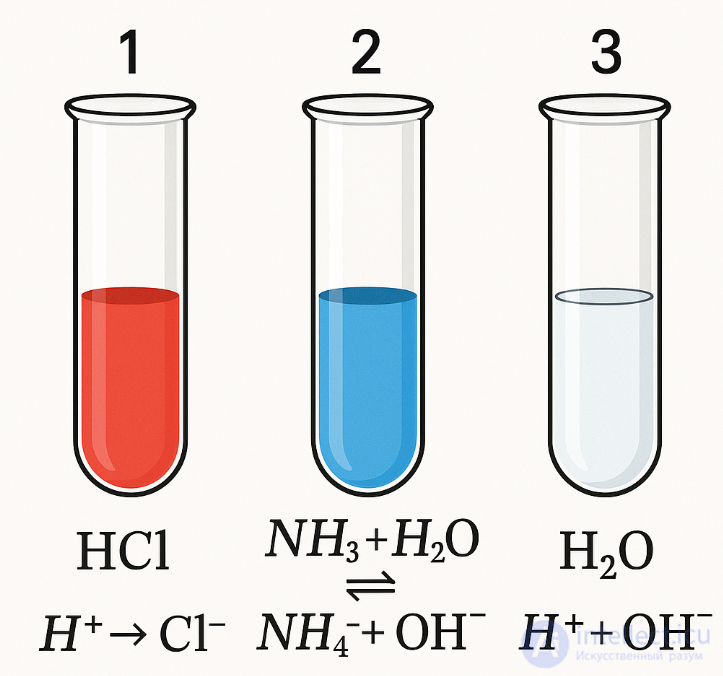
Dissociation equations:
Hydrogen chloride in water:
HCl→H+ +Cl−
Ammonia in water (reaction with water):
NH3+H2O⇌NH4++OH−
Distilled water (weak self-ionization):
H2O⇌H++OH−
Conclusion:
The indicator makes it possible to establish the acid-base character of the solution. The change in color can be used to determine which substance is present in each test tube.

Comments