
Lecture
The dependence of the rate of a chemical reaction on the concentration of the reacting substances is expressed by the law of mass action:
at constant temperature, the rate of a homogeneous chemical reaction is directly proportional to the product of the concentrations of the reacting substances.
For a chemical reaction A + B = C, proceeding between two substances in a liquid or gas in a single step, this law can be expressed in mathematical form:
ʋ = k ∙ c(A) ∙ c(B).
In this expression ʋ is the reaction rate, which is measured in mol/(dm3 · s); c(A) and c(B) are the concentrations of substances A and B, respectively; k is the proportionality coefficient, called the reaction rate constant. The value of this constant depends on the nature of the reacting substances, the temperature, and the presence of a catalyst, but does not depend on the concentration of the reacting substances.
The equation of the law of mass action includes the concentrations of substances that are present only in a homogeneous (uniform) medium (in a mixture of gases, in a solution).
The physical meaning of the law of mass action follows from obvious reasoning.
For a chemical reaction to occur between molecules A and B, they must collide. Consequently, the reaction rate is proportional to the probability of collisions between molecules. In turn, the probability of collision depends on the concentration of the molecules, and it is higher when the concentration of molecules is greater. Therefore, the reaction rate depends on the concentration of the substances. This is confirmed experimentally.
In generalized form, the mathematical expression of the law of mass action takes the following form:
ʋ = k · ca(A) · cb(B). (1)
In this expression, the exponents a and b are called the order of the chemical reaction with respect to substance A and substance B, respectively. The sum a + b represents the overall order of the reaction.
The order of any reaction is established from experimental data on the dependence of the reaction rate on the concentration of the reacting substances. This is because in most chemical reactions, the collision of two particles or the decomposition of one particle is not sufficient to obtain the product. The probability of a simultaneous collision of three molecules (ions or atoms) is vanishingly small. The collision of a larger number of particles is even more improbable. Therefore, reactions have a complex mechanism and proceed in several stages. Each stage is a simple, elementary reaction, carried out by the collision of two particles or the decomposition of one particle.
Thus, the reaction of methane with chlorine
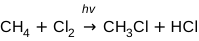
includes a series of elementary stages. First, under the action of light, the chlorine molecule breaks down into two chlorine atoms, each of which has an unpaired electron, that is, two radicals are formed:

Next, the radical Cl∙ reacts with a methane molecule to form a molecule of hydrogen chloride and a methyl radical CH3∙:
Cl∙ + CH4 → CH3∙ + HCl,
which reacts with the next chlorine molecule, forming chloromethane and a new chlorine radical:
CH3∙ + Cl2 → CH3Cl + Cl∙.
Such a chain of transformations can repeat many times until it is broken by the interaction of two radicals with each other.
Each of the reaction stages proceeds at its own rate, and the overall rate is determined by the rate of the slowest reaction. This reaction is called the rate-limiting (limiting) reaction. Only for single-stage (elementary) reactions does the reaction order coincide with the coefficients in the reaction equation. For example, for the single-stage reaction
 ,
,
or 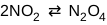 ,
,
its rate can be expressed by the equation:
ʋ = c(NO2) · c(NO2).
The order of this reaction is 2.
If the reacting substances are in different phases, the reaction proceeds only at the phase interface. Therefore, the concentration of a solid substance or a liquid that is insoluble in the reaction medium (for example, fat that is insoluble in an aqueous alkali solution when making soap) is not included in the equation of the law of mass action. For example, for the reaction
A(g) + B(s) → AB
the concentration of the solid substance B is not included in the equation of the law of mass action, and the contact area of the reagents is already included in the value of k:
ʋ = k · с(A).
Let us consider, using an example, how the law of mass action can be used to predict the change in the rate of a chemical reaction when the concentration of the reacting substances changes.
Example 1
Into a chemical reactor with a volume of 100 dm3, 4 mol of gaseous substance A and 5 mol of gaseous substance B were introduced, between which a chemical reaction occurred: A + B = C. Determine the ratio of the rates of this reaction at the initial moment and at the moment when half of substance A has reacted, given that the equation of the law of mass action for this reaction has the form:
ʋ = k ∙ c(A) ∙ c(B).
Solution
From the conditions of the problem and the equation of the law of mass action, it follows that the reaction taking place is homogeneous.
Let us determine the concentration of the reacting substances at the initial moment of the reaction:
 ;
;
 .
.
According to the given equation, the rate of this reaction at the initial moment is equal to:
ʋ0 = k · c0(A) · c0(B) = k · 0.04 · 0.05 = k · 0.002 (mol/(dm3 · s)).
By the moment when half of substance A (2 mol) has reacted, its concentration becomes equal to:
 .
.
According to the reaction equation, substances A and B react in a molar ratio of 1 : 1. This means that if, over time t, 0.02 mol of substance A has reacted, then the same amount of substance B has also reacted. This allows us to determine the concentration of substance B at time t:
 .
.
Since the rate constant of the chemical reaction does not depend on the concentration of the reacting substances, at time t the expression for the reaction rate takes the form:
ʋt = k · ct(A) · ct(B) = k · 0.02 · 0.03 = k · 0.0006 (mol/dm3 · s)
Let us compare the rates at the initial moment and at time t:
 .
.
Thus, by the moment when half of substance A has reacted, the reaction rate has decreased by a factor of 3.3.
At constant temperature, the rate of a homogeneous chemical reaction is directly proportional to the product of the concentrations of the reacting substances.
The rate constant of a chemical reaction does not depend on the concentration of the reagents, but depends on their nature and the temperature at which the reaction proceeds.
1. Name the factors that affect the rate of chemical reactions. Why does the rate of chemical reactions change over the course of the reaction?
2. On what factors does the rate constant of a chemical reaction depend? Does the value of the rate constant change over the course of the reaction?
3. Why does the rate of a chemical reaction change as it proceeds?
4. Explain why most chemical reactions proceed in stages. What is the meaning of the concept "elementary chemical reaction"?
5. Write the expression of the law of mass action for the reactions:
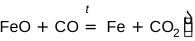 ;
; ;
;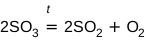 .
.6. By how many times will the rate of the homogeneous reaction change:
when the molar concentration of reagent A is increased 6 times?
7. The rate of the elementary chemical reaction
А(g) + 2B(g) = C(g)
at a concentration of substance A of 0.2 mol/dm3 and a concentration of substance B of 0.3 mol/dm3 is 3.6 ∙ 10–5 mol/(dm3 ∙ s). Determine the rate constant of this reaction. In what units is it expressed?
8. In a chemical reactor with a volume of 100 dm3, a chemical reaction occurs between gaseous substances A and B
A + B = AB,
for which the equation of the law of mass action has the form:
ʋ = k ∙ c(A) ∙ c(B).
In which case does the reaction proceed faster:
How do the reaction rates in cases a) and b) compare?
9. How should the rate of the chemical reaction proceeding according to the equation
NaHCO3 + HCl = NaCl + H2O + CO2↑,
change (increase or decrease) if the solutions of the starting substances are diluted? Justify your answer.
10. Into a chemical reactor with a volume of 50 dm3, 20 mol of gaseous substance A and 40 mol of gaseous substance B were introduced, between which the elementary chemical reaction occurred
A + 2B = C.
Determine the ratio of the rates of this reaction at the initial moment and at the moment when half of substance A has reacted.
1. According to the law of mass action, the rate of a homogeneous chemical reaction is directly proportional to:
2. The rate constant of a reaction depends on:
3. When the mass of iron powder is halved, the rate constant of the reaction 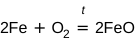 :
:
4. The formula ʋ = k · с(A) can describe the dependence of the rate on the concentration of the reacting substance for the reaction:
 NO2(g) + NO2(g).
5. A threefold increase in the concentration of substance NO2 in the reaction NO2 + NO2 N2O4 will lead to an increase in the rate by:

Comments