
Lecture
The paragraph presents previously studied concepts and definitions: what chemistry, substance, and its physical properties are, chemical element, atom, its mass, size, ions, molecules, as well as reminders of how to calculate the mass fraction of a substance in a mixture and the volume fraction of a gas in a mixture. This material is given for review in a systematized form.
Chemistry is a science that studies substances, their composition, structure, properties, and the chemical transformations of some substances into others.
Chemistry as a science is divided into a number of branches: inorganic, organic, bioorganic, analytical, physical, pharmaceutical chemistry, nanochemistry, and others. The differences between the branches are determined by the nature of the substances studied and their transformations, as well as the nature of the problems being solved.
To emphasize the specific nature of their research, chemists introduced the term “chemical substance,” although this phrase is often simplified and simply called “substance.”
A chemical substance is a stable system of particles (atoms, ions, or molecules) possessing certain physical and chemical properties.
The qualitative and quantitative composition of individual chemical substances is written in the form of chemical formulas, for example: H2O — water, CuSO4 — copper sulfate, N2 — nitrogen, Na — sodium, NaCl — sodium chloride.
A chemical formula is a conventional representation of the composition of substances using symbols of chemical elements and numerical indices.
Physical properties of a substance include color, density, hardness, melting and boiling points, and other characteristics that, as a rule, are expressed by measurable quantities. Thus, iodine can be characterized as follows: a crystalline substance at room temperature of a dark violet color with a metallic luster, sparingly soluble in water, its boiling point is 184.4 °C, its melting point is 113.5 °C, and its density is 4.9 g/cm3.
The chemical properties of substances are their ability to transform into other substances under the influence of temperature, pressure, radiation, or other substances.
Thus, calcium carbonate under the influence of temperature (and not other substances) transforms into calcium oxide and carbon dioxide:
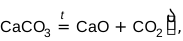
while copper(II) oxide, reacting with sulfuric acid, forms a salt — copper(II) sulfate:

An atom is an electrically neutral particle consisting of a positively charged nucleus and negatively charged electrons.
A collection of atoms with the same nuclear charge is called a chemical element.
The symbols of chemical elements are given in D. I. Mendeleev's periodic table of chemical elements. As you know, the atomic (ordinal) number of a chemical element in D. I. Mendeleev's periodic table corresponds to the relative nuclear charge (Z). Thus, the atomic number 8 corresponds to a relative nuclear charge of the oxygen atom of +8, while a nucleus with a relative charge of +13 belongs to the aluminum atom.
Atoms of different chemical elements differ not only in nuclear charge, but also in mass, size, and structure.
The mass of an atom (ma), like the mass of other objects, can be expressed in SI mass units — kilograms, for example:
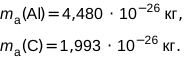
It is much more convenient to use a scale of relative units. To characterize the mass of atoms and other microparticles, chemistry uses the atomic mass unit — 1 a.m.u., equal to  of the mass of an atom of carbon-12. Instead of the Russian designation of the atomic mass unit (1 a. e. m.) its international designation is often given — 1 u (unit). The mass of 1 u is:

By comparing the masses of atoms with 1 u, a dimensionless quantity is obtained, which is called the relative atomic mass and is denoted by the symbol Ar (where r is the first letter of the Latin word relativus — relative):
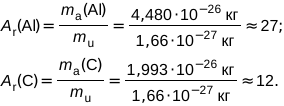
The relative atomic mass of an element is a physical quantity equal to the ratio of the averaged mass of atoms of the given element to of the mass of a carbon-12 atom (12C).
Relative atomic masses are used in chemistry for calculations and comparisons; their values are given in the periodic table of chemical elements. To calculate the mass of atoms or their relative atomic masses, the following formulas can be used:

The size of an atom is often characterized by the quantity “atomic radius” (ra). These are quantities on the order of tenths and hundredths of a nanometer. Thus, the radius of the smallest atom, helium, is 3 ∙ 10–11 m, or 0.03 nm.
The structure of atoms determines the composition and properties of the substances they form, which will be discussed in detail in Chapters II and III.
When a chemical substance is formed as a stable system of particles, atoms can give up or gain electrons, turning into ions. When electrons are given up, positively charged particles are formed — cations; when electrons are gained, negatively charged particles are formed — anions. A number of chemical substances consist of cations and anions, united by Coulomb interaction forces.
Atoms can also combine into stable systems by sharing electrons with neighboring atoms, forming uncharged particles — molecules, capable of exhibiting the chemical properties of the substance as a whole. More detailed material on substances of molecular structure is described in the next paragraph, and information on the structure of substances is presented in Chapter III.
It is important to understand that only a stable system of atoms, or ions, or molecules is a chemical substance, that is, it possesses both physical and chemical properties. For a single particle, such as a molecule of iodine, a sulfide ion, or a carbon atom, it makes no sense to speak of a boiling point, melting point, or state of aggregation.
Each substance is characterized by its own set of properties. Even a small amount of impurity can significantly change these properties. In nature, substances are usually found mixed with other substances. Therefore, for practical use or for conducting research, a substance must be obtained in pure form, that is, separated from the mixture and purified from impurities. For this purpose, both in laboratory practice and in industrial settings, various methods are used for separating mixtures of substances and purifying them. They are based on differences in the properties of the substances being separated: different melting or boiling points, density, solubility, and others. The most common purification methods are filtration (fig. 1), sedimentation (fig. 2), recrystallization, and distillation (fig. 3). A substance can be isolated from a solution by evaporation (fig. 4), and a mixture of liquid substances can be separated by rectification (fig. 5).

“Molecular sieves” can be used to separate gases, for example crystalline aluminosilicates characterized by a precise and uniform pore size. The pores allow small molecules through but retain larger ones. To restore the activity of “molecular sieves,” they must be heated or purged with gas.
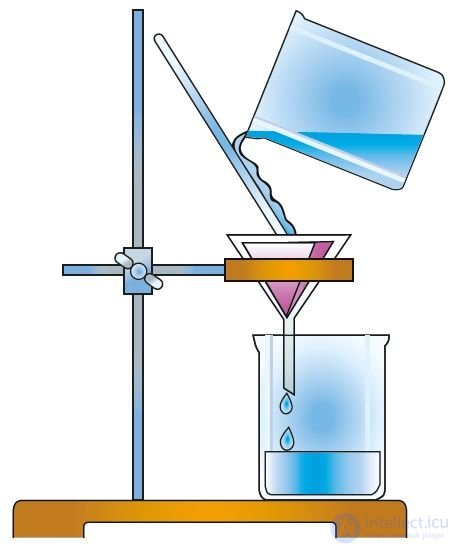
Fig. 1. Filtration
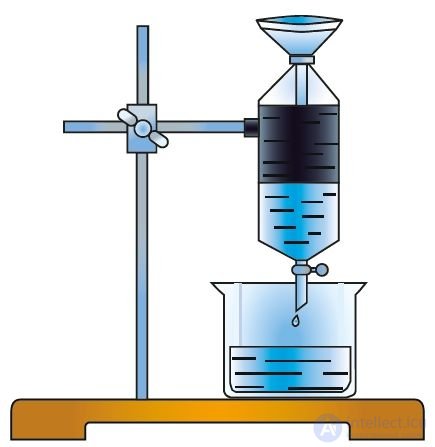
Fig. 2. Sedimentation
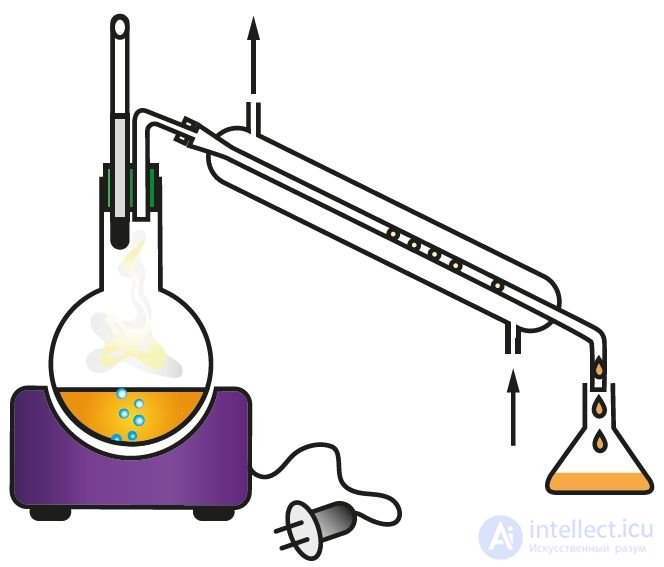
Fig. 3. Liquid distillation
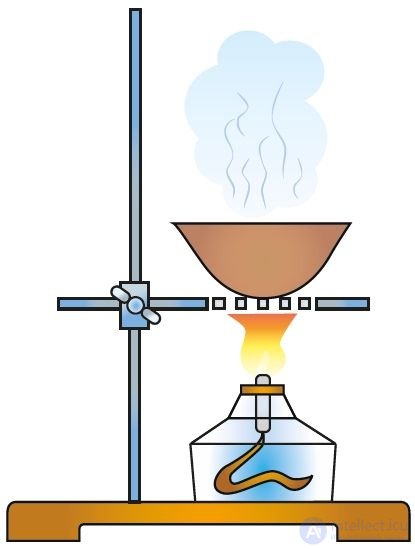
Fig. 4. Evaporation
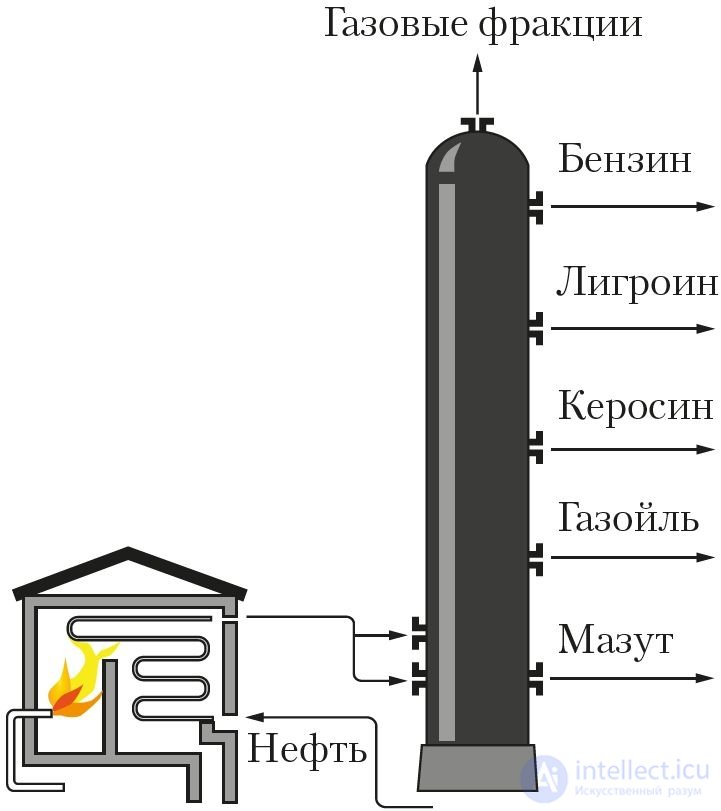
Fig. 5. Separation of oil into fractions in a rectification column
The content of a substance in a mixture can be characterized by mass and volume fractions.
The mass fraction of a substance is calculated as the ratio of the mass of the substance to the mass of the entire mixture:
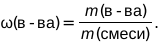
The mass fraction of a substance is a dimensionless quantity. It is more often expressed as a percentage. For this, the resulting dimensionless quantity is multiplied by 100.
Thus, mass fraction is used to characterize the content of the main components in food products, impurities in chemical reagents, rocks, fertilizers, the active substance in medicinal preparations, and so on. For example, the mass fraction of fat in milk ranges from 1 to 6%, in butter — 50–82.5%, of acetic acid in vinegar — 3–9%, of iodine in an alcohol solution — 5%. It should be noted that the mass fraction does not depend on the size of the portion of the mixture; it is determined only by the ratio of the components of the mixture.
Volume fraction of a gas in a mixture. Mixtures are formed not only by solid or liquid substances, but also by gases, so for gases the volume fraction is often calculated as the ratio of the volume of the gas to the total volume of the mixture:
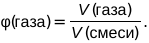
Thus, the content of oxygen by volume in air is 21%, that is, its volume fraction φ(O2) = 21% (while its mass fraction is 23%).
Absolutely pure substances do not exist. The degree of purity of substances is quantitatively assessed by the mass fraction — the ratio of the mass of the main substance (ideally pure) to the mass of the real substance with impurities.
Example 1. Analysis of a gold bank ingot sample weighing 1.00000 g showed that it contains 0.99994 g of pure gold. This means that the degree of purity of this gold is:

The remaining 0.006% in this ingot is accounted for by various impurities (other substances).
The choice of substances by purity is determined by the purposes of their use. For example, the required purity of germanium used in semiconductor devices should be 99.99999999%.
An atom is an electrically neutral particle consisting of a positively charged nucleus and negatively charged electrons.
A chemical element is a collection of atoms with the same positive nuclear charge. Atoms of different chemical elements differ in nuclear charge, mass, size, and structure.
The relative atomic mass of an element is a physical quantity equal to the ratio of the averaged mass of atoms of the given element to  of the mass of an atom of carbon-12 (12C).
A chemical substance is a stable system of particles (atoms, ions, or molecules) possessing certain physical and chemical properties.
Questions, tasks, problems
1. Write down the names and symbols of the chemical elements having:
2. Pick out the expressions characterizing the mass of an oxygen atom:
3. Suggest methods for:
4. Explain which characteristics apply to a chemical substance and which to a chemical element:
5. The mass of an atom of a certain element is equal to:
Determine its relative atomic mass.
6. In what volume of air is 10 g of oxygen contained?
7. What is the mass fraction of aluminum in an iron-aluminum thermite mixture prepared from 5 kg of aluminum and 15 kg of iron(III) oxide? A thermite mixture of this composition is used for welding rails.
8. The Mozyr oil refinery is designed to process 12 million tons of oil per year. Calculate the mass of diesel fuel that can be produced at the plant in 1 month, assuming that the mass fraction of this type of fuel is about 32% of the processed oil.
9. A giant oil refinery can process up to 25 million tons of oil per year. During oil distillation, losses amount to about 1%. Estimate the annual losses during oil distillation at such a plant by mass and volume (take the average density of oil as 0.9 g/cm3).
10. Calculate the number of atoms in a rectangular aluminum plate 5 cm long, 3 cm wide, and 1 mm thick. The density of aluminum is 2.7 g/cm3. Suggest two methods of solution.
*Self-check
1. The number of known chemical elements is:
2. Each chemical substance is characterized by:
3. The physical properties of iron are characterized by the statements:
4. The following does not belong to substance separation processes:
5. In a mixture of gases containing 1 dm3 CO, 4 dm3 H2, 1 dm3 CH4, 3 dm3 CO2, the volume fraction of hydrogen is:
d) 44%.

Comments