
Lecture
The substances studied are classified taking into account their composition, structure, properties, and other criteria. The main classes of simple substances are metals and non-metals, and of complex substances — oxides, acids, bases, and salts. Their composition, properties, and methods of preparation you have studied earlier. In this section we will recall the principles of nomenclature and classification of substances (fig. 6).
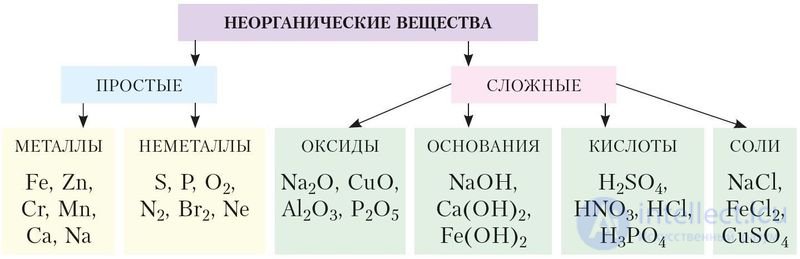
Fig. 6. Classes of inorganic substances

Inorganic substances are conventionally divided into classes (fig. 6.1). Each of the classes groups together substances that are similar in composition, structure, and properties. According to one of the generally accepted classifications, simple substances (metals and non-metals) and complex substances are distinguished. The most important classes of complex inorganic substances are oxides, acids, bases, and salts. As you know, bases and oxygen-containing acids share a common name — hydroxides.
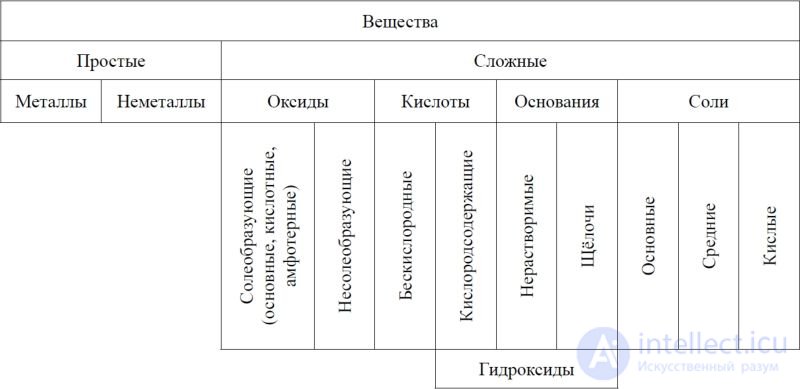
Fig. 6.1. The most important classes of inorganic compounds
Metals are simple substances that are solid at room temperature (with the exception of liquid mercury), possessing ductility and thermal conductivity, and high electrical conductivity. Polished surfaces of metals are always shiny.
Non-metals are simple substances that are solid, liquid, or gaseous at room temperature. In the solid state they are, as a rule, non-ductile or even brittle, and poorly conduct heat and electric current.
Oxides are complex substances consisting of two elements, one of which is oxygen (ExOy).
Metal oxides under normal conditions are solid substances. Non-metal oxides under the same conditions can be in the solid, liquid, and gaseous states.
Oxygen in oxides exhibits an oxidation state of –2:  (carbon(IV) oxide),
  (calcium oxide).

Let us recall: if the atoms of an element can exist in different positive oxidation states, this state is indicated in the names or formulas of oxides, bases, and salts by Roman numerals. They are placed in parentheses after the name of the corresponding element, for example: iron(III) oxide, iron(II) hydroxide, iron(II) chloride.
A distinction is made between salt-forming oxides (acidic, amphoteric, basic) and non-salt-forming oxides (fig. 7).
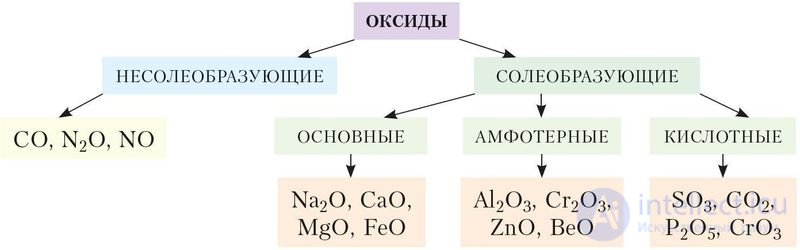
Fig. 7. Classification of oxides
Acidic oxides are those to which acids correspond. Acidic oxides react with alkalis to form a salt and water:

Acidic oxides correspond to oxygen-containing acids: the oxide  corresponds to the acid
  (the oxidation states of carbon are the same in the oxide and in the acid).
Basic oxides are those to which bases correspond. Basic oxides react with acids to form a salt and water:

Bases correspond to basic oxides. For example, the oxide  corresponds to the base
  .
.
Amphoteric oxides react with both acids and alkalis:

 (upon fusion).
Reactions of amphoteric oxides with alkalis can proceed not only upon fusion, but also in solution:

The compound  belongs to the class of complex compounds. Additional information about such compounds is given at the end of this section, as well as in the material on the properties of amphoteric oxides and hydroxides in Chapter II and of metals in Chapter VII.
Non-salt-forming oxides include 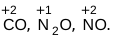 At room temperature they do not react with either acids or alkalis.
Acids are complex substances containing hydrogen atoms and acid residues, in which the hydrogen atoms are capable of being replaced by metal atoms.
Acids are also defined as electrolytes that, upon dissociation in aqueous solutions, form only hydrogen cations H+ as cations:

Tables 1 and 2 give the composition and classification of acids according to various criteria.
Table 1. Names of some acids and their salts
| Oxygen-free acids | Oxygen-containing acids (hydroxides) | ||||
| Chemical formula | Name of the acid | Name of the salt | Chemical formula | Name of the acid | Name of the salt |
| HI | Hydroiodic | Iodide | HNO3 | Nitric | Nitrate |
| HBr | Hydrobromic | Bromide | HNO2 | Nitrous | Nitrite |
| HCl | Hydrochloric | Chloride | H2SO4 | Sulfuric | Sulfate |
| HF | Hydrofluoric | Fluoride | H2SO3 | Sulfurous | Sulfite |
| H2S | Hydrosulfuric | Sulfide | H3PO4 | Phosphoric | Phosphate |
| H2CO3 | Carbonic | Carbonate | |||
| H2SiO3 | Silicic | Silicate | |||
| HClO4 | Perchloric | Perchlorate |
Table 2. Classification of acids
| Classification criterion | Classification groups | Examples |
| By origin | Inorganic (mineral) | HCl, H2SO4, HNO3 |
| Organic (carboxylic) | HCOOH, CH3COOH, C17H35COOH | |
| By the presence of oxygen atoms | Oxygen-containing | H3PO4, H2SO4, H2CO3 |
| Oxygen-free | HCl, H2S, HF | |
| By the number of hydrogen atoms capable of being replaced by metal atoms | Monobasic | HNO3, HF, HCl, CH3COOH |
| Polybasic (dibasic, tribasic) | H2SO4, H2SO3, H2CO3, H3PO4 | |
| By strength (ability to dissociate into ions in aqueous solution) | Strong | H2SO4, HNO3, HCl, HClO4 |
| Weak | H2S, H2SiO3, CH3COOH |
Bases are complex substances consisting of metal atoms and hydroxo groups OH: sodium hydroxide NaOH, iron(II) hydroxide Fe(OH)2.
Bases are electrolytes that, upon dissociation, form only hydroxide ions OH– as anions:

All bases react with acids, forming a salt and water (a neutralization reaction):

The classification of bases rests on the following criteria.
1. Number of OH groups. By the number of OH groups per metal atom, a distinction is made between monoacidic (NaOH, KOH, LiOH) and polyacidic (Mg(OH)2, Ca(OH)2, Fe(OH)2) bases.
2. Solubility in water. Metal hydroxides are solid substances. An aqueous solution of ammonia — ammonia hydrate (NH3 · H2O) — also possesses basic properties and dissociates to form hydroxide ions. To emphasize this property, the formula of ammonia hydrate is often written in the form customary for bases — NH4OH. By solubility in water, inorganic bases are divided into soluble (alkalis) and insoluble.
Alkalis are bases that are soluble in water. Alkalis include the soluble hydroxides of all elements of group IA and of the alkaline-earth metals: strontium, barium, radium, including the poorly soluble calcium hydroxide.
Amphoteric hydroxides Zn(OH)2, Be(OH)2, Al(OH)3, like the corresponding oxides, react with both acids and alkalis. Interaction with alkalis is possible in melts and in solutions:

 (fusion);
 (solution).
Salts are complex substances consisting of metal atoms and acid residues.
From the standpoint of the theory of electrolytic dissociation, salts are complex substances whose dissociation produces metal cations and anions of acid residues:

Salts also include compounds containing an ammonium ion and an acid residue (ammonium chloride NH4Cl, ammonium sulfate (NH4)2SO4, and others).
The systematic names of salts are based on the names of the acid residue and the metal, with an indication in parentheses, by Roman numerals, of the oxidation state of the metal atoms if it can have different values. For example, MgSO4 is magnesium sulfate, FeCl2 is iron(II) chloride, Fe2(SO4)3 is iron(III) sulfate.
Depending on the completeness of substitution of hydrogen atoms in acids, a distinction is made between normal (neutral) and acid salts.
Acid salts can be formed by polybasic acids (H2SO4, H2CO3, H2S, H3PO4) upon partial substitution of the hydrogen atoms in their molecules. The presence of hydrogen atoms in the composition of an acid salt is reflected in its name, for example NaHCO3 — sodium hydrogen carbonate (baking soda), Ca(HCO3)2 — calcium hydrogen carbonate, NaH2PO4 — sodium dihydrogen phosphate, NaHSO4 — sodium hydrogen sulfate.
The following scheme shows the possibility of complete and incomplete substitution.


With incomplete substitution of hydroxo groups in a base by acid residues, basic salts are formed. As an example of basic salts, one can cite Al(OH)2NO3. This salt can be regarded as the product of substituting one OH group in the base Al(OH)3 with the acid residue  .
.
A separate group of salts is formed by so-called complex compounds. In the 11th-grade chemistry course you will encounter some of these compounds: Na2[Zn(OH)4] — sodium tetrahydroxozincate, K3[Al(OH)6] — potassium hexahydroxoaluminate. They contain complex ions, which are enclosed in square brackets in chemical formulas.
Salts that include water molecules in their composition are called crystalline hydrates, and the water is called water of crystallization: FeSO4 · 7H2O (iron vitriol, or iron(II) sulfate heptahydrate), Na2SO4 · 10H2O (Glauber's salt, or sodium sulfate decahydrate).
From your course in organic chemistry you know the salts of carboxylic acids (sodium acetate CH3COONa, potassium stearate C17H35COOK) and the salts of amines (methylammonium chloride CH3NH3Cl, phenylammonium hydrogen sulfate C6H5NH3HSO4).
The main classes of simple inorganic substances include metals and non-metals, and the main classes of complex substances include oxides, bases, acids, and salts.
Questions, assignments, problems
1. Fill in the table using the formulas of the substances: Fe(OH)2, CaO, H2SO4, SO3, CO2, NaOH, Na2SO4, HCl, H2SO3, K3PO4, Ba(OH)2, KCl.
| Oxides | Acids | Bases | Salts |
2. Write out the formulas of the monobasic acids: H3PO4, CH3COOH, HI, H2S, HNO2.
3. Compose the formulas of the oxides: a) corresponding to the acids:
| Acid |  |
 |
 |
 |
 |
 |
| Acidic oxide |
b) corresponding to the bases:
| Base | LiOH | NaOH | Ba(OH)2 | Ca(OH)2 | Fe(OH)2 | Sr(OH)2 |
| Basic oxide |
4. Name the substances whose formulas are:
5. Compose the formulas of the substances:
6. Select the substances that react:
Compose the equations of the corresponding reactions.
7. Calculate and compare the mass fraction of sodium in its chloride and in its sulfate.
8. Determine the element X and name the compound K3XO4, in which the mass fraction of oxygen is equal to 30.19%.
9. Name the substances in the scheme, and compose the equations of the reactions according to the scheme:

10. Calculate the mass fraction of chlorine in a mixture in which the mass fraction of potassium chloride is 67%, of sodium chloride — 27%, and of the oxides of silicon and iron — 6%.

Comments