
Lecture
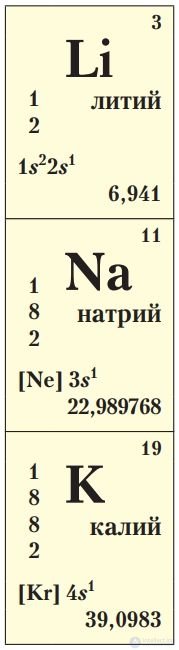 Metals that form alkalis — bases that are soluble in water — are called alkali metals. These include the elements of Group IA — lithium Li, sodium Na, potassium K, rubidium Rb, cesium Cs, and francium Fr.
As chemical elements, the alkali metals are united by the same structure of the valence electron shell of their atoms, whose electron configuration in the ground state is expressed by the formula ns1 (Table 32). Alkali metals have low electronegativity. The valence electron is weakly bound to the atom because of the small magnitude of the interacting charges and the large size of the atom. This determines the high chemical activity of alkali metals and its increase down the group, owing to the increasing atomic radius and the weakening interaction of the valence electrons with the nucleus. Upon losing their valence electrons, the atoms exhibit an oxidation state of +1 and, as a rule, form compounds with an ionic type of chemical bond.
Table 32 summarizes information on the structure and properties of alkali metal atoms, and also compares the physical properties of the simple substances. The data presented show that alkali metals have low density and low melting points. Alkali metals are crystalline substances with good electrical and thermal conductivity.
In the Earth's crust, the most abundant alkali metals are sodium and potassium (2.4% each). The remaining s-elements of Group IA are rare elements.
Table 32. Characteristics of the atoms and simple substances of the alkali metals
| Element | Li | Na | K | Rb | Cs |
| Electron configuration | [He]2s1 | [Ne]3s1 | [Ar]4s1 | [Kr]5s1 | [Xe]6s1 |
| Radius, nm | 0.159 | 0.171 | 0.216 | 0.229 | 0.252 |
| Electronegativity | 1.0 | 0.9 | 0.8 | 0.8 | 0.7 |
| Density, g/cm3 | 0.53 | 0.97 | 0.86 | 1.53 | 1.87 |
| Melting point, oC | 180.5 | 97.8 | 63.6 | 38.8 | 28.5 |
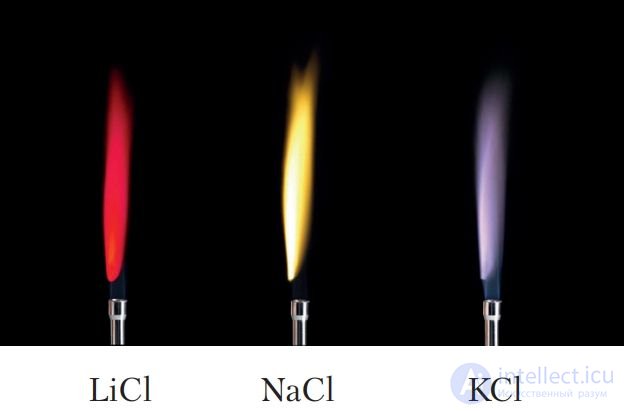
Fig. 109. Flame coloration in the presence of alkali metal compounds
Owing to their high chemical activity, alkali metals do not occur in the free state but in the form of compounds. Most of the sodium and potassium atoms are part of various silicates, including the aluminosilicate feldspar. On an industrial scale, halite, rock salt (NaCl), sylvite (KCl), and sylvinite (a mixture of KCl and NaCl) are mined. The Republic of Belarus has large reserves of these salts. Natural compounds also include the niters (saltpeters) — NaNO3, KNO3 — and mirabilite — Na2SO4 · 10H2O.
The presence of alkali metal ions in a substance can be detected by the characteristic coloration of a burner flame when a sample of the substance is introduced into it on an iron (platinum, nichrome) wire (Fig. 109, Appendix 3).
This effect forms the basis of spectroscopic methods for the qualitative and quantitative determination of alkali metals.
Alkali metals are obtained by electrolysis of molten salts, for example:
2NaCl(melt)  2Na + Cl2↑.
Chemical Properties of Alkali Metals
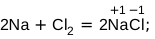
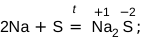
Alkali metals react with many simple nonmetal substances. Thus, alkali metals react with halogens without heating, and with sulfur, hydrogen, and nitrogen upon heating, with the exception of lithium, which reacts with nitrogen at room temperature:
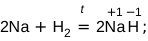
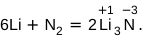

Note that hydrides are strong reducing agents. They reduce hydrogen from water: NaH + H2O = NaOH + H2↑.
In air, a number of compounds form on the surface of alkali metals. Lithium is the least active. Potassium can ignite spontaneously. Therefore, alkali metals are stored in tightly sealed jars under a layer of kerosene or in sealed ampoules.
When burned in air, alkali metals form compounds in which the oxygen content increases from Li to Cs:
lithium forms an oxide:
4Li + O2 = 2Li2O;
sodium forms the peroxide Na2О2:
2Na + O2 = Na2O2;
potassium, rubidium, and cesium form the superoxides KO2, RbO2, CsO2:
K + O2 = KO2.
Sodium oxide Na2O can be obtained only by an indirect route, by heating sodium peroxide with metallic sodium:
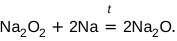
Alkali metals head the activity series and are able to reduce hydrogen from water, forming an alkali:
2Na + 2H2O = 2NaOH + H2↑.
This reaction is accompanied by a strong exothermic effect, and the hydrogen released can ignite. For the most active alkali metals, this process is accompanied by an explosion, which is why alkali metals are carefully protected from water. These metals react even more vigorously with acids.

Alkali metals also react with phenols and alcohols:
2Na + 2C6H5OH = 2C6H5ONa + H2↑;
2Na + 2C2H5OH = 2C2H5ONa + H2↑.
Compounds of alkali metals are, as a rule, crystalline, highly water-soluble substances that are colorless.
The oxides of the Group IA metals react with water, acidic and amphoteric oxides, and acids, which is characteristic of typical basic oxides.
Alkali metal oxides dissolve in water to form hydroxides:
Na2O + Н2O = 2NaOH;
they react with gaseous acidic oxides:
Na2O + CO2 = Na2CO3;
K2O + SO2 = K2SO3;
with solid acidic and amphoteric oxides upon heating, and sometimes even upon melting the mixture of components:
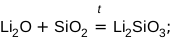
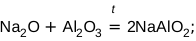
with acids, forming normal or acid salts depending on the basicity of the acid and the ratio of the components, for example:
Li2O + H3PO4 = Li2HPO4 + H2O;
Li2O + 2H3PO4 = 2LiH2PO4 + H2O.
Alkali metal oxides can also react with acid salts:
Na2O + NaH2PO4 = Na3PO4 + H2O.

Na2О2 reacts with water, forming hydrogen peroxide:
Nа2O2 + 2Н2O = 2NaOH + H2О2.
Hydrogen peroxide can decompose to form atomic oxygen: H2О2 = H2О + O↑. For this reason, Na2О2 is used for bleaching straw, silk, wool, and other materials. The bleaching effect is due to the action of atomic oxygen.
Sodium peroxide is used in gas masks and for underwater work. Its use in these cases is based on its reaction with carbon dioxide:
Na2O2 + CO2 → Na2CO3 + O2↑.
The carbon dioxide exhaled by the lungs is absorbed, with simultaneous release of gaseous oxygen. The latter can again be used for breathing.
Alkali metal hydroxides are crystalline substances that melt without decomposition. All hydroxides strongly absorb moisture from the air and can be used as desiccants. They are highly soluble in water and dissociate completely in it:
NaOH → Na+ + OH–.
You systematized the typical chemical properties of alkalis while studying the material of § 27, Table 18, considering them in light of the theory of electrolytic dissociation. Recall that alkalis react with acids, salts, acidic and amphoteric oxides, and amphoteric hydroxides. NaOH and KOH are produced industrially by electrolysis of aqueous solutions of chlorides:
2NaCl + 2Н2О 2NaОН + H2↑ + Cl2↑.
With few exceptions, the salts of alkali metals are highly soluble in water and are strong electrolytes.
Salts of alkali metals react with acids and with salts of other metals only when a product precipitates or a poorly dissociating or gaseous substance forms. Examples of such reactions were given earlier in Tables 17 and 19. You already know that salts of hydrohalic acids react in solution with halogens (§ 30).
Sodium and potassium ions play an important role in the vital activity of the human and animal organism. In an adult human body, the sodium content is about 150 g, and the potassium content is about 250 g. Sodium ions affect the electrolyte balance of the body's cells, participate in the transport of amino acids, sugars, and inorganic and organic anions across cell membranes, and take part in the formation of gastric juice. Potassium ions determine the excitability and conductivity of the cardiac muscle and take part in the processes of nerve impulse transmission. Lithium is able to regulate enzyme activity.
Potassium ions are necessary for plant life. They are found mainly in the cell sap, help the synthesis of proteins and sugars, the accumulation of carbohydrates, normalize the process of photosynthesis, and help increase the mechanical strength of tissues and resistance to certain diseases.
Compounds of alkali metals have found application in various branches of industry. For example, lithium silicate is needed for making durable ceramics. An alloy of lithium (7Li) with sodium serves as an effective heat-transfer medium in nuclear reactors. Lithium is used in the metallurgy of light alloys and in the production of storage batteries.

The 2019 Nobel Prize in Chemistry was awarded to John Goodenough, Stanley Whittingham, and Akira Yoshino for the development of lithium-ion batteries. Lithium-ion batteries are much lighter and more compact than earlier types of batteries. They are used in mobile phones, laptops, pacemakers, and electric vehicles.
From sodium chloride, sodium hydroxide, sodium peroxide, chlorine, soda ash Na2CO3 , and baking soda NaHCO3 (food additive E500) are obtained. It is also used in the manufacture of detergents and medicinal preparations.
Sodium sulfate is used in the glass and leather industries, and in the production of detergents and medicinal preparations.
Sodium silicate Na2SiO3 is obtained by fusing NaOH or soda with silica:


It is needed for making heat-resistant, acid- and water-resistant concrete, refractory paints, adhesives, fireproof coatings for wood (fire retardants), for strengthening weak soils, in the production of electrodes, and for purifying vegetable and machine oils.
Sodium and potassium hydroxides are used to prepare electrolytes for alkaline storage batteries, as well as in the production of soap, paints, and cellulose.
The potassium salts KCl, KNO3, K2CO3 are important mineral fertilizers.
Alkali metals are the s-elements of Group IA with a common electron configuration of the valence electron shell of the atom ns1, with the exception of hydrogen.
They form compounds with an ionic type of chemical bond, in which they exhibit an oxidation state of only +1.
They have the lowest electronegativity and therefore the highest chemical activity. They react vigorously with water, releasing hydrogen and forming alkalis.
The oxides and hydroxides have basic properties.
The salts are generally colorless and highly soluble in water.
The metals are extracted from natural compounds by electrolysis of a molten salt or hydroxide.
Write the equations for the reactions according to the scheme:

1. Solid substances are:
2. The formulas of the minerals halite and mirabilite, respectively, are:
3. An alkali metal can be obtained as a result of the transformation:
 ; ;
; ; ;.
;.4. In the reaction of sodium with oxygen, the predominant product formed is:
5. A piece of lithium is left in an open vessel in air. On its surface, the following may form:

Comments