
Lecture
Nitrogen forms a series of oxides with oxygen:  ,
,  ,
,  ,
,  ,
,  . Two of these oxides — N2O, NO — are non-salt-forming, while the rest are acidic.
Nitrogen(II) oxide NO under normal conditions is a colorless gas (tboil. = −151.7 °C, tmelt. = −163.7 °C).
In nature it forms as a result of the interaction of simple substances during lightning discharges (about 3000 °C):
N2 + O2  2NO – Q,
in industry — as an intermediate product in the conversion of ammonia into nitric acid:
4NH3 + 5O2  4NО + 6H2O.
In the laboratory it is obtained by the action of dilute nitric acid on copper:
3Cu + 8HNO3(dilute) = 3Cu(NO3)2 + 2NO↑ + 4H2O.
Nitrogen(II) oxide forms during the operation of internal combustion engines from nitrogen and oxygen under the action of high temperature and pressure.
Nitrogen(II) oxide does not react with either acids or alkalis. However, it readily enters into redox reactions. Thus, nitrogen(II) oxide is rapidly oxidized by oxygen to form nitrogen(IV) oxide:
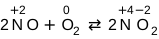 .
.
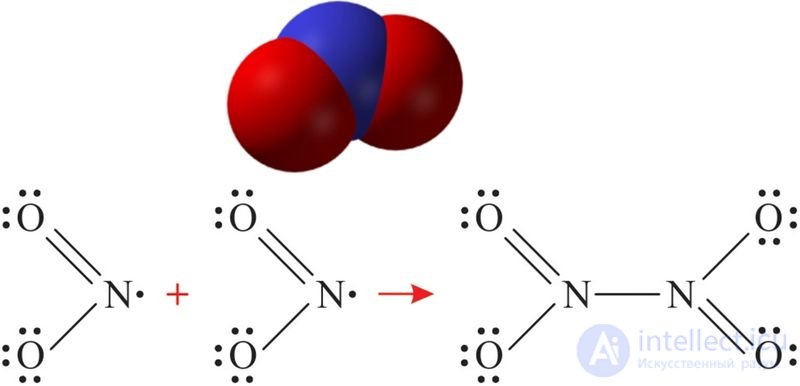
Fig. 94.1. Scale model of the nitrogen(IV) oxide molecule; the structure of NO2 molecules and their dimerization to form N2O4
Nitrogen(IV) oxide. Preparation and chemical properties
The NO2 molecule has an angular shape (Fig. 94.1). It is assumed that the nitrogen atom is in a state of sp2-hybridization, the N—O bond length is 0.119 nm, which corresponds to a bond order of one and a half.
Nitrogen(IV) oxide NO2, nitrogen dioxide, is a brown gas (tmelt. = −11.2 °C, tboil. = 21 °C); in the liquid and solid state it is colorless and consists of N2O4 molecules due to dimerization:
2NO2  N2O4 + Q.
Dimerization occurs readily because of the presence of an unpaired electron. In the gaseous state, nitrogen(IV) oxide is partially dimerized.
In the laboratory it is usually obtained by the reaction, already familiar to you, of concentrated nitric acid with copper:
Cu + 4HNO3(conc.) = Cu(NO3)2 + 2NO2↑ + 2H2O
or by the decomposition of certain nitrates (§ 38, p. 211).
Nitrogen(IV) oxide reacts with water. Depending on the conditions, different products are formed. Thus, at room temperature, nitric and nitrous acids are formed:
 .
.
When NO2 is dissolved in water at elevated temperature in excess oxygen, nitric acid is formed:
 .
.
In the industrial production of nitric acid, the equilibrium of this reversible reaction is shifted to the right by increasing the pressure.
When NO2 is dissolved in alkalis, nitrates are formed together with nitrites:

Insufficient purification of the gases released into the environment by enterprises producing nitric acid, power plant boilers, gas turbine units, and automobile and aircraft engines leads to atmospheric pollution by nitrogen oxides. Under the action of oxygen, NO is converted into NO2. In humid air, nitric acid is formed, and acid rain falls to the ground, which is harmful not only to humans and animals but also to plants. Under the action of acid rain, building structures are destroyed.
Gaseous nitrogen(I) oxide N2O, when inhaled, reduces pain sensitivity, which is why it is sometimes used in a mixture with oxygen for anesthesia.
The oxide N2O3 is stable only at low temperatures (tmelt. −102 °C, tboil. 4 °C, tdecomp. 4.5 °C) and is a blue liquid. When it interacts with water it forms nitrous acid:
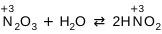 .
.
Nitrogen(V) oxide N2O5 is a white solid substance. Reacting with water, it forms nitric acid:
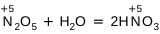 .
.
Nitrogen(II) oxide is a non-salt-forming oxide. When it interacts with oxygen, it is converted into nitrogen(IV) oxide.
Nitrogen(IV) oxide exhibits oxidizing properties; when dissolved in water in the presence of oxygen, it forms nitric acid.
1. Write out the formulas of the salt-forming oxides: N2O5, NO2, N2O3, NO, N2O.
2. Write the formulas of the oxides that correspond to the acids HNO2 and HNO3.
3. Which of the nitrogen oxides can be collected by the water displacement method?
4. Which of the nitrogen oxides can react with alkalis? Write the formulas of these oxides.
5. Write the equations of the reactions corresponding to the interaction of nitrogen(IV) oxide with water under various conditions.
6. Determine the sum of electrons in the molecule of: a) nitrogen(II) oxide; b) nitrogen(IV) oxide.
7. Indicate in which direction the equilibrium will shift in the reaction 2NO2(g) N2O4(g) + Q:
How does the color of the reaction mixture change in each case?
8. Balance the coefficients using the electron balance method:
NaOH + O2 + NO2 = NaNO3 + H2O.
9. Write the equations of the reactions according to the scheme:
 .
.
10. Determine the mass fraction (%) of the salt formed in the solution when nitrogen(IV) oxide with a volume of 1.12 dm3 (at STP), mixed with excess oxygen, is passed through a solution of calcium hydroxide with a mass of 300 g and an alkali mass fraction of 0.166%.
1. The non-salt-forming oxides are:
2. Both an oxidizer and a reducer in chemical reactions can be:
3. The products of the interaction of NO2 with water can be:
4. The oxide NO2 forms salts by reacting with:
5. The volume of gas (at STP) obtained in the reaction of copper with a mass of 3.2 g with concentrated nitric acid, at a product yield of 85%, is equal to:

Comments