
Lecture
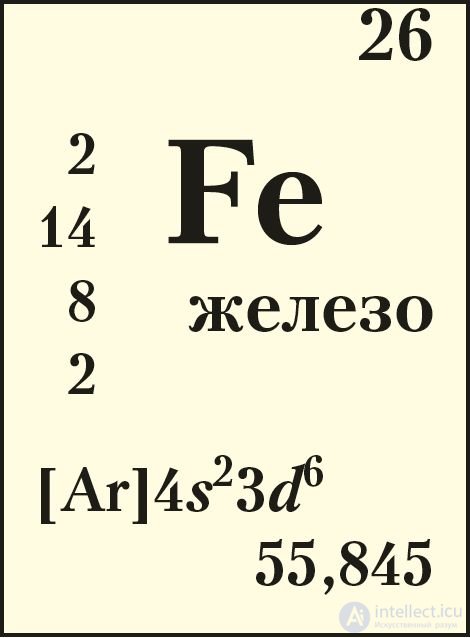
Iron is an element located in period 4, group VIIIB of the periodic table. The electron shell diagram, the electron configuration formula, and the electron-graphical diagram of its atom have the form:
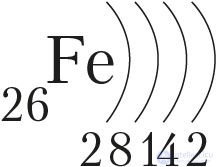 or 26Fe 2е–, 8е–, 14е–, 2е–;
26Fe 1s22s22p63s23p63d64s2 or 26Fe [Ar]3d64s2;
26Fe 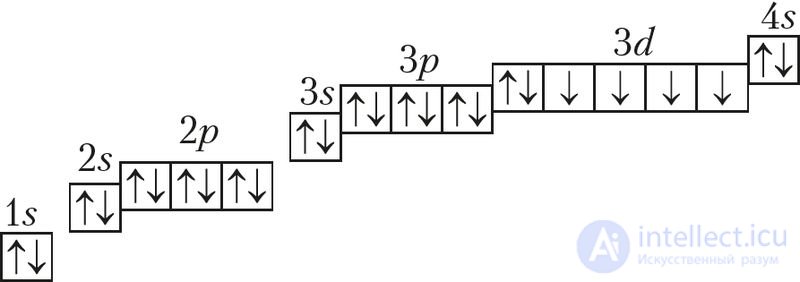
Iron belongs to the d-elements. The most stable oxidation states of iron atoms are +2 and +3.
Iron is the second most abundant metal in the Earth's crust after aluminum (mass fraction about 5%). In its unoxidized state, iron is occasionally found in meteorites as part of an alloy with cobalt and nickel. In nature, iron occurs in the form of compounds. The most common minerals containing iron are Fe2O3 (hematite), Fe3O4 (magnetite), FeO(OH) (goethite), FeS2 (pyrite), and FeCO3 (siderite).
Two iron ore deposits have been discovered in the Republic of Belarus — Novosyolki (Korelichi district, Grodno region) and Okolovo (Stolbtsy district, Minsk region). They are considered a possible raw material base for our country's metallurgical industry. The main ore mineral of these deposits is magnetite.
Physical properties. Iron is a light silvery-white metal with a density of 7.87 g/cm3 and a melting point of 1538 °C. The metal is ductile and relatively soft: its relative hardness on the Mohs scale is 4 (Appendix 2).
At red heat (above 600 °C) iron softens and is readily weldable, forgeable, and rollable. A distinctive feature of iron is its pronounced magnetic properties — ferromagnetism.
In addition to iron, cobalt, nickel, and some alloys of these metals, as well as the natural mineral magnetite, also possess magnetic properties. Ferromagnetic materials are used in electric generators, transformers, for audio and video recording, in telephones, computers, and elsewhere.
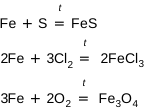
Chemical properties. In terms of chemical properties, metallic iron is a typical metal. Let us recall the known features of the interactions of iron with nonmetals, water vapor, acids, and salts (Table 35).
Table 35. Chemical properties of iron
| Reagents and reaction equations (schemes) | Reaction conditions and product |
| Nonmetals | When heated, iron reacts with nonmetals (nitrogen, boron, silicon, phosphorus, sulfur). Halogens oxidize iron to the +3 oxidation state (except I2). When iron burns in oxygen, an oxide is formed containing both iron(II) and iron(III) atoms |
 |
|
| Water | At high temperature (about 800 °C) iron reduces hydrogen from water vapor |
 |
|
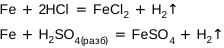
| Acids | Iron is able to reduce hydrogen from acids. At room temperature iron does not dissolve in concentrated HNО3 or H2SО4, since they passivate its surface |
 |
|
| Salts | Iron displaces less active metals from salt solutions |
 |
Iron products in engineering, everyday life, and nature undergo corrosion. Corrosion is the destruction of a metal as a result of its interaction with substances from the environment.
Causes of corrosion. The process of iron corrosion in a humid atmosphere can conventionally be represented by the equation:
 .
.
The Fe(OH)3 formed undergoes partial dehydration — loss of water — and therefore the composition of rust is expressed by the formula Fe2O3 · xH2O.
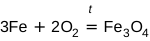
At high temperatures, oxidation by dry oxygen may occur, forming Fe3O4:
 .
.
In the environment, in the presence of other oxidizing agents, such as acids and acidic oxides, iron salts are formed.
In all these processes iron is oxidized and destroyed, while the components of the environment are reduced. The oxidation products of iron form loose layers that do not protect the metal from further corrosion (§ 20, Fig. 47, b).
As with other redox processes, the rate of corrosion depends on the chemical nature and contact area of the reactants, their concentration, and temperature. Corrosion is accelerated by salt and acid solutions (Fig. 113). Corrosion is slowed by polishing the metal surface and keeping the metal in dry air. Corrosion of iron is slowed in alkaline solutions or upon contact with a metal more active than iron (Fig. 114).
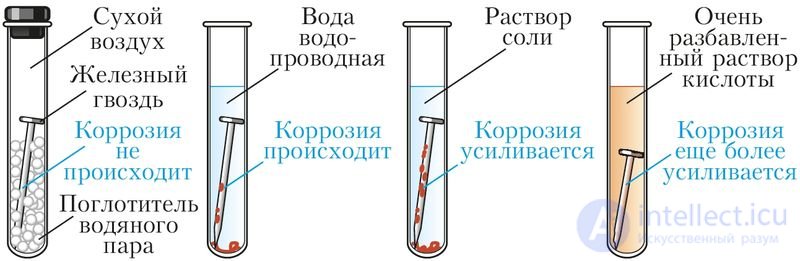
Fig. 113. Corrosion of iron in media of various composition
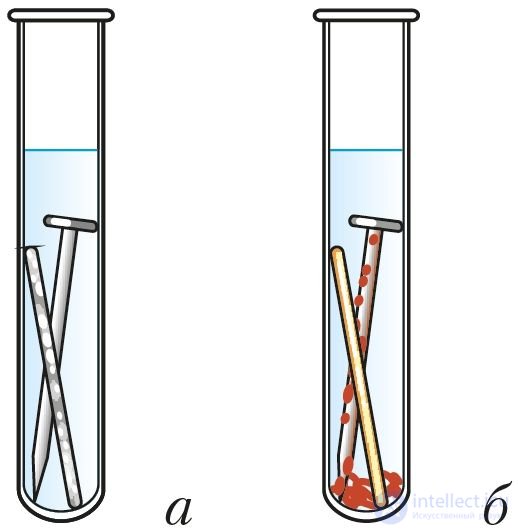
Fig. 114. Corrosion of iron in contact with: a — zinc, b — copper
You already know from the 9th-grade chemistry course that the rate of corrosion increases when iron is in contact with a less active metal (Fig. 114).
Knowledge of the factors affecting the rate of corrosion has made it possible to propose a number of methods of corrosion protection.
1. Protective coatings. Zinc, nickel, copper, chromium, silver, bronze, brass, and others are used as materials for metal coatings (Fig. 115). For example, galvanized iron is used as roofing material, in the manufacture of car bodies, and screws. In this case iron will not be destroyed until the entire zinc coating has reacted. Coatings of metals less active than iron protect it from corrosion only if they contain no pores, cracks, or scratches.
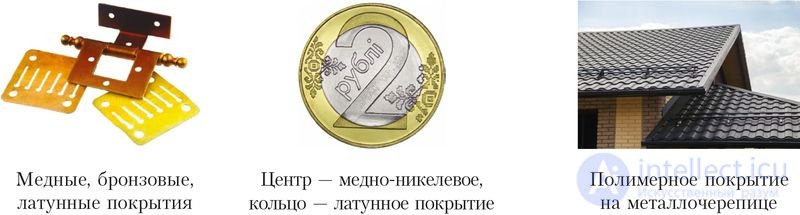
Fig. 115. Protective-decorative coatings on steel products
Nonmetallic coatings include paints, polymer materials, and lubricating oils.
Protective coatings are also obtained by oxidizing (creating a scale layer of Fe3O4) and by phosphating (applying a layer of phosphates) to the metal surface.
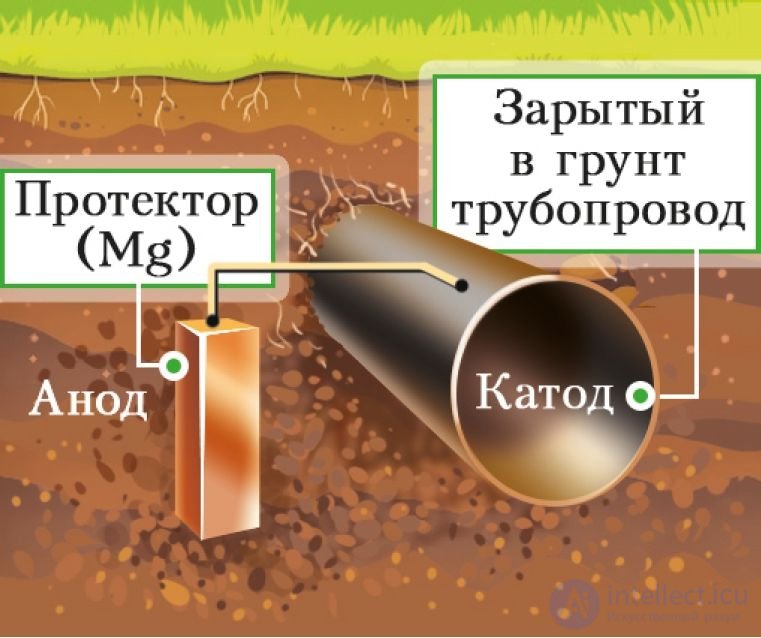
Fig. 116. Corrosion protection of an underground steel pipeline
2. Electrochemical protection is carried out by connecting the structure being protected to the negative pole of an external direct current source (cathodic protection) or by bringing the metal being protected into contact with a more active metal (Fig. 116).
3. Alloying of metals. Alloying additives — chromium, nickel, molybdenum, and others — that reduce the metal's activity are added to the molten metal during its production. This is how, for example, stainless steel is obtained.
4. Changing the composition and properties of the corrosive medium. The corrosive medium can be altered by adding inhibitors to it (substances that significantly reduce the rate of metal corrosion, for example, sodium nitrite, phosphate, or chromate, and a number of others).
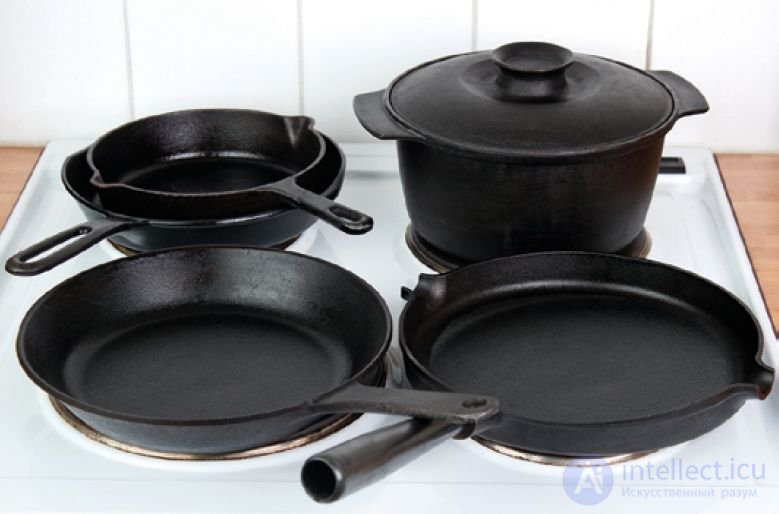
Fig. 117. Cast-iron products
Uses of iron and its alloys. Up to 95% of all mined iron is produced in the form of its alloys — cast iron and steels. You have already become familiar with the composition, properties, and areas of application of these alloys while studying the material in § 43, and with the methods of their production in § 45. Recall that the carbon content in steels is below 2%, that is, much lower than in cast iron, which is why steel is a more malleable, stronger, and less brittle alloy compared with cast iron. It is easily machined (cut, ground, rolled, forged).
Cast iron is a cheaper alloy with good casting properties, but is more brittle. Cast-iron products are more corrosion-resistant than those made of unalloyed steel (Fig. 117). The difference in properties has also determined the different areas of use of iron alloys.
Pure iron is used as a catalyst, for example in the synthesis of ammonia and the bromination of benzene.
Iron belongs to the d-elements. The most stable oxidation states of iron atoms are +2 and +3.
Iron reacts with nonmetals, water vapor, acids, and salts.
Products made of iron and its alloys undergo corrosion — destruction as a result of interaction with substances from the environment. It can be slowed by applying coatings, bringing the metal into contact with a more active metal, alloying the metal, or changing the composition and properties of the corrosive medium.
1. Write the electron configuration formula and the electron-graphical diagram of iron. Indicate the number of unpaired electrons in the ground state of the iron atom.
2. Iron cans are often coated with tin. This process is called tinning. When scratches appear on the tin, corrosion of the iron can proceeds faster than that of galvanized iron. How can this be explained using the position of the metals in the activity series?
3. Which rivets — copper or aluminum — are preferable for joining two iron parts?
4. Why can a solution of copper sulfate not be prepared in an iron bucket?
5. Three iron plates were completely immersed in dilute solutions of potassium hydroxide, potassium chloride, and acetic acid, and a fourth in distilled water. Describe what an experimenter would observe after a day.
6. Determine the mass of the normal salt formed by the reaction of 11.2 g of iron with a sufficient amount of dilute sulfuric acid.
7. Write the equations of the reactions of the iron oxides FeО, Fe2О3, and Fe3О4 with hydrogen, and with dilute sulfuric and hydrochloric acids.
8. Indicate the direction of the equilibrium shift in the system
 :
:
9. An iron plate with a mass of 10 g was kept in a copper sulfate solution containing 2.4 g of copper(II) sulfate. Determine the mass of the plate at the end of the reaction.
10. From each ton of iron ore, in which the mass fraction of Fe3O4 is 82%, 575 kg of cast iron with a mass fraction of iron of 95.5% was obtained. Determine the yield of iron.
1. In the ground state of the iron atom there is (are):
2. Corrosion of iron is enhanced:
3. At room temperature iron reacts with:
4. In the reaction of iron with water vapor, the main product is:
5. When reacting with chlorine and hydrochloric acid, iron forms, respectively:

Comments