
Lecture
Reagents: universal indicator, distilled water, solutions of НCl, H2SO4, Ca(OH)2, NaOH.
Determine the pH of the given solutions of acids, alkalis, and distilled water. To do this, use glass rods to place one drop of each test solution onto a strip of universal indicator. Compare the color with the special pH scale.
Draw a conclusion about the acid-base character of each solution.
Indicators are substances that change color depending on the acidity or alkalinity of the medium. They allow the character of a solution to be determined quickly and visually without complex instruments.
Principle of operation:
In an acidic medium, the indicator takes on one color.
In an alkaline medium — another.
In a neutral medium — it retains an intermediate shade.
Examples of indicators:
Litmus: red in acid, blue in alkali.
Phenolphthalein: colorless in acid, crimson in alkali.
Methyl orange: red in acid, yellow in alkali.
Practical significance: The use of indicators helps determine the pH of a solution in the laboratory, at home (for example, when checking water quality), and in industry.
A universal indicator is a mixture of several indicators that makes it possible to determine not only the acidic or alkaline character of a solution, but also its approximate pH value from the color change. It is convenient because it covers a wide pH range and gives a more accurate visual assessment than individual indicators.
Composition: a mixture of several indicators (for example, litmus, phenolphthalein, methyl orange, and others).
Range of action: approximately from pH 1 to pH 14.
Principle of operation: each component of the mixture responds to a specific portion of the pH scale, and together they produce a smooth transition of colors.
Form of supply: most often as a solution or as indicator paper.
Practical application
Laboratories: rapid monitoring of the acidity of solutions.
Education: illustrative experiments for schoolchildren and students.
Everyday life: checking the quality of water, beverages, and soil for plants.
Industry: control of technological processes where the pH level is important.
Limitations
A universal indicator gives an approximate pH value, not an exact one.
For precise measurements, pH meters or special electrode methods are used.
In this laboratory experiment, you need to determine whether a solution is acidic or alkaline using a universal indicator.
(typical values for these substances)
| Solution | Color of universal indicator | Approximate pH | Character of medium |
|---|---|---|---|
| HCl | red | 1–2 | acidic |
| H₂SO₄ | red / dark orange | 1–2 | acidic |
| NaOH | blue / violet | 12–14 | alkaline |
| Ca(OH)₂ | blue | 11–12 | alkaline |
| Distilled water | green | ≈7 | neutral |
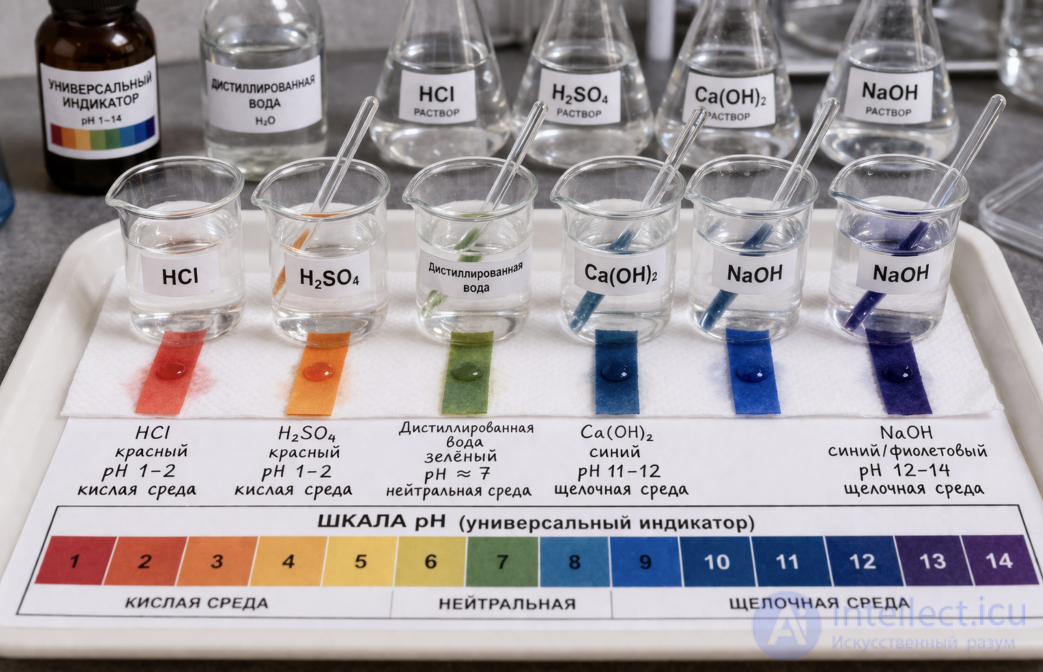
Therefore:

Comments