
Lecture
Among the most important compounds of the halogens are the hydrogen halides of composition HE (E — a halogen element) and their aqueous solutions — the hydrohalic acids — as well as the salts they form. The atoms in hydrogen halide molecules are joined by a single covalent polar σ-bond. Figure 70 shows the formation of the chemical bond in the HCl molecule.
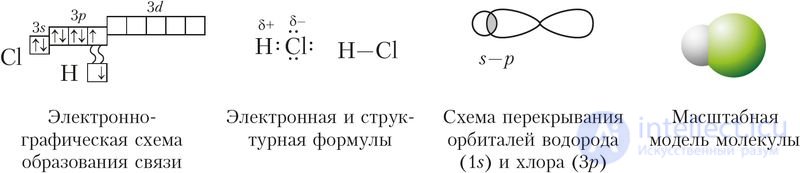
Fig. 70. Models of chemical bond formation in the hydrogen chloride molecule
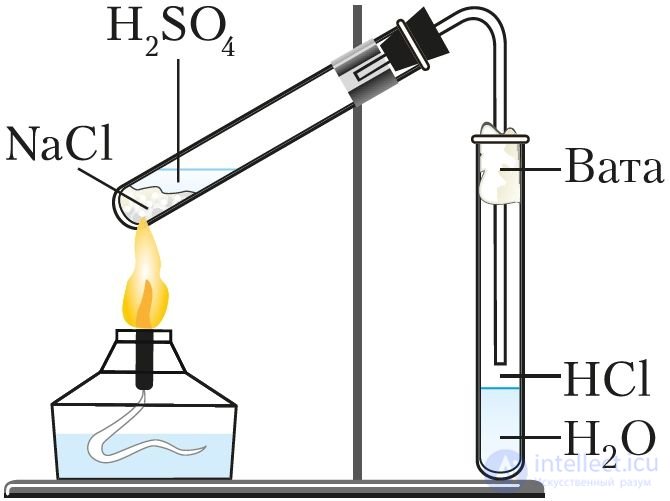
Fig. 71. Preparation of hydrochloric acid in the laboratory
Hydrochloric (muriatic) acid HCl is a large-tonnage product of the chemical industry. It is an aqueous solution of hydrogen chloride, which is a colorless gas with a sharp odor. The solubility of HCl at 20 °C is about 450 volumes per 1 volume of water.
Concentrated hydrochloric acid, containing 36–38% hydrogen chloride and having a density of 1.19 g/cm3, fumes in air because gaseous hydrogen chloride is released from it. Dilute solutions of HCl do not fume.
In industry, hydrochloric acid is obtained by dissolving hydrogen chloride in water. The hydrogen chloride itself is synthesized from the elements:
H2 + Cl2 = 2HCl.
In laboratory conditions, hydrogen chloride is obtained by the action of concentrated sulfuric acid on chlorides (NaCl or KCl) on heating (Fig. 71):
 .
.
Chemical properties. Being a strong electrolyte, hydrochloric acid dissociates to form hydrogen ions and chloride ions:
HCl → H+ + Cl–
and possesses all the general properties of acids: it acts on indicators and forms salts (chlorides) when it reacts with metals (1), basic and amphoteric oxides (2), metal hydroxides (3), and salts (4):
| 1 | Fe + 2HCl = FeCl2 + H2↑ metal |
Fe0 + 2H+ = Fe2+ + H2↑ |
| 2 | MgO + 2HCl = MgCl2 + H2O basic oxide |
MgO + 2H+ = Mg2+ + H2O |
| ZnO + 2HCl = ZnCl2 + H2O amphoteric oxide |
ZnO + 2H+ = Zn2+ + H2O | |
| 3 | KOH + HCl = KCl + H2O base (alkali) |
H+ + OH– = H2O |
| Al(OH)3 + 3HCl = AlCl3 + 3H2O amphoteric hydroxide |
3H+ + Al(OH)3 = Al3+ + 3H2O | |
| 4 | Na2CO3 + 2HCl = 2NaCl + H2O + CO2↑ salt |
2H+ +  = CO2↑ + H2O = CO2↑ + H2O |
The specific properties of hydrochloric acid include reactions attributable to the presence of the Cl– anion. Let us highlight two of the most important.
1. Oxidation reactions of chloride ions. The chlorine ion in hydrochloric acid has the lowest oxidation state, –1, and is able to raise it by losing electrons. This means that, owing to its chloride ions, the acid acts as a reducing agent. For example, to obtain chlorine in the laboratory, the reaction of concentrated hydrochloric acid with strong oxidizing agents (MnO2, KMnO4, KClO3) is used:
 .
.
2. Reactions in which the Cl– anion binds with the cations of certain metals, for example lead Pb2+ or silver Ag+, in solution. This is illustrated by the reaction equations:
2HCl + Pb(NO3)2 = PbCl2↓ + 2HNO3;
Pb2+ + 2Cl– = PbCl2↓;
HCl + AgNO3 = AgCl↓ + HNO3;
Ag+ + Cl– = AgCl↓.
The action of silver(I) nitrate produces a white curd-like precipitate of AgCl, which is used as a test (qualitative reaction) for chloride ions (Appendix 3).
Hydrogen fluoride HF is a liquid at temperatures below 19 °C, while HCl, HBr, and HI are gases under standard conditions (Table 23). This sharp difference in the physical state of HF can be explained by the formation of hydrogen bonds between the polar molecules of the substance: H—F … H—F … H—F … H—F.
Table 23. Hydrogen Halides
| Hydrogen halide | HF | HCl | HBr | HI |
| Bond length, nm | 0.092 | 0.128 | 0.141 | 0.161 |
| Bond energy, kJ/mol | 565 | 431 | 364 | 297 |
| Melting point, °C | –83 | –114 | –87 | –51 |
| Boiling point, °C | 19.5 | –85 | –67 | –35 |
| Physical state (at standard conditions) | Liquid | Gas | Gas | Gas |
The associates of hydrogen fluoride molecules are so strong that they persist even in the gas phase up to 90 °C. Hydrogen fluoride has unlimited solubility in water. Its solution is a weak acid (hydrofluoric acid):  . The low strength of HF as an acid is due to the high strength (energy) of the bond in the molecule.
Hydrofluoric (fluorspar) acid is able to destroy ("etch") glass, Na2O ∙ CaO ∙ 6SiO2, according to the equation:
6HF + SiO2 = H2SiF6 + 2H2O
or 4HF(g) + SiO2  SiF4↑ + 2H2O.
The remaining hydrogen halides are highly soluble in water and are strong acids: HBr → H++ Br–; HI → H+ + I–.
Most of the salts formed by these acids are readily soluble in water. To qualitatively detect chloride, bromide, and iodide ions in solutions, a reaction with a solution of silver(I) nitrate AgNO3 is used. In this case chlorides form a white curd-like precipitate of AgCl, bromides a pale-yellow precipitate of AgBr, and iodides a yellow precipitate of AgI (Table 24, Appendix 3):
Ag+ + Cl– = AgCl↓; Ag+ + Br– = AgBr↓; Ag+ + I– = AgI↓.
These precipitates do not dissolve in nitric acid.
Silver(I) nitrate does not form a precipitate with soluble fluorides, so fluoride ions are detected using a solution of CaCl2 (Appendix 3):
CaCl2 + 2NaF = CaF2↓ + 2NaCl; Ca2+ + 2F–= CaF2↓.
Table 24. Qualitative Reactions for the Anions of Hydrohalic Acids
| Name of the acid and its chemical formula | Salts | Qualitative reactions for the anions | |||
| Ion | Reagent | Sign of the reaction | |||
| Hydrofluoric (fluorspar) | HF | Fluorides | F– fluoride |
CaCl2 | White precipitate of CaF2  |
| Hydrochloric (muriatic) | HCl | Chlorides | Cl– chloride |
AgNO3 | White curd-like precipitate of AgCl  |
| Hydrobromic | HBr | Bromides | Br– bromide |
AgNO3 | Pale-yellow precipitate of AgBr  |
| Hydriodic | HI | Iodides | I– iodide |
AgNO3 | Yellow precipitate of AgI  |
Halogens find extremely broad application both as elemental substances and in the form of compounds. This is illustrated by the data in Table 25.
Table 25. Applications of the Halogens and Some of Their Compounds
| Halogen | Compound | Most important areas of application |
| Fluorine | Na3[AlF6] (cryolite) | Aluminum production |
| NaF (sodium fluoride) | Additive to toothpastes. Medicinal preparation | |
| HF (hydrofluoric acid) | Glass industry. Aluminum production | |
 |
Heat-resistant polymer. Nonstick coating for frying pans and irons | |
| Chlorine | Cl2 (chlorine) |
Disinfection of drinking water. Bleaching of linen and cotton fabrics. Organic synthesis. Extraction of nonferrous metals from ore. Production of hydrochloric acid |
| NaClO (sodium hypochlorite) | Component of bleaching agents | |
| HCl (hydrochloric acid) | Chemical industry | |
| NaCl (halite) | Food additive. Raw material for the production of chlorine, sodium, and sodium hydroxide | |
| Bromine | Br2 (bromine) | Organic synthesis: production of flame retardants (combustion inhibitors), rubber, and plant protection agents. Production of medicinal preparations |
| Iodine | I2 (iodine) | Medicine — alcohol solution (5–10%). Pharmaceutical industry |
Chlorine is contained in a substance extremely hazardous to life and health — dioxin, which can form as a result of reactions between organic substances and chlorine at elevated temperature. Scientists consider organic compounds of chlorine and fluorine (for example, freons) to be one of the causes of the destruction of Earth's ozone layer.
Solutions of hydrogen halides are acids.
Hydrogen chloride is obtained either by synthesis from the elements or by the action of concentrated sulfuric acid on solid sodium chloride.
Hydrochloric acid is an oxidizing agent by virtue of its hydrogen and a reducing agent by virtue of its chlorine.
Chloride, bromide, and iodide ions can be detected using a solution of silver(I) nitrate. The insoluble silver halides differ in color: AgCl is white, AgBr is pale yellow, and AgI is yellow.
1. Write the chemical formulas and name the physical state of the hydrogen halides under standard conditions.
2. From the list Mg(OH)2, FeCl2, FeCl3, Fe(NO3)3, HBr, HCl, MgCl2, ZnSO4, write out the formulas and name the substances that form a white curd-like precipitate when treated with a solution of AgNO3.
3. Determine the oxidation states of the atoms in the compounds: KClO3, HClO4, Cl2, KCl. In which of these can the chlorine atoms act only as a reducing agent?
4. Determine the mass of hydrogen chloride in a 50 g portion of hydrochloric acid with a mass fraction of the substance of 12%.
5. Calculate the volume of hydrogen chloride (at standard conditions) that can be released by the action of concentrated sulfuric acid on 100 g of sodium chloride.
6. Write the chemical formulas of the substances that react with hydrochloric acid: copper, copper(II) oxide, calcium oxide, carbon(IV) oxide, iron, zinc hydroxide, sodium sulfate, sodium carbonate. Explain your choice. Write the equations of the corresponding reactions.
7. Propose a plan for the experimental identification of solutions of potassium iodide, sodium bromide, and sodium fluoride located in numbered test tubes, using:
Write the equations of the corresponding reactions in molecular and ionic form.
8. Explain the reasons for the irregularity in the sequence of change in the boiling points of the hydrogen halides shown in Figure 44 in § 17.
9. Determine the mass fraction of the substance in the solution obtained by dissolving 40 dm3 of hydrogen chloride (at standard conditions) in 120 cm3 of water.
10. To obtain bromine, gaseous chlorine was passed through 2 kg of a solution with a mass fraction of potassium bromide of 0.12%. Calculate the mass of bromine obtained.
1. The weakest acid is:
2. An aqueous solution of hydrogen fluoride contains the particles:
3. Hydrochloric acid reacts with:
4. A white curd-like precipitate and a yellow precipitate, respectively, are formed on reaction with silver(I) nitrate by:
5. Gaseous hydrogen chloride can be obtained by the reaction of:

Comments