
Lecture
From the material of § 43 and § 49, you already know the practical applications of copper-based alloys, as illustrated by bronze and brass, and the huge role played by the production of iron alloys—cast iron and steel—for the needs of machine building, machine-tool building, tractor building, instrument making, and shipbuilding, as well as in construction, the production of household appliances, and plumbing equipment, and rail transport.
Let us consider the areas of use of other Group B metals, as well as their compounds.
Chromium. This metal is used in metallurgy as an alloying component in producing special steels and other alloys. Stainless steels containing up to 23% chromium are resistant to corrosion and high temperatures. They are used in the chemical and petroleum industries for manufacturing various apparatus. Chromium-molybdenum and nickel-molybdenum steels are needed for making armor and gun barrels.
Thanks to their luster, corrosion resistance, and wear resistance, protective-decorative chromium coatings are applied at the finishing stage of automobile and bicycle parts and tools, as well as for restoring worn machine parts. Various chromates are used to prepare fabrics for dyeing. Chromates are added to varnishes and paints to give them color. Chrome alum is used in leather tanning. The very hard and refractory powder of chromium(III) oxide Cr2O3 is used in polishing compounds, in preparing paints, as a catalyst in a number of organic reactions, and as a ceramic component.
Manganese. About 90% of manganese is used in metallurgy for alloying steels. It gives alloys corrosion resistance, toughness, and hardness. For example, manganese steel containing 12–15% manganese is used to make railroad rails. Manganin alloy (83% Cu, 13% Mn, 4% Ni) is used to make wire for resistance coils, since the electrical conductivity of such wire barely changes with temperature.
Manganese(IV) oxide MnO2 is used as a catalyst, as an oxidizer in chemical current sources (batteries), for decolorizing glass, and in the production of matches.
KMnO4 is used as a reagent in analytical chemistry. Its oxidizing action is the basis for using potassium permanganate as a topical preparation with antimicrobial properties.
Silver. Jewelry and cutlery are made from this precious metal. Thanks to its high electrical conductivity and corrosion resistance, silver is used as a contact material in electrical engineering products. Silver is a component of solders—low-melting alloys with copper and tin. In the chemical industry, silver is used as a catalyst in oxidation reactions, for example, in producing formaldehyde from methanol.
Silver(I) bromide, with additions of its chloride or iodide, is the main component of silver-halide photographic materials for recording holograms and X-ray diagnostic results in medical diagnosis.
Silver is a component of some medicinal preparations (collargol, protargol) owing to its bactericidal action.
Copper. Owing to its exceptionally high electrical and thermal conductivity, about 40% of all mined copper is used to manufacture electrical wires and cables, various connecting devices such as printed circuit boards in electrical appliances, credit cards, and electronic devices. Heating apparatus is made from copper.
An alloy of copper with tin, bronze, is used in mechanical engineering for making friction parts, thanks to its corrosion resistance and abrasion resistance, as well as in aviation, shipbuilding, and the making of sculptures, monuments, household items, and chandeliers. Brass, an alloy of copper with zinc that also has corrosion resistance, ductility, and a decorative appearance, is used to make machine parts, instrument and equipment parts including plumbing fixtures, various pipes and coils, hardware, dishware, and jewelry.
Alloys of copper with nickel (cupronickel), copper with manganese and a small addition of nickel (manganin), and copper with zinc and nickel (nickel silver) are widely used. They are resistant to atmospheric corrosion. Cupronickel is used in shipbuilding and apparatus manufacturing and in making medical instruments. Manganin is needed for making electrical measuring instruments. Nickel silver is in demand in the production of parts for precision instruments and medical instruments.
Copper(II) oxide CuO is used in the glass industry for coloring glass and enamels, and as an oxidizer in organic analysis. Copper(II) sulfate or chloride is the main component of the electrochemical deposition of copper coatings. Copper sulfate is used in agriculture to destroy plant pests, and in medicine as an antiseptic and astringent agent for external use.
Zinc. Zinc coatings protect steel products from corrosion. Zinc is a component of alloys with copper, aluminum, and magnesium. Large amounts of zinc are used to manufacture anodes for galvanic cells.
Zinc sulfate ZnSO4 ∙ 7H2O is used for dyeing fabrics, in medicine, and for the electrolytic production of zinc. Zinc oxide ZnO is used in the production of automobile tires, as well as in making white oil paint (zinc white).
Titanium. This metal resembles polished steel in appearance. It is chemically fairly reactive, but owing to the formation of a dense oxide film on its surface, titanium is more resistant to corrosion than stainless steel. It is also heat-resistant, resistant to the action of seawater, and resistant to a number of aggressive chemical environments (nitric acid, aqua regia, etc.). This allows it to be used for making chemical equipment and submarines.
The density of titanium (4.5 g/cm3) is 1.7 times greater than the density of aluminum, but titanium is 3 times stronger than aluminum. This opens up prospects for using titanium as a structural material for engines and aircraft bodies.
Titanium is often called the surgeon's metal. It is used to make strong, lightweight prostheses and implants implanted in the human body. Owing to the strong oxide film on its surface, titanium is stable in the aggressive environments of the human body, does not cause allergies, and the tissues around titanium prostheses and implants do not become inflamed.
Titanium(IV) oxide is used in making refractory glass, glaze, enamel, ceramics, and heat-resistant laboratory glassware, as well as for preparing white oil paint—titanium white. The semiconductor properties of titanium dioxide make it possible to use it in gas sensors, in a number of catalytic redox processes, and for the photocatalytic purification of water.
Crystals of barium titanate BaTiO3 have special electrical properties, and are therefore used to make sensing elements in ultrasonic and hydroacoustic equipment.
Nickel. This is a silvery-white metal with ferromagnetic properties that is fairly ductile. Compact nickel is chemically not very reactive. Under normal conditions it becomes covered with a thin film of NiO, which protects it from the action of air and water. These properties determine the areas of application of nickel.
Nickel is an important component of structural, stainless, and heat-resistant steels, and is a component of constantan, used in instrument making. Heat-resistant nickel alloys containing up to 80% nickel are used to make turbine blades and combustion chamber parts for jet engines of aircraft, as well as many parts in nuclear reactors. Nickel is the main component of permanent magnets.
Protective-decorative coatings of nickel and its alloys with phosphorus or boron are widely used on products made of metals, polymers, glass, and ceramics. Dispersed nickel is used as a catalyst in many chemical-technological processes for producing hydrogen, and for the hydrogenation or hydrogen reduction of organic compounds.
Nickel sulfate and chloride are used in electroplating for depositing nickel coatings.
Unlike the elements of Group A (C, H, O, N, P, K, Ca, etc.), the content of Group B metals in living organisms is extremely low. Thus, the proportion of iron does not exceed 10−2%, while the content of Mn, Cu, Zn, Mo, V, Co, Ni, and Cr is less than 10–3%. This is why they are called trace elements. Nevertheless, compounds of Group B metals perform a number of biological functions in organisms.
Trace elements are part of biologically active compounds (enzymes, hormones, vitamins) that regulate metabolic processes and cellular energetics, tissue respiration, and other vital processes.
Among the Group B elements there are also metals hazardous to health, such as Cd, Hg, and others. Their compounds are toxic. Nickel compounds cause allergies.
When considering whether metal compounds are necessary for the organism or, on the contrary, dangerous, it should be kept in mind that the physiological action of different elements depends on their dose. Therefore, at low concentration a metal compound may act on the organism as a medicine or perform vitally necessary functions, whereas at higher concentration a compound of the same metal causes poisoning.
For example, the importance of zinc for life lies in this element's activation of more than 50 enzymes. The required daily intake for the human body is 12–15 mg. However, a dose of 150 mg becomes poisonous to humans.
Let us consider in more detail the biological action of the most widely used transition metals.
Chromium. The body of an adult human contains about 5 mg as part of enzymes that speed up carbohydrate metabolism. Chromium deficiency raises blood levels of cholesterol and sugar.
At high content, chromium compounds exhibit carcinogenic properties. In the human body they cause genetic changes in cells.
Manganese. This metal is present in an amount of about 20 mg in the human body as part of vital enzymes. Similar enzymes are present in animal organisms and in plants. Manganese compounds are used as micronutrient fertilizers (most often MnSO4 ∙ 5H2O). Manganese deficiency in animal organisms leads to impaired bone growth and reduced reproductive function.
Dilute solutions (about 0.1%) of potassium permanganate have found the widest use in medicine as an antiseptic agent, for gargling, wound irrigation, and treating burns.
Copper. The human body contains about 70–100 mg of copper. It activates the function of enzymes catalyzing various redox reactions. Copper deficiency causes weakness of the arteries, impaired liver function, and anemia. High copper concentration can lead to poisoning, impaired central nervous system function, and damage to the teeth and stomach.
Copper deficiency (content below 2 mg/kg) has a negative effect on the productivity of agricultural plants. This is because copper-containing proteins and enzymes enhance the binding of atmospheric molecular nitrogen and the uptake of nitrogen from soil and fertilizers. Therefore, agriculture uses micronutrient fertilizers containing copper compounds, most often copper sulfate. However, when the copper content in the topsoil rises to 100 mg/kg, the soil becomes toxic to plants.
Copper ions are lethal to lower microorganisms, which is why compounds of this metal are included in coatings applied to ship hulls to combat biofouling (Fig. 118.3).
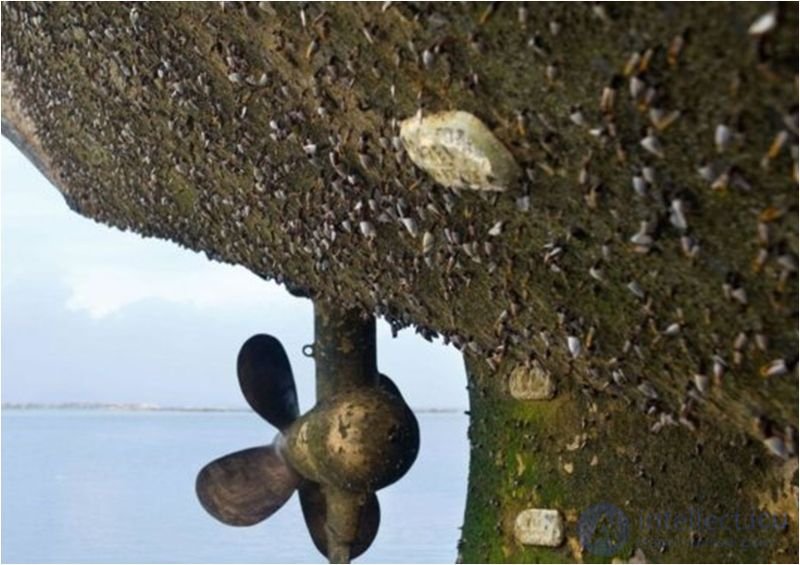
Fig. 118.3. Ship hull
Zinc. Zinc is an important trace element for all microorganisms, plants, and animals. Its content in the human body is 20 times greater than that of copper. It functions in more than 50 enzymes that affect carbohydrate, lipid, and protein metabolism. Zinc is necessary for the sexual maturation of animals and humans.
The recommended daily intake of zinc is 300 μg/kg of body weight. Zinc is found in beef, pork, and lamb (20–40 mg/kg), seafood (15–30 mg/kg), eggs (15–20 mg/kg), fruits, vegetables, and nuts.
Zinc is relatively low in toxicity.
Group B metals and their compounds are widely used in industry and everyday life.
In terms of their biological role, they are classified as trace elements, participating in various biochemical processes that determine the functioning of living organisms. However, an elevated content of these elements is dangerous for humans and the environment.
1. In the industrial production of titanium, ore or concentrate is converted into the oxide TiO2, which is then sintered with coke at a temperature of 800–1000 °C and treated with chlorine. This forms titanium tetrachloride TiCl4, while the reaction of carbon with oxygen mainly produces carbon monoxide. The titanium(IV) chloride is then reduced with magnesium. The resulting mixture is heated in a vacuum to remove the magnesium and its chloride. The residue is spongy titanium, which is remelted into compact metal. Using this information, write the equations of the reactions occurring at the different stages of the titanium production process.
2. Permanganates are poisons for the body. In treating acute poisoning by potassium permanganate, a 3% aqueous solution of hydrogen peroxide acidified with acetic acid is used. Give the equation of the chemical reaction that in this case leads to a decrease in the amount of permanganate.
3. To diagnose the degree of intoxication, there is a test: the subject is asked to exhale into a glass containing a weak solution of potassium permanganate. Explain what chemical process underlies this test.
4. Copper occurs in nature in the form of the following minerals: CuFeS2, Cu2S, CuO, Cu2(OH)2CO3. Suggest methods for extracting metallic copper from them. Give the corresponding equations of the chemical reactions.
5. Silver does not oxidize in air, however, in the presence of hydrogen sulfide in the air, a black tarnish of Ag2S can form on silver objects. Give the equation of the chemical reaction explaining this phenomenon. Suggest a method for removing the black tarnish from the surface of silver.
6. An example of chemical corrosion is the process of patina formation—a blue-green coating on bronze objects. It can be seen on bronze monuments. In terms of chemical composition, this coating is a mixture of two copper compounds—malachite Cu2(OH)2CO3 and azurite Cu3(OH)2(CO3)2. Give the equations of the possible chemical reactions leading to the formation of these substances.
7. Solutions of copper salts have an acidic environment. Over time, sparingly soluble precipitates form in them. Explain this phenomenon and give the corresponding equations of the chemical reactions.
8. Suppose you need to silver-plate a copper item. Suggest several methods by which this can be accomplished. Illustrate them with equations of the chemical reactions.
9. One of the properties of copper, silver, and gold is their ability to form alloys with each other. Determine the atomic ratio of the metals in a copper-gold alloy in which the mass fraction of gold is 58%.
10. A mixture of zinc, iron, and crystalline silicon with a mass of 53.10 g was treated with an excess of hydrochloric acid. This produced a colorless gas with a volume of 17.92 L (at STP). The same sample of the mixture was treated with a 30% sodium hydroxide solution, with NaOH taken in excess. As a result of the reaction, a gas with a volume of 15.68 L (at STP) was released. Determine the mass fractions of the substances in the initial mixture.
1. The trace elements include all the elements in the series:
2. Highly toxic elements are:
3. Most often used for alloying steels are:
4. For making photographic materials and preparing medicinal products (collargol, protargol), compounds of the following are needed:
5. Widely used as anticorrosion coatings for steel products are:

Comments