
Lecture
The properties of substances are determined not only by their elemental composition but also by the characteristics of the chemical bonds between atoms.
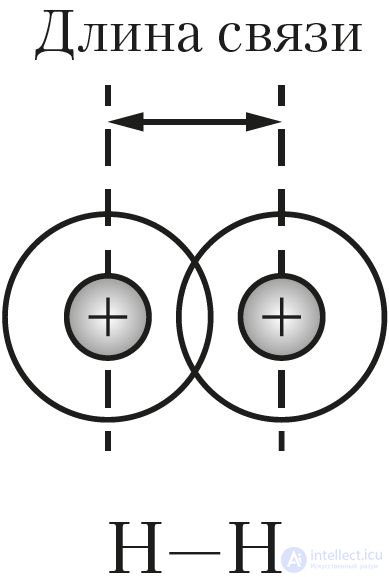
Fig. 27. Determining bond length from the distance between the nuclei of chemically bonded atoms
A covalent bond is characterized by length, energy, order (multiplicity), saturability, directionality, and polarity.
Covalent bond length — is the distance between the nuclei of chemically bonded atoms (Fig. 27). The covalent bond length is usually somewhat different from the sum of the atomic radii because of the redistribution of electron density and overlap of electron clouds (Fig. 27–29). The larger the radii of the bonded atoms, the greater the bond length (Table 12).
Table 12. Characteristics of covalent bonds in the molecules of hydrogen and hydrogen halides
| Element | Atomic radius, nm | Molecule | Bond length, nm | Ebond, kJ/mol | Δχ | Molecule model |
| H | 0.037 | H2 | 0.074 | 436 | 0 |  |
| F | 0.071 | HF | 0.092 | 565 | 1.8 | 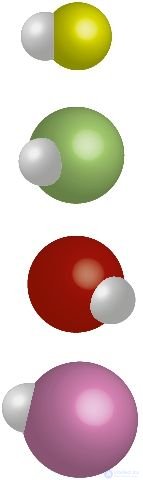 |
| Cl | 0.099 | HCl | 0.128 | 431 | 0.8 | |
| Br | 0.114 | HBr | 0.141 | 364 | 0.6 | |
| I | 0.133 | HI | 0.161 | 297 | 298 |
Chemical bond energy (Ebond) — is the energy that must be expended to break it. As a rule, the stronger the bond, the shorter its length (Table 12).
The order (multiplicity) of a covalent bond is the number of electron pairs that participate in forming the chemical bond between two atoms.
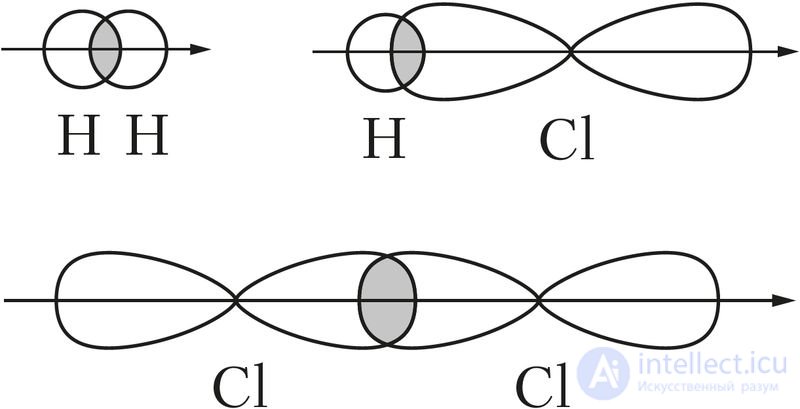
Fig. 28. Formation of σ-bonds
Single ( ), double (
 ), and triple (
 ) bonds are distinguished. When orbitals overlap along the line connecting the atomic nuclei, only σ-bonds are formed (Fig. 28).
However, two or three covalent bonds between two atoms cannot form simultaneously in the same plane. Therefore, in the case of double and triple bonds, "side-on" overlap of p- or d-orbitals occurs, meaning π-bonds are formed:
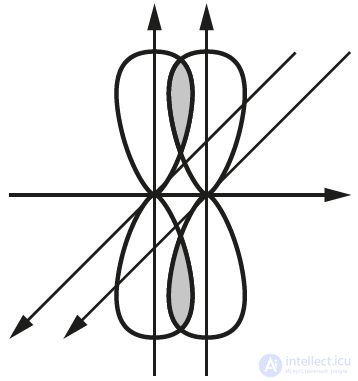
For example, the double bond in the oxygen molecule  is formed by the overlap of two p-orbitals. Here, the perpendicularly arranged p-orbitals form one σ-bond and one π-bond (Fig. 29).

Fig. 29. Electron-graphic diagram and diagram of electron cloud overlap
in the formation of a σ-bond and a π-bond in the O2 molecule
The triple bond in the nitrogen molecule  arises from the overlap of three p-orbitals. In this case, one σ-bond and two π-bonds are formed, as shown in Figure 30.

Fig. 30. Electron-graphic diagram and diagram of electron
cloud overlap in the formation of σ- and π-bonds in the N2 molecule
Bond order is clearly indicated in structural formulas. Thus, in the formaldehyde molecule there are two single bonds and one double bond: 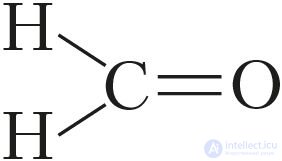 . In this molecule there are three σ-bonds and one π-bond.
The directionality of covalent bonds is determined by the spatial orientation of the atomic orbitals involved in forming the bond. It determines the spatial structure of molecules (Fig. 31).
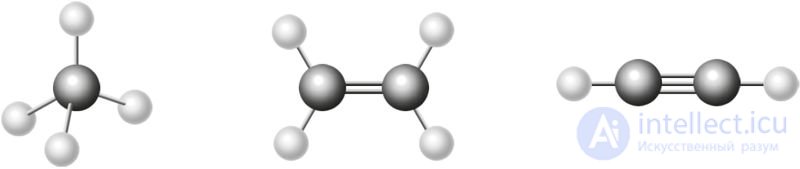
Fig. 31. Ball-and-stick models of methane, ethylene, and acetylene molecules
The angle formed by the directions of chemical bonds originating from the same atom is called the bond (valence) angle.
For example, you know that in the CH4 molecule the bonds are arranged at an angle of approximately 109°, in the  molecule — 120°, and in the
  molecule — 180°.
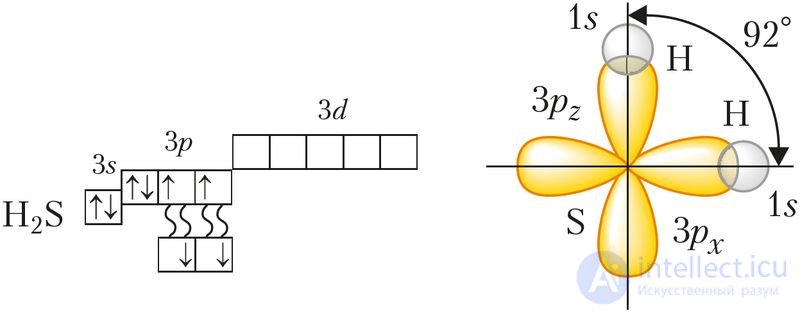
Fig. 32. Electron-graphic diagram and diagram of electron cloud overlap in the H2S molecule
In the H2O and H2S molecules, the oxygen and sulfur atoms form two σ-bonds with the hydrogen atoms. The p-orbitals of the outer energy level, which are oriented mutually perpendicular, participate in the formation of these bonds. This means that the bond angles between the O—H or S—H bond lines should be close to 90°. However, the actual values of these angles are somewhat larger because of the mutual repulsion of the hydrogen atoms (Fig. 32). Thus, in a water molecule in the vapor state, this angle equals 104.5°, while in the H2S molecule it is 92° (the repulsion is weaker because of the larger radius of the sulfur atom).
Similarly: in NH3 molecules, three mutually perpendicular p-orbitals of the nitrogen atom form three σ-bonds with hydrogen atoms, and the bond angles should be equal to 90°. The mutual repulsion of the hydrogen atoms increases these angles to 107°. This material is discussed in more detail in § 37.

To predict and explain the magnitude of bond angles in many molecules, the concept of hybridization of atomic orbitals is often used. You gained initial ideas about hybridization in the course of organic chemistry in the 10th grade. Taking hybridization into account, one can explain the structure of the CH4, NH3, and H2O molecules. During hybridization of the atomic orbitals of an atom forming bonds with neighboring atoms, averaging occurs in the shape and energy of the electron density of orbitals close in energy. For example, when the energy of one s-orbital and three p-orbitals of a given carbon atom is averaged, four identical hybrid orbitals are formed, directed toward the vertices of a tetrahedron:
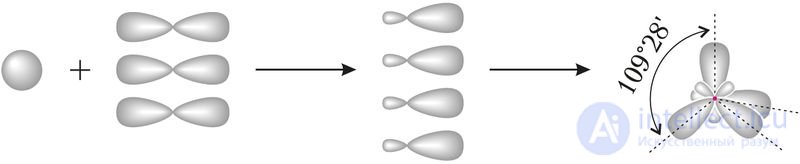
The tetrahedral structure of the methane molecule is explained by sp3-hybridization of the carbon atomic orbitals.
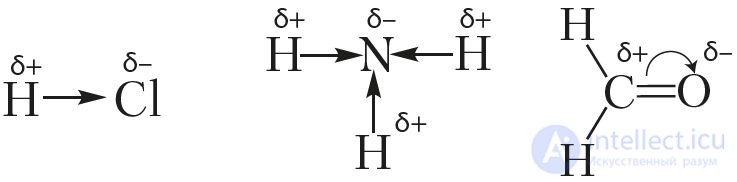
Bond polarity is a characteristic that accounts for the shift of the shared electron pair toward one of the atoms. If a covalent bond is formed by atoms with the same electronegativity, the bond is classified as nonpolar (H2, Cl2, N2). In the case of different electronegativity, the bond will be polar (HCl, NH3). The greater the difference in electronegativity values (Δχ) of the bonded atoms, the greater the polarity of the covalent bond. For example, the bond in the H—Cl molecule is more polar than in the H—Br molecule, since the electronegativity of the Cl atom (3.0) is greater than that of Br (2.8). A partial (non-integer) charge arises on the atoms. It is denoted by the symbols δ+, δ–.
The shift of electron density is indicated in structural formulas by arrows pointing toward the more electronegative atom. The shift of electron density upon formation of a σ-bond is indicated by a straight arrow, and of a π-bond by a curved arrow:
A molecule whose electronic structure is described as a system of two charges equal in absolute magnitude but opposite in sign, located at a certain distance from each other, is called a dipole.
Molecules that are dipoles are called polar. The molecules of hydrogen halides, hydrogen sulfide, and water are polar. Thus, in the water molecule, the electron density is shifted from the hydrogen atoms toward the more electronegative oxygen atom. Water molecules are dipoles (Fig. 33).
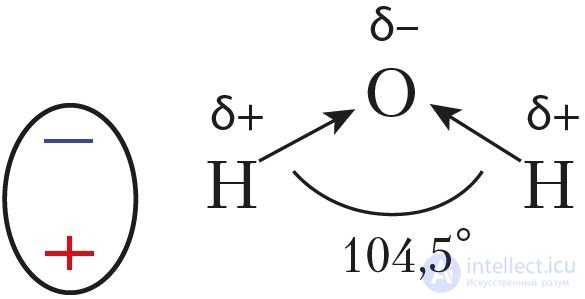
Fig. 33. Representation of the polar water molecule as a dipole
Saturability is the ability of an atom to form a certain (fixed) number of covalent bonds. This number of bonds is determined by the valence of the atom. Any atom is limited in its ability to form covalent bonds. There cannot be more of them than the number of atomic orbitals that can take part in forming covalent bonds. For elements of the 2nd period, there cannot be more than four such bonds, since the outer electron shell of the atoms of these elements has only four orbitals. For elements of the 3rd period, saturability increases owing to vacant d-orbitals.
The length and energy of ionic bonds depend on the size and charge of the interacting ions. As a rule, the smaller the size and the greater the charge of the ions, the stronger the bond. Its energy values lie in the range of 300–700 kJ/mol.
Unlike a covalent bond, an ionic bond is nondirectional and unsaturable, since an ion can attract ions of opposite sign toward itself in any direction. The arrangement and number of neighboring ions is determined by their sizes and by the forces of attraction and repulsion between ions of different signs. Therefore, the ions are arranged in a definite order, forming a crystal lattice.
A metallic bond is also nondirectional and unsaturable. Its energy varies over a wide range: from tens to several hundred kJ/mol. In metal crystals, atoms have a large number of nearest neighbors, which ensures very dense packing of the atoms. Thus, in crystals, a copper atom has 12 nearest neighbors, while a sodium ion in NaCl has six neighboring Cl– ions. The structure of crystals can be represented as densely packed spheres (Fig. 34).
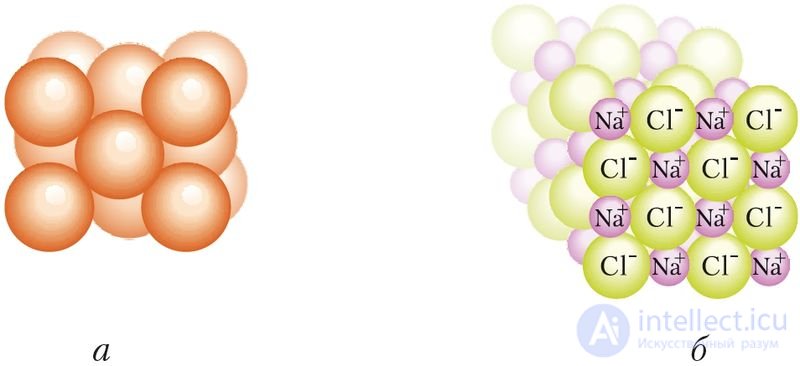
Fig. 34. Representation of crystal structure: a — copper, b — sodium chloride, as densely packed spheres
A covalent bond is characterized by length, energy, order (multiplicity), directionality, and polarity:
Ionic and metallic bonds are nondirectional and unsaturable.
1. Describe how the following are formed:
2. Fill in the table by placing under each chemical bond the appropriate energy value (167; 945; 418 kJ/mol) and bond length (0.145; 0.110; 0.125 nm). Explain your choice.
| Bond |  |
 |
 |
| Energy, kJ/mol | |||
| Length, nm |
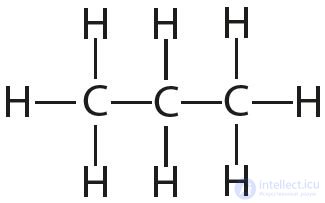
3. Indicate the number of single and multiple bonds in each molecule:
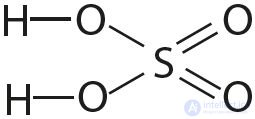
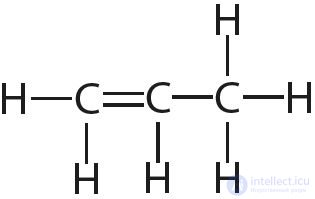
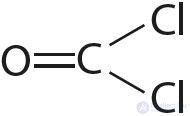
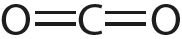
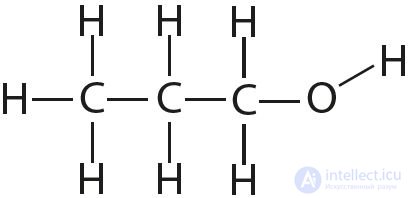
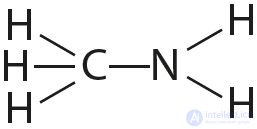
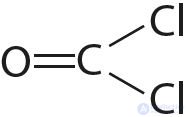
4. Mark the polar and nonpolar covalent bonds:
5. Explain why and how the bond length between atoms changes in the series:
 ,
,  ,
,  ;,
;,  .
.6. Compare the length and energy of the bond between carbon and oxygen atoms in the series: methanol  , methanal (formaldehyde)
  , carbon monoxide
  .
.
7. Explain the decrease in thermal stability of the compounds in the series: H2O, H2S, H2Se.
8. Explain why hydrogen and fluorine molecules react instantly, while the reaction of hydrogen and nitrogen molecules requires high temperature and pressure.
9. Draw a diagram of the overlap of the atomic 1s- and 3p-orbitals in the H2X molecule, if the relative density of this gaseous compound with respect to hydrogen  equals 17.
10. The bond energy in the O2 molecule is 494 kJ/mol. How much energy must be expended to break all the bonds in a 1 dm3 sample of oxygen (at STP)?
1. Directionality and saturability characterize the bond:
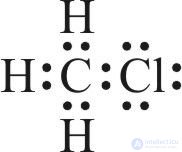
2. Two bonding and two non-bonding electron pairs are contained in the molecules:


3. σ-Bonding corresponds to the overlap of orbitals:




4. The bond length in the first molecule is greater than in the second in the pair of substances:
5. Bond energy decreases in the series:
 ,
,  ,
,  ;
;
Comments