
Lecture
Let us consider the calculations needed to prepare solutions with a given mass fraction or a given molar concentration of a dissolved substance. These are the simplest calculations that every researcher in a chemical laboratory encounters. Skill in certain calculations is also necessary in everyday life for preparing food, detergent solutions, fertilizers, or pesticides. For example, a recipe in a cookbook calls for 5% vinegar, while the store only sells 9% vinegar. It is clear that the mass fractions of acetic acid differ by a factor of 9 : 5 = 1.8, that is, the available 9% vinegar must be taken in an amount 1.8 times smaller than indicated in the recipe.
The simplest problem of preparing a solution with a given mass fraction of dissolved substance is presented in Example 1 and is familiar to you from the 8th grade.
Example 1. Calculate the mass of sodium chloride and the volume of distilled water needed to prepare a solution with a mass of 300 g and a salt mass fraction of 5%.
Given:
ω(NaCl) = 5 %
m(solution) = 300 g
m(NaCl) — ?
V(H2O) — ?
Solution
1. Let us calculate the mass of the salt, considering that 5% corresponds to 0.05 as a fraction of unity:
m(NaCl) = ω(NaCl) ∙ m(solution) = 0.05 ∙ 300 g = 15 g.
2. Let us calculate the mass of the solvent (water) using the formula:
m(solvent) = m(solution) – m(substance).
Therefore m(H2O) = 300 g – 15 g = 285 g.
3. Let us find the volume of water taking into account its density (ρ(H2O) = 1 g/cm3):

Answer: m(NaCl) = 15 g; V(H2O) = 285 cm3.
To prepare solutions, an experimenter uses scales and measuring vessels (Fig. 55).
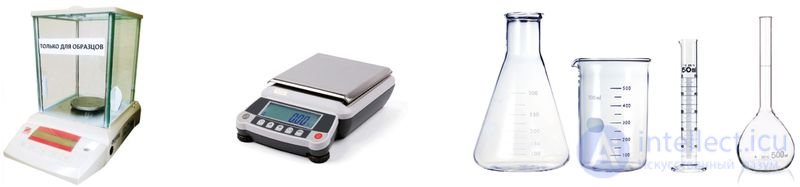
Fig. 55. Equipment and vessels for preparing solutions
Example 2. Calculate the mass of potassium chloride needed to prepare its saturated solution with a mass of 350 g. The solubility of this salt under the experimental conditions (20 °С) is 34.4 g per 100 g of water.
Given:
s(КCl) = 34.4 g/100 g H2O
m(solution) = 350 g
m(КCl) — ?
Solution
1. Let us calculate the mass fraction of the salt in a saturated solution consisting of 100 g of water and 34.4 g of salt (based on the solubility data). In this case the mass of the solution will be 100 + 34.4 = 134.4 g.
 (i.e. 25.6%)
2. Since 350 g of saturated solution will contain 25.6% salt, the mass of salt will be equal to:
m(КCl) = ω(КCl) ∙ m(solution) = 0.256 ∙ 350 g = 89.6 g.
Answer: m(КCl) = 89.6 g.
Sometimes it is necessary to calculate the mass fraction of a substance in an already prepared solution. Let us consider this calculation using Example 3.
Example 3. Copper sulfate with a mass of 25 g was dissolved in water with a mass of 475 g. Calculate the mass fraction (%) of copper(II) sulfate in the resulting solution.
Given:
m(CuSO4 · 5H2O ) = 25 g
m(Н2О) = 475 g
ω(CuSO4) — ?
Solution
M(CuSO4) = 160 g/mol;
M(CuSO4 · 5H2O) = 250 g/mol.
1. Let us calculate the amount of copper(II) sulfate in the portion of its crystalline hydrate:

hence, n(CuSO4 ) = 0.1 mol.
2. The mass of anhydrous salt in the crystalline hydrate:
m(CuSO4) = n(CuSO4) ∙ M(CuSO4) = 0.1 mol ∙ 160 g/mol = 16 g.
3. Let us calculate the mass of the prepared solution:
m(solution) = m(Н2О) + m(CuSO4 · 5H2O) = 25 g + 475 g = 500 g.
4. Let us find the mass fraction of copper(II) sulfate in the solution:
ω(CuSO4) = m(CuSO4) : m(solution) = 16 g : 500 g = 0.032, or 3.2 %.
Answer: ω(CuSO4) = 3.2 %.

In chemistry it is convenient to express the composition of solutions in units of molar concentration — mol/dm3. Indeed, knowing the number of moles of a substance in 1 dm3 of solution, it is easy to measure out the required number of moles for a reaction using measuring vessels (Fig. 55).
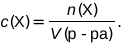
As you know, the molar concentration с(Х) of substance X is a quantity equal to the amount of this substance (mol) per unit volume of solution:
Example 4. Calculate the mass of sodium hydroxide needed to prepare its solution with a molar concentration of 0.05 mol/dm3, if the experimenter has available a volumetric flask with a volume of 250 cm3 (Fig. 55).
Given:
c(NaOH) = 0.05 mol/dm3
М(NaOH) = 40 g/mol
V(solution) = 250 cm3
m(NaOH) — ?
Solution
1. Let us determine the amount of alkali in a solution with a volume of 250 cm3, that is, 0.25 dm3:
n(NaOH) = c(NaOH) ∙ V(solution) = 0.05 mol/dm3 ∙ 0.25 dm3 = 0.0125 mol.
2. The mass of sodium hydroxide is:
m(NaOH) = n(NaOH) ∙ М(NaOH) = 0.0125 mol ∙ 40 g/mol = 0.5 g.
Answer: m(NaOH) = 0.5 g.
Knowing the mass and volume, or directly the density of a solution, it is easy in a calculation to go from the mass fractions of its components to their molar concentrations.
Example 5. The mass fraction of sulfuric acid in a solution is 95%, and its density is ρ(solution) = 1.834 g/cm3. Calculate the molar concentration of sulfuric acid in this solution.
Given:
ω(Н2SO4) = 95 %
ρ(solution) = 1.834 g/cm3
с(Н2SO4) — ?
Solution
1. M(H2SO4) = 98 g/mol.
Let V(solution) = 1 dm3 = 1000 cm3.
Let us determine the mass of the H2SO4 solution:
m(solution) = V(solution) ∙ ρ(solution) = 1000 cm3 ∙ 1.834 g/cm3 = 1834 g.
2. Let us calculate the mass of H2SO4 in the solution:
m(H2SO4) = m(solution) ∙ ω(H2SO4) = 1834 g ∙ 0.95 = 1742 g.
3. Let us find the amount of acid in the solution:

4. Since 1 dm3 of solution was initially taken for solving the problem, the amount of H2SO4 in this volume corresponds to the molar concentration: с(H2SO4) = 17.8 mol/dm3.
Answer: с(H2SO4) = 17.8 mol/dm3.
Let us consider an example of the crystallization of a crystalline hydrate from a solution.
Example 3.1. Anhydrous CuSO4 with a mass of 129 g was dissolved at 100 °С in the minimum amount of water. Determine the mass of the crystalline hydrate CuSO4 · 5H2O that precipitates upon cooling to 20 °С, if the solubility of CuSO4 in water at 100 °С is 77 g/100 g H2O, and at 20 °С — 20.5 g/100 g H2O.
Given:
m(CuSO4) = 129 g
s100(CuSO4) = 77 g/100 g H2O
s20(CuSO4) = 20.5 g/100 g H2O
m(CuSO4 · 5H2O) = ?
Solution
1. Mass fractions of the salt in the saturated solutions:
 ,
,
 .
.
2. The mass of the initial solution is m100(solution) = 129 : 0.435 = 297 g.
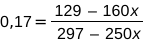
3. Let the amount of crystalline hydrate that precipitates equal х mol, then its mass equals 250х g. In this case the precipitate contains х mol of anhydrous salt, whose mass equals 160х. The mass of salt in the final solution will equal 129 – 160х, and the mass of the final solution will equal 297 – 250х.
We set up the equation:
 .
.
Whence х = 0.668, that is, n(CuSO4 · 5H2O) = 0.668 mol.
4. The mass of the crystalline hydrate is:
m(CuSO4 · 5H2O) = 0.668 mol · 250 g/mol = 167 g.
Answer: m(CuSO4 · 5H2O) = 167 g.
Note that the mass of the precipitated crystalline hydrate CuSO4 · 5H2O turned out to be greater than the mass of the anhydrous salt CuSO4 taken for recrystallization.
When preparing solutions, it is often necessary to mix them. The concentration of the resulting solution must be calculated. Let us consider how to do this in Example 3.2.
Example 3.2. To a solution with a mass of 60 g with a mass fraction of barium chloride equal to 12%, a solution with a mass of 2000 g was added, in which the mass fraction of the same salt was 0.010. Calculate the mass fraction of barium chloride in the resulting new solution and express it in fractions of unity and percent.
Given:
m1(solution) = 60 g
ω1(BaCl2) = 12 % (0.12)
m2(solution) = 2000 g
ω2(BaCl2) = 0.01 (1 %)
ω3(BaCl2) = ?
Solution
1. Let us find the mass of BaCl2 in the first solution:
m1(BaCl2) = m1(solution) · ω1(BaCl2) = 60 g · 0.12 = 7.2 g.
2. Let us find the mass of BaCl2 in the second solution:
m2(BaCl2) = m2(solution) · ω2(BaCl2) = 2000 g · 0.01 = 20 g.
3. Let us determine the mass of BaCl2 in the new solution m3:
m3(BaCl2) = m1(BaCl2) + m2(BaCl2) = 7.2 g + 20 g = 27.2 g.
4. Let us calculate the total mass of the new solution:
m3(solution) = m1(solution) + m2(solution) = 60 g + 2000 g = 2060 g.
5. Let us determine the mass fraction of barium chloride in the new solution:
ω3(BaCl2) = m3(BaCl2) : m3(solution) = 27.2 g : 2060 g = 0.0132, or 1.32 %.
Knowing the masses of BaCl2 in the first, second, and new solutions, this problem can be solved through x, where x is the mass fraction of BaCl2 in the resulting solution. Let us determine the total mass of BaCl2 in the new solution:
m3(BaCl2) = m1(BaCl2) + m2(BaCl2), therefore
(60 g + 2000 g) · x = 60 g · 0.12 + 2000 g · 0.01 = 27.2 g, whence x = 0.0132.
Answer: ω3(BaCl2) = 0.0132, or 1.32 %.
When expressing the quantitative composition of solutions, the mass fractions of the components or their molar concentrations are used.
Questions, assignments, problems
1. Do the mass fraction of a dissolved substance and its molar concentration change when the temperature of the solution changes?
2. Calculate the mass fraction of salt in a solution obtained by dissolving 30 g of salt in 270 g of water.
3. Calculate the mass of sodium chloride and the volume of distilled water needed to prepare a physiological saline solution with a mass of 20 kg and a salt mass fraction of 0.9%.
4. Calculate the molar concentration of a substance in a solution with a volume of 2.5 dm3, if it contains potassium hydroxide:
5. Calculate the mass fraction of potassium chlorate (bertholite salt) KClO3 in its saturated solution with a mass of 800 g. The solubility of the salt at 10 °С is 5 g per 100 g of water.
6. Calculate the mass fraction of sodium sulfate in a solution obtained by dissolving 16.1 g of the crystalline hydrate Na2SO4 ∙ 10H2O in 500 g of water.
7. Sulfuric acid with a mass of 50 g was dissolved in 50 g of water. Calculate the mass fraction and molar concentration of the acid in the solution, if its density is 1.395 g/cm3.
8. Calculate the volume (cm3) and molar concentration (mol/dm3) at 20 °С of the solution with ρ = 1.55 g/cm3, obtained by mixing 50 cm3 of water (ρ = 1.00 g/cm3) with 50 cm3 of sulfuric acid (ρ = 1.83 g/cm3).
9. The mass fraction of sulfuric acid in a solution is 0.620, and its molar concentration is 9.61 mol/dm3. What is the volume (cm3) of this solution with a mass of 200 g?
10. A solution with a mass of 450 g and a mass fraction of iron(II) sulfate equal to 30.0% was cooled, as a result of which a precipitate of FeSO4 ∙ 7H2O with a mass of 99.0 g separated from this solution. What is the mass fraction (in %) of iron(II) sulfate in the solution above the crystalline hydrate precipitate?

*Questions, assignments, problems
1. Calculate the volume (cm3) and molar concentration of H2SO4 (mol/dm3) at 20 °С of the solution with ρ = 1.550 g/cm3, obtained by mixing 50 cm3 of water (ρ = 0.9982 g/cm3) with 50 cm3 of 100% sulfuric acid (ρ = 1.8305 g/cm3).
2. A nitric acid solution with a volume of 50 cm3 and a mass fraction of HNO3 of 0.11 (ρ = 1.060 g/cm3) was mixed with a nitric acid solution with a volume of 50 cm3 and a mass fraction of HNO3 of 0.67 (ρ = 1.400 g/cm3). Calculate the volume (cm3), mass fraction (in %), and molar concentration of HNO3 (mol/dm3) in the resulting solution, if its density is 1.264 g/cm3.
3. At 20 °С, pure ethyl alcohol with a volume of 40 cm3 and a density of 0.7893 g/cm3 was diluted with water (ρ = 0.9982 g/cm3) to a volume of 100 cm3. Indicate the volume of water needed for this, as well as the mass fraction of alcohol in the resulting solution, if its density is 0.9481 g/cm3.
4. A hydrochloric acid solution with a volume of 100 cm3 and a mass fraction of HCl of 30% (ρ = 1.149 g/cm3), after absorbing a certain mass of gaseous HCl, turned into a solution with a mass fraction of 40% (ρ = 1.198 g/cm3). Indicate the mass of the absorbed HCl, as well as the volume and molar concentration of HCl (mol/dm3) in the resulting solution.
5. To a solution with a volume of 100 cm3 and a mass fraction of ZnSO4 of 6% (ρ = 1.062 g/cm3), a certain mass of zinc vitriol ZnSO4 · 7H2O was added, and a solution with a mass fraction of ZnSO4 of 30% (ρ = 1.378 g/cm3) was obtained. Indicate the mass of ZnSO4 · 7H2O taken, as well as the volume of the resulting solution and the molar concentration of ZnSO4 (mol/dm3) in it.
6. At 25 °С, to pure acetone (ρ = 0.786 g/cm3) with a mass of 78.6 g, an equal volume of water (ρ = 0.997 g/cm3) was added. Indicate the mass and volume of the resulting solution, if its density is 0.929 g/cm3. Calculate the molar concentration of acetone.
7. At 20 °С, to a hydrochloric acid solution with a volume of 100 cm3 and a mass fraction of HCl of 36% (ρ = 1.174 g/cm3), an equal volume of water (ρ = 0.998 g/cm3) was added. Indicate the mass, mass fraction, volume, and molar concentration of HCl (mol/dm3) in the resulting solution, if its density is 1.095 g/cm3.
8. The solubility of oxygen in water is 4.89 cm3/100 cm3 at STP. Given that the volume fraction of oxygen in air is 21%, indicate the volume, mass, mass fraction, and molar concentration (mol/dm3) of oxygen in 1 dm3 of water aerated with air at STP.
9. At 20 °С, to a nitric acid solution with a volume of 500 cm3 and a mass fraction of HNO3 of 76.2% (ρ = 1.438 g/cm3), an equal volume of an ammonia solution with a mass fraction of NH3 of 33.5% (ρ = 0.882 g/cm3) was added. Indicate the molar concentration of the substances (mol/dm3) in the initial solutions. Indicate the mass, mass fraction, and molar concentration of NH4NO3 (mol/dm3) in the resulting solution, if its density is 1.279 g/cm3.
10. At 20 °С, to a hydrochloric acid solution with a volume of 500 cm3 and a mass fraction of HCl of 35.4% (ρ = 1.176 g/cm3), an equal volume of a sodium hydroxide solution with a mass fraction of NaOH of 33.4% (ρ = 1.365 g/cm3) was added. Indicate the molar concentration of HCl and NaOH (mol/dm3) in the initial solutions. Indicate the mass, mass fraction, and molar concentration of the substances in the resulting solution, if its density is 1.199 g/cm3.
*Self-check
1. The mass fraction of salt in a solution:
2. A saturated aqueous solution can be prepared for the substance:
3. To prepare solutions with a molar concentration of substance of 0.1 mol/dm3, a volumetric flask with a volume of 1000 cm3 was used. In this case it was necessary to weigh out:
4. Using sodium hydroxide with a mass of 4 g, a solution with a volume of 0.5 dm3 was prepared. The molar concentration of the alkali (mol/dm3) is equal to:
5. The mass fraction (%) of copper(II) sulfate in a solution obtained by dissolving 250 g of copper sulfate CuSO4 · 5H2O in 1750 g of water, is equal to:

Comments