
Lecture
An oxidizing agent — is a substance that contains atoms which attach electrons to themselves during a chemical reaction. During the reaction these atoms are reduced, and their oxidation state decreases.
Oxidizing properties are most pronounced in substances whose properties you are already familiar with or will become acquainted with later:
 , in which oxygen atoms in the oxidation state −1 are reduced;
 ,
,  ), in which chlorine atoms are reduced;
 ,
,  ), in which manganese atoms are reduced;
 ,
,  ), in which chromium atoms are reduced;
A reducing agent — is a substance that contains atoms which give up electrons during an oxidation-reduction reaction. During the reaction these atoms are oxidized, and their oxidation state increases.
Let us give examples of the most important reducing agents, whose properties you will consider while studying the material of Chapters VI and VII:
Of course, the list of substances given above does not exhaust the entire variety of oxidizing and reducing agents. It should be emphasized that oxidizing agents and reducing agents differ in their strength. Thus, for example, fluorine is one of the strongest oxidizing agents, and the oxidizing ability of chlorine is greater than that of iodine. For many substances, the oxidizing ability depends on the conditions of the reaction. In an acidic medium, as a rule, the oxidizing ability is more pronounced. A number of substances possess oxidizing ability under some conditions and reducing ability under others.
Whether a substance will display oxidizing or reducing properties can be assessed by following these rules.
Reducing agents are substances containing atoms of an element that can display a higher oxidation state than the one they have in the given substance. Simple substances that are metals are always reducing agents, and in the products of oxidation the oxidation state of the metal has only positive values.
Atoms of nonmetals present in compounds in their lowest oxidation states display only reducing properties, for example halogen atoms in halides, sulfur atoms in sulfides, hydrogen atoms in hydrides.
Oxidizing agents are substances containing atoms of an element that can display a lower oxidation state than the one they have in the given substance. Complex substances containing metal and nonmetal atoms in their highest oxidation states are always oxidizing agents, for example H2SO4(conc.), HNO3, KMnO4, CrO3, HClO4, etc. In lowering their oxidation state, nonmetal atoms can acquire positive, negative, or zero oxidation state values. The oxidizing ability of substances within a series of oxidizing agents, like the reducing ability of substances within a series of reducing agents, can vary greatly.
When in an intermediate oxidation state, atoms of an element can be oxidized by a stronger oxidizing agent or reduced by a stronger reducing agent. For example, iron(II) in the oxide FeO can be oxidized by oxygen to Fe(III) or reduced by carbon to metallic iron. Both oxidizing and reducing properties can be displayed by H2O2, FeCl2, SO2, CuCl, carbon, halogens (except fluorine), and others.
In a number of oxidation-reduction reactions, part of the atoms of one of the elements displays the properties of an oxidizing agent, while another part displays the properties of a reducing agent. As a result, both oxidation and reduction products of this element are formed. Examples of such reactions (disproportionation reactions) include:
a) the reaction of nitrogen(IV) oxide with water:

b) the decomposition of hydrogen peroxide:
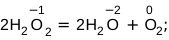
c) the reaction of chlorine with an alkali solution to form the salts of hypochlorous and hydrochloric acids:

Oxidation-reduction processes are widespread in nature. These include metabolism in living organisms, respiration, decay and fermentation, and photosynthesis. Oxidation-reduction processes accompany the cycling of substances in nature. They occur during the corrosion of metals.
In industry and everyday life, exothermic oxidation-reduction reactions are used in the combustion of natural gas, coal, peat, wood, oil, and its processing products. These reactions underlie the conversion of the energy of interacting chemical substances into electrical energy in galvanic cells and fuel cells.
In metallurgy, oxidation-reduction processes are used to reduce metals, and in the chemical industry — to obtain alkalis, acids, ammonia, alcohols, aldehydes, and other products. You will become more closely acquainted with many oxidation-reduction reactions and their applications while studying the material of Chapters VI and VII of this textbook.
In the course of oxidation-reduction reactions, two processes take place simultaneously: oxidation (the loss of electrons by the reducing agent) and reduction (the gain of electrons by the oxidizing agent).
The number of electrons given up by the reducing-agent atoms is equal to the number of electrons accepted by the oxidizing-agent atoms.
The ability of atoms within chemical compounds to display oxidation-reduction properties depends on their oxidation state.
Atoms in higher oxidation states display oxidizing ability, while those in lower oxidation states display only reducing ability. In intermediate oxidation states, atoms are capable of both being oxidized and being reduced.
1. Which of the proposed substances — SO3, Na2S, SO2, H2S, H2SO4, BaSO3 — display, owing to their sulfur atoms:
Explain your answer.
2. Which of the proposed substances — N2, NO2, NO, HNO3, NH3, Ba(NO3)2, HNO2 — display, owing to their nitrogen atoms:
Explain your answer.
3. In each of the schemes of oxidation-reduction reactions, place the coefficients using the electron balance method and indicate the element that acts as both the oxidizing agent and the reducing agent:
 ;
;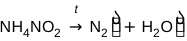 ;
;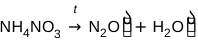 ;
; ;
;4. Place the coefficients using the electron balance method, and also indicate the oxidizing agents and reducing agents:
 CH2 + KMnO4 + H2O → CH2(OH)
 CH2(OH) + MnO2↓ + KOH;
5. To obtain acetaldehyde, the reaction of oxidation of ethyl alcohol by potassium dichromate () in an acidic medium can be used. Write the corresponding equation of the oxidation-reduction reaction.
6. Name the series in which the two proposed substances can be simultaneously present in solution:
Explain your answer.
7. Calculate the volume (cm3 at STP) of nitrogen(II) oxide that should be released upon dissolving 1.92 g of copper in dilute nitric acid taken in excess.
8. A zinc granule with a mass of 6.5 g was placed into a solution of copper sulfate with a mass of 160 g and a mass fraction of copper sulfate of 20%. Determine the quantitative composition (%) of the solution after the zinc granule has completely dissolved. Give the equation of the chemical reaction describing the process of zinc dissolution.
9. Pyrite (FeS2), in which the atoms have the oxidation states: iron +2, sulfur –1, can be used as a raw material for obtaining sulfuric acid. Write the equation for the roasting of pyrite in oxygen, as a result of which iron(III) oxide and sulfur(IV) oxide are formed.
10. A zinc plate was placed into a solution of copper(II) sulfate and left for some time. It was then removed from the solution, dried, and weighed. It turned out that the mass of the plate had decreased by 0.01 g owing to the deposition of copper from the solution onto its surface. Explain this phenomenon and determine the mass of copper deposited on the plate. Take the molar mass of zinc as 65 g/mol and of copper as 64 g/mol.
1. The oxidation-reduction processes include:
 ;
;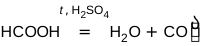 ;
; ;
; .
.3. In the oxidation-reduction reaction whose equation is 3Cu + 8HNO3(dil.) = 3Cu(NO3)2 + 2NO↑ + 4H2O, a salt in the amount of 3 mol was formed. No other processes took place. In this case, the correct statements for this reaction are:
4. Atoms of metals in their highest oxidation states can:
5. Manganese atoms in the composition of МnO2 can:

Comments