
Lecture
1. Investigate the action of hydrochloric acid on metals:
2. Three numbered test tubes contain solutions:
Using alkali, determine the contents of each test tube.
3. Starting from:
obtain an amphoteric hydroxide and prove its amphoteric nature.
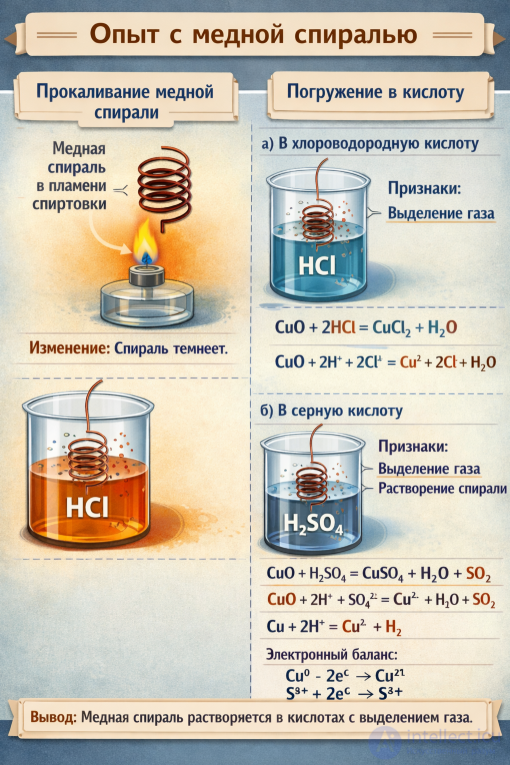
4. Calcine a copper coil in the flame of a spirit lamp. Note the changes. Place the coil into an acid solution:
Note the signs of the reaction. Explain the observed phenomena.
In your report, present all reaction equations in molecular and ionic forms. For redox reactions, draw up the electron balance.
a) Zinc and copper
Zinc + HCl: Molecular equation:
Zn+2HCl→ZnCl2+H2↑
Full ionic:
Zn+2H++2Cl−→Zn2++2Cl−+H2↑
Net ionic:
Zn+2H+→Zn2++H2↑
Electron balance:
Zn0−2e−→Zn2+2H++2e−→H20
Copper + HCl: No reaction occurs, since copper does not displace hydrogen from the acid (it is less active).
b) Magnesium and copper
Magnesium + HCl:
Mg+2HCl→MgCl2+H2↑
Full ionic:
Mg+2H++2Cl−→Mg2++2Cl−+H2↑
Net ionic:
Mg+2H+→Mg2++H2↑
Copper + HCl: No reaction occurs.
a) FeCl₃, KCl, MgCl₂ + NaOH:
FeCl₃ + 3NaOH → Fe(OH)₃↓ + 3NaCl
(brown precipitate — Fe(OH)₃)
KCl + NaOH — no reaction (both substances give ions that do not form a precipitate)
MgCl₂ + 2NaOH → Mg(OH)₂↓ + 2NaCl
(white precipitate — Mg(OH)₂)
b) FeSO₄, CuSO₄, K₂SO₄ + NaOH:
FeSO₄ + 2NaOH → Fe(OH)₂↓ + Na₂SO₄
(pale-green precipitate — Fe(OH)₂)
CuSO₄ + 2NaOH → Cu(OH)₂↓ + Na₂SO₄
(blue precipitate — Cu(OH)₂)
K₂SO₄ + NaOH — no reaction
a) AlCl₃ + NaOH:
AlCl3+3NaOH→Al(OH)3↓+3NaC
Upon addition of excess NaOH:
Al(OH)3+NaOH→Na[Al(OH)4]
b) ZnCl₂ + NaOH:
ZnCl2+2NaOH→Zn(OH)2↓+2NaC
Excess NaOH:
Zn(OH)2+2NaOH→Na2[Zn(OH)4]
Conclusion: Both hydroxides (Al(OH)₃ and Zn(OH)₂) dissolve in alkali, forming complex salts — this confirms their amphoteric nature.
Upon calcination:
Copper reacts with atmospheric oxygen:
2Cu+O2→2CuO
(black copper(II) oxide is formed)
a) CuO + HCl:
CuO+2HCl→CuCl2+H2O
b) CuO + H₂SO₄:
CuO+H2SO4→CuSO4+H2O
Signs of the reaction: dissolution of the black precipitate and formation of a blue solution of copper(II) salts.

Comments