
Lecture
Это окончание невероятной информации про электролитическая диссоциация веществ.
...
bond.
Dissociation of compounds with an ionic type of bonding
Ionic crystals consist of cations and anions bound to one another by electrostatic forces of attraction into an ordered crystal structure. Under the action of polar water molecules, ionic crystals break down and dissolve, forming hydrated ions (Fig. 57).
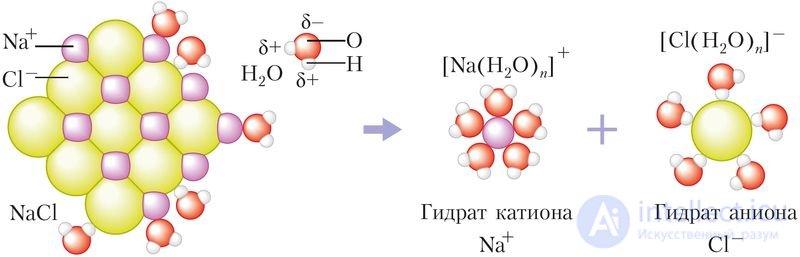
Study Figure 57 and note the relative sizes of Na+ cations, Cl– anions, and water molecules, as well as the signs of the partial charges on the H and O atoms in the water molecule. Note which atom of the water molecule is turned toward the Na+ cation, and which toward the Cl– anion. Why is the water molecule oriented toward the Na+ cation with its oxygen atom, and toward the Cl– anion with its hydrogen atom?
A feature of the dissociation of ionic compounds (salts and alkalis) is that these substances already consist of ions, and polar water molecules merely separate the cations and anions. The energy expended on dissociation is compensated by the energy released during hydration of the ions, and overall the process proceeds spontaneously.
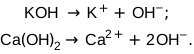
Being bases that are readily soluble in water, alkalis dissociate in aqueous solutions into hydroxide anions and metal cations:
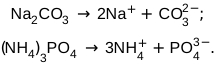
As a result of the dissociation of salts in water, their ionic crystals break down into metal (or ammonium) cations and anions of the acid residues:
Dissociation of compounds with a covalent polar type of bonding
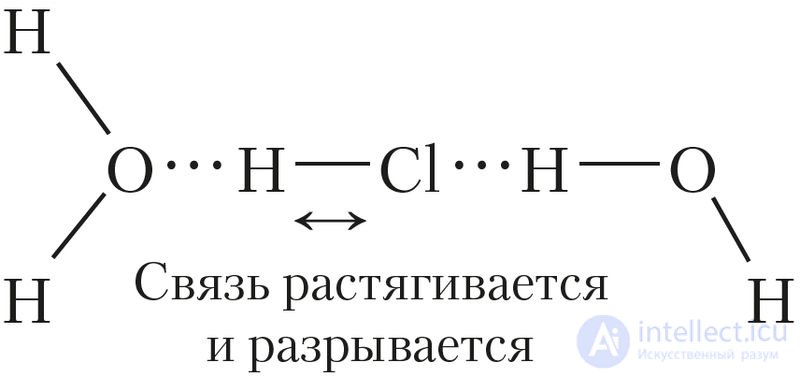
Most organic and inorganic acids are soluble in water and are electrolytes. In acids, the hydrogen atoms are joined to the atoms of the acid residues by covalent polar bonds. Polar molecules do not contain ready-made ions. Let us consider the process of dissociation of acids using the molecule  as an example.
First, the polar acid molecules are attracted to the polar water molecules and become even more polarized.
Hydrogen bonds form between the acid and water molecules (Fig. 58).
Then the covalent polar bond  lengthens and becomes less strong. As a result, it breaks, that is, ions are formed:

The H+ cation formed upon dissociation of the acid attaches to a water molecule to form a hydronium cation H3O+ by a donor–acceptor mechanism, with which you became familiar while studying the material in § 13. The chlorine ion formed upon ionization is likewise hydrated, as shown in Figure 57.
To simplify equations of reactions written in ionic form, the hydrated hydrogen cation is usually written as H+.
In a similar manner, under the action of polar water molecules, the dissociation of other compounds with a covalent polar type of bonding also takes place.
Dissociation includes the processes of hydration of the initial molecules, their polarization, the breaking of bonds within the molecules, and their breakdown to form hydrated ions.
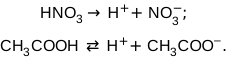
Acid molecules, upon dissociation in aqueous solutions, dissociate fully or partially into hydrogen cations and anions of the acid residues:

*The difference between the chemical properties of ions and those of atoms and molecules
Atoms and molecules are electrically neutral particles. Metal cations, for example K+, as you know, are formed as a result of metal atoms giving up electrons. Anions of nonmetals, for example Br–, are formed as a result of the addition of electrons to nonmetal atoms.
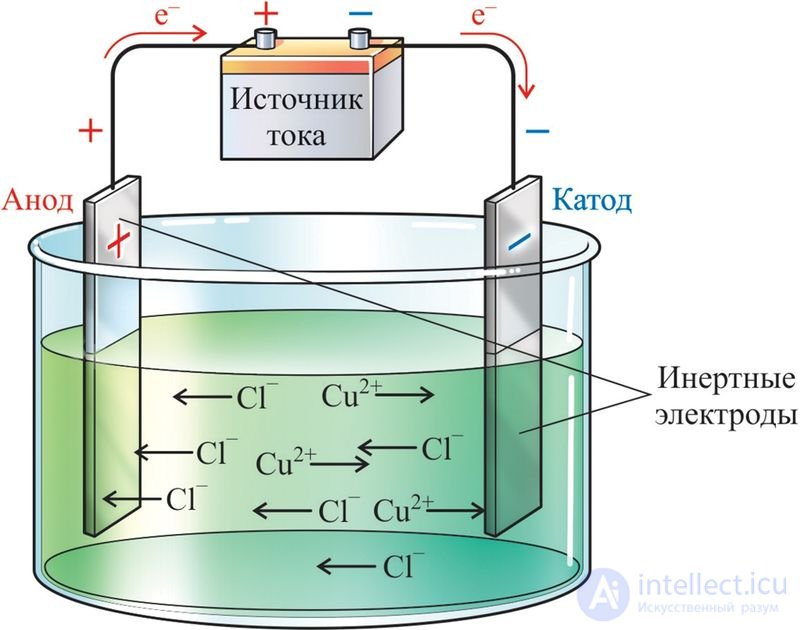
The properties of cations and anions differ from the properties of the corresponding electrically neutral atoms. Thus, in an electric field created by electrodes, an ordered movement of the electrolyte's cations and anions occurs — an electric current. Positive ions — metal cations, H+,  and others — move toward the negative electrode (the cathode).
Negative ions — anions of acid residues and OH– — move toward the positive electrode (the anode) (Fig. 58.1).
Unlike neutral atoms (in particular, metal atoms), cations, for example Cu2+, Fe3+, and others, have fewer electrons in their outer electron levels and a smaller size, and can always act as an oxidizing agent, accepting electrons:
CuSO4 + Zn = ZnSO4 + Cu↓
or Cu2+ + Zn = Zn2+ + Cu↓.
Compared with neutral atoms (I, S, O), simple anions, for example I–, S2– , O2– , and others, have a greater number of electrons in their outer electron levels and a larger size, and can act as a reducing agent, giving up electrons:
2NaI + Cl2 = 2NaCl + I2
or 2I– + Cl2 = 2Cl– + I2.
Strong and weak electrolytes
Simultaneously with electrolytic dissociation in an electrolyte solution, ion association processes occur. Therefore, in electrolytes only a certain fraction of the substance exists in the form of free ions, that is, the substance may not fully break down into ions.
To quantitatively characterize electrolytic dissociation, the concept of the degree of dissociation α is used.
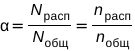
The degree of dissociation α — is the ratio of the number of molecules or formula units of the electrolyte that have broken down into ions to the total number of its dissolved molecules or formula units:
 .
.
The number of particles and their amount (mol) are related by the equation:
 , hence,
  ,
,
where n is the amount (mol) of the corresponding molecules or formula units.
The value α is expressed as a fraction of unity or as a percentage. The degree of dissociation shows what part of the electrolyte has broken down and exists in the solution in the form of free ions. For example, the degree of dissociation of acetic acid in a solution with a molar concentration of 0.1 mol/dm3 is 1.3 %. This means that out of 1000 acid molecules, only 13 dissociated into H+ cations and CH3COO– anions.

Ion association — the combination of oppositely charged ions under the action of electrostatic forces into neutral or charged particles.
Examples of association include irreversible exchange reactions (they will be discussed in § 27), written in ionic form:
Ag+ + Cl– = AgCl↓,
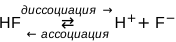
or reversible dissociation reactions of weak acids:
 .
.
It would seem that strong acids fully dissociate into ions in aqueous solutions. Nevertheless, water-moistened litmus paper turns red when placed above 20–30% solutions of HCl and HNO3. This indicates the presence, in the solution and in the vapor above the solution, of undissociated HCl and HNO3 molecules, which dissociate upon contact with the moist paper. However, above 5–10% solutions of these strong electrolytes, the litmus paper no longer turns red. This indicates the complete dissociation of HCl and HNO3 molecules into nonvolatile ions even in such comparatively concentrated solutions.
One can assess how strong the dissociation is in aqueous solutions of ammonia. Moist litmus paper placed above a dilute ammonia solution turns blue. This is explained by the fact that most of the ammonia in water is in molecular form and evaporates. Thus, above a 4% solution of NH3, the number of NH3 molecules is one and a half times greater than the number of water vapor molecules.
The probability of ion association decreases as the electrolyte concentration decreases, and consequently, the degree of dissociation in dilute solutions is greater than in concentrated ones. This means that the degree of dissociation depends not only on the nature of the substance but also on the concentration of the electrolyte.
Depending on the numerical value of α, electrolytes are conventionally divided into strong and weak.
Strong electrolytes — are chemical compounds that are practically completely dissociated into ions in dilute solutions. The degree of dissociation α of strong electrolytes is close to 1.
Strong electrolytes include soluble ionic compounds and some substances with a covalent polar type of bond; for these, the process of association of the formed ions is practically absent. Therefore, in the equations reflecting electrolytic dissociation, an arrow in one direction is used instead of an equal sign. As examples, let us give the dissociation equations of soluble salts (a), bases (b) and strong acids (c) — H2SO4, HCl, HBr, HI, HClO4, HNO3:



The degree of dissociation of weak electrolytes is, as a rule, less than 5 %. Weak electrolytes include water (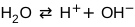 ), as well as:
Weak electrolytes — are chemical compounds that dissociate into ions only slightly, even in dilute solutions. Ions of weak electrolytes are in mobile equilibrium with molecules that have not dissociated, or with a substance of non-molecular structure that has not dissolved.
The dissociation of weak electrolytes is depicted by a breakdown equation with arrows in both directions:  .
.
It is quite difficult to draw a clear boundary between strong and weak acids. Hydrofluoric acid (HF) is conventionally considered weak, although in dilute solutions it dissociates to 8–25 %. Phosphoric acid H3PO4, sulfurous acid H2SO3, and oxalic acid HOOC—COOH are also considered weak. At the first step of dissociation, they dissociate to 10–30 % in concentrated solutions and more than 50 % in dilute ones.
For example, in a dilute solution H3PO4 dissociates according to the equation:

The degree of dissociation at this step can reach 50 %. At each subsequent step, the degree of dissociation decreases significantly, and dissociation proceeds according to the equations:
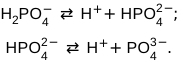
The decrease in the degree of dissociation is related to the strengthening of the interaction of hydrogen ions  with acid residues in the series
  ,
,  and
and  .
.
The degree of dissociation α is usually determined experimentally from the electrical conductivity of the solution.
The dissociation of weak electrolytes, as a reversible reaction, obeys Le Chatelier's principle. Thus, the H+ cations formed at the first dissociation step shift the equilibrium of the dissociation reaction at the second and third steps to the left, in accordance with Le Chatelier's principle. This decreases the degree of dissociation of the  and
and  anions and the concentration of the and
  anions, respectively.
As a rule, at each subsequent step the degree of dissociation decreases.
In a H3PO4 solution with a molar concentration of 1 mol/dm3, the fractions of H3PO4 molecules and of the anions  , and formed at the various stages are:
| H3PO4 | H+ | |
|
|
| 92 % | ~8 % | ~8 % | ~6 · 10–6 % | ~10–16 % |
All polybasic weak acids dissociate practically only at the first step. Let us consider one more example — the dissociation of weak hydrosulfuric acid. At the first step, a small part of the H2S molecules dissociates to form hydrogen ions and hydrosulfide ions; at the second, sulfide ions are formed from hydrosulfide ions:
H2S  H+ + HS–;
HS– H+ + S2–.
Dissociation at the second step proceeds significantly more weakly, because:
Electrolytes are substances whose aqueous solutions or melts conduct electric current.
The dissociation process of molecular compounds with covalent polar bonds differs from the dissociation process of ionic compounds in that it involves a stage of molecular polarization and covalent bond cleavage.
Based on their degree of dissociation, strong and weak electrolytes are distinguished.
The degree of dissociation depends not only on the nature of the substances but also on the concentration of the solutions, and increases as they are diluted.
Questions, exercises, problems
1. Why do salts conduct electric current after melting?
2. How does electric current in metals differ from electric current in solutions or melts of electrolytes?
3. Write the dissociation equations for the following substances: KHCO3, HClO4, Sr(OH)2, LiOH, КHSO4, NH4H2PO4, HNO2.
4. Why does electrolytic dissociation in solutions proceed spontaneously?
5. Compare the oxidizing and reducing ability of:

6. Why does dissociation at the second step proceed more weakly than at the first step for the anions of most polybasic acids, for example ,  ,
,  ,
,  ? How will the degree of dissociation change when hydrogen ions are added to solutions of these acids?
7. An aqueous solution contains 50 mol of hydrogen fluoride. What is the total number of ions formed upon its dissociation, if α(HF) = 9 %?
8. Determine the total number of cations and anions of the salt in a solution containing sodium sulfate with a mass of 2.84 g.
9. What is the molar concentration of H+ cations in an aqueous solution of acetic acid with a volume of 4 dm3, if the degree of dissociation of the acid is 2.6 %, and the mass of the acid is 6 g?
10. In a solution with a volume of 2.5 dm3, the mass of Ba(OH)2 is 14 g. Calculate the molar concentration of OH– ions in this solution.

*Self-check
1. The dissociation of both NaCl and HCl includes:
2. The F– ion differs from the fluorine atom F in:
3. A solution of a certain salt contains 2 mol of cations and 3 mol of anions. This salt could be:
4. Dissociation equations of weak electrolytes:
2H++  ; H+ + ОH–; С6Н5О– + Н+;
5. In a solution of nitrous acid, the number of undissociated molecules is 4 times greater than the number of dissociated ones. The degree of dissociation of the acid is equal to:
Часть 1 5.25. Electrolytic dissociation of substances in solutions
Часть 2 - 5.25. Electrolytic dissociation of substances in solutions

Comments