
Lecture
The figure four is a sitting position in which a person crosses the ankle of one leg over the knee of the other. Visually, the legs form a shape resembling the number "4," hence the name.
In English-speaking circles, it is often called the figure four position.
Historical and Cultural Context
This position became widespread in the 20th century in the United States and became associated with:
This position can often be seen:
Over time, it has become accepted as part of the American business non-verbal code.
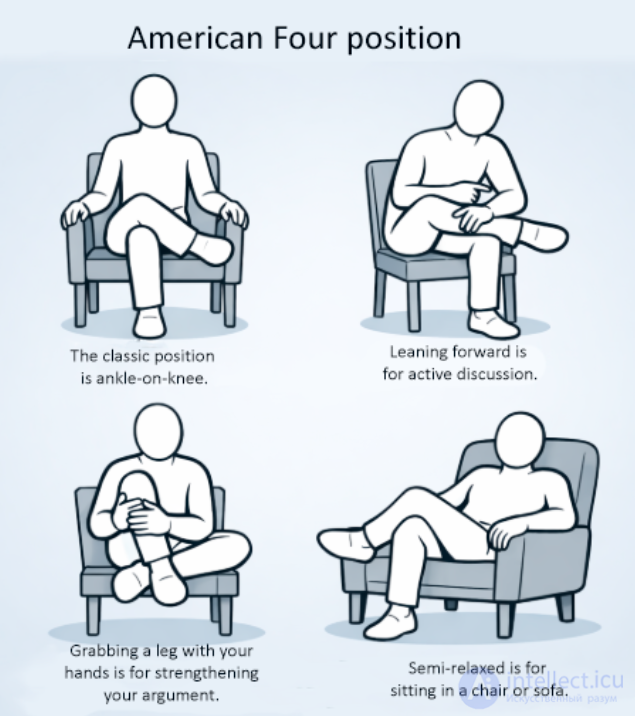
From a nonverbal communication perspective, posture can mean:
Confidence
The person takes up more space, demonstrating openness and inner stability.
Dominance
Sometimes interpreted as a manifestation of superiority or control over the situation.
Relaxation
In an informal setting, it is a sign of comfort and calm.
Closedness (in some cases)
If the leg is additionally clasped with the hands, this may indicate a defense of one's position in an argument.
Important: the meaning always depends on the context, culture, and specific situation.
Physiological Aspects
Pros:
Cons:
Ergonomics experts recommend not holding this position for too long and alternate it with a neutral leg position.
In the United States and Canada, this position is considered normal and common.
In some European countries, it is acceptable, but less formal.
In some Asian cultures, showing the sole of a shoe can be considered disrespectful.
Therefore, it is important to consider cultural differences in the international environment.
The "American Four" posture (ankle on the opposite knee) has different meanings and prevalence depending on the culture. Below is an overview by region.
North America (USA, Canada)
Very common.
Reasons:
Western Europe
Moderately common.
In countries such as:
Reasons:
United Kingdom
Used, but with caution.
British body posture culture is more conservative. Normal in private conversations, less so in formal settings.
Japan
Rarely used.
Reasons:
high culture of respect;
showing the soles of shoes can be considered disrespectful;
a more closed and careful sitting posture is accepted.
This posture is almost never seen in business settings.
China
It is uncommon in formal settings.
In young urban environments, it can be seen as a sign of Western influence, but is traditionally considered too relaxed for business communication.
South Korea
The situation is similar to Japan:
in formal settings, it is frowned upon;
in informal settings, it is acceptable.
Southeast Asia
In countries where showing the soles of shoes is considered disrespectful (for example, Thailand), this posture can be perceived negatively, especially towards elders.
Middle East
Here, much depends on the situation.
In some countries:
showing the soles of shoes is undesirable;
the posture can be interpreted as disrespectful. However, in the international business environment, especially among those with a Western education, it is more common.
Eastern Europe
Moderately common.
Common in informal settings.
In strict, formal settings, it is used less frequently.
Often perceived as a sign of confidence or "American style."
In fact, as a way of sitting, it is physically known almost everywhere—people intuitively adopt different postures.
But:
As a cultural symbol of confidence and status, it is known primarily in the Western world;
In traditional societies, it has no specific name and carries no special social significance.
Why is there such a big difference in the use of this posture?
Key factors:
Attitudes toward showing the soles of shoes
In some cultures, this is a sign of disrespect.
The more hierarchical the culture, the more neutral the posture should be.
Level of Western Influence
In countries with a strong American cultural influence, this posture is more common.
Body Distance and Personal Space
Individualistic cultures allow for more "spatial expansion."
The American "four" is not just a way of sitting, but an element of nonverbal communication.
It can convey confidence, status, comfort, or, conversely, resistance—depending on the context.
Like any posture, it is most appropriate where it suits the situation, culture, and the individual's state of mind.

Comments
To leave a comment
Body language
Terms: Body language