
Lecture
In the case of a sudden short circuit of a synchronous machine, the system of differential equations has the form


The use of numerical integration methods for their study requires first casting the system of differential equations into the form of a Cauchy problem, i.e. carrying out transformations and computing the initial conditions.
The problem-solving algorithm is as follows:
The initial conditions are determined based on calculation of the preceding regime of the synchronous machine.
A system of differential equations of the form is formed
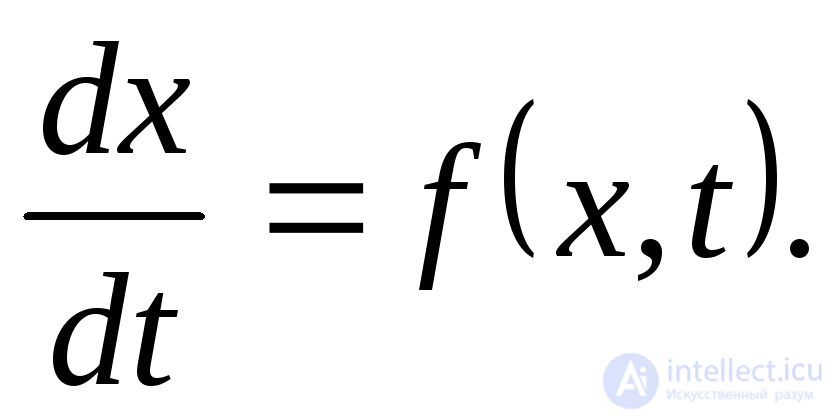
Integration of the system of differential equations is performed.
In addition to a quantitative assessment of the short-circuit process of a synchronous machine, a qualitative solution of these differential equations can be considered, using their analytical solutions.
For the analytical study it is necessary to use operator equations, and instead of the full variables it is necessary to consider their increments, which correspond to zero initial conditions of the original differential equations.
Let the machine have no damper windings and no automatic excitation regulation (AER). Considering a sudden short circuit at the generator terminals, it can be assumed that 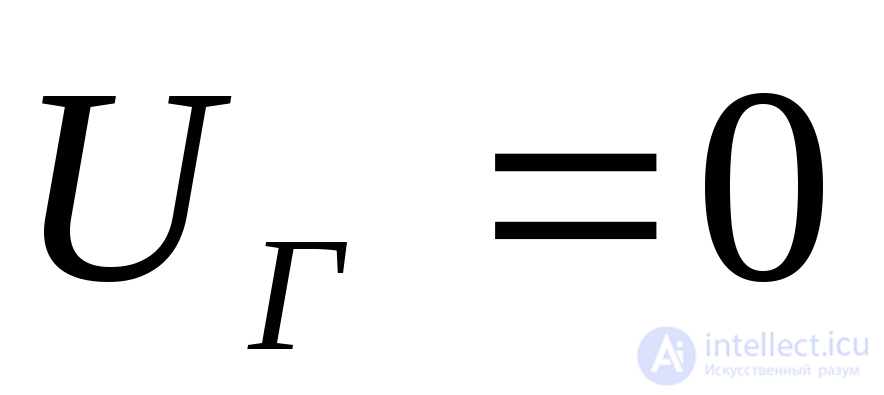 .
.
The system of operator equations has the form:
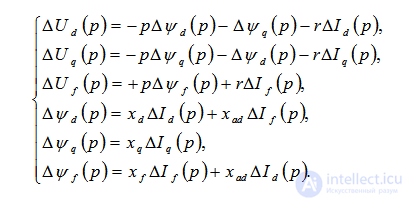
In the case of an asymmetrical regime, the equation for the zero-sequence component must be considered

The sought short-circuit regime can be obtained as a result of superimposing the transient regime on the preceding steady-state regime, characterized at the instant of switching by the parameters 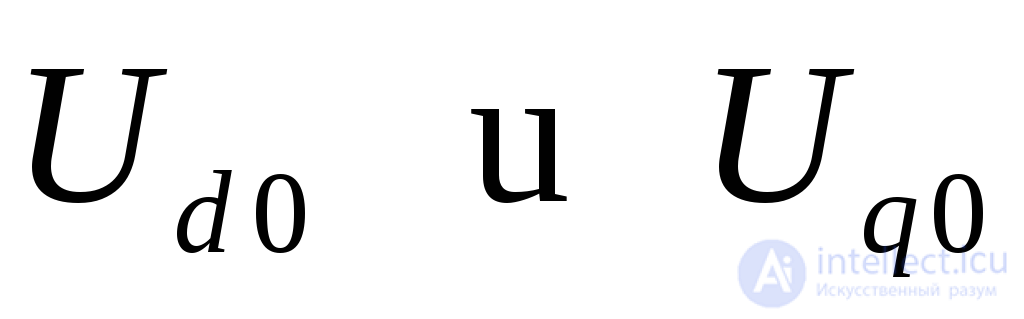 . Moreover, the transient regime develops from zero initial conditions and is caused by the increments of the voltages
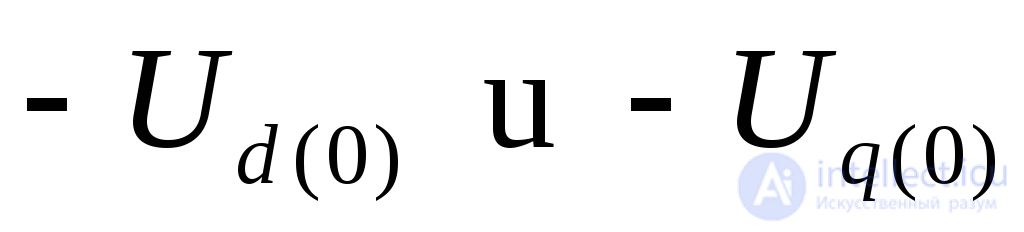 at the short-circuit location. Thus, taking into account
 we have
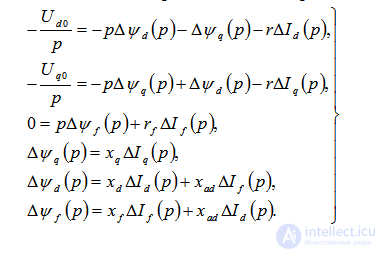 (3.11)
The problem reduces to solving algebraic equations with respect to the stator current – 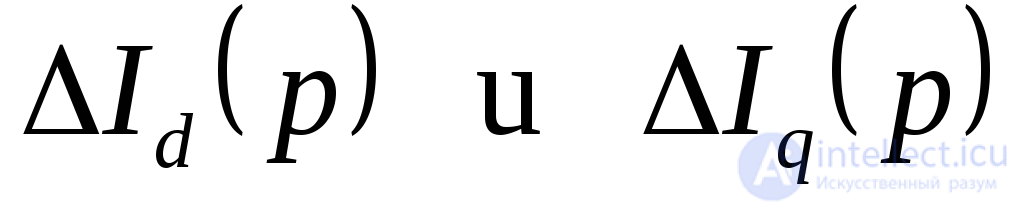 with a subsequent transition from images to the original.
From the system of equations (3.11) we obtain
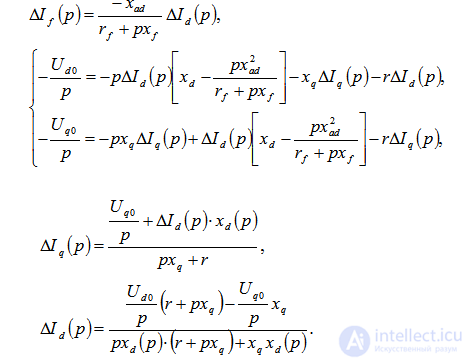
To transition to the original, we use the expression

The denominator has 4 roots: one zero, two complex conjugate, one real. If we assume 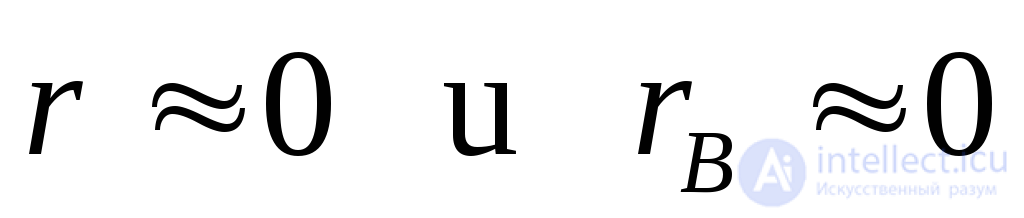 , then in analytical form we can write:
Using the expansion theorem, the originals 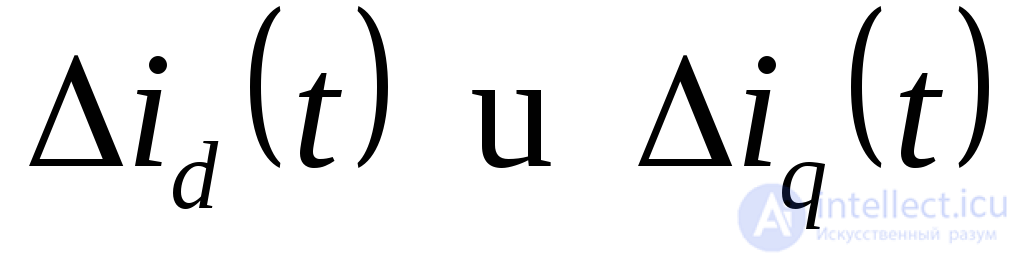 can be constructed, and then the full values of the phase currents, for example for phase A:
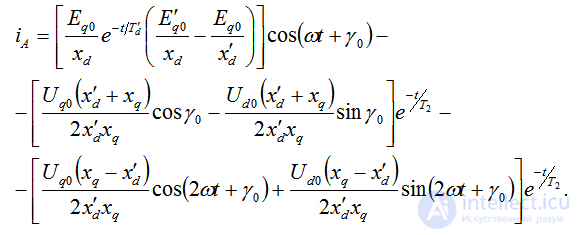
Here 
The third component determines the second harmonic and is caused by the asymmetry of the rotor ( ). Physically, the stator's second harmonic is associated with the pulsating component of the rotor field created by the aperiodic components of the stator current.
In the case of a machine without damper windings, but with AER, the voltage-balance equation in the field winding has the form:
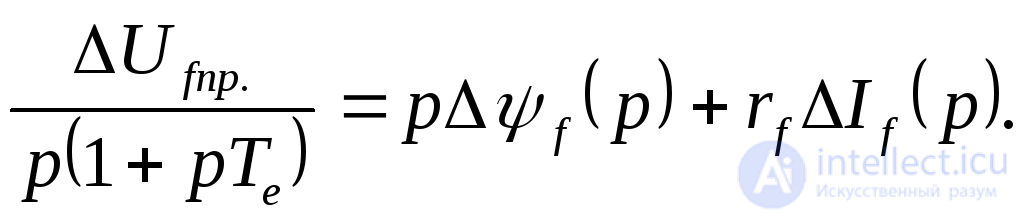
The solution of the problem is similar to the previous case. However, the polynomial in the denominator has 6 roots, two of which are zero.
Accounting for damper windings in solving problems on the sudden short circuit of a synchronous machine can be performed in general form only approximately, as an account of the effect of short-circuited loops.
The solutions obtained are also applicable to the analysis of processes during a short circuit in the external circuit, if 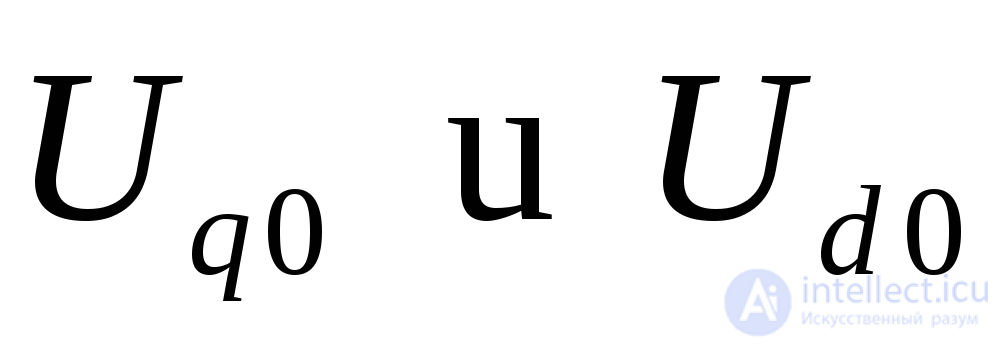 is taken to mean the values of the voltages at that point in the preceding regime, and all the machine reactances and the active stator resistance are increased by
 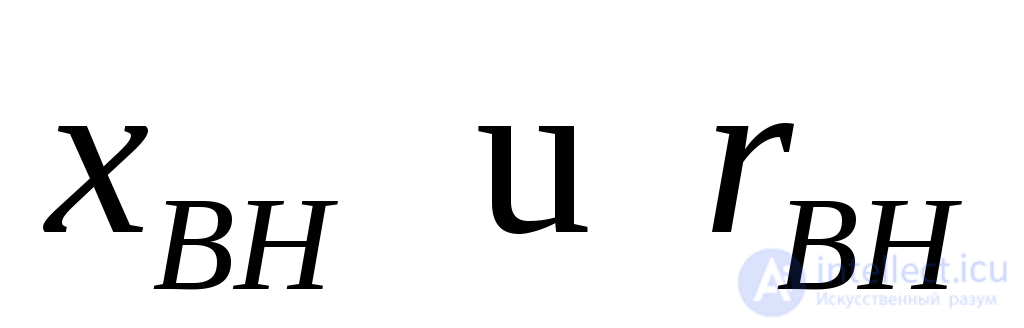 , characterizing the circuit between the stator and the short-circuit point.

Comments