
Lecture
When a three-phase circuit is symmetrical overall but the asymmetry is local in nature (a local short circuit or open phase, connection of an unbalanced load), it is convenient to use the active two-terminal network theorem for the calculation.
If the asymmetry (the asymmetric section) is mentally removed, the remaining circuit is in a symmetrical no-load condition. In accordance with the equivalent-generator method, it is now necessary to determine the equivalent EMFs and input impedances of the symmetrical circuit. In the general case – when the source's phase voltage system is itself asymmetric – besides the equivalent positive-sequence EMF  there will also be equivalent negative-sequence
  and zero-sequence
  EMFs. Usually, however, the generator voltages are symmetrical – in that case
  . The value
  , corresponding to the open-circuit voltage
  at the terminals where the local asymmetry is connected, is determined with the local unbalanced load disconnected, by any known method of linear-circuit analysis; since the circuit is symmetrical, the calculation is carried out for a single phase.
The input impedances of the symmetrical circuit for the different sequences are calculated separately, the circuit first being converted into a passive one by known methods. Here, when calculating the zero-sequence input impedance  only those sections of the circuit connected to the neutral conductor or a grounded neutral point need be taken into account, i.e., only the branches through which zero-sequence currents can flow. The circuits used to calculate the positive- and negative-sequence input impedances are identical, although for rotating machines the values of these impedances differ.
Since a symmetrical mode exists separately for each symmetrical sequence, the calculation by this method is carried out for a single phase using the equivalent circuits for the positive (Fig. 1,a), negative (Fig. 1,b) and zero (Fig. 1,c) sequences.
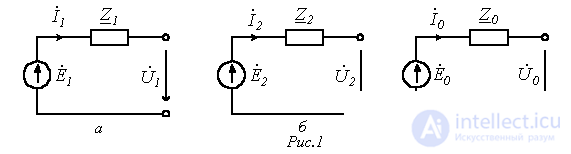
These circuits correspond to the relations
 ; ; |
(1) |
 ; ; |
(2) |
 . . |
(3) |
Since there are only three relations while the number of unknowns they contain is six  , three additional equations must be formed that account for the specific type of asymmetry.
Let us consider some typical examples of applying the method.
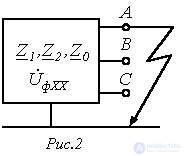
Single-phase-to-ground fault (Fig. 2).
 .
.
Since phase A is short-circuited to ground, the additional equations are
 ; ; |
(4) |
 ;
;
 .
.
Then
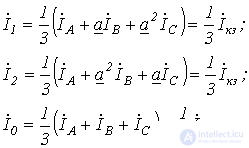
Taking these last relations into account, equations (1)…(3) can be written as
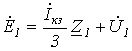 ; ; |
(5) |
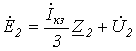 ; ; |
(6) |
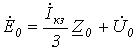 . . |
(7) |
Taking (4) into account, and also the fact that the supply source is symmetrical 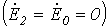 , let us sum (5), (6) and (7):
 ,
,
from which we obtain
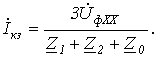
Two-phase short circuit without ground fault (Fig. 3).
For the case under consideration we can write
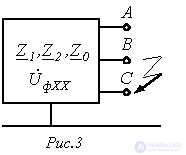
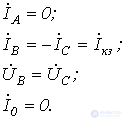
The last equality is explained by the absence of a path for zero-sequence currents to flow.
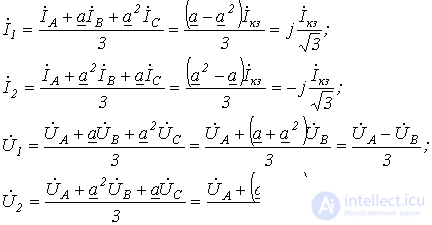
From the last two relations it follows that  . Here
  , since
  and
and  .
.
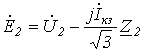
Substituting the resulting expressions for the positive- and negative-sequence voltages and currents into (1) and (2), we write
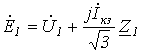 ; ; |
(8) |
 . . |
(9) |
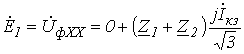
Subtracting relation (9) from (8), and taking into account that due to the symmetry of the source  , we obtain
 ,
,
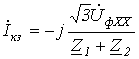
from which
 .
.
Open line conductor (Fig. 4) – determine the voltage at the point of the break.
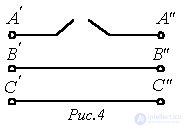
In the case under consideration the additional equations take the form
 ; ; |
(10) |
 ; ; |
(11) |
 . . |
(12) |
From relations (11) and (12) the following equality follows:
 . . |
(13) |
Based on (1)…(3), taking (13) into account, we write
 .
.
Taking into account the symmetry of the source 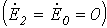 , let us substitute the last expressions into (10):
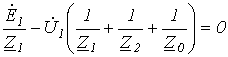 ,
,
- from which
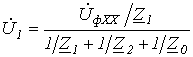 .
.
Thus the required voltage is
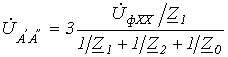 .
.
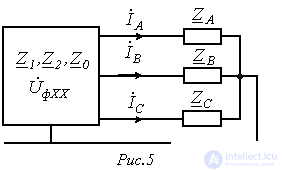
Connection of an unbalanced load  to a symmetrical circuit (Fig. 5).
Taking into account that  , let us substitute into equations (1)…(3) the expressions
  and
and  derived in the previous lecture (see relation (12) in Lecture No. 19):
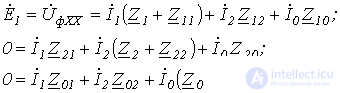
Solving this system of equations, we find  and
and  . Then
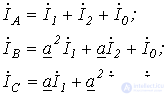
and  .
.
In the examples considered, it was assumed that the parameters  and
and  needed for the circuit analysis had already been determined. Let us consider their calculation using the previous problem as an example, for a certain circuit shown in Fig. 6.
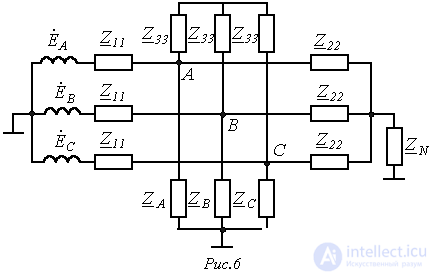
Since, with the unbalanced load  disconnected, the remaining part of the circuit operates in a symmetrical mode, to determine
  we obtain the single-phase equivalent circuit shown in Fig. 7.
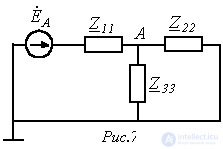
From it
 .
.
The circuit for determining the positive-sequence  and negative-sequence
  input impedances is the same and corresponds to the circuit in Fig. 8,a. In accordance with it
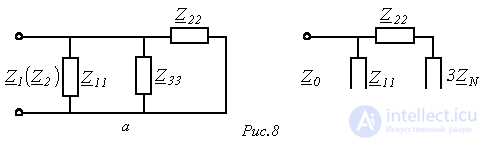
 .
.
The circuit for determining  , obtained taking into account the possible paths for zero-sequence currents, is shown in Fig. 8,b. From it
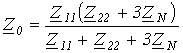 .
.
Expressing power through symmetrical components
The complex apparent power in a three-phase circuit
 . . |
(14) |
For the phase voltages we have
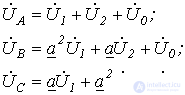 |
(15) |
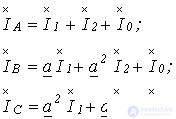
Taking into account that the complex conjugate of  is
is  and vice versa, for the conjugate current complexes we write:
 |
(16) |
Substituting (15) and (16) into (14), after the corresponding transformations we obtain
 .
.
Hence

and
 ,
,
where  are the phase differences of the corresponding symmetrical components of voltages and currents.
References
Review questions and problems
Answer:  .
.
Answer: 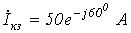 .
.
 and
and  in the circuit in Fig. 3, if the phase EMF is
  , and the positive- and negative-sequence impedances are:
  .
. , and the positive- and negative-sequence impedances are
  .
.
Comments