
Lecture
The short-circuit surge current is the term for the maximum instantaneous value of the total current under the most unfavorable conditions.
For electrical circuits in which inductance predominates, this occurs if the pre-fault regime was no-load and the short circuit occurs at the instant when the voltage passes through zero (Fig. 2.4).
In this case the periodic component of the short-circuit current starts from its amplitude value. According to the laws of commutation, at the first instant of the short circuit the initial value of the aperiodic component turns out to be the maximum possible and equal to the amplitude of the periodic component of the short-circuit current
Ia(0) = Inm
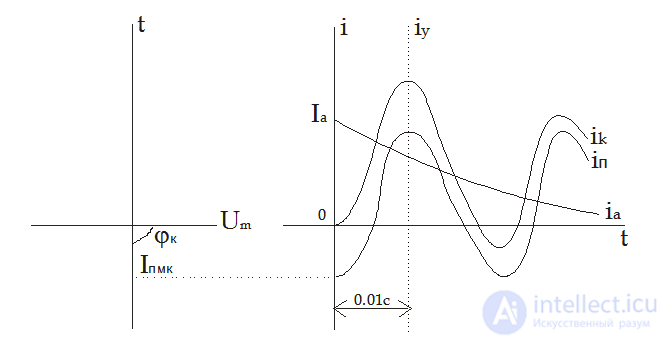
Fig. 2.4. Short-circuit surge current
The largest instantaneous value of the total short-circuit current – the surge current – occurs at the first largest value of the aperiodic component that coincides in sign with the periodic component of the short-circuit current. This instant occurs approximately half a period after the short circuit appears. Under this condition the surge current is
Isc = Ip m + Ip m e –0,01/Ta = Ip m ( 1 + e—0,01/Ta ) = Ip m ksc.(2.9)
The quantity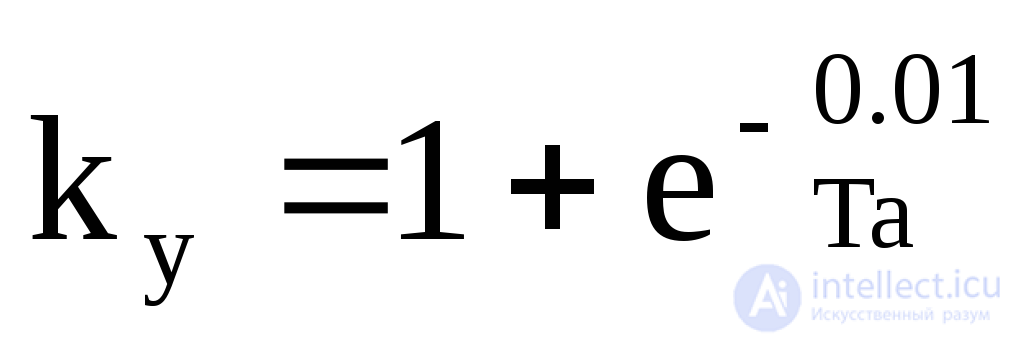 is called the surge-current coefficient, characterizing the excess of the surge current over the amplitude of the periodic component of the short-circuit current
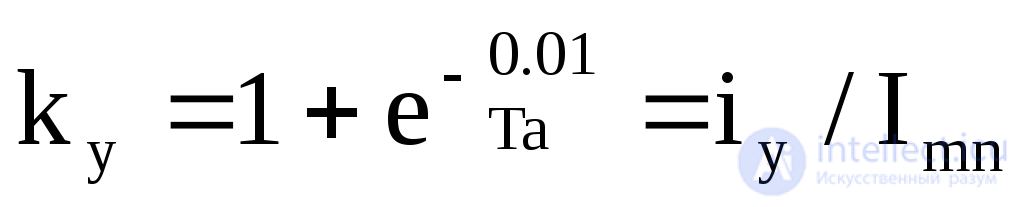 .(2.10)
The surge-current coefficient depends on the decay time constant of the aperiodic component Ta = xk / (314rk).
At  ,
,
and at 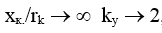 , i.e. the values of the surge-current coefficient vary within the range
1<ksc<2.
The dependence of the surge-current coefficient on the ratio xk./rk (the time constant Ta) is shown in Fig. 2.5. Over the interval 3Ta the aperiodic component of the short-circuit current practically decays.
In practical calculations the surge current is determined by the formula
 (2.11)
where I" - the subtransient short-circuit current (the rms value of the periodic component at the first instant of the short circuit).
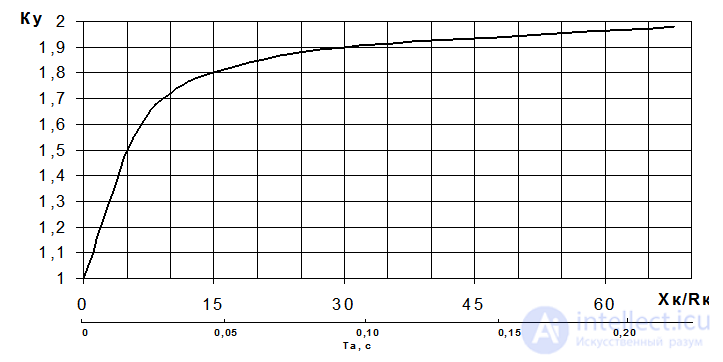
Fig. 2.5. Dependence of the surge-current coefficient on the ratio xk./rk and the time constant of the short-circuited path

Comments