
Lecture
The method of symmetrical components belongs to the special methods for calculating three-phase circuits and is widely used to analyze unbalanced modes of their operation, including with non-static loads. The method is based on representing an unbalanced three-phase system of variables (EMFs, currents, voltages, etc.) as the sum of three balanced systems, which are called symmetrical components. A distinction is made between symmetrical components of positive, negative, and zero sequence, which differ in the order of phase rotation.
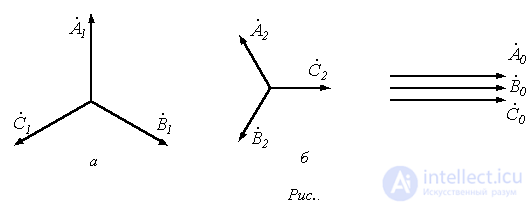
A positive-sequence symmetrical system is formed (see Fig. 1,a) by three vectors equal in magnitude,  and
and  , shifted relative to one another by
  rad, with
  lagging
  , and
, and  lagging
  .
.
Introducing the rotation operator  , for the positive-sequence symmetrical system we can write
 .
.
A negative-sequence symmetrical system is formed by vectors equal in magnitude,  and
and  , with a relative phase shift of
  rad, but now with
  lagging
  , and
, and  lagging
  (see Fig. 1,b). For this system we have
 .
.
The zero-sequence system consists of three vectors equal in magnitude and phase (see Fig. 1,c):
 .
.
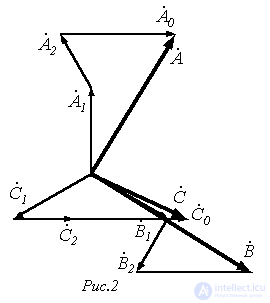
Adding the three systems of vectors described above yields an unbalanced system of vectors (see Fig. 2).
Any unbalanced system can be uniquely decomposed into symmetrical components. Indeed,
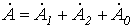 ; ; |
(1) |
 ; ; |
(2) |
 . . |
(3) |
Thus, a system of three equations is obtained with respect to the three unknowns  , which are therefore uniquely determined. To find
  we add equations (1)…(3). Then, taking into account that
 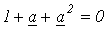 , we obtain
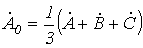 . . |
(4) |
To find  we multiply (2) by
  , and (3) by
  , and then add the resulting expressions to (1). This gives us the relation
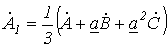 . . |
(5) |
To determine  , together with relation (1) we add equations (2) and (3), first multiplied respectively by
  and
and  . As a result we have:
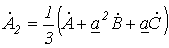 . . |
(6) |
Formulas (1)…(6) hold for any system of vectors  , including a symmetrical one. In the latter case
  .
.
In closing this section, we note that besides being computed, symmetrical components can also be measured using special symmetrical-component filters used in relay protection and automation devices.
Properties of symmetrical components of currents
and voltages of different sequences
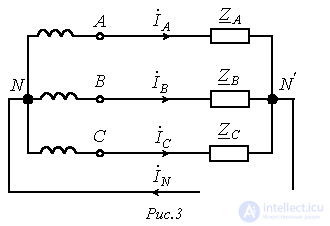
Consider the four-wire system in Fig. 3. For the current in the neutral wire we have
 .
.
Then, taking (4) into account
 ,
, |
(7) |
i.e., the current in the neutral wire equals three times the zero-sequence current.
If there is no neutral wire, then  and correspondingly there are no zero-sequence current components.
Since the sum of the line voltages equals zero, according to (4) the line voltages contain no zero-sequence components.
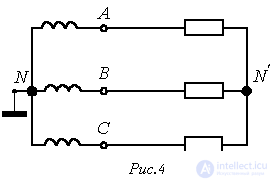
Consider the three-wire unbalanced system in Fig. 4.
Here
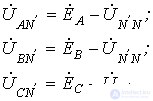
Then, by summing these relations, for the zero-sequence symmetrical components of the phase voltages we can write
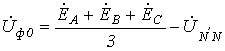 .
.
If the generator's EMF system is symmetrical, then from the above we obtain
 . . |
(8) |
From (8) it follows that:
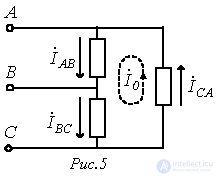
When the load is connected in delta, the phase currents  and
and  may contain zero-sequence symmetrical components
  . In this case
  (see Fig. 5) circulates around the loop formed by the load phases.
Impedances of a balanced three-phase circuit
for currents of different sequences
If a balanced system of phase voltages of positive (negative or zero) sequence is applied to a balanced circuit, a balanced system of currents of positive (negative or zero) sequence arises in it. When using the method of symmetrical components in practice, the symmetrical components of voltages are related to the symmetrical components of currents of the same sequence. The ratio of the symmetrical components of phase voltages of positive (negative or zero) sequence to the corresponding symmetrical components of currents is called the complex impedance of positive
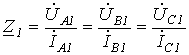 ,
,
negative
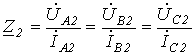
and zero
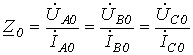
sequence.
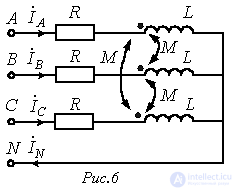
Let us have a section of a circuit as in Fig. 6. For phase A of this section we can write
 . . |
(9) |
Then for the symmetrical components of the positive and negative sequences, taking into account that  , based on (9) we have
 .
.
Hence the complex impedances of the positive and negative sequences are equal and given by:
 .
.
For the zero-sequence symmetrical components, taking into account the equality  , relation (9) transforms into the equation
 ,
,
whence the zero-sequence complex impedance
 .
.
In the example considered, the positive- and negative-sequence impedances turned out to be equal. In the general case these impedances can differ from one another. The most typical example is the difference between the impedances of a rotating machine for positive- and negative-sequence currents, due to the large difference in the rotor's slip relative to the rotating magnetic field for these sequences.
Application of the method of symmetrical components
to balanced circuits
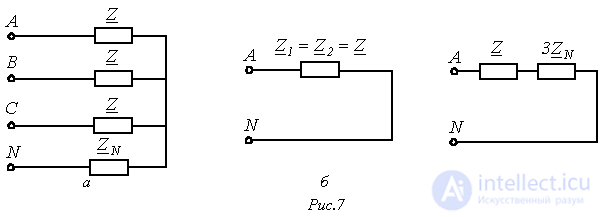
Calculating circuits by the method of symmetrical components is based on the superposition principle, and for this reason the method applies only to linear circuits. According to this method, the calculation is carried out separately for the voltage and current components of different sequences, and, because the circuit's operating modes are symmetrical, it is performed for a single phase (phase A). After that, the actual required quantities are determined in accordance with (1)…(3). In the calculation it should be kept in mind that, since in a balanced mode the current in the neutral wire is zero, the neutral wire's resistance has no effect whatsoever on the positive- and negative-sequence symmetrical components of the currents. Conversely, on the basis of (7), three times the neutral-wire resistance is introduced into the equivalent circuit for the zero sequence. Taking the above into account, the original circuit in Fig. 7,a corresponds to the single-phase calculation circuits for the positive and negative sequences (Fig. 7,b) and for the zero sequence (Fig. 7,c).
The situation is considerably more complex when the impedances are unbalanced across phases. Suppose that in the circuit of Fig. 3  . Decomposing the currents into symmetrical components, for this circuit we can write
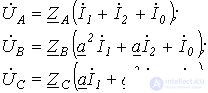 |
(10) |
In turn
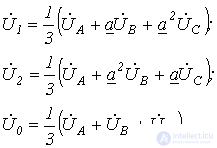 |
(11) |
Substituting the corresponding parameter values from (10) into (11) and grouping terms, we obtain
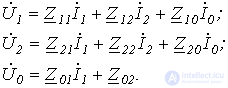 |
(12) |
where  ;
;
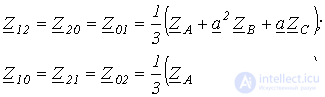
From the relations obtained it can be seen that if an unbalanced system of voltages is applied to an unbalanced circuit, each of the symmetrical current components depends on the symmetrical voltage components of all sequences. Therefore, if a three-phase circuit were unbalanced at every section, the calculation method under consideration would offer no advantages. In practice the system is mostly balanced, and the imbalance is usually local in nature. This circumstance, as will be shown in the next lecture, significantly simplifies the analysis.
At all sections of the circuit where the impedances are the same across phases,  for i¹k. Then from (12) we obtain
 .
.
References
Review Questions and Problems
Answer:  .
.
Answer: 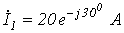 ;
; 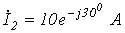 .
.
Answer:  ;
;  ;
;  .
.
 , if
, if  ,
,  .
. .
. and
and  . Determine the RMS values of the currents in the motor phases if its positive- and negative-sequence impedances are respectively equal to:
  ;
;  . There is no neutral wire.
Comments