
Lecture
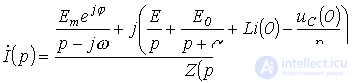
 , then when going from a complex quantity to a function of time, the imaginary part of the right-hand side of the expansion formula is taken, i.e. the term with j. If other sources are also present in the circuit at the same time, for example, a constant EMF E and an exponential EMF
  , and the initial conditions for the currents in branches with inductive elements and for the voltages on capacitors are nonzero, then all of these must be introduced into the formula pre-multiplied by j, since only in that case will they be accounted for when the imaginary part of the expansion formula is taken, i.e.
 . For complex circuits, computing this term can turn out to be quite laborious, and for that reason it is expedient in such cases to determine the forced component separately by the symbolic (phasor) method, and the free component by the operator method.
 correspond, in the expansion formula, to complex-conjugate terms which together give a doubled real term, i.e. for the k-th pair of complex-conjugate roots we have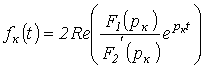
Sequence for calculating transient processes
by the operator method
1. Determination of the independent initial conditions by calculating the pre-switching operating mode of the circuit.
2. Construction of the operator equivalent circuit of the network (for simple circuits with zero initial conditions this step can be omitted).
3. Writing the equations by Kirchhoff's laws or by other methods of linear-circuit analysis in operator form, taking the initial conditions into account.
4. Solving the resulting equations for the transforms (images) of the sought quantities.
5. Determining the originals (using the expansion formula or tables of correspondence between originals and transforms) from the transforms found.
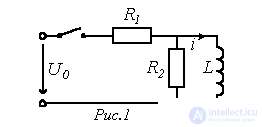
As an example of using the operator method, let us determine the current through an inductor in the circuit of fig. 1.
Taking into account the zero initial condition, the operator transform (image) of this current is
 .
.
To find the original  we use the expansion formula for a zero root
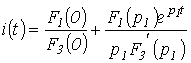 , , |
(1) |
where 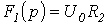 ,
,  .
.
The root of the equation 
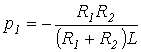 .
.
Then

and
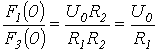 .
.
Substituting the values found for the terms of the expansion formula into (1), we obtain
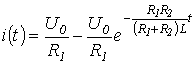 .
.
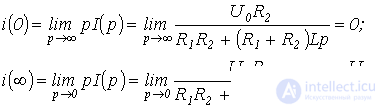
Using limiting relations, let us determine  and
and  :
:
Switch-on formulas
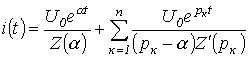
The expansion formula can be used to calculate transient processes both with zero and with nonzero initial conditions. If the initial conditions are zero, then when the circuit is connected to a source of constant, exponential, or sinusoidal voltage, it is convenient to use the switch-on formulas, which follow from the expansion formula, for calculating the transient process.
 , , |
(2) |
where  - the input operator impedance of the two-terminal network for determining the current in the branch with the switch (when calculating the current in an arbitrary branch, this is the operator impedance that determines the current in it by Ohm's law);
  - the k-th root of the equation
  .
.
 .
.

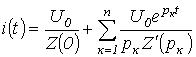
 (follows from (2) at
  )
) (formally follows from (2) at
  and
and  )
)
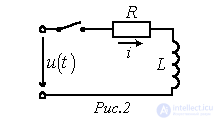
As an example of using the switch-on formula, let us calculate the current in the circuit of fig. 2 if at the instant t=0 it is connected to a source with voltage 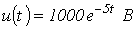 ;
;  ;
;  .
.
In accordance with the given form of the source voltage, formula (2) should be used for the solution. In it 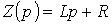 . Then the root of the equation is
  . The derivative
  and
and  .
.
As a result
 .
.
Reducing the calculation of a transient process to a calculation
with zero initial conditions
Using the superposition principle, the calculation of a circuit with nonzero initial conditions can be reduced to the calculation of a circuit with zero initial conditions. The latter circuit, containing passive elements, can then be reduced by series-parallel transformations and delta-to-wye (or wye-to-delta) transformations to a form that allows the sought current to be determined by Ohm's law using the switch-on formulas.
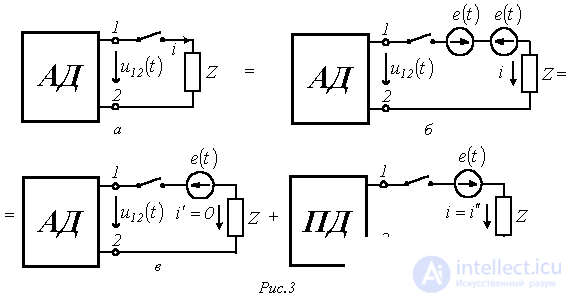
The method for reducing a circuit to zero initial conditions is illustrated in fig. 3, in which the original circuit of fig. 3,a is replaced by an equivalent circuit in fig. 3,b, where  . In accordance with the superposition principle, the latter is decomposed into two circuits; here, in the circuit of fig. 3,c, the component
  of the total current
  is equal to zero. Thus, the total current
  is equal to the current component
  in the circuit of fig. 3,d, where the original active two-terminal network AD is replaced by a passive one PD, i.e. the circuit is reduced to zero initial conditions.
It should be noted that if the current in the branch with the switch is being determined, it is sufficient to calculate the circuit of fig. 3,d. When calculating the current in some other branch of AD, in accordance with the above, it will consist of the current in that branch before switching plus the current in it caused by connecting the EMF  to the passive two-terminal network.
Similarly, it can be shown that disconnecting a branch that does not contain inductive elements can, for calculation purposes, be simulated by inserting into it a current source whose value equals the current in the branch before switching and which acts in opposition to it.
Transient conductance
When considering the superposition method, it was shown that the current in any branch of a circuit can be represented in the form
 ,
,
where  - the self (k=m) or mutual
  conductance.
This relation, transformed into the equation
 , , |
(3) |
remains valid in the transient regime as well, i.e. when closing the switch in the m-th branch connects to the circuit a constant-voltage source  located in that branch. Here
  is a function of time and is called the transient conductance.
In accordance with (3), the transient conductance is numerically equal to the current in the branch when the circuit is connected to a constant voltage  .
.
Transient function with respect to voltage
The transient function with respect to voltage is most often used in the analysis of two-port networks.
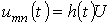
If a linear electric circuit with zero initial conditions is connected to a constant-voltage source  , then a voltage will arise between arbitrary points m and n of the circuit
 ,
,
where  - the transient function with respect to voltage, numerically equal to the voltage between points m and n of the circuit when a constant voltage
  is applied to its input.
The transient conductance  and the transient function with respect to voltage
  can be found either by calculation or experimentally (by oscillography).
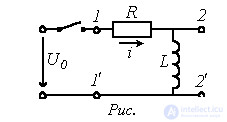
As an example, let us determine these functions for the circuit in fig. 4.
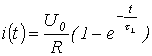
In this circuit
 ,
,
where  .
.
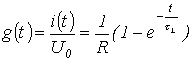
Then the transient conductance
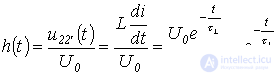
The transient function with respect to voltage
References
Review questions
Answer:  .
.

 .
. in the undivided part of the circuit in
 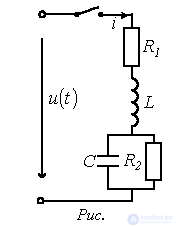 |
if: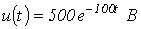  ; ;  ; ;  . . |
Answer: |

Comments