
Lecture
In the second section, it was assumed that the circuit under consideration is connected to a source of sinusoidal voltage with constant amplitude. Under such conditions, the transient process in the circuit is characterized by decay of only the free aperiodic components of current, while the periodic component is a sinusoidal current of constant amplitude, established in this circuit in its changed state.
As the point of short circuit approaches the generator, this assumption becomes unacceptable. The increase in the armature reaction of the stator during a short circuit causes demagnetization of the generator and, consequently, a reduction of its EMF to some level depending on the generator's parameters and the electrical remoteness of the short circuit.
F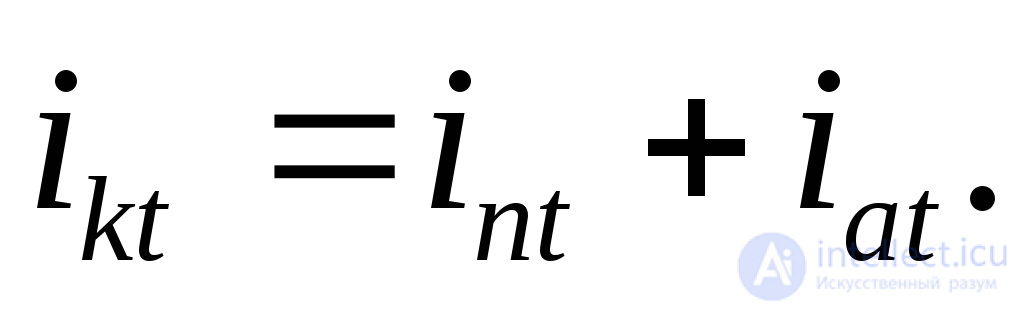 ull short-circuit current during the transient process consists of periodic and aperiodic components. The instantaneous value of the total short-circuit current at time t:
Since the generator is a source of finite power and, in accordance with the assumed condition, operates without AVR, the voltage at its terminals, and consequently its periodic component of short-circuit current, decrease with time. This is explained by the fact that as the free currents induced at the initial instant of the short circuit in the field winding, damper windings, and rotor body decay, the armature reaction flux, with unchanged field current, weakens the resultant magnetic flux in the generator's air gap. This, in turn, leads to a decrease in the EMF induced in the stator, a drop in voltage at the generator terminals, and a change in the periodic component of the short-circuit current.
Fig. 4.1 shows the time-domain diagram of the change in the short-circuit current components at the generator terminals without AVR, from which it follows that the decay time of the periodic component is much longer (up to 9 s) than the decay time of the aperiodic component. The initial short-circuit current is greater than the steady-state current value 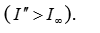
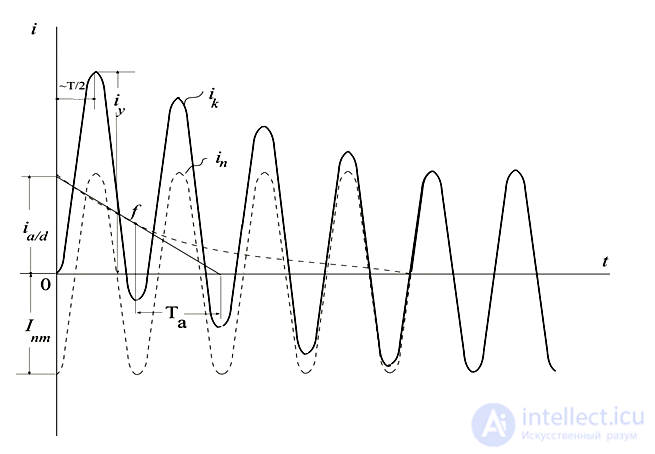
Fig. 4.1. Variation of the total current and its periodic component for one phase of a generator without AVR during a sudden short circuit at its terminals
The purpose of AVR is to automatically maintain the rated voltage at the load under all possible generator operating conditions.
In the event of a voltage drop caused by a short circuit, the AVR increases the generator's field current, and consequently the voltage at the generator terminals and at various elements of the network.
At the initial instant of the short circuit, owing to the inertia of the magnetic fluxes linked with the generator windings, the AVR has practically no effect on the transient process, so that the periodic component of the short-circuit current appears as a sinusoid with decreasing amplitude (Fig. 4.2).
The rise in generator voltage due to the action of the AVR does not begin at the instant of the short circuit but after some time needed for the AVR to respond. This time interval is determined by the drop in voltage to the value at which the AVR is activated, and by the AVR's own response time. Therefore, the short-circuit current decreases in the same way as without AVR until the AVR takes effect, after which it begins to increase and reaches a steady-state value corresponding to the increased generator voltage due to the action of the AVR (Fig. 4.2).
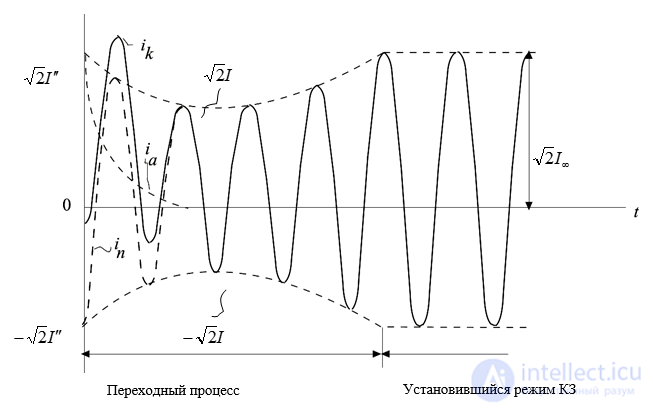
Fig. 4.2. Variation of the total short-circuit current and its components for one phase of a generator with AVR during a sudden short circuit at its terminals
Since the action of the AVR manifests itself only after several periods following the onset of the short circuit, the initial value of the total current and its components, as well as the shock (peak) current, remain the same as without AVR.
Thus, in the operation of a synchronous generator with AVR, the decay of the free currents in the stator and field winding arising from a sudden short circuit is to some extent compensated by an increase in the short-circuit current due to the action of the AVR. Depending on the relationship between the values of these currents and the nature of their variation, the curve of the total short-circuit current can take different forms. In this case, the aperiodic component remains practically the same as without AVR.
Depending on the relationship between the initial and steady-state short-circuit currents at the limiting field current, the periodic component may decay, increase, or remain unchanged, as shown in Fig. 4.3.
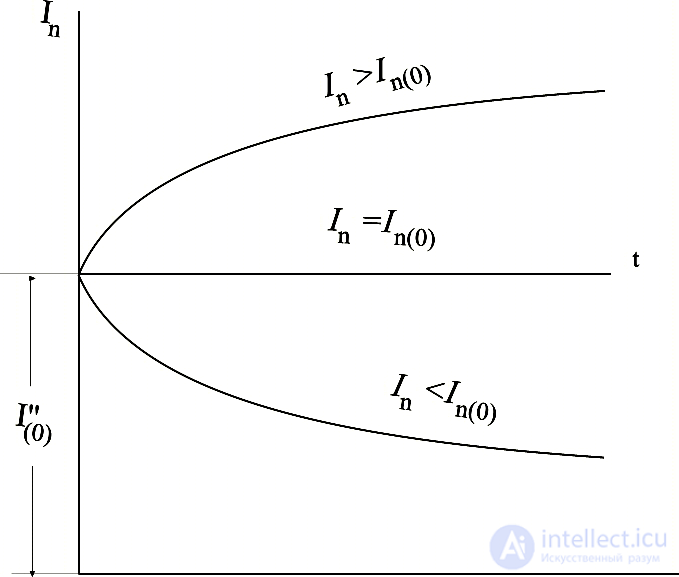
Fig. 4.3. Behavior of the periodic component of the short-circuit current of a synchronous generator with AVR at a field-winding time constant Tf=0 and at various values of limiting excitation.
If, under the action of the AVR, the generator voltage reaches its limiting value (it may also reach a minimum value), the short-circuit current thereafter remains unchanged.

Comments