
Lecture
A simplest circuit is the term for a symmetrical 3-phase circuit with lumped parameters in which there is no transformer. It is supplied from a source of infinite power, characterized by the fact that its own reactance is equal to zero, while the voltage, varying at constant frequency, has a constant amplitude.
Problems of this kind include studies of transient processes in elements of a power supply system that are electrically remote from the sources of energy. In this case, the power of the sources exceeds the power of the power-system consumers by two or more orders of magnitude.
The purpose of such problems is to develop engineering methods for the quantitative and qualitative assessment of regime parameters, and to determine the extreme values of the parameters of emergency transient regimes.
An analysis of transient processes in 3-phase unbranched circuits can be performed using the generalized electrical circuit (Fig. 2.1)
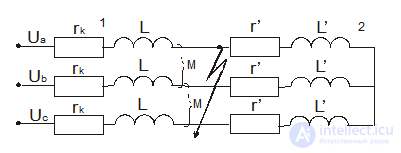
Fig. 2.1. Simplest 3-phase electrical circuit
The phase voltages for this circuit can be determined:
(2.1)
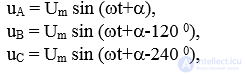
where Um - the voltage amplitude;
 - the switching-on phase angle;
t - time.
At point K, at instant t = 0, a 3-phase metallic (bolted) fault occurs (a fault between phases through a negligibly small transition resistance).
After the short circuit occurs, the circuit splits into two independent parts, and the second part of the circuit contains no sources. Consequently, only energy-dissipation processes will take place in this part.
The transient processes in the first part of the circuit can be represented by the differential equation
 (2.2),
where M – the mutual-inductance coefficient.
Taking into account that iB + iC = -iA, and dropping the phase index, we obtain
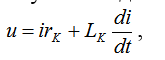 , (2.3)
where rK – the active resistance in the short-circuit path;
LK – the resulting phase inductance, LK = L - M.
The solution of equation (2.3) has the form:

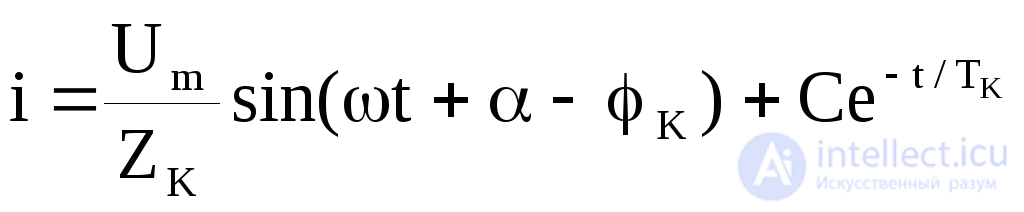 ,(2.4)
where ZK – the modulus of the total impedance of the short-circuit path;
 – the phase-shift angle of the current in the short-circuit path;
α – the angle determining UA at t = 0 (the switching-on phase);
C – a constant determined from the initial conditions;
TK – the time constant of the short-circuit path,
 ,TK = L / r = x K / (ω rK),
xK – the inductive reactance in the short-circuit path.
The first term of the right-hand side of equation (2.4) – the forced current of the new regime, constant in amplitude:
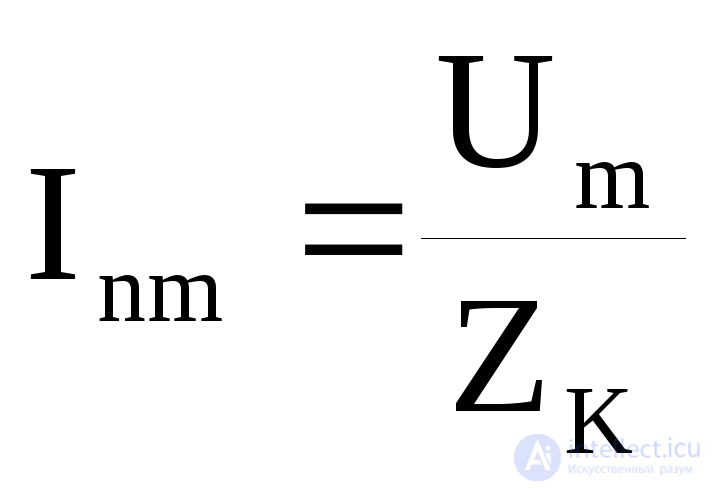 (2.5)
(2.5)
.
The second component of the short-circuit current – the aperiodic (DC) component. It decays exponentially with time constant TK.
The initial value of the aperiodic component of the short-circuit current is found from the condition that the current cannot change instantaneously at the first moment of the short circuit (t = 0).
 (2.6)
(2.6)
,
from which the initial value of the aperiodic component ia(0) = C
 ,(2.7)
where Im, - the amplitude and phase of the current in the regime preceding the short circuit.
Thus, the total current in the circuit after the short circuit is
i = in + ia = Inmsin(ωt + α – φk) + [Imsin(α – φ) – Im sin(α – φk)]e—t/Tk ,(2.8)
where in - the instantaneous value of the periodic component of the short-circuit current
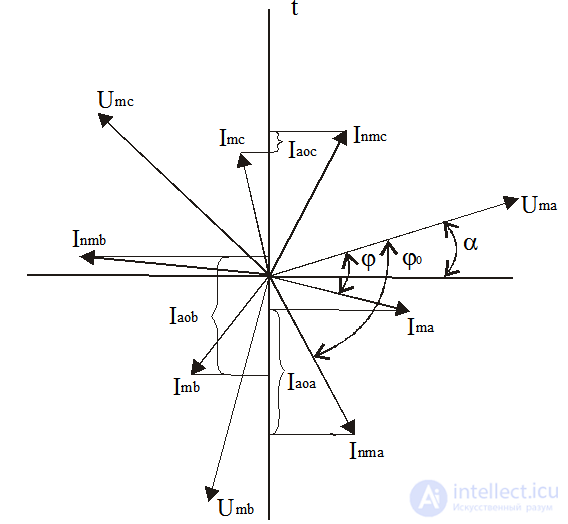
Fig. 2.2. Phasor diagram for the initial instant of a three-phase short circuit.
The initial value of the aperiodic component, based on (2.8), is determined graphically as the difference between the projections onto the time axis of the periodic components of the pre-fault and fault currents (Im and Imn in Fig. 2.2). For each phase it has its own magnitude depending on the spatial position of these vectors at the moment of the fault.
The aperiodic component of the short-circuit current acts, as it were, as a curvilinear axis on which its periodic component is superimposed. Normally the aperiodic component decays within 0.1-0.3 s to a negligibly small value.
The decay time constant of the aperiodic component Ta - is the time during which the current drops to 0.368 of its initial value.
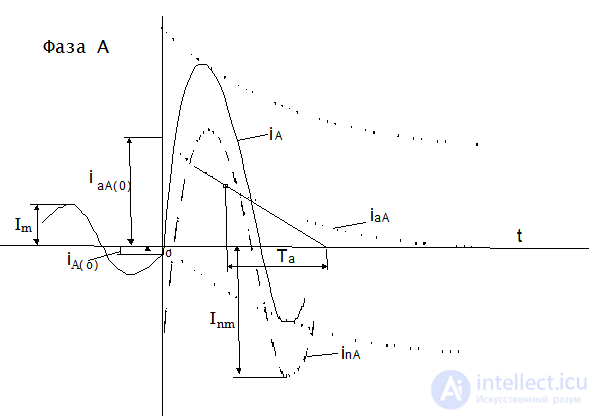
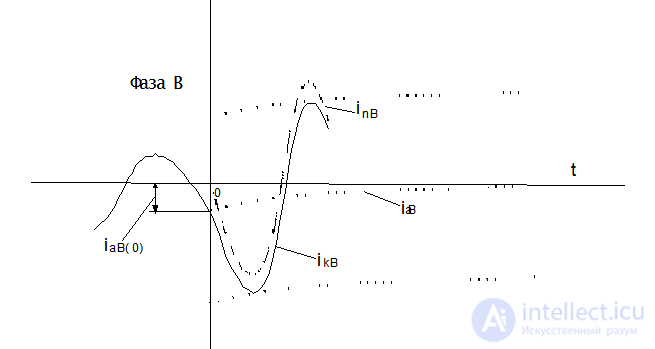
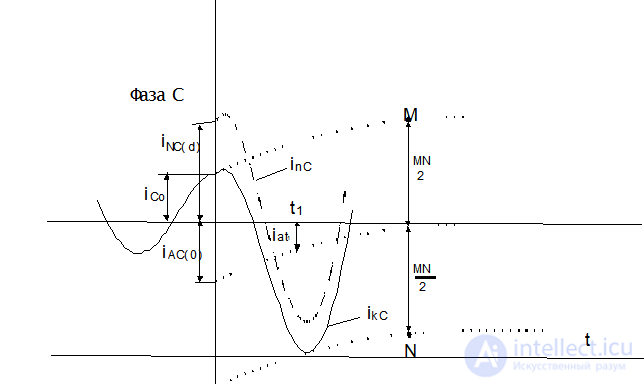
Fig. 2.3. Variation of the total current and its components in different phases
+during a sudden three-phase short circuit

Comments