
Lecture
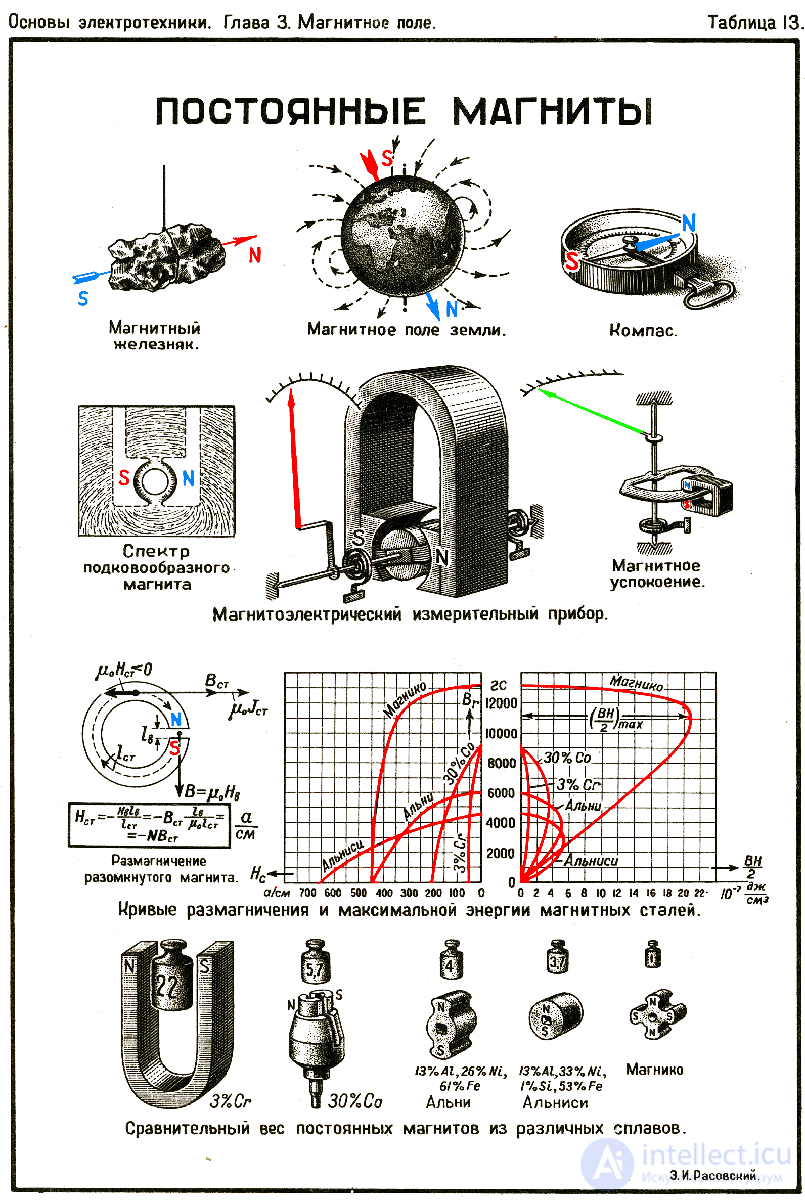
A permanent magnet is an article made of a hard magnetic material with high remanent magnetic induction that retains its state of magnetization over a long period of time. Permanent magnets are manufactured in various shapes and are used as autonomous (energy-free) sources of magnetic field.
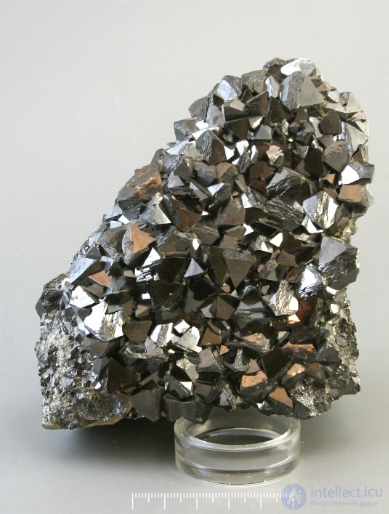
natural magnetite mineral
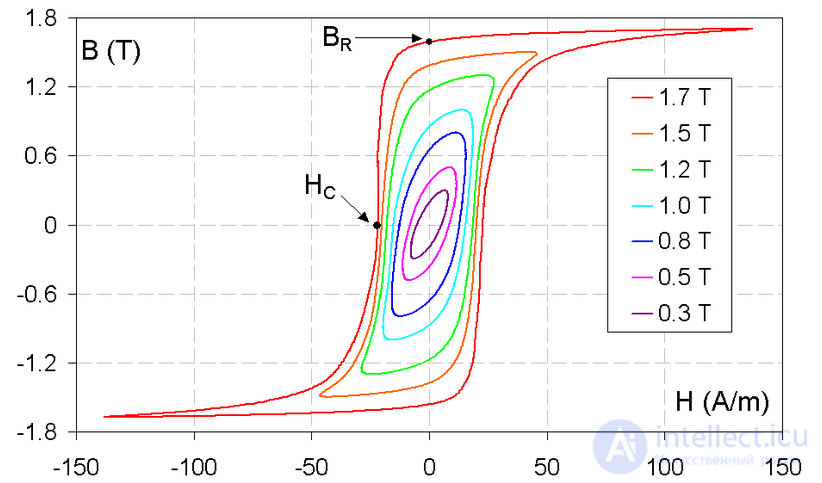
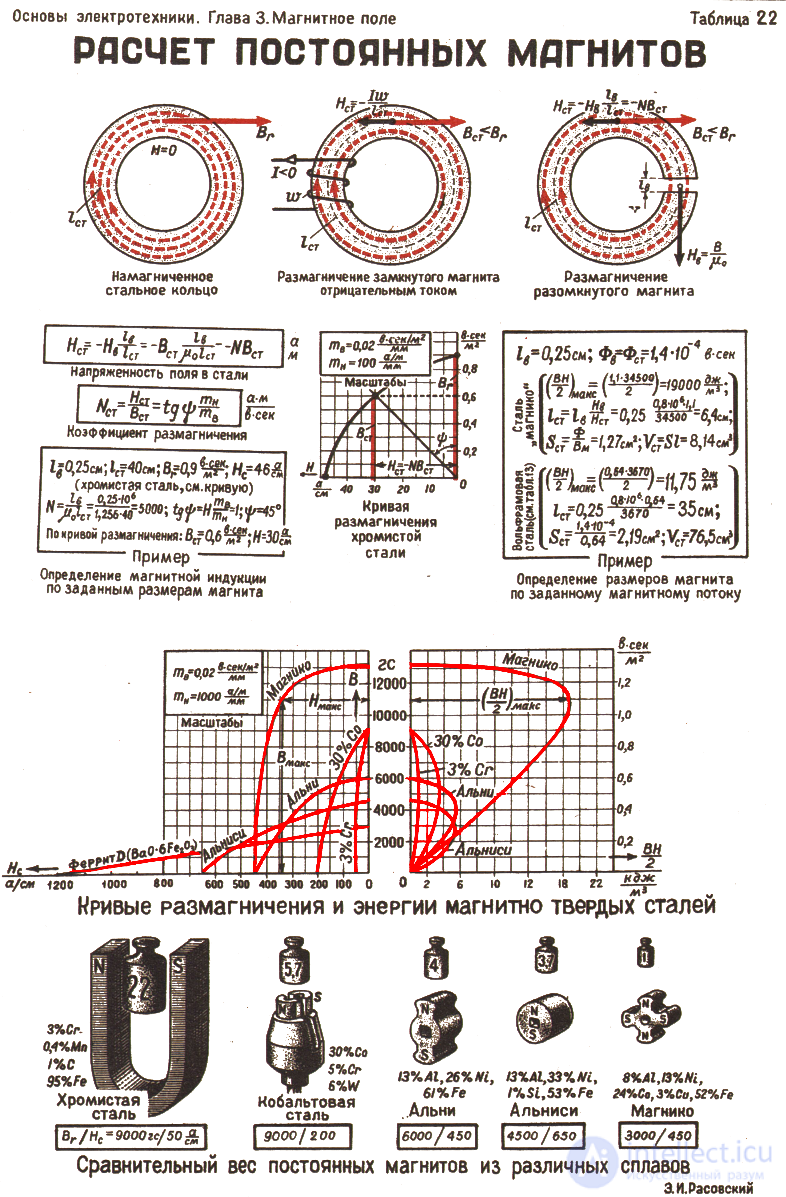
Family of loops of magnetic hysteresis for electrical steel. Br — remanent induction, Hc — coercive force, the outer loop corresponds to the saturated state.
Permanent magnets made of magnetite have been used in medicine since ancient times. Queen Cleopatra of Egypt is said to have worn a magnetic amulet. In ancient China, the "Yellow Emperor's Classic of Internal Medicine" touched on the use of magnetic stones to correct the body's Qi — its "vital force." In later times, the beneficial effect of magnets was discussed by great physicians and philosophers such as Aristotle, Avicenna, and Hippocrates. In the Middle Ages, the court physician Gilbert, who published the treatise "De Magnete," treated Queen Elizabeth I for arthritis using a permanent magnet. The Russian physician Botkin also made use of magnetotherapy.
The first artificial magnetic material was high-carbon steel, quench-hardened to a martensitic structure and containing about 1.2—1.5% carbon. The magnetic properties of such steel are sensitive to mechanical and thermal effects. During the operation of permanent magnets made from it, an "aging" of the steel's magnetic properties was observed.
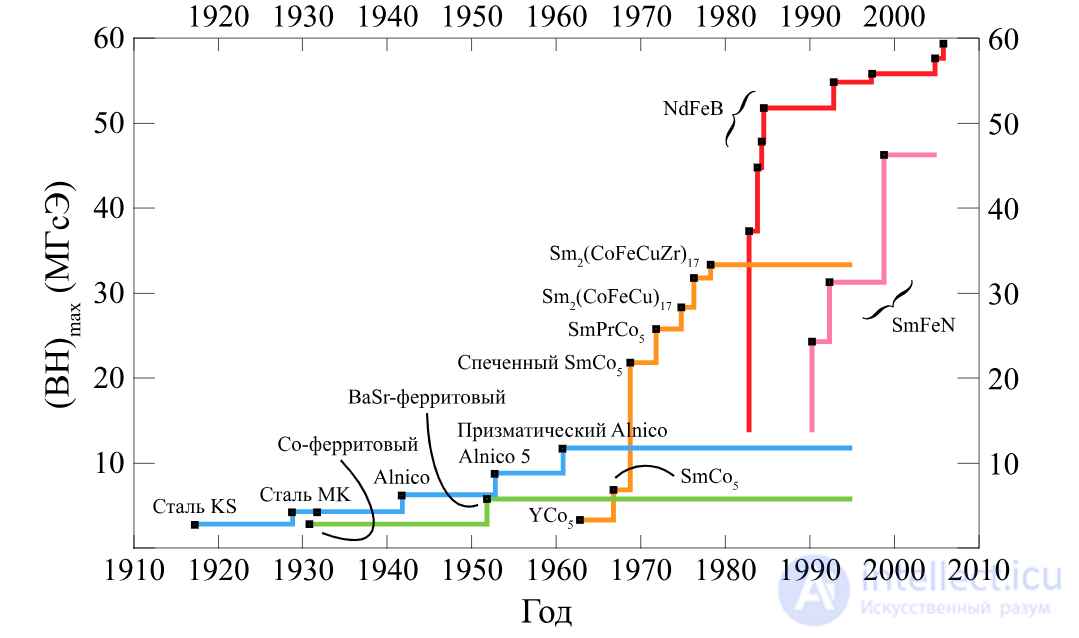
Alloying such steel with tungsten and up to 3% chromium, and later with up to 6% cobalt together with up to 6% chromium, allowed Dr. Honda of Tohoku University to create a new type of steel — KS steel — with high magnetization and considerable coercive force. To obtain high magnetic properties, the steel was subjected to a specific heat treatment. The high remanent induction of magnets made from KS steels was achieved by reducing the demagnetizing factor. For this reason, such magnets were often produced in an elongated, horseshoe shape.
Studies of the magnetic properties of alloys showed that they primarily depend on the material's microstructure. In 1930, a qualitative breakthrough was achieved in obtaining a new microstructure of age-hardening alloys, and in 1932, by alloying KS steel with nickel, aluminum and copper, Dr. T. Mishima obtained MK steel.
This was a significant step in the development of a family of alloys later given the general name Alnico (designated YuNDK under Russian standards).
A major breakthrough in this field was made in the 1930s by Japanese scientists Dr. Yogoro Kato and Dr. Takeshi Takei of the Tokyo Institute of Technology. Replacing part of the divalent iron oxide in magnetite with cobalt oxide during the ceramic synthesis of ferrite led to the creation of a solid solution of cobalt and iron ferrites. The coercive force of this type of ferrite reached 48—72 kA/m (600—900 Oe). Commercial ferrite magnets appeared in Japan around 1955, and in Russia in the mid-1960s. Barium ferrites were gradually replaced by strontium ferrites, since the latter proved more manufacturable (they did not require very precise control of the sintering temperature and were environmentally safer). Ferrite magnets contain 85—90% iron oxide, which is a byproduct of the metallurgical industry (from Ruthner plants that regenerate spent pickling chloride solutions), which significantly lowered production costs.
The next major technological breakthrough occurred at the U.S. Air Force Material Research laboratory, where an intermetallic compound of samarium and cobalt (SmCo5) with a large magnetocrystalline anisotropy constant was discovered. A permanent magnet made from this material achieved properties of (BH)max = 16—24 megagauss-oersteds (MGOe), and on the Sm2Co17 compound — 32 MGOe, with the coercive force raised to 560—1000 kA/m. SmCo magnets have been produced industrially since the 1970s. At the same time, the compound Nd2Fe14B was discovered. Magnets made from this material appeared in both Japan and the USA simultaneously in the mid-1980s, but their production technology differed. In Japan, production was organized in the same way as for SmCo magnets: powder was produced from a cast alloy, then pressed in a magnetic field and sintered. In the USA, the meltspinning process was adopted: first an amorphous alloy is produced, then it is ground down, and a composite material is made. The magnetic powder is bound with rubber, vinyl, nylon or other plastics into a composite mass, which is pressed (injection-molded) or calendered into finished parts. Compared with sintered magnets, magnets made from composite material have somewhat lower properties, but they do not require electroplated coatings, are easily machined, and often have an attractive appearance when colored in various shades. Magnets made from Nd2Fe14B appeared on the permanent-magnet market in the 1990s and very quickly reached an energy of 50 MGOe (400 kJ/m3) in sintered samples. This material quickly displaced others, above all in miniature electronics.
The properties of a magnet are determined by the characteristics of the demagnetizing portion of the magnetic hysteresis loop of the magnet material: the higher the remanent induction Br and the coercive force Hc, the higher the magnetization and stability of the magnet.
The induction of a permanent magnet Bd cannot exceed Br: the equality Bd = Br is possible only if the magnet forms a closed magnetic circuit, that is, has no air gap; however, permanent magnets are, as a rule, used to create a magnetic field in an air gap (or one filled with another medium), in which case Bd < Br, the magnitude of the difference depending on the shape of the magnet and the properties of the medium.
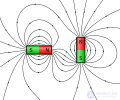
Schematic representation of magnetic field lines for magnets of various shapes:
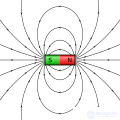
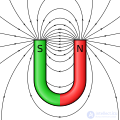
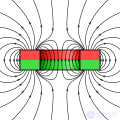
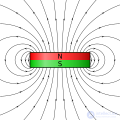
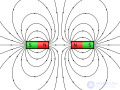
Schematic representation of magnetic field lines during the interaction of two magnets depending on the arrangement of their poles (like poles repel, unlike poles attract):
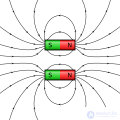
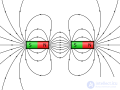
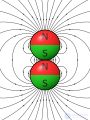
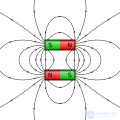
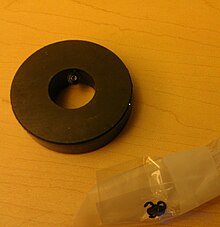
Ring-shaped ferrite magnet of a loudspeaker
The following materials are usually used for the production of permanent magnets:
Obtained by pressing and/or sintering iron oxide powder with oxides of other metals; the result is a ceramic.
Barium and strontium hard ferrites
Have the composition Ba/SrO·6 Fe2O3 and are characterized by high resistance to demagnetization combined with good corrosion resistance. Despite magnetic parameters that are lower than other classes and high brittleness, hard ferrite magnets are the most widely used in industry thanks to their low cost.
neodymium magnets NdFeB (neodymium-iron-boron)
Rare-earth magnets manufactured by pressing or casting from the Nd2Fe14B intermetallic compound. The advantages of neodymium magnets are their high magnetic properties (Br, Hc and (BH)max) as well as their low cost. Because of their poor corrosion resistance they are usually coated with copper, nickel, or zinc.
samarium magnets SmCo (samarium-cobalt)
Manufactured by powder metallurgy from the composite alloy SmCo5/Sm2Co17 and characterized by high magnetic properties, excellent corrosion resistance, and good parameter stability at temperatures up to 350 °C, which gives them an advantage over NdFeB magnets at high temperatures. In terms of magnetic strength they are more powerful than ferrite magnets but weaker than neodymium magnets. In addition to the main elements — samarium and cobalt — some grades of samarium magnets may include other additives: iron, copper, erbium, gadolinium, zirconium, and cerium mischmetal.
Distinguished by mechanical strength. Depending on the grade and manufacturing technology, they may have a columnar, equiaxed, or single-crystal structure.
Alnico alloy magnets (Russian designation YuNDK)
Developed in the 1930s. Manufactured from an Al-Ni-Co-Fe alloy. Their advantages include high thermal stability up to 550 °C, high long-term stability of parameters combined with a large coercive force, and good corrosion resistance. An important factor in their favor can be their significantly lower cost compared with Sm-Co magnets.
Alni alloy magnets
FeCoCr alloy magnets
Precious-metal alloy magnets
Cobalt-platinum, iron-platinum, and iron-palladium alloys have high magnetic properties and the ability to deform.
Manufactured from a mixture of magnetic powder and a polymer binder (for example rubber or vinyl). The advantage of magnetoplasts is the ability to produce complex-shaped parts with high dimensional accuracy, low brittleness, as well as high corrosion resistance combined with high resistivity and low weight.
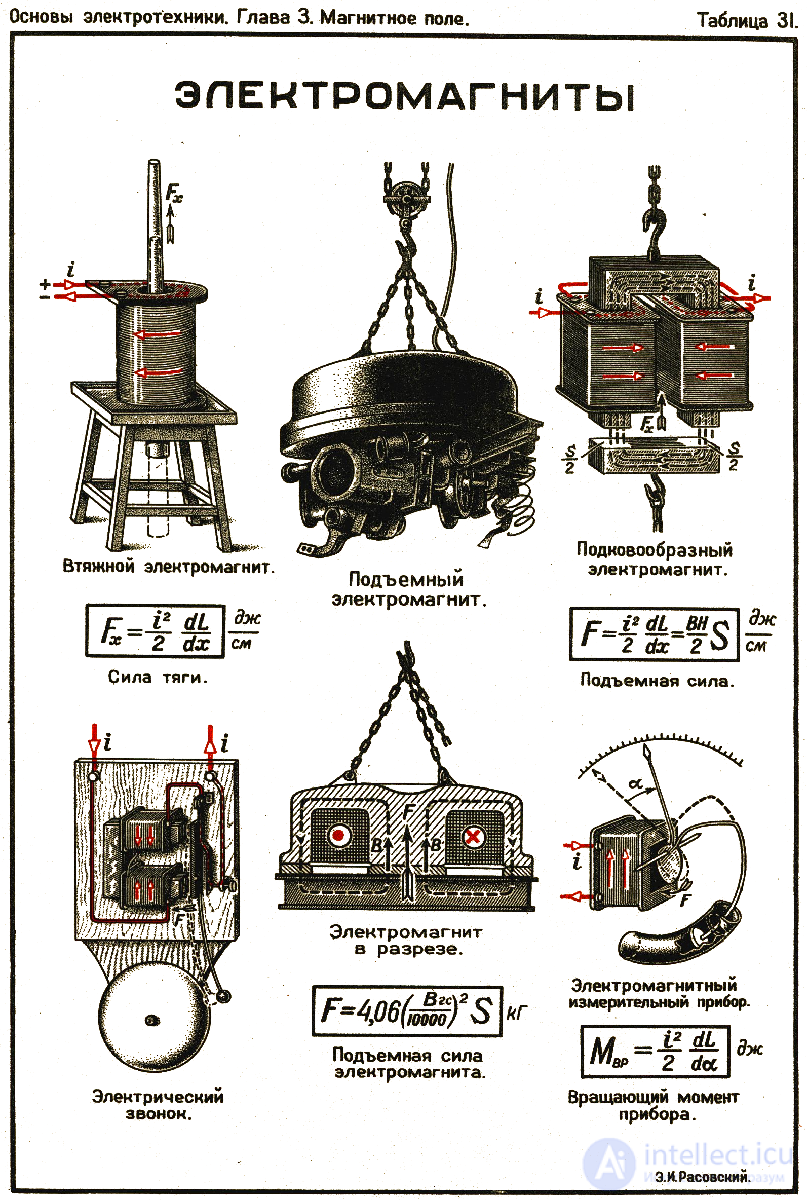
Electromagnet — a device that creates a magnetic field when an electric current passes through it. An electromagnet usually consists of a winding and a ferromagnetic core, which acquires the properties of a magnet when electric current passes through the winding. Electromagnets designed, above all, to produce mechanical force also include an armature (the moving part of the magnetic circuit) that transmits the force.
The winding of electromagnets is made of insulated aluminum or copper wire, though superconducting electromagnets also exist. Magnetic cores are made of magnetically soft materials — usually electrical or good-quality structural steel, cast steel and cast iron, and iron-nickel or iron-cobalt alloys. To reduce eddy-current (Foucault current) losses, magnetic cores are made from a stack of laminations.
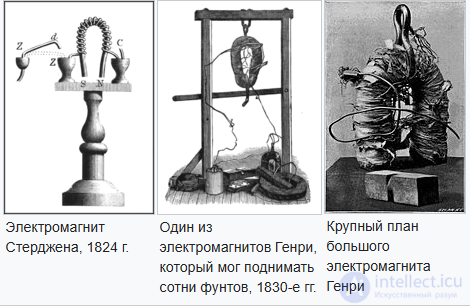
In 1825 the English engineer William Sturgeon built the first electromagnet, a bent bar of soft iron with a winding of thick copper wire. To insulate it from the winding, the bar was coated with varnish. When current was passed through it, the iron bar acquired the properties of a strong magnet, but lost them instantly when the current was interrupted. It was precisely this feature of electromagnets that allowed them to be widely used in engineering.
Besides industrial use, magnets came to be widely used in medicine as well. As far back as the late 19th — early 20th century, in the pages of the Brockhaus and Efron Encyclopedic Dictionary, M. E. Mendelssohn wrote that the electromagnet «serves as the best way to extract foreign bodies from the cavity of the eye».
Neutral direct-current electromagnets
A constant magnetic flux is created by a constant current in the winding in such a way that the attractive force depends only on its magnitude and not on the direction of the current in the winding.

The simplest electromagnet: an insulated wire wound around a ferromagnetic core
Polarized direct-current electromagnets
There are two independent magnetic fluxes — a working flux and a polarizing flux. The former is created by the working (or control) winding. The polarizing flux is most often created by permanent magnets, sometimes by additional electromagnets, and is used to ensure an attractive force is present when the working winding is switched off. Overall, the action of such a magnet depends both on the magnitude and on the direction of the electric current in the working winding.
Alternating-current electromagnets
In these magnets the winding is powered from an alternating-current source, the magnetic flux periodically changes in magnitude and direction, and the unidirectional attractive force changes only in magnitude, so that the attractive force pulsates from zero to a maximum value at twice the frequency of the supply current. They are widely used in electrical engineering, ranging from household appliances to electromagnetic chucks for machine tools, and in the magnetic-particle method of nondestructive testing.
Electromagnets are also distinguished by a number of other features: by the way the windings are connected — with parallel and series windings; by their duty type — operating in continuous, intermittent, and short-time duty; by their speed of action — fast-acting and slow-acting, producing a constant or alternating magnetic field, and so on.
Magnetic stirrer
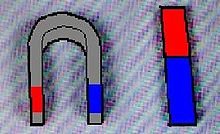
Horseshoe-shaped and flat demonstration magnets. The north pole of the magnet is colored blue, the south pole — red
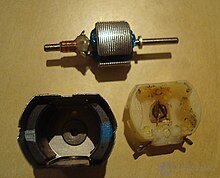
Permanent magnets of the inductor (in the housing) of a DC electric motor
For applications at ordinary temperatures, the strongest permanent magnets are made of alloys containing neodymium. They are used in fields such as magnetic resonance imaging, hard-disk servo actuators, and high-quality loudspeakers, as well as in the drive units of model-aircraft engines, and are also used in hand-crank generators and as retrieval magnets.
Permanent magnets are widely used in moving-coil (magnetoelectric) electrical measuring instruments.
In physics lessons, permanent magnets are usually demonstrated in the shape of a horseshoe, whose poles are colored blue and red, and are also available as bar magnets with halves colored in different colors, as well as rectangular ones.
Individual balls and cylinders with strong magnetic properties are used as high-tech decorations/toys — they assemble into chains without additional fasteners and can be worn as a bracelet. Construction sets are also sold consisting of a set of cylindrical magnetic rods and steel balls. A wide variety of structures can be assembled from them, mostly of a truss-like type.
In addition, there are flexible flat polymer-based magnets with magnetic additives, which are used, for example, to make decorative refrigerator magnets and for display and other purposes. They are produced in the form of tapes and sheets, usually with an applied adhesive layer and a protective film. The magnetic field of such a flat magnet is striped — north and south poles alternate across the entire surface with a pitch of about two millimeters. A polymer magnetic strip is also found inside the rubber door gasket of household refrigerators, simultaneously sealing evenly and holding the doors in the closed position.
Permanent magnets are widely used in electrical engineering: relatively low-power DC motors and generators (including automobile starter motors) have a stator with permanent magnets, and synchronous motors and generators, in which the rotor contains permanent magnets, are also mass-produced. Combined-type synchronous motors (reluctance motors with permanent magnets) are used as traction motors in electric vehicles.
Applications of electromagnets
A portable electromagnet — this is one intended only to hold material in place; an example is a lifting magnet.
A traction electromagnet applies force and moves something.
Electromagnets are very widely used in electrical and electromechanical devices, including:
A lifting electromagnet is an automatic load-grabbing device for hoisting and transporting steel, cast iron, and ferrous-metal scrap. Cranes fitted with such a load-grabbing device are commonly called magnetic cranes. Lifting magnets are used on various cranes (truck-mounted, crawler, rail, overhead, wheeled, and others), including specialized metallurgical overhead cranes (pratzen cranes, magnet-grab cranes

Comments