
Lecture
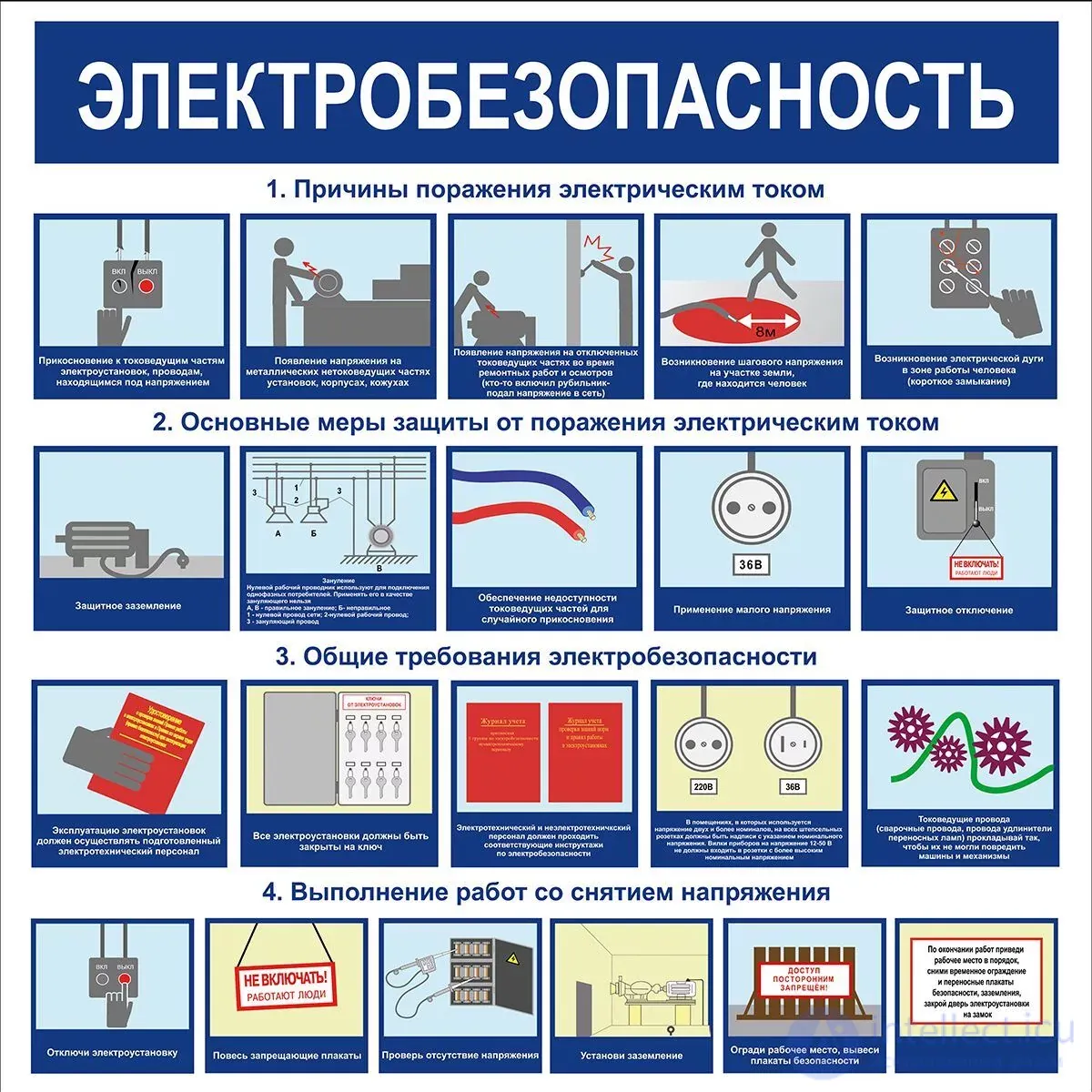
Electrical safety, ES — a system of organizational measures and technical means that prevent the harmful and dangerous effects of electric current, electric arc, electromagnetic field and static electricity on workers.
Electrical safety comprises legal, socio-economic, organizational-technical, sanitary-hygienic, medical-preventive, rehabilitation and other measures.
Electrical safety rules are governed by legal and technical documents and by the normative-technical framework. Knowledge of the fundamentals of electrical safety is mandatory for personnel servicing electrical installations and electrical equipment.
Protection methods are a set of measures aimed at reducing to zero the probability of injuries and/or damage when using electrical equipment.
Design is carried out by a person holding the documentation (competence) required for designing electrical systems, or by a qualified person under the supervision of a competent person. During design, all possible risks arising from the use of electric energy are taken into account and methods of avoiding hazards are applied. Design always proceeds from the worst-case operating conditions, taking into account a 100% probability of all risks. Before a project is commissioned, depending on the degree of hazard of the facility being designed, it must be approved by the relevant authorities.
Values of up to 50 volts, with galvanic isolation of the circuits, allow the distance between a living organism and the given live part to be reduced all the way to actual contact.
A protective, deliberate electrical connection of electrical installations and consumers to a grounding device in accordance with the manufacturer's instructions or the design.
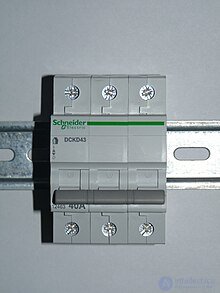
Disconnector (load-break switch)
In the event of a hazardous situation, it must always be possible to remove the voltage as quickly as possible, thereby freeing people who have come into contact with live parts. For this purpose, a load-break switch — a disconnector — is used at the entrance to the electrical panel. If people come into contact with live parts, switching off the incoming disconnector immediately de-energizes all circuits, freeing the affected people — the voltage is removed much faster this way than by searching for the branch fuse, greatly increasing the chances of saving the victims. The disconnector is selected according to the number of phases and the rated current. The rated current of the disconnector can be chosen based on one of three criteria:
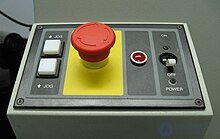
Emergency stop button
To prevent mechanical injuries in equipment fitted with electric motors, an emergency stop button is used — the so-called mushroom-head button. As a rule, it is a button with normally closed contacts that locks in a fixed position and is wired into the motor control circuit in series with the contactor. When this button is pressed, the mechanism locks in the "depressed" position, keeping the control circuit open; and since the contactor coil no longer receives power, the contactor opens its contact pairs, breaking the circuit and cutting off the supply to the motor. Once power to the motor is cut off, it stops, freeing the person from the mechanical action of the motor's rotating parts.
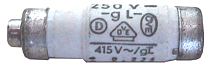
Fuse
One of the aims of design is to prevent hazardous operating modes in which wiring could overheat and cause a fire. The electrical system must be designed so as to rule out operation under fault conditions that lead to damage from excessive temperature or to fire. In other words, all the heat energy released during operation must be dissipated into the environment without damaging any part of the electrical equipment.
An extensive, branched electrical network has significant capacitance and low phase-to-ground resistance. In this case, even touching a single phase is very dangerous. If a single network is divided into a number of smaller networks of the same voltage, the risk of electric shock is sharply reduced. Network separation is usually carried out by connecting individual electrical installations through isolating transformers. Protective network separation is permitted only for networks up to 1000 V.
When carrying out electrical work, ensuring that live parts are inaccessible (both during and after the work) is considered, in order to minimize risks or eliminate entirely the danger of touching live parts of the electrical equipment. This is achieved by guarding and positioning live parts at an inaccessible height or in an inaccessible place. Both solid and mesh guards are used, with a mesh cell size of 25×25 mm. Solid guards in the form of enclosures and covers are used in electrical installations up to 1000 V.
Before starting electrical work, the site is prepared:
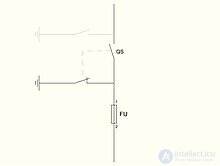
Single-side supply diagram. During electrical work, the consumer side must always be short-circuited to ground.
To avoid creating hazardous situations, the voltage is removed from the relevant section of the electrical circuit before work begins, and the switching device is marked with the appropriate warning signs. In industrial electrical installations, grounding blades are used to short-circuit the phase conductors on the consumer side when the voltage is removed to ground: if the voltage is mistakenly restored, a short circuit will occur and the fuse will blow, so people working in the installation will not be harmed. In domestic electrical work, it is usually sufficient to switch off the fuse — in this case, an accidental return of voltage would endanger the lives of people working in the installation. Portable grounding is used for overhead lines.
A technical measure. Checking for the absence of voltage on bare conductors is carried out exclusively with a two-pole voltage indicator, the UNN-1. Before use, the UNN-1 itself is checked for correct operation at a point where the corresponding voltage is present. The device must be operated and stored properly. In networks above 1000 volts, a high-voltage indicator, the UVN, is used.

Screwdriver with an insulated handle.
When working in an electrical installation, only insulated tools with a handle insulated for the relevant voltage may be used. To avoid electric shock or burns from a short circuit, it is strictly forbidden to work in an electrical installation with ordinary metal hand tools.
Live working carries the following risks:
When it is not possible to remove the voltage, workers use special equipment: dielectric gloves and face protection against burns. Before starting work, the possible risks are carefully weighed and sources of potential danger to the workers themselves are eliminated.
Diagram: current-carrying conductor — a tested insulating rod — rubber gloves — lineman on the ground.
Working at potential without removing the voltage and without breaking the line, at permissible safe distances between lines and to ground
Diagram: a tested basket on insulating supports — lineman in shielded protective clothing — a rod for attaching the equalizing conductor on the basket to the line conductor.
Another arrangement: a helicopter with an equalizer suspended in the air — rod attachment of the equalizer to the line — landing on the line.
The main aim of the installation is to minimize the risks associated with the use of electric energy. For example, all control and monitoring devices must be enclosed in a panel, access to conducting parts carrying dangerous voltage must be reliably shielded against accidental contact, and the protection rating of the electrical equipment must correspond to the operating environment.
Upon completion of the work, the work site is tidied up, waste is disposed of, and before the voltage is restored, the work is accepted by the person responsible for the electrical work (the person in charge of the electrical work) or by an inspector of the technical supervisory authorities holding the appropriate powers. At the moment the voltage is restored, the electrical installation must be fully fit for use: all workers must have left the site of the electrical work (as it is complete) and the conducting parts must be carefully closed off from outsiders.

This symbol marks electrical installations with double insulation
A layer of dielectric that covers the surface of live parts, or a structure made of non-conducting material that separates live parts from the other parts of the electrical equipment. The following types of insulation are distinguished:
Every electrical appliance used in the home has a certain protection class. Each protection class corresponds to a certain degree of insulation:
In Russia, in accordance with the PTEEP (Rules for the Technical Operation of Consumer Electrical Installations) and the PTB (Labor Safety Rules), personnel servicing (working with) electrical installations are assigned 5 electrical safety qualification groups:
Persons with qualification group V have the right to issue instructions and direct work in electrical installations with voltages both up to 1000 V and above.
Electrical safety tests with four answer options, one of which is correct:
1. Which organizational measures help prevent the harmful effects of electric current on workers?
2. Which legislative acts regulate electrical safety issues?
3. What measures are provided for protection against an electric arc?
4. What technical means are used to prevent the hazardous effects of static electricity?
5. What kinds of electric fields can have a harmful effect on the human body?
6. Which medical-preventive measures are recommended when the body is exposed to electric current?
7. What basic principles of electrical safety should be observed when working with electrical equipment?
8. What is remote control and how is it related to electrical safety?
9. What requirements are placed on personnel within the framework of electrical safety?
10. What safety measures are recommended when carrying out electrical installation work?
11. What are the basic principles of organizing a safe workplace when working with electrical installations?
12. What technical protective means are used to prevent electric shock?
13. What grounding principles are applied to ensure electrical safety?
14. What measures should be taken in the event of an emergency situation involving electrical equipment?
15. What hazards are associated with the improper operation of electrical installations?
16. What preventive measures help prevent fires associated with electrical equipment?
17. What safety measures are recommended when working near power lines?
18. What special considerations are associated with the rehabilitation of workers after an electrical injury?
19. What are the basic requirements for personal protective equipment when working with electrical equipment?
20. What safety measures should be observed when operating power tools?

Comments