
Lecture
Power distribution is the final stage of electricity delivery . Electricity is carried from the transmission system to individual consumers. Distribution substations connect to the transmission system and step the transmission voltage down to medium voltage in the range of roughly 2 kV to 33 kV using transformers . Primary distribution lines carry this medium voltage to distribution transformers located near consumers' premises. Distribution transformers, in turn, step the voltage down to the voltage used for lighting, industrial equipment, and household appliances. Often several consumers receive electricity from a single transformer via secondary distribution lines. Commercial and residential consumers connect to secondary distribution lines through service drops . Consumers who need much larger amounts of electricity may be connected directly to the primary distribution level or to the substation level .
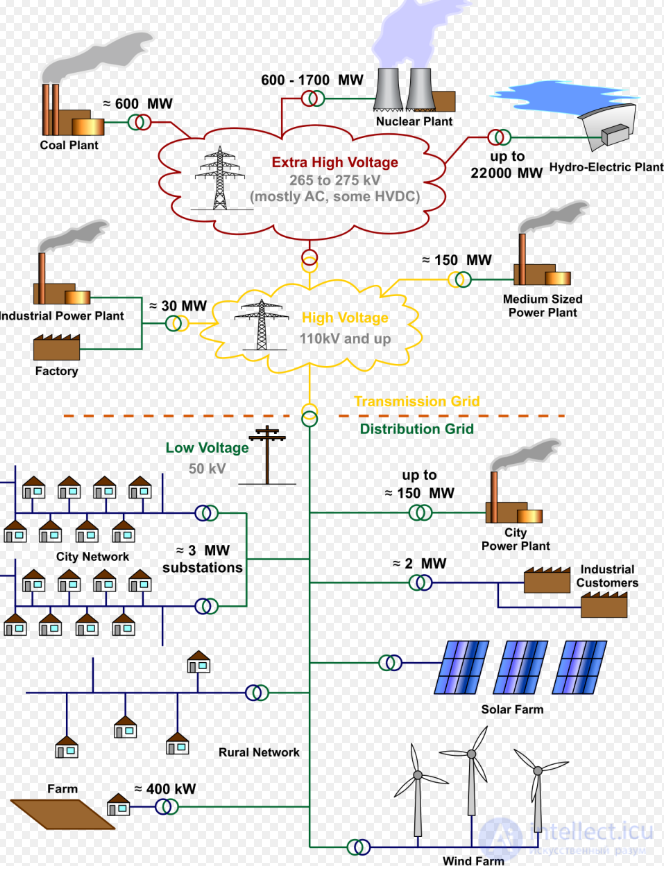
General diagram of the electric power grid . Voltages and loads are typical of European networks (for example, in Canada extra-high voltage may refer to 735 kV).
The transition from transmission to distribution takes place at a substation , which performs the following functions:
In cities, electricity distribution is carried out mostly underground, sometimes in shared cable ducts . In rural areas, distribution is mostly carried out overhead using utility poles , while in suburbs a mixed arrangement is used. Closer to the consumer, a distribution transformer steps the primary distribution network voltage down to a low-voltage secondary circuit, typically 120/240 V in the US for residential consumers. Electricity reaches the consumer through a service cable and an electricity meter . The length of the final circuit in an urban system may be less than 15 meters (50 feet), but for a rural consumer it can exceed 91 meters (300 feet).
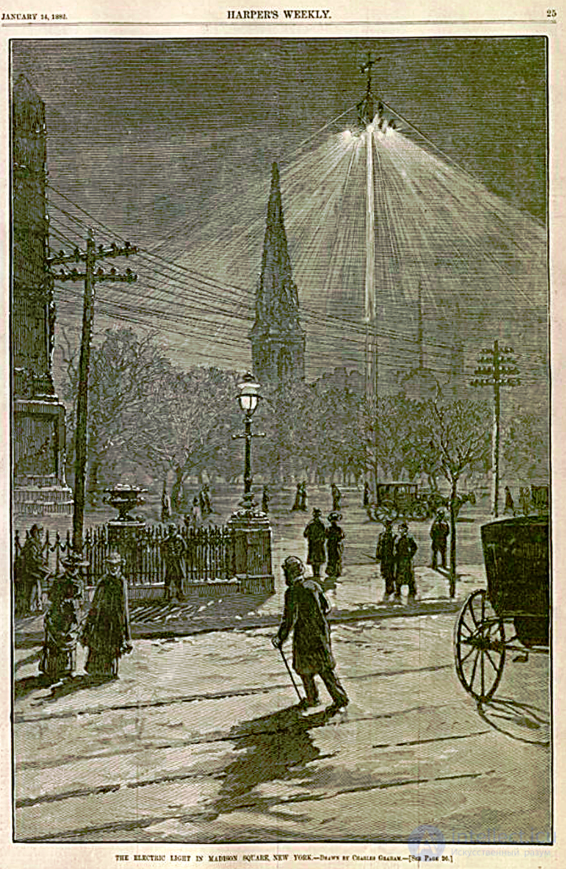
In the late 1870s and early 1880s, arc lighting was introduced for use outdoors or in large enclosed spaces, such as the system installed by the Brush Electric Company in New York in 1880 .
The need for electricity distribution arose only in the 1880s, when electricity began to be generated at power stations . Before that, electricity was usually generated where it was used. The first electricity distribution systems, installed in cities in Europe and the US, were used for lighting: arc lamps running on very high-voltage alternating current (AC) or direct current (DC) (around 3000 V) , and incandescent lamps running on low-voltage direct current (100 V). [Both systems displaced gas lighting systems: arc lamps came to be used for lighting large areas and streets, while incandescent lamps replaced gas lamps for commercial and residential premises.
The high voltage used in arc lighting allowed a single power station to supply a string of lamps up to 7 miles (11 km) long. And each doubling of the voltage allowed a given cable to carry the same amount of power over a distance four times as great as at the lower voltage (with the same power losses). By contrast, direct-current indoor lighting systems with incandescent lamps, such as Edison's first power station , installed in 1882, had difficulty supplying consumers more than a mile away, because they carried low voltage (110 V) all the way from the source to the end consumer. Low voltage resulted in higher current and required thick copper cables for transmission. In practice, Edison's DC power stations had to be located about 1.5 miles (2.4 km) from the farthest consumer to avoid the need for even thicker and more expensive conductors.
The problem of transmitting electricity over long distances became a recognized engineering obstacle to the development of the electric power sector, and many lighting companies tested unsatisfactory solutions. However, in the mid-1880s a breakthrough came with the development of functional transformers, which made it possible to «step up» alternating-current voltage to a much higher level for transmission, and then step it down to a lower level near the end consumer. Compared with direct current, alternating current had much lower transmission costs and greater economies of scale — large AC power stations could supply electricity to entire cities and regions, which led to the rapid spread of alternating-current use.
In the US, competition between direct and alternating current in the late 1880s took on a personal character in the form of the « War of Currents », when Thomas Edison began criticizing George Westinghouse and his development of the first American AC transformer systems, emphasizing the fatalities caused by high-voltage AC systems over the years and arguing that any AC system was inherently dangerous. Edison's propaganda campaign was short-lived, and his company switched over to alternating current in 1892.
Alternating current became the dominant form of power transmission thanks to innovations in Europe and the US in electric motor design and the development of universal engineering systems that allowed large numbers of legacy systems to be connected to large AC networks
In the first half of the 20th century, in many countries the electric power industry was vertically integrated , meaning a single company handled generation, transmission, distribution, metering, and billing. Starting in the 1970s and 1980s, countries began a process of deregulation and privatization , which led to the creation of electricity markets . The distribution system remained regulated, but the generation, retail, and sometimes transmission systems were transformed into competitive markets.
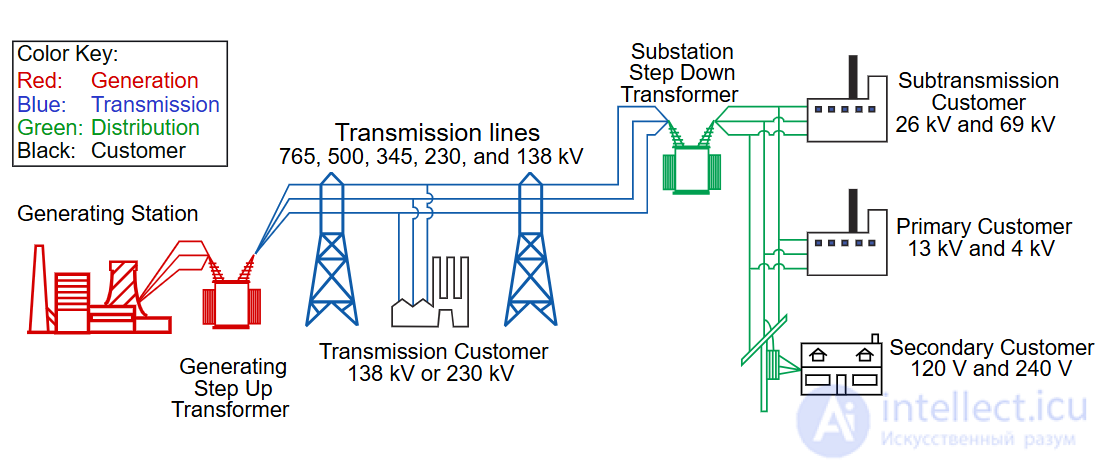
Simplified diagram of AC power supply from power stations to consumer connection points .
Electricity comes from a power station, where the potential difference can reach 33,000 volts. Alternating current is normally used. Consumers of large amounts of direct current, such as some railway electrification systems , telephone exchanges, and industrial processes such as aluminum smelting , use rectifiers to obtain direct current from the public AC network, or may have their own generation systems. High-voltage direct current can be advantageous for isolating AC systems or for controlling the amount of power transmitted. For example, Hydro-Québec has a DC line running from the James Bay area to Boston .
From the power station, electricity travels to a substation, where a step-up transformer raises the voltage to a level suitable for transmission, from 44 kV to 765 kV. In the transmission system, the electricity from each power station is combined with electricity generated elsewhere. For AC generators, all generating units connected to a common grid must be synchronized and operate at the same frequency within a small tolerance. Alternatively, disparate sources can be combined to serve a common load if an external power converter is used, for example a rotating machine or a DC converter system . Electricity is consumed as soon as it is produced. It travels at a very high speed, close to the speed of light .
Primary distribution voltages range from 4 kV to 35 kV phase-to-phase (2.4 kV to 20 kV phase-to-neutral) . Only large consumers are supplied directly at distribution voltages; most power-system consumers are connected to a transformer that steps the distribution voltage down to the low «utilization voltage», «supply voltage», or «mains voltage» used by lighting systems and interior wiring.
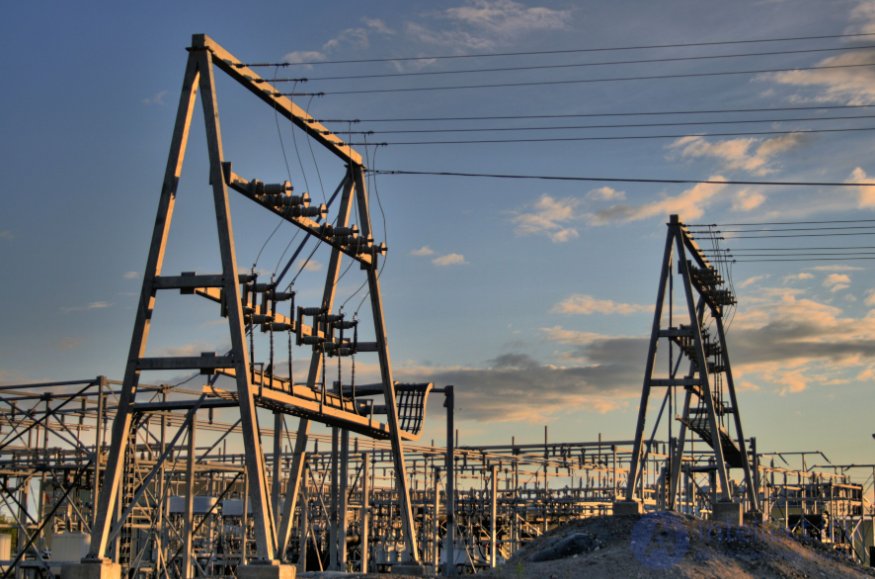
A substation near Yellowknife , Northwest Territories, Canada.
Distribution networks fall into two types: radial systems and network systems. A radial system has a tree-like structure in which each consumer has a single source of supply. A network system has several sources of supply operating in parallel. Spot networks are used for concentrated loads. Radial systems are typically used in rural or suburban areas.
Radial systems usually include emergency ties that allow the system to be reconfigured if problems arise, such as a fault or scheduled maintenance. This can be done by opening and closing switches to isolate a particular section from the network.
Long feeders experience voltage drop ( power-factor distortion ), which requires the installation of capacitors or voltage regulators .
Reconfiguration, by swapping functional ties between elements of the system, is one of the most important measures capable of improving the operating performance of a distribution system. The optimization problem of reconfiguring an electric power distribution system is, by definition, a longstanding problem with a single objective function and constraints. Since 1975, when Merlin and Back proposed the idea of distribution-system reconfiguration to reduce active-power losses, and continuing to the present day, many researchers have proposed various methods and algorithms for solving the reconfiguration problem as a single-objective problem. Some authors have proposed approaches based on Pareto optimality (including active-power losses and reliability indices as objective functions). Various methods based on artificial intelligence have been used for this purpose: micro-genetic algorithms , branch exchange , particle swarm optimization and the non-dominated sorting genetic algorithm .
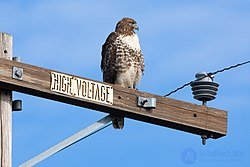
A high-voltage power line pole in rural Butte County, California.
Rural electrification systems typically use higher distribution voltages because of the greater length of the power lines (see Rural Electrification Administration ). In the US, distribution networks with voltages of 7.2, 12.47, 25, and 34.5 kV are common; in the UK, Australia, and New Zealand, networks with voltages of 11 kV and 33 kV are common; in South Africa, networks with voltages of 11 kV and 22 kV are common; in China, networks with voltages of 10, 20, and 35 kV are common. Other voltages are sometimes used.
In rural areas, efforts are usually made to minimize the number of poles and wires. Higher voltage (than in urban distribution networks) is used, which in turn makes it possible to use galvanized steel wire. Strong steel wire allows for more economical, wider spacing between poles. In rural areas, a pole-mounted transformer may serve only a single consumer. In New Zealand , Australia , Saskatchewan (Canada ), and South Africa, single-wire earth return ( SWER) systems are used to electrify remote rural areas.
Three-phase power supply provides electricity to large agricultural operations, oil refineries, water treatment plants, and other consumers with large loads (three-phase equipment). In North America, overhead distribution networks may be three-phase, four-wire, with a neutral conductor. Rural distribution systems may have long sections with a single phase conductor and a neutral. In other countries or in remote rural areas, the neutral conductor is connected to earth so that it can be used as a return conductor (single-wire earth return).
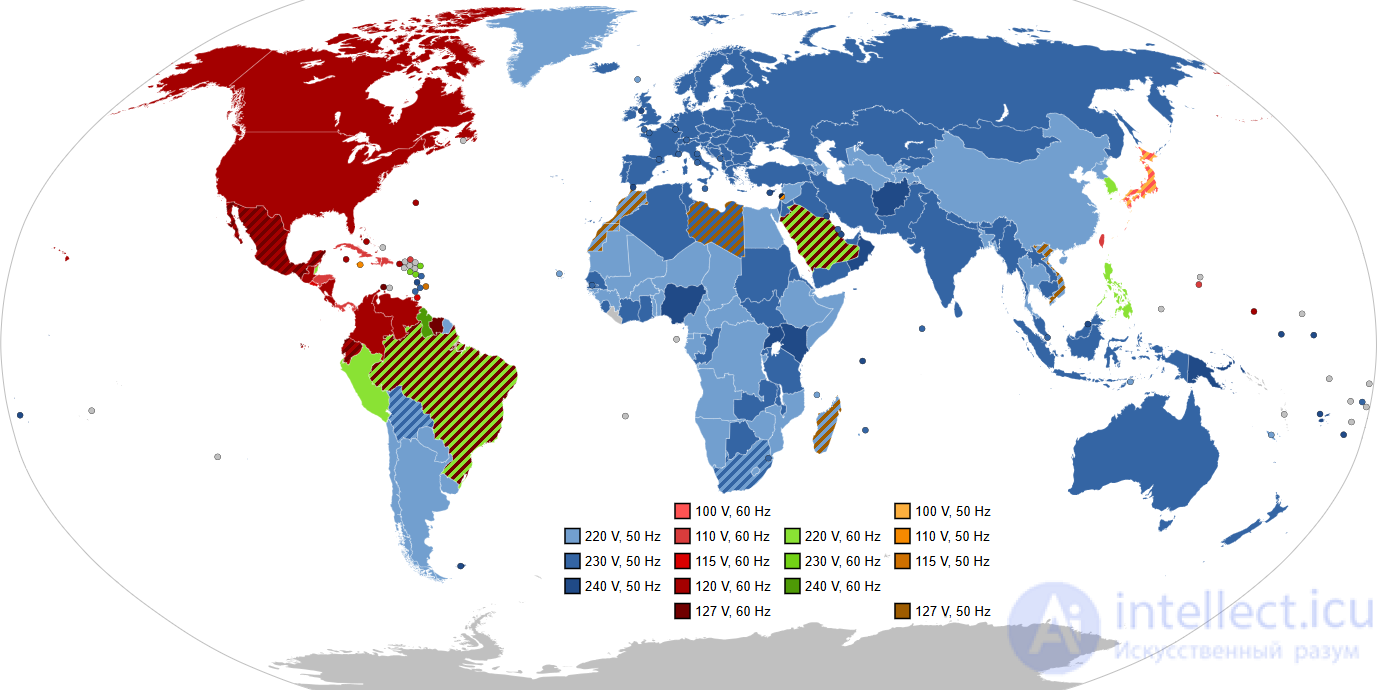
World map of grid voltage and frequency.
Electricity is supplied at a frequency of 50 or 60 Hz depending on the region. It is supplied to household consumers as single-phase power . In some countries, for example in Europe, three-phase power supply may be available for large houses. On an oscilloscope, household power supply in North America would look like a sine wave oscillating between −170 volts and 170 volts, giving an RMS voltage of 120 volts. [ Three-phase power supply is more efficient in terms of the power delivered per cable used, and is better suited to running large electric motors. Some large European appliances can be powered by three-phase supply, such as electric stoves and clothes dryers.
Grounding is usually provided both for the consumer's system and for equipment belonging to the utility. The purpose of grounding the consumer's system is to limit the voltage that can arise if high-voltage conductors fall onto low-voltage conductors, which are usually routed below ground level, or if a fault occurs in a distribution transformer. Grounding systems can be of the TT, TN-S, TN-C-S, or TN-C type.
In most countries of the world, single-phase 220 or 230 V at 50 Hz, or three-phase 380 or 400 V, is used for household and light industrial power supply. In this system, the main distribution network supplies power to several substations in each district, and 230/400 V electricity from each substation is distributed directly to end consumers within a radius that is usually less than 1 km. Three phase (hot) conductors and a neutral are connected to the building for three-phase power supply. Single-phase distribution with one phase conductor and a neutral is used in households, where the total load is small. In Europe, electricity for industrial and household consumption is usually distributed via a three-phase, four-wire system. This provides a phase-to-phase voltage of 400 volts in a «star» (wye) system and a single-phase voltage of 230 volts between any phase and neutral. In the UK, a typical urban or suburban low-voltage substation usually has a capacity of 150 kVA to 1 MVA and supplies power to an entire district of several hundred homes. Transformers are usually rated for an average load of 1 to 2 kW per household, and protective devices and cable are sized so that any individual building can draw a peak load possibly ten times this amount. Three-phase 400/690 volt power is also available for industrial consumers, or it may be generated locally. Large commercial and industrial consumers have their own distribution transformers with an input voltage of 11 kV to 33 kV. Some consumers with high power consumption receive electricity from the transmission network at 110 kV to 220 kV.
Most countries in the Americas use 60 Hz alternating current; within the home a split-phase 120/240 volt system is used, while for larger installations a three-phase system is used. North American transformers usually supply homes at 240 volts, comparable to the European 230 volts. It is precisely this split-phase system that makes it possible to use 120 volts in the home.
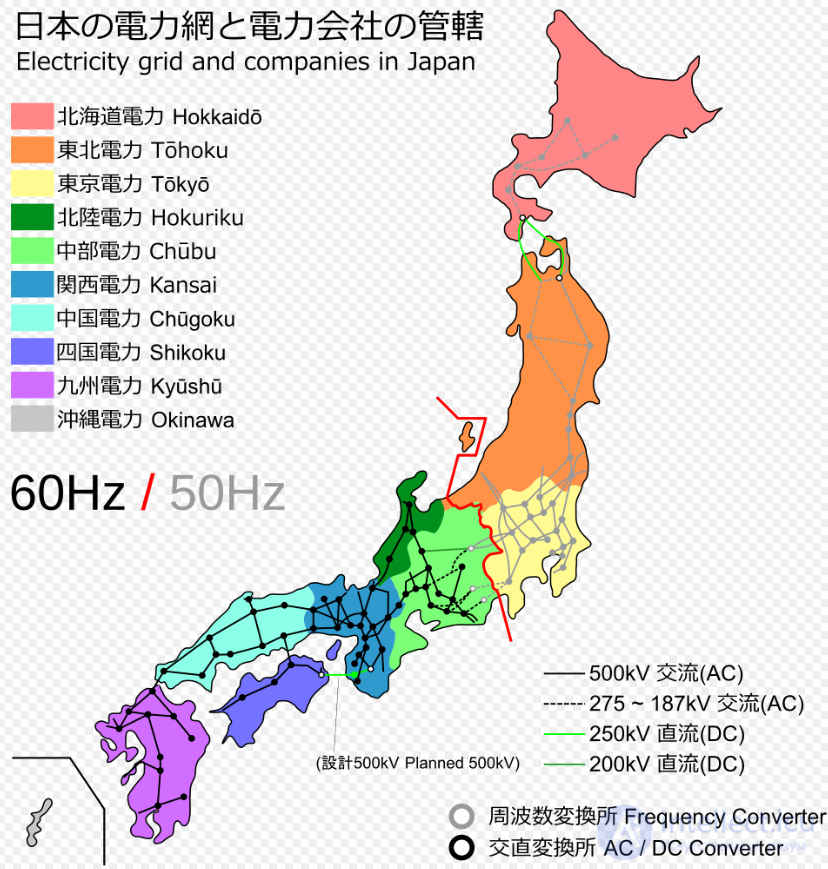
Japan uses both 50 Hz and 60 Hz frequencies .
In Japan's electric power sector, the standard voltage is 100 V, with both 50 Hz and 60 Hz AC frequencies in use. Some parts of the country use 50 Hz, while others use 60 Hz. This is a holdover from the 1890s. Some local electricity suppliers in Tokyo imported German 50 Hz equipment, while local electricity suppliers in Osaka brought in 60 Hz generators from the US. The power grids grew until eventually the whole country was interconnected. Today the frequency is 50 Hz in Eastern Japan (including Tokyo, Yokohama , Tohoku , and Hokkaido ) and 60 Hz in Western Japan (including Nagoya , Osaka , Kyoto , Hiroshima , Shikoku , and Kyushu ).
Most household appliances are designed to operate at either frequency. The incompatibility problem drew public attention after the 2011 Tohoku earthquake and tsunami, which knocked out about a third of the power grid in the east of the country, and electricity from the west could not be fully distributed to the eastern regions because the country has no common frequency.
Japan has four high-voltage DC converter substations that transfer electricity across the AC frequency boundary. Shin Shinano is a DC converter substation located in Japan, one of four frequency-conversion substations linking Japan's western and eastern power systems. The other three are located at Higashi-Shimizu , Minami-Fukumitsu , and the Sakuma Dam . Together they can transfer up to 1.2 GW of electricity eastward or westward.
In most modern North American homes, the wiring is rated for 240 volts from the transformer, and thanks to the use of split-phase power supply it is possible to have both 120 volt and 240 volt outlets. 120 volts is usually used for lighting and most wall outlets . 240 volt circuits are usually used for appliances that require high power, such as ovens and heaters. They can also be used to power an electric vehicle charger .
Traditionally, distribution systems operated only as simple distribution lines, where electricity from transmission networks was distributed among consumers. Today, distribution systems are largely integrated with renewable energy sources at the power-system distribution level through distributed generation sources , such as solar and wind power . As a result, distribution systems are becoming more independent of transmission networks every day. Balancing supply and demand in these modern distribution networks (sometimes called microgrids ) is an extremely complex task and requires the use of various technological and operational tools. Such tools include battery storage power plants , data analytics , optimization tools, and so on.

Comments