
Lecture
Often it is the units marked with letters in the picture that need repair, located on the outer part of the control mechanism for the programmer and power regulator. In devices with touch control, all of them are replaced with electronic ones. Troubleshooting faults in them requires certain knowledge, but otherwise they function the same way.
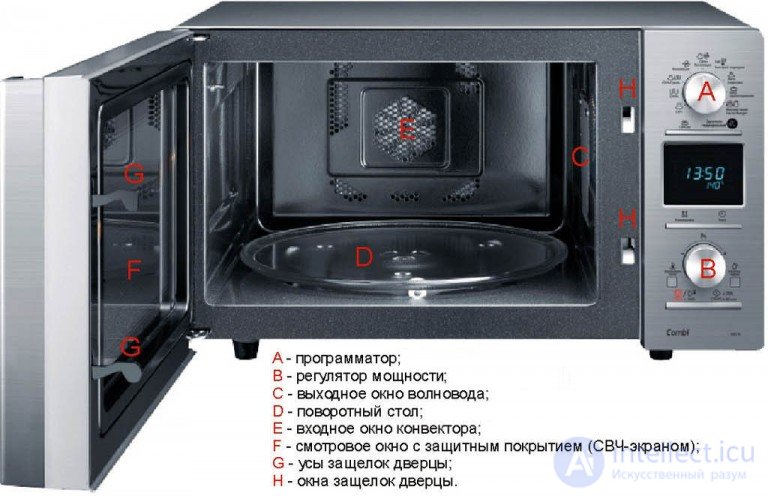
Often, even in recent manufacturer manuals, the programmer is called a timer, but strictly speaking, the timer is only one of the components of the programmer.
Microwave ovens for heating food use electromagnetic waves, which are also known from radio and television broadcasting. A frequency of 2450 MHz means that the emitted energy performs 2,450,000,000 oscillations per second. The figure below clearly shows how microwave energy interacts with various materials, in this case with different types of dishware.
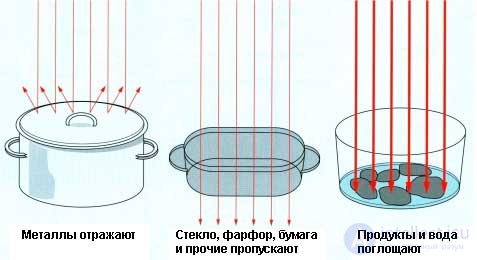
Fig. 2 Interaction of microwave radiation with various materials
Microwave energy is reflected from metal surfaces. It is this feature of microwave radiation that is used on the inner surface of the oven for better distribution of electromagnetic waves. However, microwave radiation will not be able to reach the dish itself if you cook it in metal dishware. This can lead to fire or, if the waves have a reverse effect on the magnetron, to damage of its cathode.
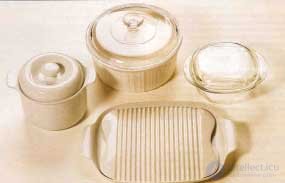
Many materials are capable of transmitting electromagnetic waves without being affected by them in any way (glass, porcelain, ceramics, plastic (only that specifically intended for microwave ovens!) and paper/cardboard (dry)). These materials are suitable for use in microwave ovens: electromagnetic waves penetrate the food without losses.
Liquids and almost any organic food absorb electromagnetic waves and convert their energy into heat during cooking. This effect varies depending on the liquid content of the food.
 |
Closed containers, such as plastic bottles, cups with screw-on lids, and especially eggs in the shell, are not suitable for heating in a microwave oven! |
|
Type of material intended for the oven |
Operating mode |
||
|---|---|---|---|
|
Defrosting |
Reheating |
Cooking |
|
|
Heat-resistant glass and ceramic dishware |
+ |
+ |
+ |
|
Non-heat-resistant glass and porcelain (dishware intended exclusively for table serving)1) |
+ |
- |
- |
|
Glass-ceramic made of heat/frost-resistant materials (e.g. Acroflam) |
+ |
+ |
+ |
|
Heat-resistant clay dishware 2) |
+ |
+ |
+ |
|
Plastic with heat resistance up to 200°C 3) |
+ |
+ |
+ |
|
Paper, cardboard |
+ |
- |
- |
|
Food film |
+ |
- |
- |
|
Film intended for use in a microwave oven |
+ |
+ |
+ |
|
Black lacquered or silicone-coated tin baking dishware |
- |
- |
|
+ (suitable) – (not suitable)
Notes:
1) Except for dishware with silver, gold, platinum, or metal decorations
2) This does not include dishware coated with a glass layer containing metal
3) Please pay attention to the maximum permissible temperature specified by the manufacturer.
 |
 |
 |
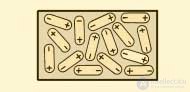 |
Any food contains positively and negatively charged liquid molecules, which are in constant random motion. |
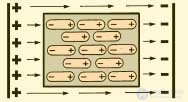 |
If you now place this food in an electromagnetic field, its molecules will instantly align according to the +/- direction of the energy flow in that field. If you change the direction of the energy in the field, the order of the molecules in the product will change accordingly |
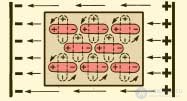 |
If this change in the field occurs rapidly, the molecules will also move at a corresponding speed. As a result, friction occurs between the molecules and they generate heat. A microwave oven operates at 2450 MHz, so the number of such changes in the electromagnetic field equals 4,900,000,000 per second. This is how the heat needed for cooking is generated. |
The thermal response resulting from the interaction of microwave energy and water molecules weakens after penetrating the food. This effect is measured in Watts/cm2.
Depending on the level of electrical non-conductivity of the food, the energy level drops with increasing penetration depth.
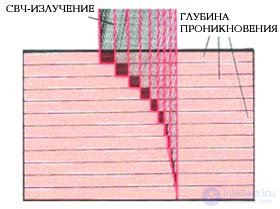 |
On the left, the power loss of microwave energy interacting with food is shown graphically. The thermal transmission capacity decreases from the surface toward the interior of the product. Therefore, it is recommended to reduce the power if, for example, you are cooking meat cut into large pieces, and increase the cooking time to allow the thermal energy to penetrate deeper into the product. For the same reason, various liquids – for example, soups – should be stirred. This helps distribute the thermal energy and avoid overheating the surface. In extreme cases, there is a risk that such overheating of the liquid could cause damage to the upper edge of the dishware used, if it is a plastic container. |
The electromagnetic waves emitted by the magnetron are directed into the inner cavity of the oven through a special metal waveguide channel.
The wave stirrer (dissector) consists of a reflective metal and is in continuous motion. Since its position is constantly changing, the reflection and distribution of the waves is also unstable. The wave stirrer can have various shapes, but in most cases it is a propeller.
A motor drives it. In older oven models, the airflow effect produced by the fan was also partially used to drive the wave stirrer.
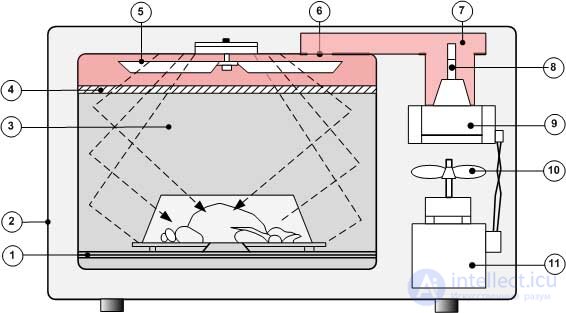
Fig. 3 Oven with wave stirrer:
| 1. Bottom plate | 7. Waveguide channel |
| 2. Housing | 8. Anode |
| 3. Cooking cavity | 9. Magnetron |
| 4. Collector plate | 10. Fan |
| 5. Stirrer (dissector) | 11. High-voltage transformer |
| 6. Electromagnetic energy feed input |
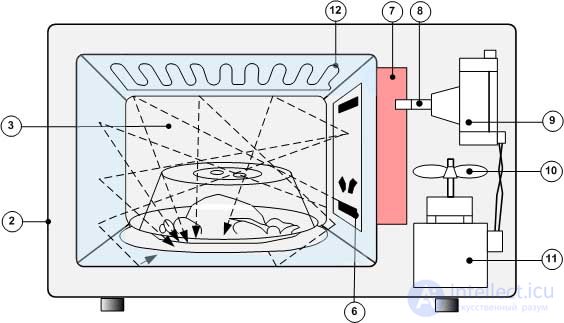
Fig. 4 Oven without wave stirrer, a special energy feed input and a rotating platform ensure uniform distribution of electromagnetic waves.
| 1. | 7. Waveguide channel |
| 2. Housing | 8. Anode |
| 3. Cooking cavity | 9. Magnetron |
| 4. | 10. Fan |
| 5. | 11. High-voltage transformer |
| 6. Electromagnetic energy feed input + grease protection |
12. Grill |
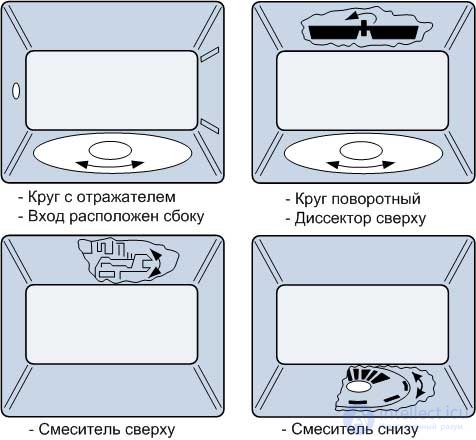
Fig. 5 Using a rotating platform ensures uniform distribution of waves for cooking food.
The magnetron cannot smoothly regulate its power. During operation it always operates at 100% of its capacity. To control the power, the magnetron must operate in pulses, in other words, the desired power is achieved by periodically switching the magnetron on/off for varying intervals of time. A similar operating principle is found in various electric ovens.
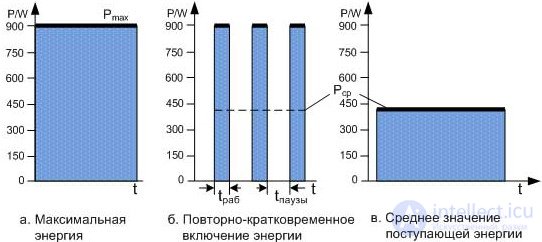
Fig. 6 Principle of controlling magnetron power
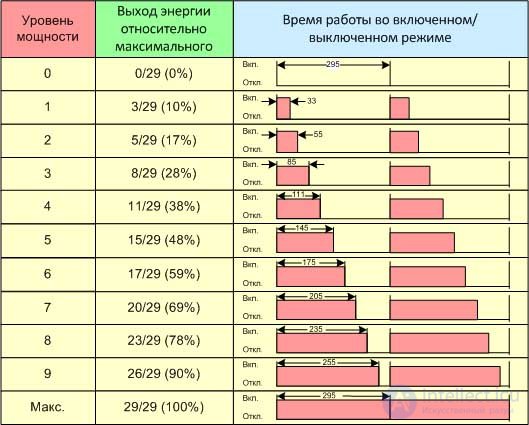
Fig. 7 Intermittent duty cycle of magnetron operation
Duration of a standard time cycle 29/30 sec (example 29 sec)
If the required power level is 48(50)%, this means that the magnetron remains on for 14(1) seconds and 15 – off.
Time cycles may differ slightly on various electronic timers, but the operating principle always remains unchanged!
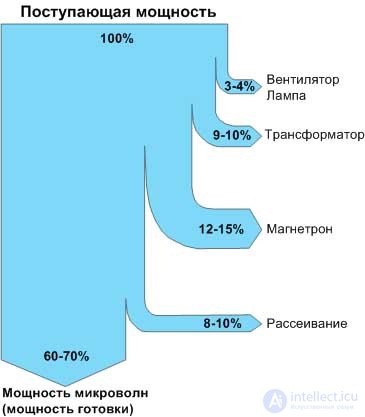
Fig. 8 Energy distribution in the microwave oven.
Pay attention to an important note!
The result will be sparks and scorched areas. In the worst case, the anode antenna in the magnetron may be damaged or destroyed!
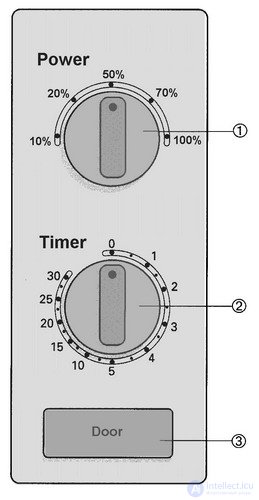
Mechanical timer 1. Power 2. Timer 3. Door opening |
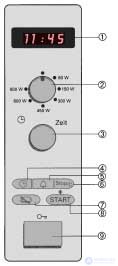
Electronic control 1. Display 2. Power 3. Timer 4-8. Start button and functions 9. Door opening |
Here a mechanical timer is shown, replaced by an electronic one with a display. In the appliance's operating manuals you can find the features and cooking programs of the oven.
The basic functions of microwave ovens are, on the whole, the same.
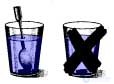 |
When cooking liquid foods, particularly during repeated cooking or in tall narrow containers, a so-called delayed-boiling effect may occur. In this case the liquid is in a boiling state, but the usual air bubbles do not rise from the bottom. A slight jolt, for example when you take the container out of the oven, can cause the contents to suddenly boil over as a result of a chemical reaction, and the user may be scalded by the liquid escaping over the edge. To avoid this, it is recommended to place, for example, a teaspoon in the container while it is boiling. This way, the delayed-boiling effect can be avoided and the liquid will boil "normally". |
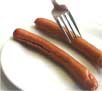 |
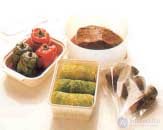
Foods in a food casing, such as sausages and tomatoes, tend to burst during cooking due to the internal formation and buildup of steam. To avoid this unpleasant effect, the food should be pierced slightly with a fork beforehand. As a result, the steam will escape and internal pressure will not build up, and in most cases the skin will remain undamaged. However, if you use a high power level - which means an accelerated cooking mode - there is a chance that bursting of the food's skin cannot be avoided, even after piercing it with a fork. |
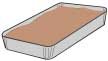 |
Ready meals in aluminum packaging can also be reheated in the microwave oven. In this case you must bear in mind that microwave energy will only affect the top layers of the food, and as a result, the required cooking time will increase. Moreover, a distance of 2 cm should be maintained between the plate and the wall of the microwave oven to avoid arcing. |
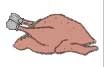 |
Wrap thin parts of the food, such as the tips of a bird's legs, in foil - this will shield the food from direct contact with electromagnetic waves and protect it from drying out. |
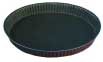 |
Browning dishes are coated with a special absorbing material. Thanks to this absorption, the dish heats up and works additionally as a frying pan. With the grill function switched on, you can brown the food, for example when cooking pizza or a vegetable pie, from the top and bottom simultaneously. As a rule, a browning dish needs 2-3 minutes to heat up to maximum temperature before food is placed in it. |
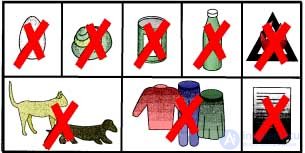
Closed containers, such as bottles, glass jars with screw threads, as well as eggs (in the shell) are not intended for use in the microwave oven!!! Use available lids to retain moisture, but do not overdo it! When reheating food, remember that its interior may reach a temperature of - at least - 70°C. However, never use liquid or mercury thermometers in the oven!!! |
|
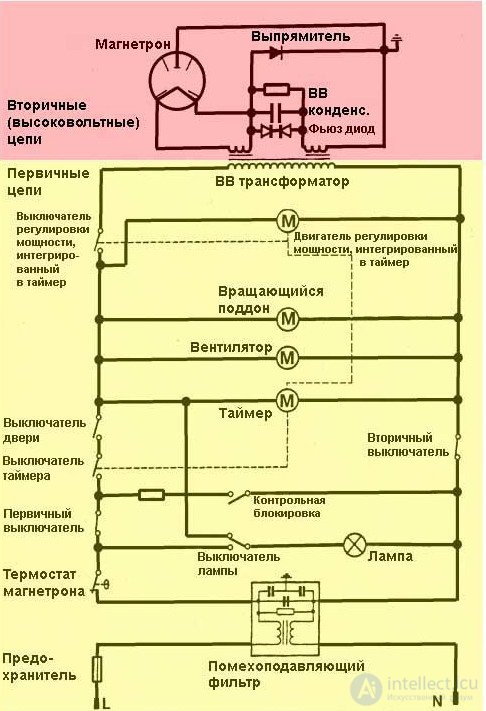
Fig. 9 Simplified electrical circuit of a microwave oven.
 |
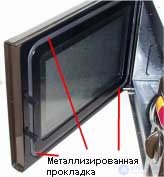 |
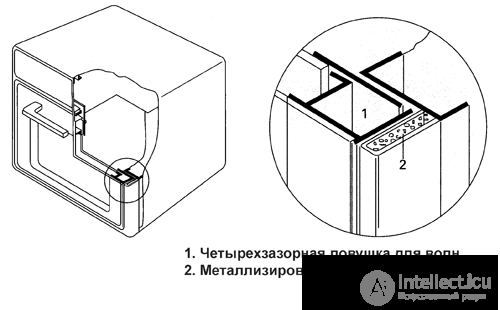
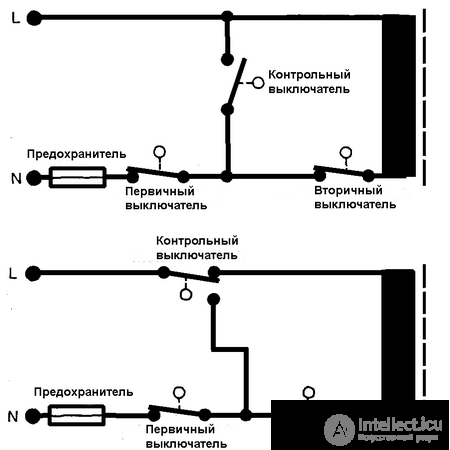
Fig. 10 Protection against microwave energy leakage
The purpose of this system is to suppress leakage of microwave energy between the oven housing and the door.
-Primary
-Secondary
-Monitor
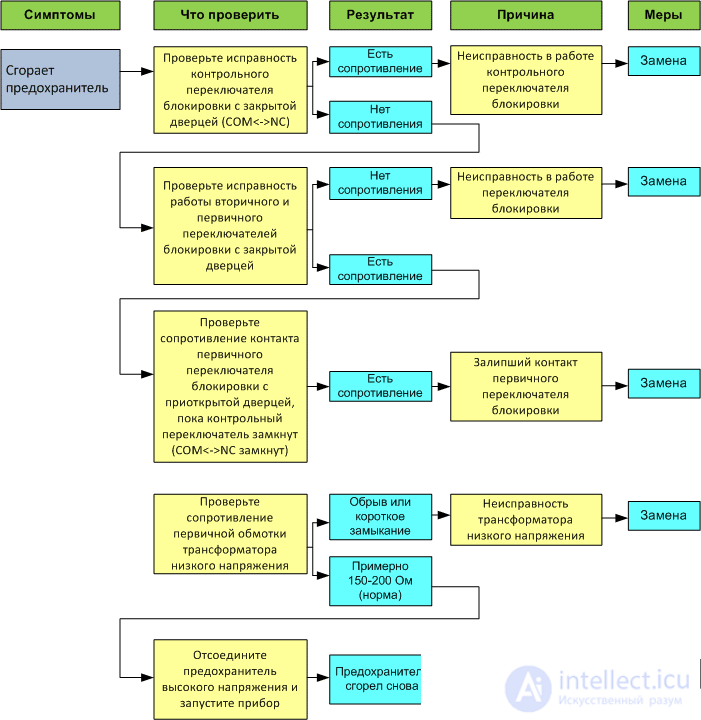
When the door is opened, all three microswitches are actuated by at least 2 mechanical systems. Thus, the primary and secondary switches interrupt the power supply.
If for some reason one of these switches fails to open, the monitor switch will short the internal circuit of the high-voltage transformer. Blowing of the fuse is acceptable in this situation.
 |
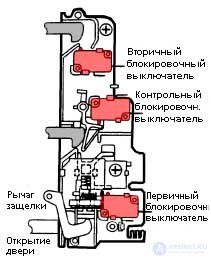 |
Fig.11 Electromagnetic door interlock
The safety interlock system may have different variations in different oven models, one of the possible options is shown below.
But the basic functions are always identical!
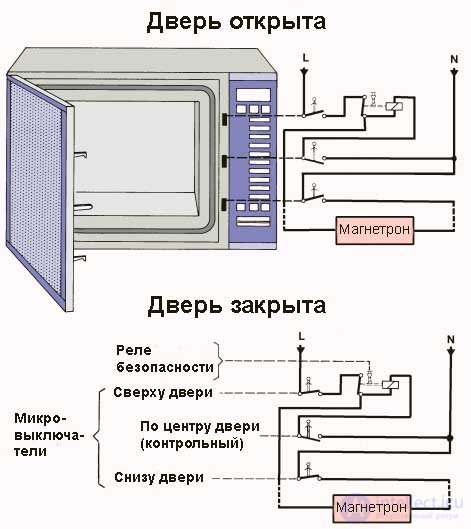
Fig. 12 Door safety system interlocks
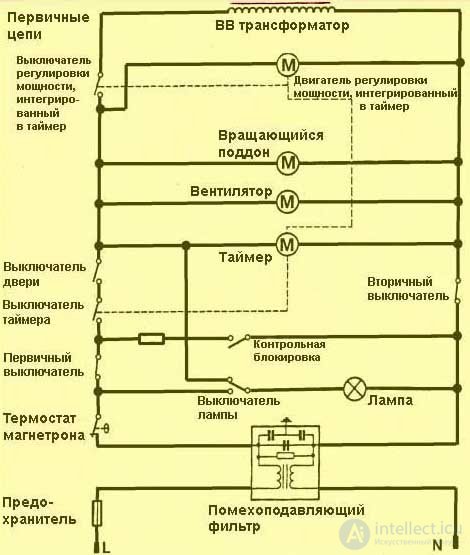
Fig. 13 Primary (low-voltage) electrical circuits
Below is an explanation of the function of the secondary circuit and/or the high-voltage circuit.
 |
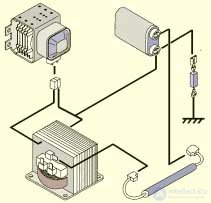 |
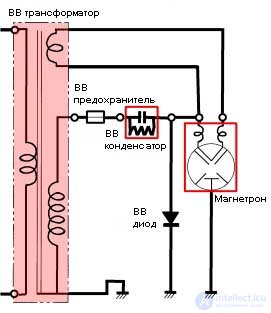
Fig. 14 Secondary (high-voltage) electrical circuits
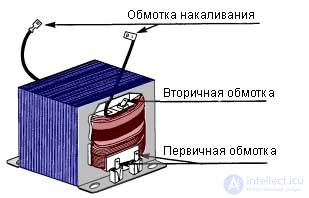 |
A high-voltage transformer usually has three windings: – primary winding – high-voltage secondary winding – low-voltage secondary winding |
|
|
The primary winding is powered from the 220 V mains, and the following voltages are induced on the secondary windings:
|
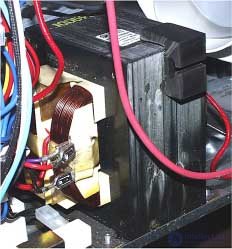 |
This is what the high-voltage transformer looks like, placed in the housing. The glued rubber parts are needed to reduce vibration and housing hum |
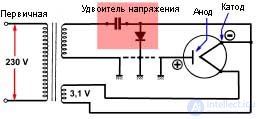 |
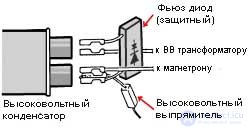
The voltage multiplier consists of a diode and a capacitor. All measurements, especially those related to parts under high voltage, must be carried out only as resistance measurements, and the oven must be disconnected from the mains during this!!! |
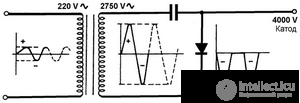 |
The 2750 Volt AC voltage in the secondary circuit of the high-voltage transformer is converted into a DC voltage of 4000 Volts. This energy is used to power the magnetron. |
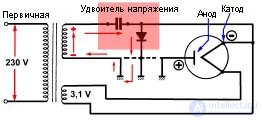 |
After the oven is switched on, the first wave of positively charged energy is directed to the capacitor at a voltage of over 2000 Volts. |
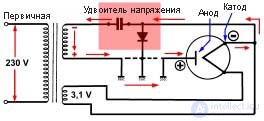 |
The change in polarity does not affect the operation of the diode, but the capacitor loses its charge. The voltage of the positive half-wave is added to the total energy of the capacitor. In this way, the required amount of DC voltage, approximately equal to 4000 Volts, is achieved. |
 |
 |
 |
 |
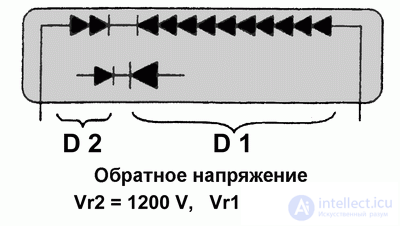
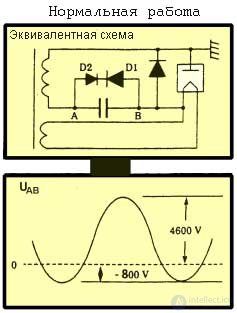
Negative half-cycleUABmax = - 800 Volts D1: forward direction D2: reverse voltage less than Vr2 Positive half-cycle UABmax = +4600 Volts D2: forward direction D1: reverse voltage less than Vr1 Operating mode is not disrupted |
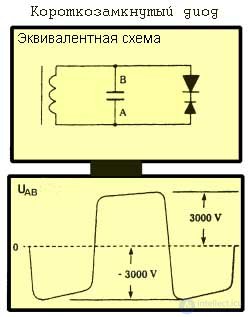
Negative half-cycleUABmax = - 3000 Volts D1: forward direction D2: reverse voltage greater than Vr2 (1200 V) Breakdown of diode D2 leads to a short circuit The current in diode D1 exceeds the norm and leads to a short circuit Secondary winding in short-circuit mode. The magnitude of the electric current in the secondary coil exceeds the norm and causes the main fuse to blow. The transformer is protected |
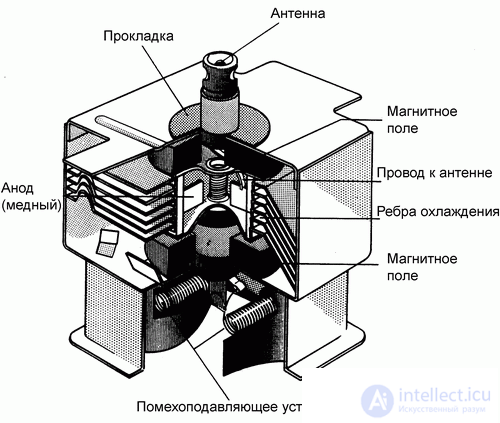 |
The magnetron – is the heart of the microwave oven. Using a transformer, a rectifier, and a magnetic field, it converts the 230 Volt 50 Hz electric current into electromagnetic energy with a frequency of 2,450 MHz |
|
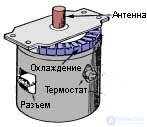
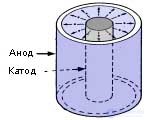
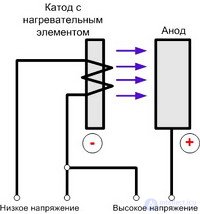
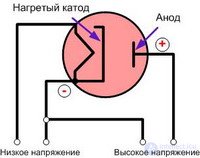
The magnetron consists of the following parts: The main housing with anode (positive) and cathode (negative), heatsink fins, a permanent magnet, connections for the filament and high voltage, as well as an antenna for transmitting electromagnetic energy. The inner cylinder is both the filament element and the cathode. The outer cylinder represents the anode block with resonating chambers. Due to the significant voltage difference between the anode and cathode, the electrodes move from the inner cylinder to the outer one. |
 |
 |
 |
||
|
For the magnetron to operate, a high AC voltage (4000 Volts), a low DC voltage for cathode heating, and a magnetic field are required. The cathode is heated to cause the emission of electrons, which are directed toward the anode |
. |
|
|
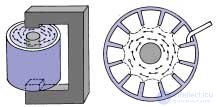
A permanent magnet is needed to achieve current oscillation. Due to its magnetic field, the electrons constantly rotate around the cathode, instead of moving directly from the cathode to the anode. Therefore, the electrons pass through the resonating chambers and cause the electromagnetic field to oscillate. |
 |
|
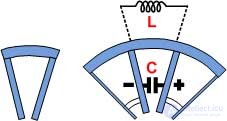 |
These resonating chambers have a special structure. They have a capacitive and even inductive effect within the high-frequency range. They also set the frequency of the generated electromagnetic energy. Subsequently, these oscillations of electric current are directed by the antenna directly into the oven. |
|
Before, as well as during measurements, safety precautions must be observed to avoid exposure to electromagnetic energy.
Check the door interlock mode (insulation and surfaces, hinges and latch bolts, mechanical tampering outside the oven).
When carrying out measurements or repair work:
!Be sure to discharge the high-voltage capacitor in advance.
This must be done using a suitable jumper with insulated ends.
When working with any microwave oven, it is important to always perform a check for high-frequency energy leakage (radiation leakage measurement) and a check according to the VDE 0701 standard after repair work has been carried out (even simply opening the oven housing is considered repair work).
Repair of a microwave oven must be carried out by a specialist who has the appropriate qualifications, possesses the relevant information, and has the necessary equipment, measuring tools, and technical documentation.
|
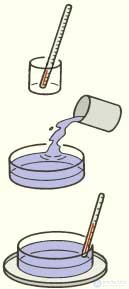
1 liter of water (17-24°C) 62 seconds of operation at full power |
Temperature difference |
Electromagnetic energy output |
|
 |
Important aspects:
|
7 8 9 10 11 12 13 14 15 16 17 |
490 560 630 700 770 840 910 980 1050 1120 1190 |
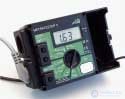 |
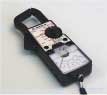
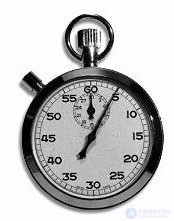
The most rational method for measuring power consumption is timing with a stopwatch (left) and a clamp meter (right). If the electric current suddenly increases, the parts responsible for high voltage are activated and electromagnetic energy is emitted. |
 |
|
The correct on/off duty ratio of the appliance should be determined from the technical documentation. |
||
|---|---|---|
|
Simplest rule: 50% on – 50% off 30% on – 70% off Time cycle used: |
 |
|
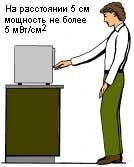
In most countries, the leakage radiation limit is specified by law and is no more than 5 mW/cm2 at a distance of 5 cm.
 |
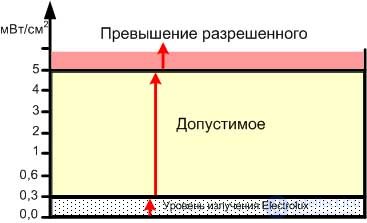 |
In modern microwave ovens, the doors are designed in such a way that they let through no more than 1 mW/cm2
A similar result can also be achieved by adjustment.
Pour 275 ml of water into a measuring cup and place it in the center of the oven.
|
Close the door Set the timer to 3 minutes Set power to 100% Turn on the oven |
 |
 |
To use measuring instruments, refer to their operating manual.
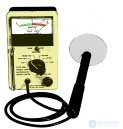
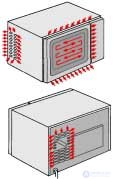
Inspect the oven for radiation leakage by moving the test probe clockwise over the top, starting from the door, at no more than 25 mm/sec, back to the starting position.
The measurement should be taken at a distance of 5 cm. In most cases the probe has parts made of plastic or other materials that help maintain this distance. Also check the entire front of the door, openings, and corners where energy emission occurs.
Fig. 15 Microwave oven door interlock
The table below shows the values that should be measured and recorded in tabular form, in this case > O Ohm < or >infinity<
| Switch | Door open | Door closed |
|---|---|---|
| Primary interlock switch | ∞ | 0 |
| Secondary interlock switch | ∞ | 0 |
| Monitor interlock switch | 0 | ∞ |
Switch measurements are carried out after disconnecting the wires and opening/closing the door.
It is recommended to check its operability after working with the main switches. Its wires must be disconnected.
In any case, the monitor switch must close when the door is open.
|
Diagram of the high-voltage connections between the capacitor and the diodes. Warning: Incorrect connections will cause instant damage and may destroy components! |
|
Unplug the power cord from the outlet before taking any measurements!!!
|
 |
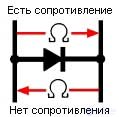 |
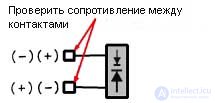
In one direction the diode should show no resistance at all; in the other direction you need to take a measurement and obtain a value in the range of a hundred kOhm. The instrument used for the measurements must support a voltage above 9 Volts, this being the threshold at which the diode should open. |
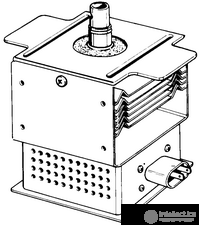 |
Measuring the magnetron
|
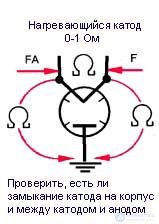 |
|
Low resistance that rises quickly… …ok Low resistance persists… …short circuit Very high resistance persists… …normal |
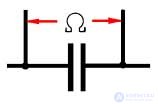 |
If the capacitor needs to be replaced, please use an original component.
Correct operation largely depends on precise power and capacitance.
|
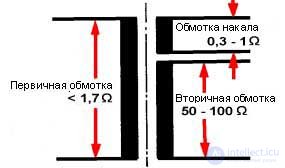 |
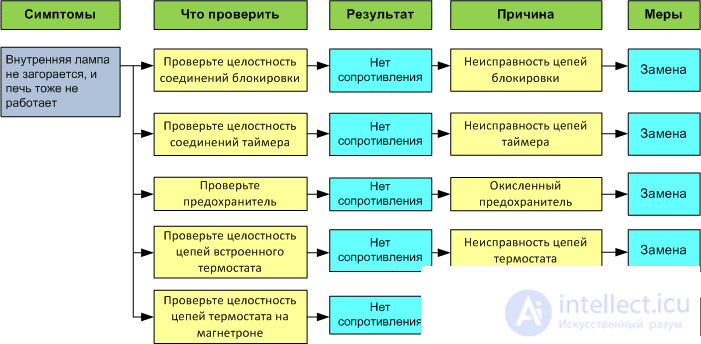
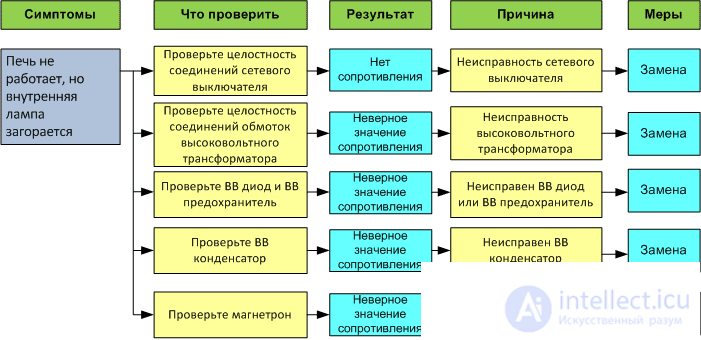
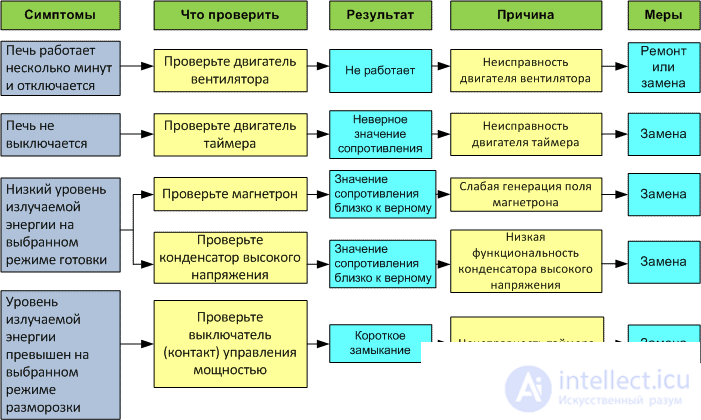
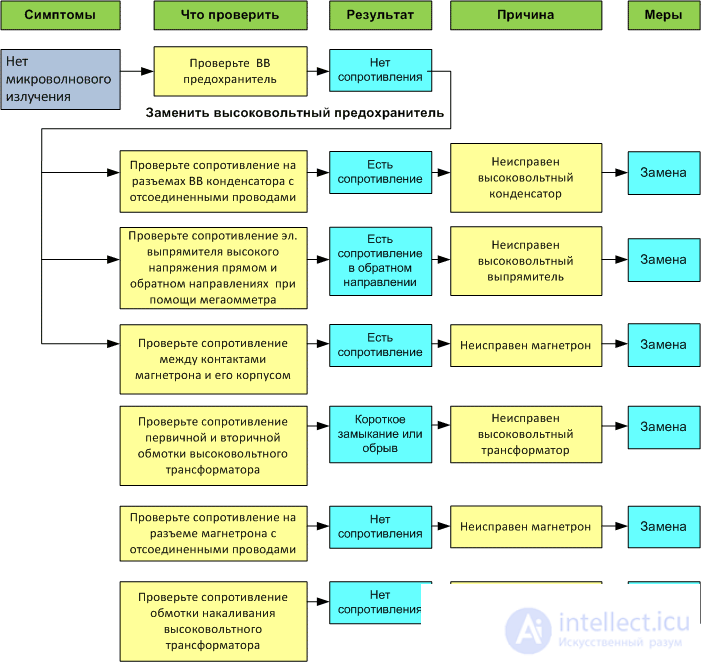
Finally, useful tips for consumers:
 |
|
 |
|
 |
|
 |
|
 |
|
продолжение следует...
Часть 1 Diagnostics and Repair of Microwave Ovens
Часть 2 Composition of a microwave oven - Diagnostics and Repair of
Часть 3 High-voltage test bench - Diagnostics and Repair of Microwave Ovens

Comments