
Practice
What are the dangers of bulging electrolytic capacitors on the motherboard or in the PSU?
Bulging electrolytic capacitors on the motherboard or in the PSU can lead to serious problems in the operation of the computer and even cause it to break down.
Electrolytic capacitors play an important role in stabilizing and filtering voltage in the computer. They are able to accumulate an electrical charge and release it when needed, which allows smoothing out ripple and voltage fluctuations in the system.
However, with improper use or over time, electrolytic capacitors can fail and begin to bulge. Bulging of a capacitor occurs due to the electrolyte leaking from inside the capacitor to the outside, which leads to an increase in its size and disruption of its operation.
Such capacitors are often found in the circuit of a switching PSU and serve to smooth out ripple at a frequency of tens of kilohertz. In principle, due to the ripple, an alternating current already flows through the capacitors, which heats up slightly due to internal resistance. At low frequency this heating is small and the capacitor stays cold. Boiling occurs when the dissipated power exceeds the power being released. So why does heating occur, causing the electrolyte to boil and result in an explosion, and what role does inductance play in the heating?
In switching circuits, if you look with an oscilloscope, you can see that at the moment the transistors switch, a damped oscillatory process occurs, with the amplitude of the spike being quite significant and the frequency of the oscillatory process high. The high-frequency component passes well through the capacitance, and it is the main cause of capacitor heating. What about inductance? Inductance is the cause of the oscillations, since it is part of the LC oscillating circuit. Consequently, the greater the parasitic inductance of the capacitor, the more energy of the high-frequency oscillatory component is released inside the capacitor. To prevent an explosion, notches are made on the capacitor's case, allowing the vapors of the boiling electrolyte to escape.
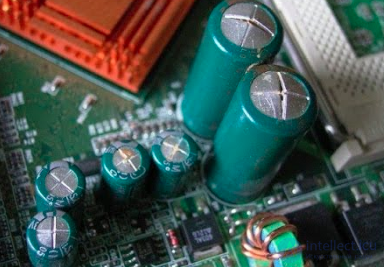
Bulging electrolytic capacitors on the motherboard or in the PSU can be dangerous for several reasons:
Disruption of computer operation: bulging capacitors can lead to errors in computer operation, unexpected freezing or system reboots.
Damage to the motherboard: bulging of capacitors can damage microchips and other components on the motherboard.
Increased fire risk: if bulging capacitors are not replaced in time, they can overheat and even catch fire, which can lead to serious damage to the computer or other devices.
Power supply disruption: bulging capacitors can lead to power supply disruption in the computer, which can lead to a malfunction in the operation of other components, such as hard drives or video cards.
Overall, bulging electrolytic capacitors can seriously affect the operation of the computer and cause unforeseen problems. If you notice bulging of capacitors on the motherboard or in the PSU, it is recommended to replace them as soon as possible to avoid further problems.

Comments