
Lecture
The capacity and internal resistance tester for 18650 lithium batteries BT4-1CHN 18650 is a specialized device designed to evaluate the quality and remaining service life of power cells widely used in portable electronics, electric bicycles, and energy storage systems. The primary task of such a device is to measure the actual battery capacity during discharge down to a set threshold and to determine the internal resistance, which directly affects the battery's ability to deliver current without significant voltage loss. Modern tester models are equipped with digital displays that allow real-time monitoring of current, voltage, and operating time parameters. The device's specifications typically include a measurable voltage range from 2.5 to 4.2 V, a discharge current of 0.5–3 A, and capacity measurement accuracy within a few percent. An important design element is the housing: it is made of durable plastic or aluminum, ensuring reliable protection of the electronics and ease of use. The housing is often compact, with ventilation holes for heat dissipation and connectors for attaching batteries via holders or terminals. Some versions feature a modular design that allows easy replacement of components or device upgrades.
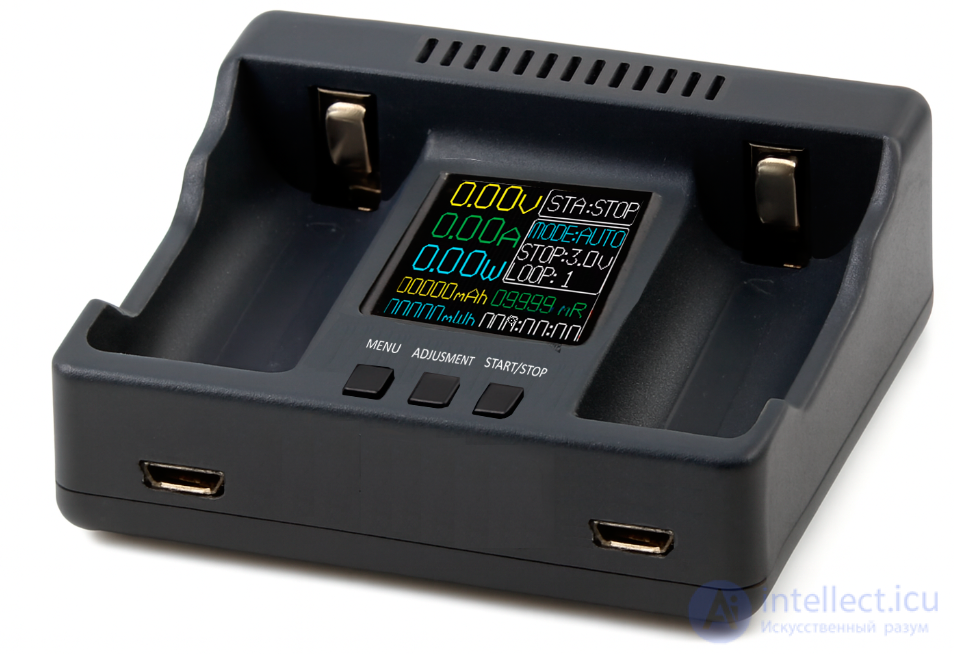
Thanks to its ergonomic housing, the tester is convenient to use both in laboratory conditions and at home, and the presence of clear labeling and control buttons makes the testing process intuitive. Thus, the capacity and resistance tester for 18650 lithium batteries is a practical tool for enthusiasts and professionals, allowing an objective assessment of battery condition and extending the service life of the devices in which they are used.
This product supports single-channel measurement of internal resistance and capacity; it supports charging and up to 9 automatic charge/discharge cycles. It can be used not only for charging a battery, but also for measuring the battery's internal resistance and capacity. And more importantly, it can be used for battery capacity grading and cycling.
Features:
Digital display: 1.77-inch digital display, clearly showing real-time voltage, real-time current, real-time power, accumulated capacity, accumulated energy, status indication, operating mode, discharge cutoff voltage, cycle count, battery internal resistance, and accumulated time.
Multifunctional design: It can be used not only for charging a battery, but also for measuring the battery's internal resistance and capacity. And more importantly, it can be used for battery capacity grading and cycling.
Three operating modes design: Preset automatic, three charge/discharge modes, select the appropriate mode and the program starts automatically; the discharge current can be switched for convenience.
Charging function: External 5 V power supply, maximum current 1 A through the charging chip during charging, and the charging process records the charged capacity and time. (Not suitable for charging LiFePO4 batteries)
Internal resistance test: The product uses a 2-wire DC method to check the battery's internal resistance with high accuracy when the battery is fully charged.
Capacity test: The capacity test is performed by discharging through a resistor, and the results represent only the capacity measured between the start of battery discharge during the test phase and the stop trigger. Accumulated capacity, energy, and time are recorded during the discharge process.
Battery capacity grading and duty cycle: Battery capacity grading and duty cycle is a process of charging, discharging, and recharging. During use, the cutoff voltage cannot be lower than 2.8 V, otherwise the battery cannot be charged and the program will not work properly.
Data clearing function: Automatic reset of power, energy, and time data upon power-off and mode switching.
Language switching: Two working languages by design; the factory default language is Chinese, but you can freely switch according to your preference.
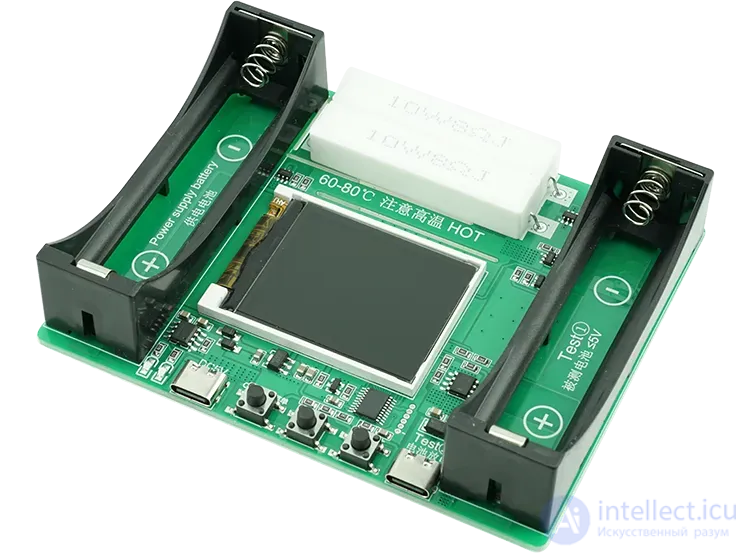
Name: Battery Capacity Tester
Material: printed circuit board.
Power supply: 5 V DC power source or 18650 battery (must be prepared separately)
Applicable battery: matches discharge cutoff voltage 2.5–3.5 V, 2.8 V triggers at a voltage of 4.2 V. A fully charged battery is also applicable.
Power interface: Type-C interface, power cable provided separately (mobile phone C-port cable)
System language: Chinese (default), English.
Number of tests: 1-channel charge/discharge measurement (only the right battery slot)
Internal resistance measurement: supported, using a 2-wire DC method to check internal resistance.
Charging function: supported, fully automatic charging with automatic cutoff (LiFePO4 charging not supported)
Discharge function: supported, automatic stop when conditions are met, discharge current not adjustable.
Automatic charge and discharge: supported, battery fully recharged at the end of automatic mode.
Cyclic charge and discharge: supported, adjustable 1–9 cycles (supported only in automatic mode)
Status indication: supported
Discharge cutoff voltage: 2.5 V, 2.6 V, 2.7 V, 2.8 V, 2.9 V, 3.0 V, 3.3 V, 3.3 V, 3.4 V, 3.5 V, 11 adjustable levels.
Discharge current: dual-side resistor, max. current 1A, not adjustable, independent transformation not supported
Charging voltage: dedicated battery charging chip control, max. charging 1 A, full charge voltage 4.2 V.
Power failure retention: only settings parameters are retained, not measurement data.
Product dimensions: 110*89*30 mm/4.33*3.50*1.18 in
Product weight: 80 g/2.82 oz
Package dimensions: 153*100*42 mm/6.02*3.94*1.65 in
Package weight: 120 g/4.23 oz
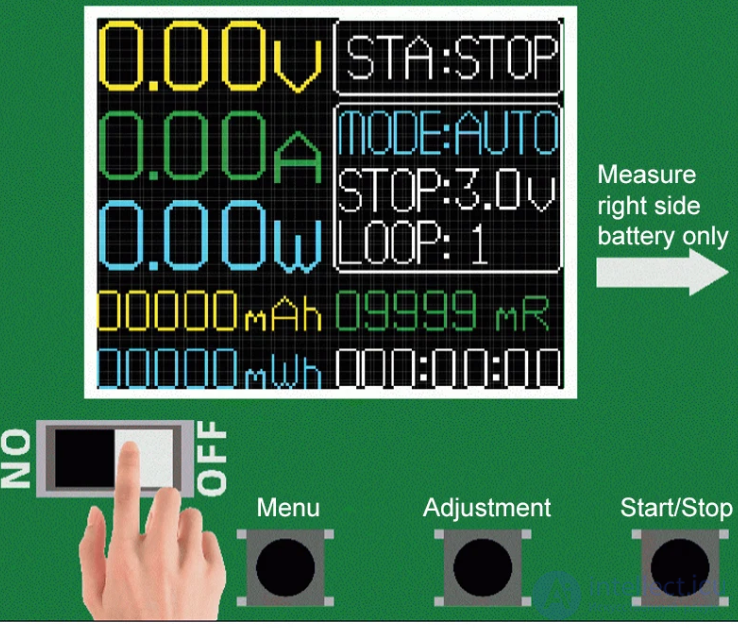
Language switching
Turn off the device
Press and hold the Menu key to start the device, release the key after the screen lights up, and wait 10 seconds after startup to turn off the device
Restart to complete the switch
How to use
Internal resistance measurement The device uses a two-wire DC method (DC 2-wire) to test the battery's internal resistance. The most accurate results are achieved with a fully charged battery. The obtained data is intended for reference and comparison between batteries tested in the same batch. For those who require high-precision internal resistance measurement, it is recommended to use a professional instrument that uses the four-wire method (4-wire).
Testing method After installing the battery, wait a few seconds, then read the data. Voltage and internal resistance parameters will be displayed on the screen. There may be a data loading delay when installing and removing the battery — they will be verified after stabilization.
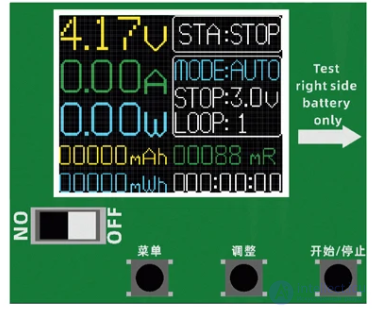
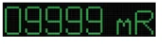
On display: "999.99 mR" The circuit is open when the battery is not installed, and the resistance value is considered infinite.
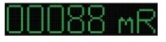
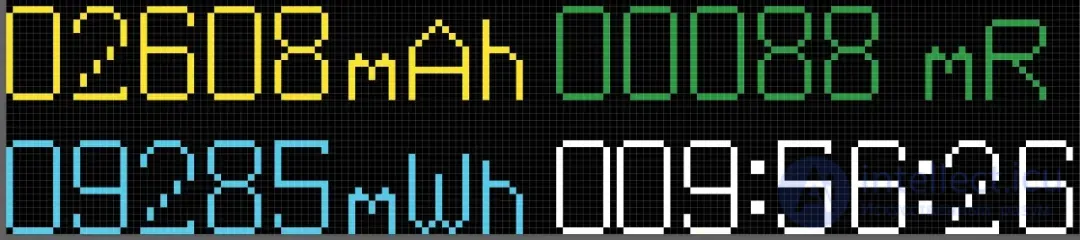
On display: "00088 mR" After the battery is installed, the circuit is closed, and the internal resistance is 88 milliohms.
Reminder:
High accuracy of internal resistance measurement is achieved with a fully charged battery
If the voltage is insufficient, the displayed resistance value may be overstated. Please reinstall the battery after fully charging it
Internal resistance of individual batteries may vary, please rely on actual measurement results
Using an extension cable for testing introduces line resistance, which increases the margin of error
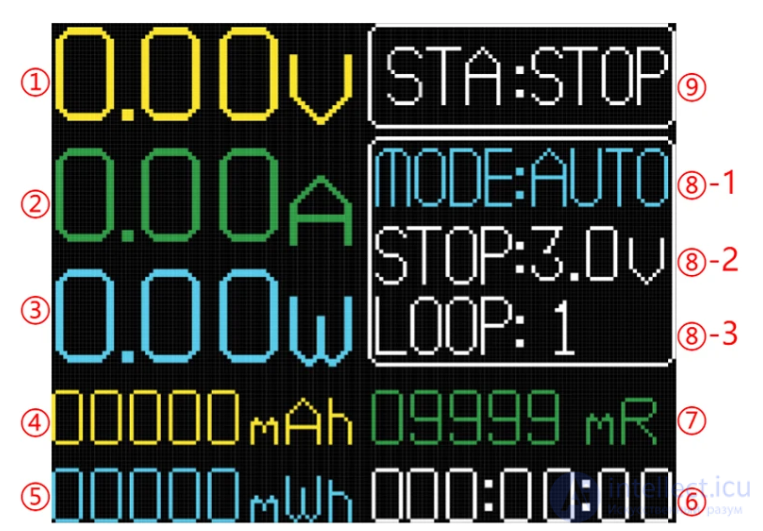
① Current voltage
② Current current
③ Current power
④ Accumulated capacity
⑤ Accumulated energy
⑥ Total operating time — hhh:mm:ss
⑦ Battery internal resistance in milliohms
⑧ - 1: Operating mode menu
⑧ - 2: Threshold (cutoff) voltage menu
⑧ - 3: Cycle count menu
⑨ Status indicator
Battery capacity measurement: Battery capacity can only be measured after discharge is complete.
During discharge: The cement load resistor will heat up and reach a high temperature — do not touch it and ensure enhanced cooling!!!
If the working battery (left battery) is fully charged: Discharge mode can operate without an external 5 V power supply. If the button does not work without external power, please replace the working battery promptly.
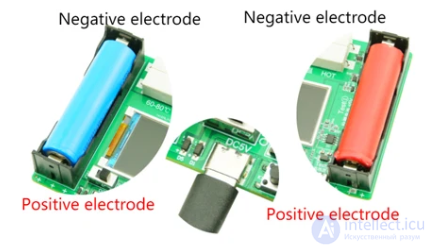
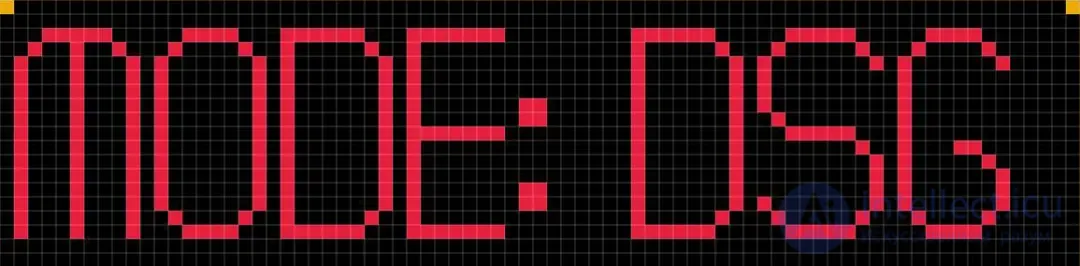
Mode setting: DSG Install the battery in the right holder MODE: DSG — discharge mode

Discharge cutoff voltage setting STOP: 3.0V — discharge will stop when a voltage of 3.0 V is reached

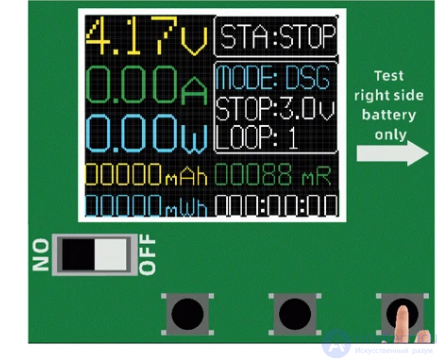
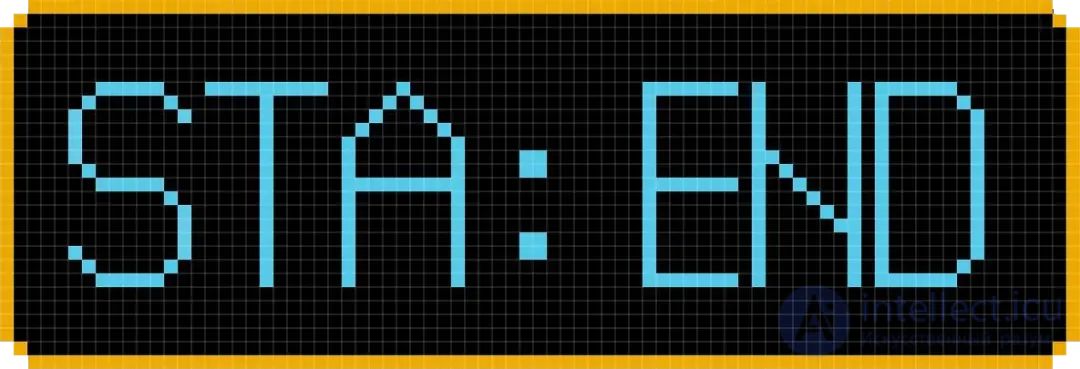
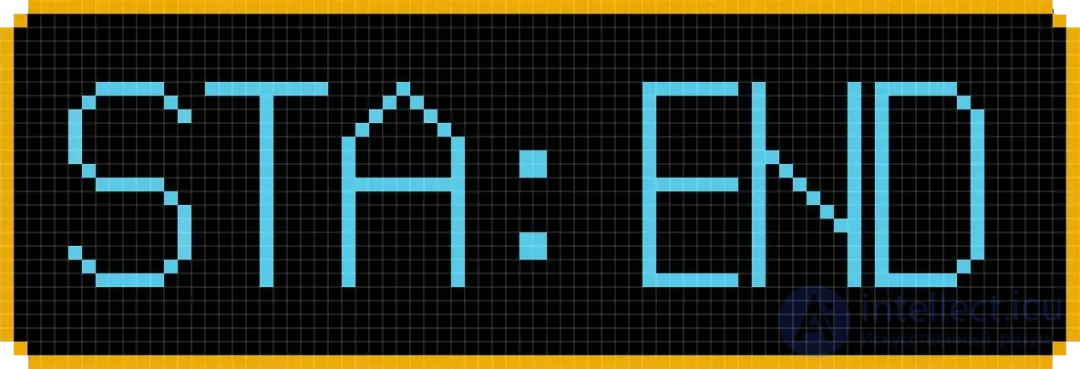
Press "Start/Stop" to start the program. After starting, the program displays the status: discharge. During the discharge process, time, capacity, and energy are recorded. After charging is complete, the program stops, and the status changes to: STA:END (status: complete).
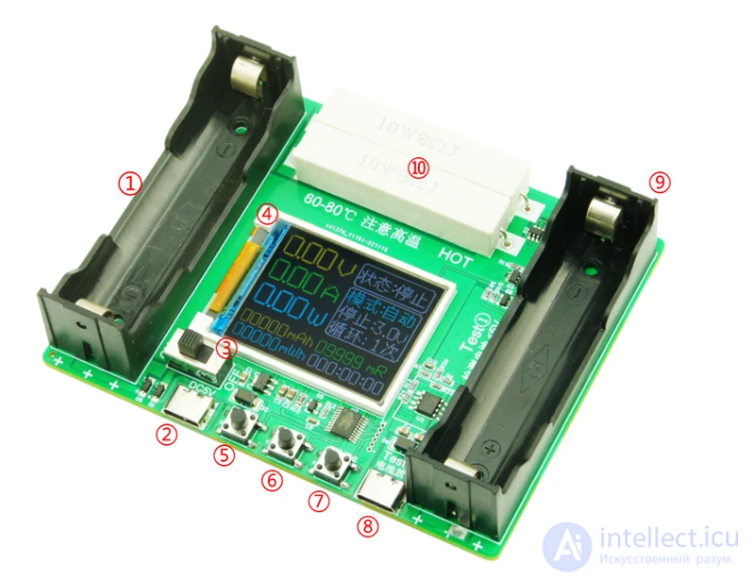
① Working battery compartment (not involved in charging or discharging)
② Type-C 5 V power interface
③ ON/OFF switch
④ 1.77-inch display
⑤ Menu button
⑥ "Adjust" button
⑦ "Start/Stop" button
⑧ Test
② — external discharge via Type-C
⑨ Test
① — compartment for charging and discharging the 18650 battery
⑩ Cement discharge resistor 10 W, 8 Ohm
✔ Main parameters
Power supply: DC 5 V or 18650 battery (not included)
Supported batteries: cells with a discharge cutoff voltage from 2.5 to 3.5 V and a charging voltage of 4.2 V
Power interface: Type-C, power cable not included
System language: Chinese (default), English
Number of batteries tested: one — charge and discharge of the right battery only
Internal resistance measurement: supported, using the two-wire DC method (DC 2-wire)
Charging function: supported, automatic shutoff when fully charged
Discharge function: supported, automatic stop when the specified conditions are met
Automatic charge and discharge: supported, cycle completes upon full charge
Cyclic charge and discharge: supported, adjustable from 1 to 9 cycles
Status indication: supported
Discharge cutoff voltage: adjustable across 11 levels: 2.5 V, 2.6 V, 2.7 V, 2.8 V, 2.9 V, 3.0 V, 3.1 V, 3.2 V, 3.3 V, 3.4 V, 3.5 V
Discharge current: two resistive channels, maximum current about 1 A, not adjustable and does not support independent configuration
Charging voltage: controlled by a dedicated chip, maximum charging current about 1 A, full-charge voltage — 4.2 V
Retention on power loss: only setting parameters are retained, measurement data is not saved
Product weight: g (net), g (with packaging)
Product size: 110 × 88 × 30 mm
Package size: 153 × 100 × 42 mm (corrugated box)
✔ Comparison of internal resistance measurement accuracy
The device uses the direct-current two-wire method (DC 2-wire) to measure the internal resistance of the battery. When the battery is fully charged, the reading accuracy is high. Test results are intended for reference and for comparison between batteries tested in the same batch. For those who require high-precision internal resistance measurement, it is recommended to use a professional instrument that applies the alternating-current four-wire method (AC 4-wire).
Testing principle
The DC impedance is calculated using the physical formula R=V/IR = V/I. The test equipment briefly (typically 2–3 seconds) passes a large direct current through the battery (currently typically 10–80 A), measures the voltage across the battery terminals, and calculates its internal resistance using the formula.
Comparison table:
| Measured voltage (V) | This device (mΩ) | Professional instrument (4-wire, mΩ) |
|---|---|---|
| 3.70 | 18 | 16 |
| 4.00 | 62 | 62 |
| 4.18 | 58 | 70 |
| 4.16 | 22 | 17 |
| 3.77 | 68 | 57 |
| 3.47 | 95 | 80 |
| 3.99 | 80 | 77 |
| 3.69 | 79 | 69 |
| 4.05 | 90 | 104 |
| 3.85 | 96 | 119 |
Notice
Damaged or leaking batteries must not be tested.
The positive and negative poles of the battery must be correctly oriented during testing.
The charging chip is a 4056 charging chip, specifically designed for ternary lithium batteries and does not support charging lithium iron phosphate batteries.
An adapter is not included in the package. Use a quality 5 V charger. Using a low-quality charger increases the risk of high-voltage breakdown of the chip.
The cement discharge resistor is matched to the software algorithm and does not support adding, reducing, or replacing discharge resistors of other specifications.
Heat sinks may be installed on the cement resistors, or fans may be used, to improve heat dissipation.
When using extension cables for testing (Test 2) or welding extension cables, the extension cables increase line resistance. Internal resistance values obtained during the DC two-wire test are not reliable for reference. As the length of the extension cables increases, power drop and line losses become significant, which may cause charging and discharging to stop prematurely. Try to avoid using extension cables for testing. If extension testing is necessary, it is recommended to use copper wires and reduce the length of the extension cables.
Table of contents for the tutorial
1. Technical parameters
2. Equipment introduction
3. Interface introduction
4. Charging electrical parameters (does not support charging lithium iron phosphate batteries)
5. Physical appearance
6. Method of use
1. Technical parameters
Operating voltage: DC5V
Applicable batteries: suitable for batteries with a discharge cutoff voltage of 2.5-3.5 V, starting from 2.8 V and fully charged to 4.2 V.
Power interface: Type-C power interface (power supply and power cord included)
System language: Chinese, English
Number of channels: 1 channel for charge and discharge measurement (the right battery holder is intended for measurement)
Internal resistance measurement: supported, uses the DC two-wire method to test internal resistance
Charging function: supported, automatically stops charging when fully charged (does not support charging lithium iron phosphate batteries)
Discharge function: supported, automatically stops when the conditions are met,
Discharge current is not adjustable.
Automatic charge and discharge: supported, the battery is fully charged after the automatic mode completes.
Charge and discharge cycle: supported, adjustable from 1 to 9 cycles (supported only in automatic mode)
Status query: Supported
Heat dissipation method: natural heat dissipation
Discharge cutoff voltage: 2.5 V, 2.6 V, 2.7 V, 2.8 V, 2.9 V, 3.0 V, 3.1 V, 3.2 V
3.3 V, 3.4 V, 3.5 V, 11 adjustable levels in total
Discharge current: maximum about 1 A, not constant current, not adjustable and does not support independent modification.
Charging voltage: charging voltage is 4.2 V, controlled by the 4056 chip. The maximum charging current on the right battery holder is about 1 A, charging stops when the charging current drops below 0.1 A.
Retention on power off: only saves the set parameters, not the measurement data.
Product weight: 110 g (including packaging)
Product size: 85 × 108 × 28 mm
Package size: 153 × 100 × 42 mm
2. Equipment introduction
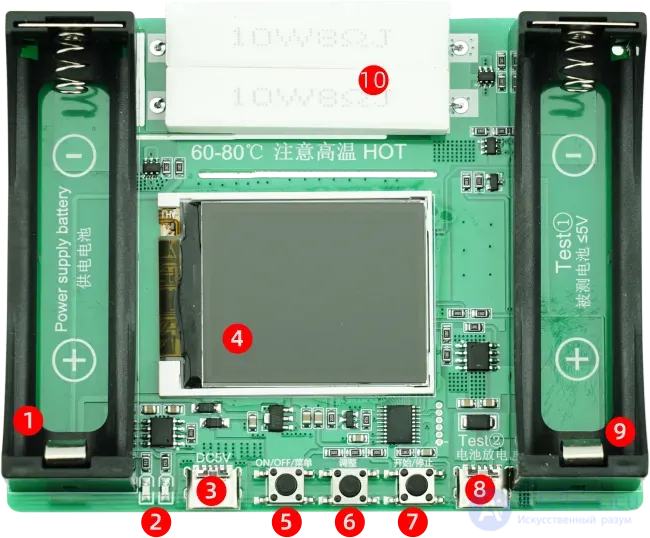
① Power battery compartment (not involved in discharge, not related to the on-screen display)
② Blue and red indicators: charge control indicators for the power supply battery, not related to tests ⑧/⑨
③ Type-C 5 V power interface
④ 1.77-inch screen
⑤ ON/OFF/Menu button
⑥ Adjustment button
⑦ «Start/Stop» button
⑧ Test ② External Type-C discharge interface
⑨ Test ① Charging and discharging of the 18650 battery compartment
⑩ 10 W 8 Ω J discharge cement resistor x 2
⑪ Scan the QR code to view the link to the electronic manual.
Note: ⑧ and ⑨ cannot be tested simultaneously.
3. Interface introduction
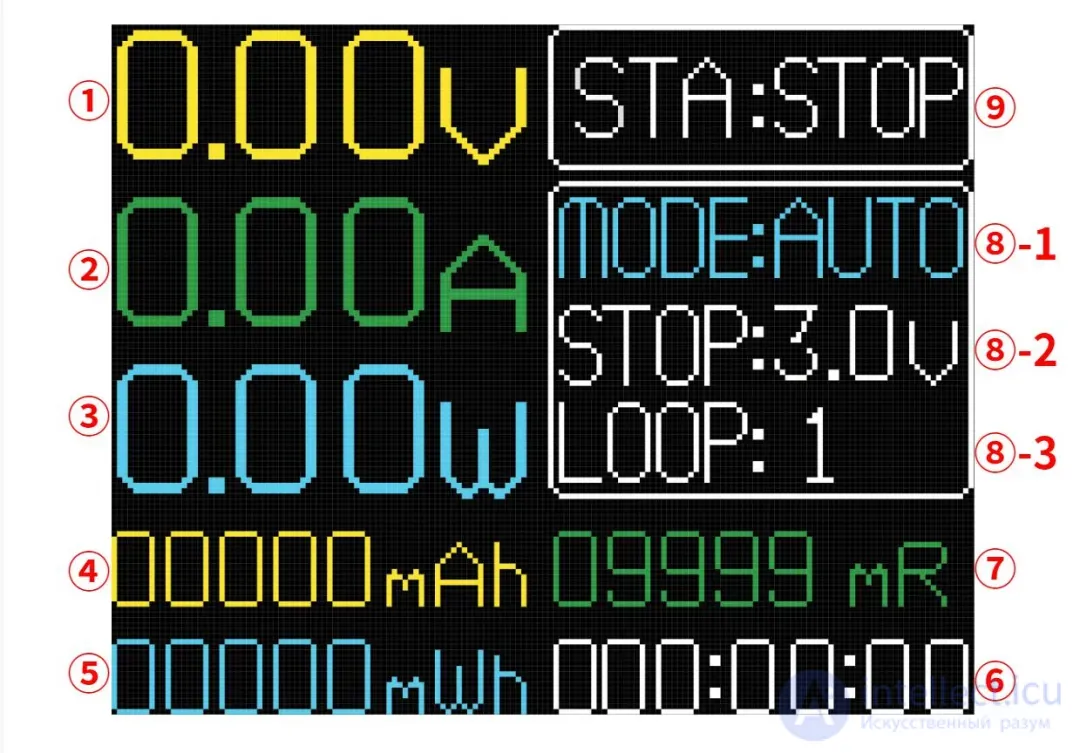
① Real-time voltage
② Real-time current
③ Real-time power
④ Total capacity
⑤ Accumulated energy
⑥ Total elapsed time - hhh:mm:ss
⑦ Battery internal resistance
⑧ - 1: Operating mode menu
⑧ - 2: Cutoff voltage menu
⑧ - 3: Cycle time menu
⑨ Status indication
4. Charging electrical parameters (does not support charging lithium iron phosphate batteries)
|
Symbol |
Parameter |
Test conditions |
Minimum value |
Nominal value |
Maximum value |
Unit |
|
V CC |
Input supply voltage |
|
4 |
5 |
6 |
V |
|
VFLOAT |
Output float voltage |
0 ℃ ≤T A ≤85 ℃ |
4.158 |
4.2 |
4.242 |
V |
|
ITRIKL |
trickle charge current |
VBAT<VTRIKL,RPROG=1.2K |
100 |
120 |
150 |
mA |
|
VTRIKL |
Charging threshold voltage |
RPROG=1K,VBAT 上升 rising |
2.8 |
2.9 |
3 |
V |
|
VTRHYS |
Hysteresis voltage for trickle charging |
RPROG=1K |
60 |
80 |
100 |
mV
|
At a current below 3 V, charging is performed with a small current. At a current above 3 V, charging is performed at about 1 A. If the current exceeds 4.2 V and does not stop, float charging occurs. The charging chip automatically stops charging. When the current drops below 0.1 A, charging stops. After charging is complete, the screen shows a voltage of 4.1... V, which is normal. If the charging current still exceeds 4.2 V, this may indicate that the charging chip is faulty.
5. Physical display
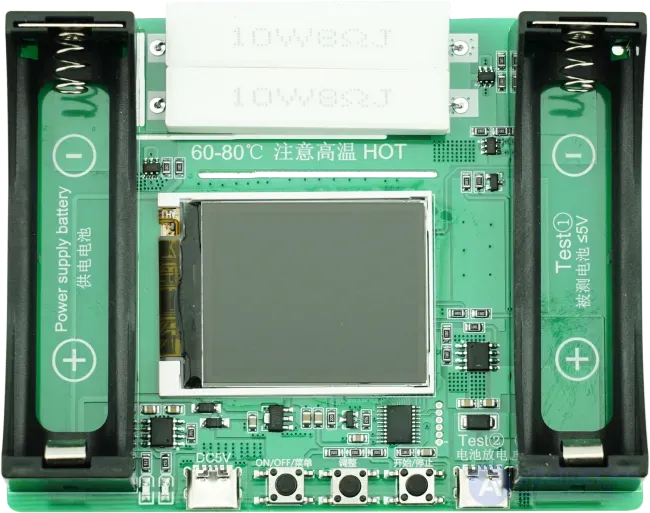
△ Front side
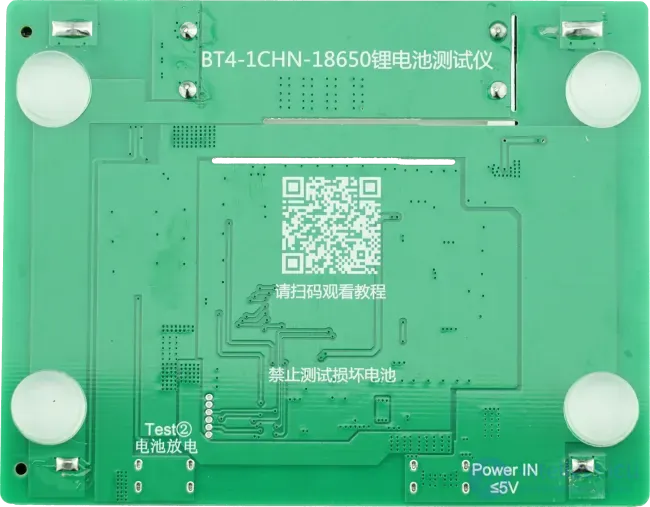
△Back side
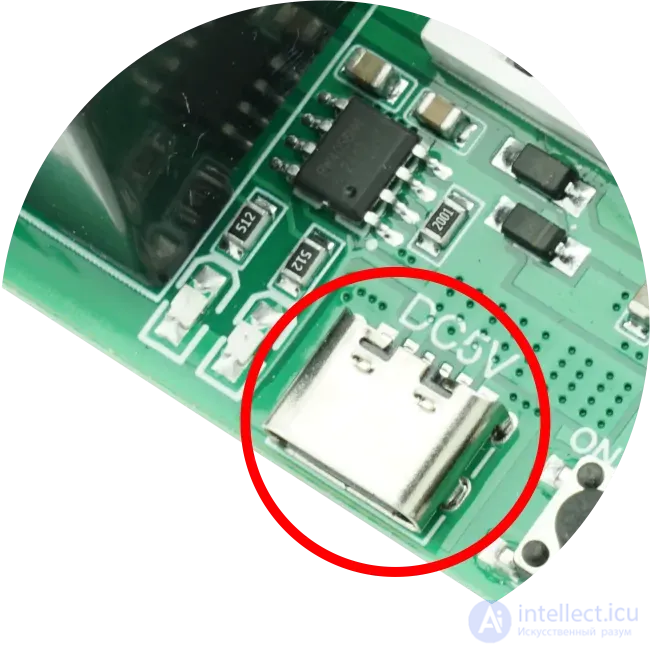
△ Power interface
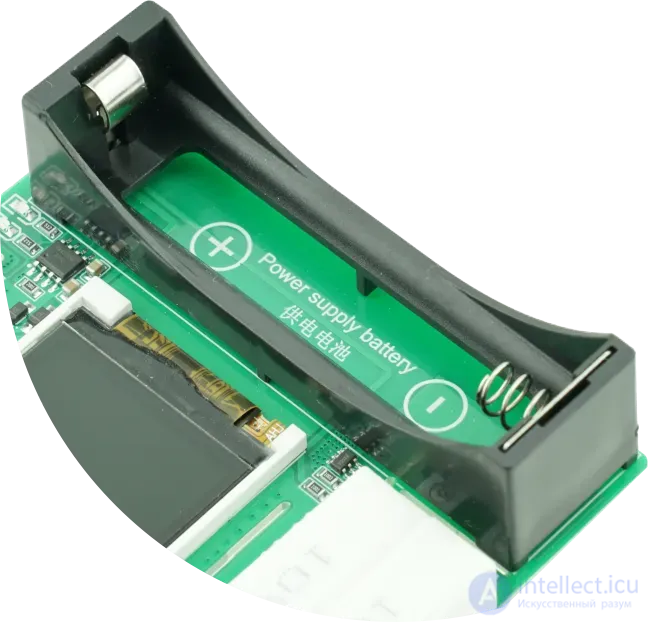
△ Left power battery holder (capacity cannot be measured)
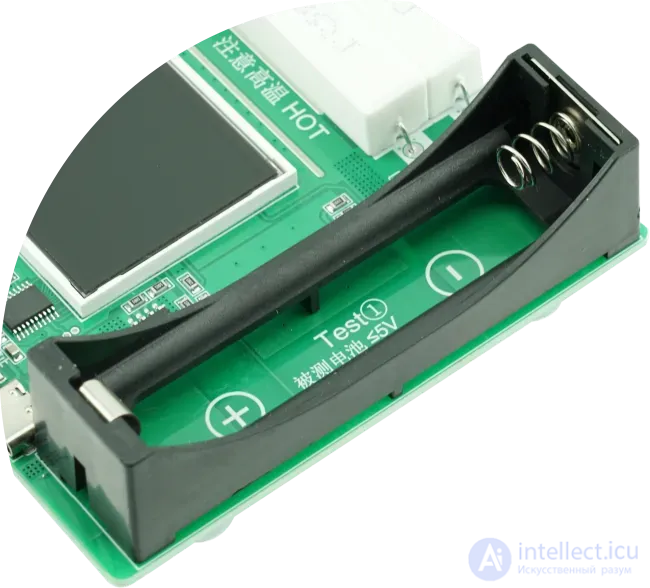
△ Right test battery holder
6. Instructions for use
When installing the battery, carefully check the positive and negative terminals.
If the voltage is not detected and the program cannot start, first check whether the battery is installed correctly.
6.1、ON/OFF
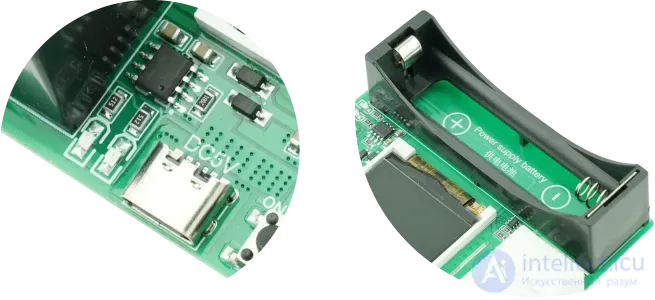
Turns on automatically when the working battery is first installed or a 5V power source is connected.
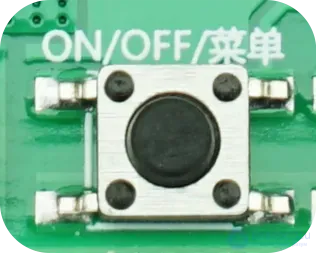
Press and hold the "ON/OFF/Touchscreen" button to turn off the screen while powered on, and press the "ON/OFF/Touchscreen" button to wake it from sleep mode while powered off.
6.2. Language
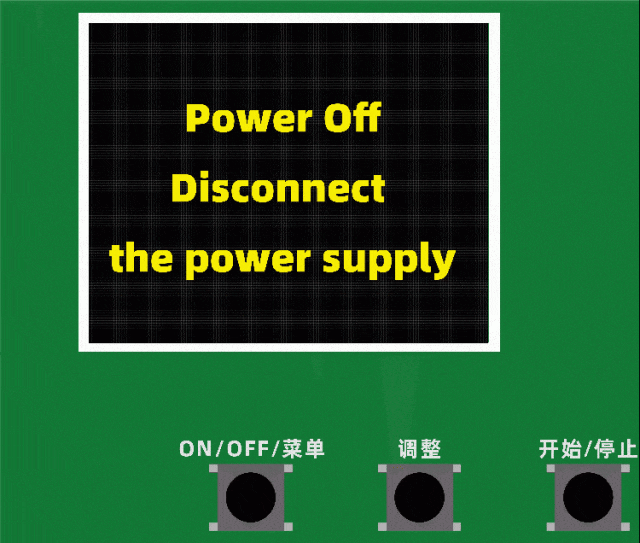
Press and hold the "Setup" button before powering on. Once the main interface appears on the screen, release the "Setup" button and wait 10 seconds before turning off and restarting the device!
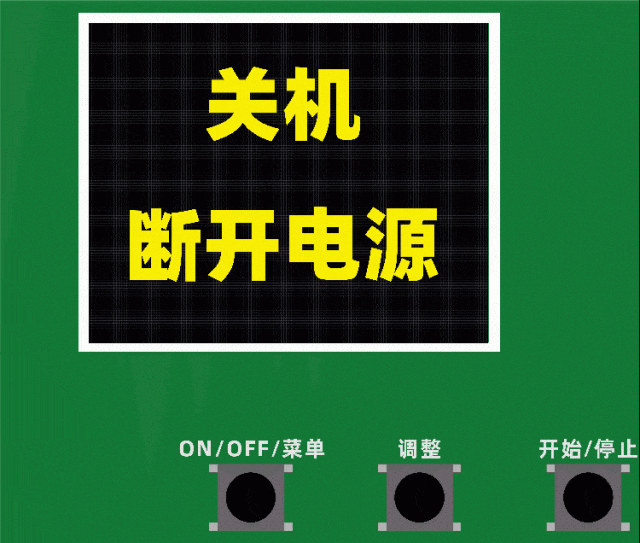
6.3. Internal resistance test (test results are for qualitative reference only)
Using the principle of the two-wire method for measuring DC internal resistance, high measurement accuracy can be achieved with a fully charged battery. Test results may be affected by factors such as contact resistance. This method is intended only for comparing batteries from the same batch. If you have high requirements for internal resistance measurement accuracy, use a professional internal resistance meter that operates on the four-wire AC measurement method.
Test principles
DC resistance is determined by the physical formula R = V / I. The test equipment passes a large direct current through the battery for a short period of time (typically 2-3 seconds), measures the voltage across the battery terminals, and calculates the current internal resistance of the battery using the formula.
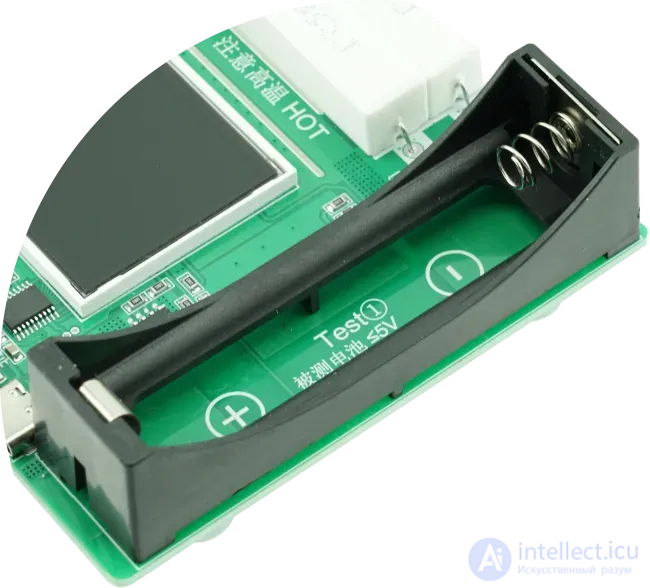
Only the right battery holder has the internal resistance detection function, while the left battery holder does not have the internal resistance detection function.
Install the battery, turn on the power, and wait 10 seconds. The display will show the measured voltage and internal resistance of the battery. This device uses the two-wire DC method to measure internal resistance. Due to limitations of the testing principle, in some cases the battery cannot be identified, and the internal resistance is always displayed as 9999. In this case, the internal resistance measurement results will be ignored.
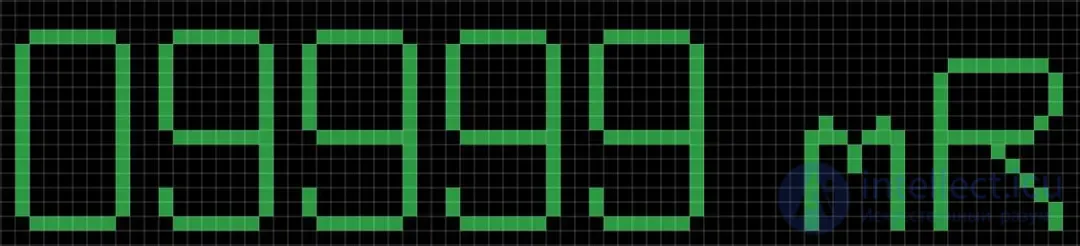
If the battery is not installed, the test circuit is open, which is equivalent to an infinite resistance value, and the internal resistance is displayed on the screen as 9999 mOhm.
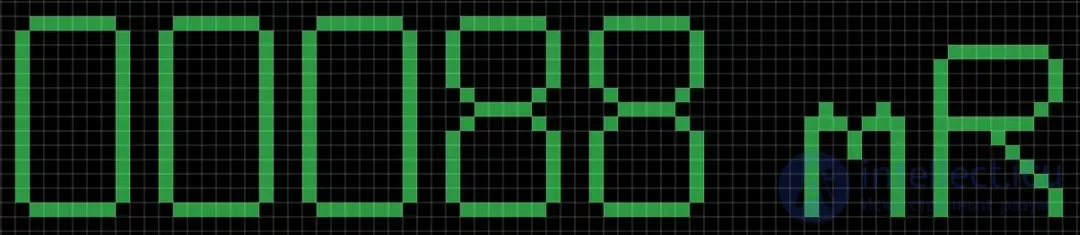
After the battery is installed, the circuit closes and the internal resistance of the battery under test is displayed.
6.4. Charging function (not suitable for charging lithium iron phosphate batteries)
Tips
For the charging function to work correctly, it must be powered via Type-C.
If the charging program is started without connecting a Type-C power source, the program runs normally, does not detect a charging current, and terminates automatically. The battery voltage does not change before and after the program is run.
6.4.1. Charging function of the power supply's left battery holder.
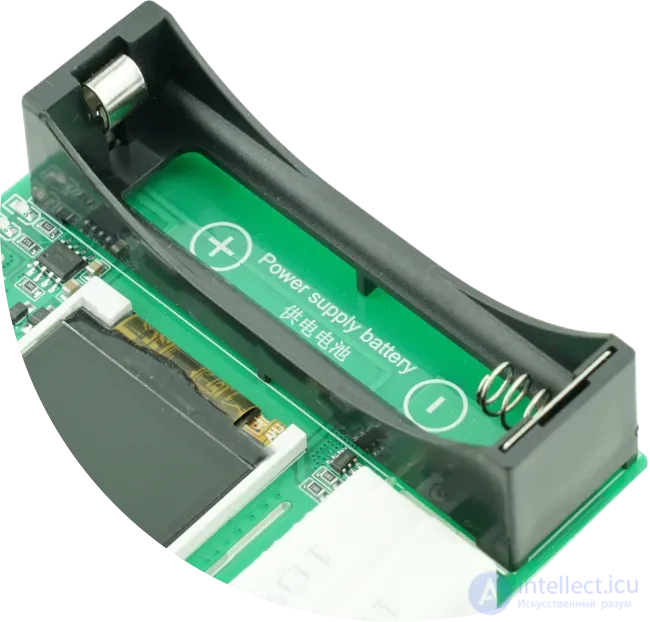
Charging of the left battery holder is not controlled by the on-screen program. Once the Type-C power supply is connected, charging is carried out according to a fixed program at 4.2V with a variable current of 0.5A. The charging process is not logged, and the charging capacity is not displayed.
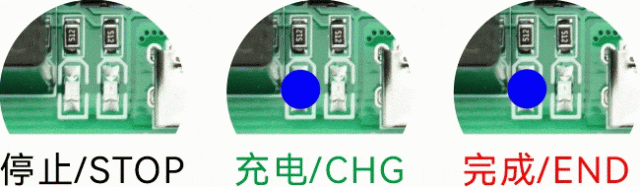
The indicator light shows the status of the left battery holder only and is not related to the right battery holder.
When using only Type-C power without installing the left battery, the indicator will also blink. This is the equipment detection process, and it is normal.
6.4.2. Charging function of the right battery holder
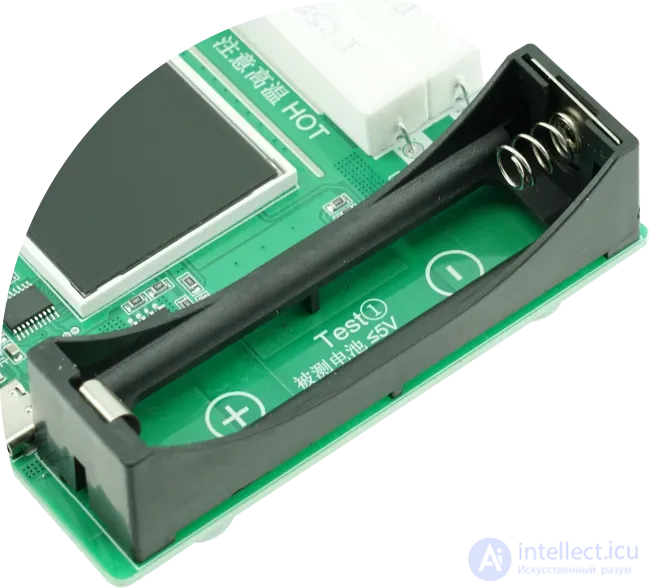
Estimated charging time:
Charging time = Capacity (mAh) ÷ 1000 × 1.2 hours
For example:
charging 1500mAh, charging time=1500 (mAh) ÷ 1000 × 1.2 hours=1.8 hours, approximately 1.8 hours.
Set the "CHG" mode, press "Start/Stop" to start the program.
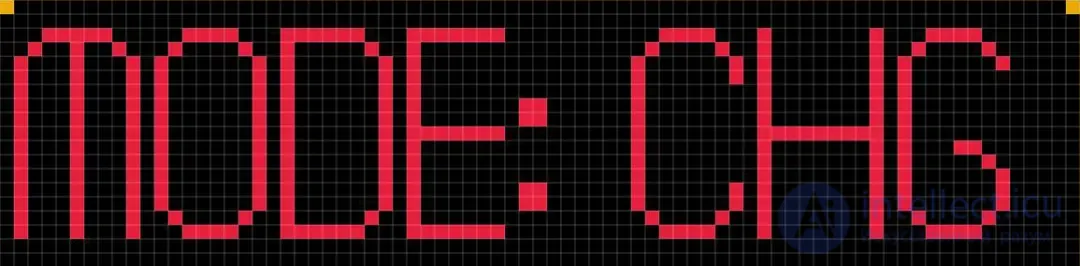
After charging is complete, the status «END» is displayed.
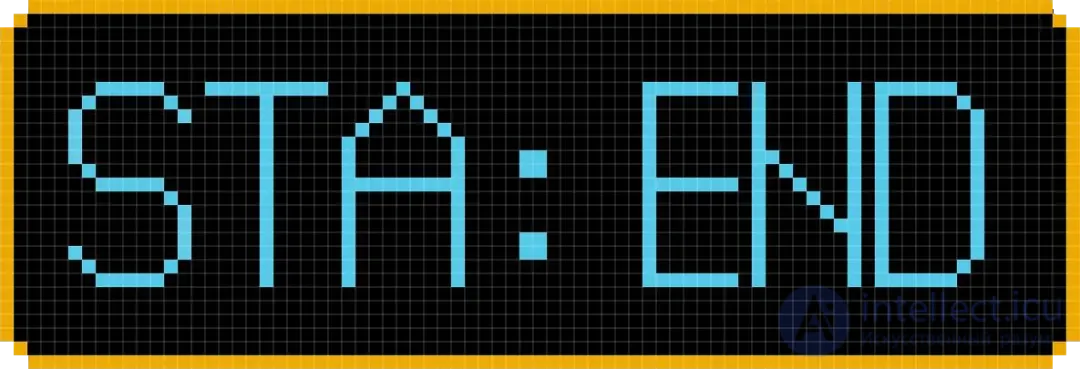
During charging, the capacity, energy, and charging time are recorded. Charging capacity data is for reference only; use the discharge capacity as the guide.
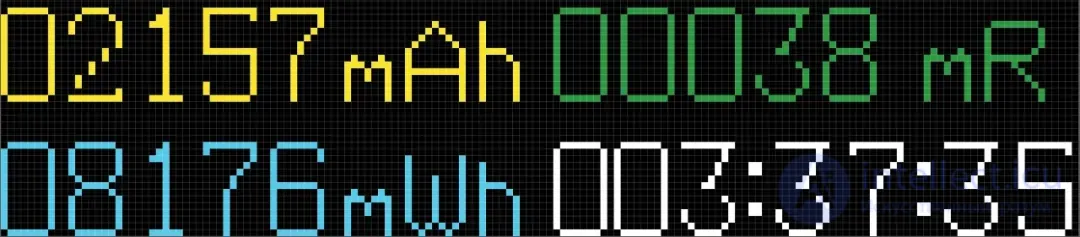
6.5. Test power
Test ① and Test ② are different interfaces for using the same control point.
Test ① and Test ② cannot be used at the same time.
Only Test ① or Test ② can perform capacity testing.
Reference information for estimating the duration of pure discharge capacity measurement:
Test duration = Capacity (mAh) ÷ 1000 × 1.5 hours
For example: 2500 mAh discharge, test duration = 2500 (mAh) ÷ 1000 × 1.5 hours = 3 hours, approximately 3.75 hours.
Capacity testing requires discharging and waiting. Capacity testing is performed using the resistive discharge method, during which the resistor heats up and generates high temperature. Do not touch it with your hands to avoid burns. The capacity test results include only the capacity measured from the start of the battery discharge until it stops during testing.
Set the «DSG» mode
Adjust the discharge stop voltage according to the battery requirements, and after completion
Press «启停/R/S» to start the program.
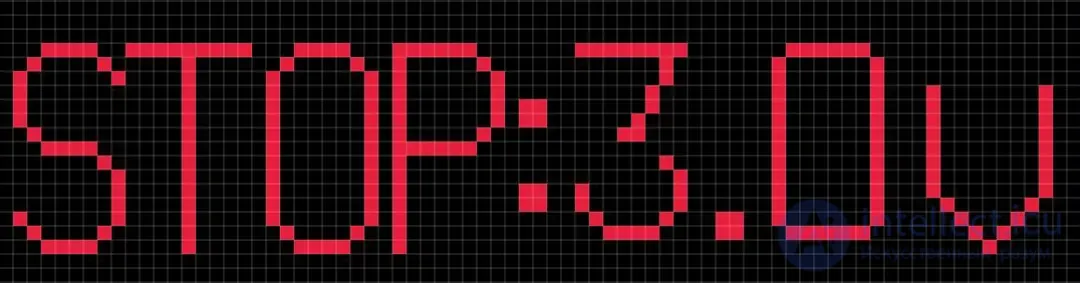
The stop voltage is the load voltage. After the discharge stops, the open-circuit voltage (shown on the screen) increases. For example, when «Stop: 3.0V» triggers the stop, the screen may show a voltage of 3.30 V, which is normal.
After discharge is complete, the status indicator shows «END».
Record the accumulated capacity, energy, and time during the discharge process.
6.6、Auto (cycle)
Reference for estimating the duration of automatic mode:
Test duration = Capacity (mAh) ÷ 1000 × (N+N+1) × 1.5 hours (N = number of cycles)
For example, testing with a rated cycle of 1800 mAh in automatic mode once
Test duration = 1800 (mAh) ÷ 1000 × (1+1+1) × 1.5 hours = 8.1 hours, the estimated test time is 8.1 hours.
Set the «AUTO» mode

Set the discharge stop voltage according to requirements; using 2.8 V is recommended.

Set the number of cycles according to requirements and press «Start/Stop/R/S» to start the program after completing this.
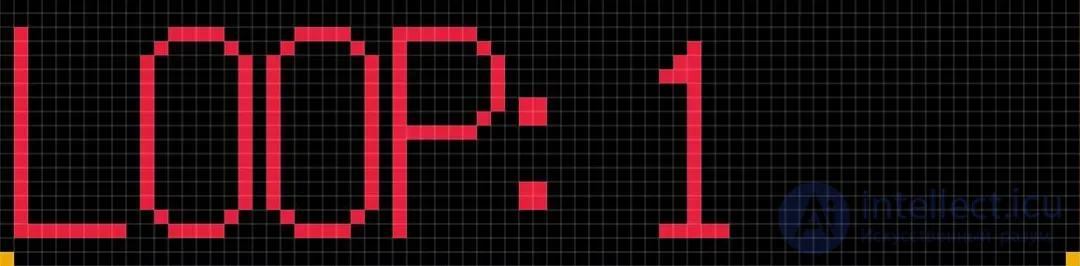
After the program is complete, the status indicator will finish.
During testing, the charging capacity is not recorded, only the single discharge capacity, discharge energy, and cumulative time.
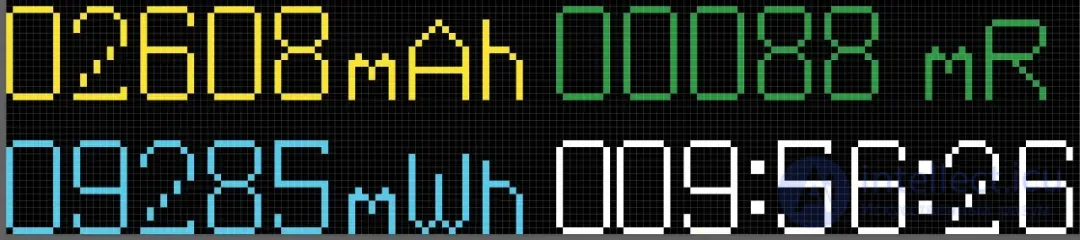
6.7. Clearing data
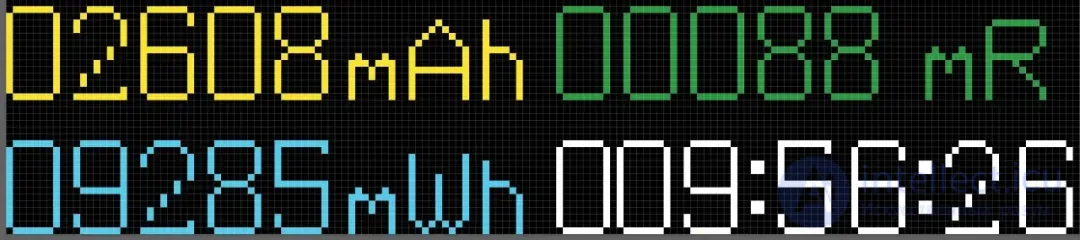
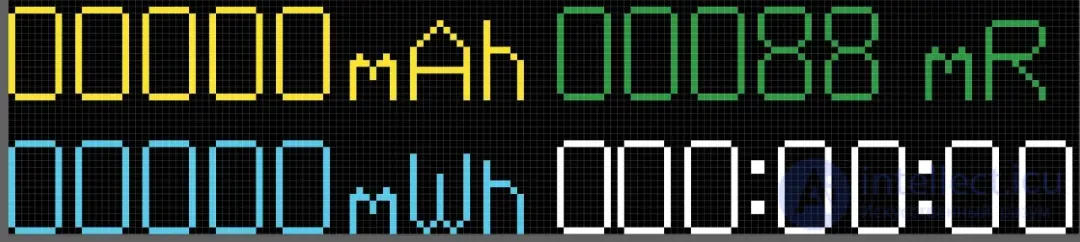
Power off, switching modes, and automatic reset of capacity, energy, and time data.
-END-

Comments