
Lecture
Speaking of the most common fraud schemes that users may encounter directly during equipment repair – several examples can be highlighted.
Fraud can take many forms. It can start with your equipment being taken from your home for repair, and you never seeing the technicians or your property again. They may charge an incredible sum for a trivial repair, claiming that everything has already been fixed and now you simply must pay. Or instead of a genuine new part, a used one is installed. The latter option is also unpleasant, but perhaps the most harmless.
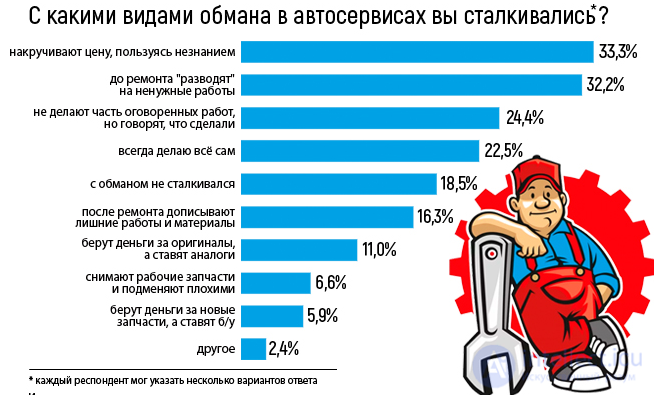
Frightening you and convincing you of the existence of non-existent problems – that is the main task of unscrupulous technicians. And if, for example, your washing machine won't turn on – the cause may be a broken cord or lack of power, but definitely not a broken motor. And if you believe what such "experts" say – the repair cost will be substantial.
For example, it's not uncommon for a technician to perform a repair of, say, 2-3 faults, but when the technician submits the bill – the repair is listed as covering 5-10 faults. And accordingly the amount to be paid will be several points higher. At the same time, the essence of the deception lies in the fact that they may list components and parts that were not actually repaired, or all the repair work is actually part of a single service that was simply split into several and presented separately.
And the point is – the work is done, you have to pay, since the technician isn't going to take everything back apart. And the client already has to pay – the technician simply presents them with this fact.
It often happens that an unscrupulous technician quotes one price for the repair over the phone/on the internet, but in the end the cost of the service turns out higher.
Example:
Your washing machine's control board is broken and you ask the technician how much the repair will cost. Having agreed, you call them out, but in the end the repair turns out to be twice as expensive.
The catch here is that, in addition to repairing the board, the repair cost turns out to include diagnostics, the call-out, disassembling the machine, etc.
Therefore, ALWAYS ask whether there will be any additional repair costs.
Tip: ask the technician what the FINAL repair cost will be.
This can happen when the necessary part is not available at the given company or the company is unable to perform the repair. Then the timeframe can be significantly extended until another organization completes the repair or until special parts arrive.
According to our technicians, this option is the most brazen – the technician simply takes your equipment supposedly for repair to the workshop, while the stated repair cost is minimal. But when the repair is finished – the repair cost increases several times over. And accordingly, if the client is not satisfied with this situation – blackmail follows from the technician's side. Supposedly, the equipment stays with them, and that's that.
Often the work is performed by a person without specialized education or experience
Frequently, a person who presents themselves as a repair technician may not actually be one. They have no understanding of how or in what sequence the repair should proceed. And this phenomenon is not uncommon among both independent technicians and companies that deceive clients in their work.
It's not uncommon for a technician or company to not actually perform the equipment repair themselves at all – they simply take it and hand it off to third parties for repair, acting as an intermediary. Accordingly, the repair ends up costing several times more. There are also companies on the equipment repair services market that use not new but used parts in repairs and accordingly profit from the difference.
At the same time, as our technicians say – there is no guarantee that the equipment repaired by such technicians will work reliably for long. And our specialists often encounter situations where supposedly repaired equipment fails again just ….. days, weeks later.
You can hear this phrase even before the technician opens up the computer, washing machine, or refrigerator. The fact is that repairing electronics requires special, specialized education; without it, it's difficult to make sense of the jumble of electronic components on a circuit board.
That is, because the technician can't repair the board, you're forced to overpay for a new one (the board or the entire device). So how can you find out whether a technician can actually repair electronics or not? After all, most likely, even without knowing how to repair it, they'll say they can.
Of course, it does happen that the cost of repairing a unit really is higher than the cost of a new module, or that repairing the given unit is impossible (but this isn't always the case).
One should distinguish between the concepts of call-out, travel, and diagnostics of a washing machine.
The call-out fee — payment for inviting a technician to your home to carry out the repair;
The travel fee — payment for time spent traveling to you and fuel;
The diagnostics fee — payment for identifying the fault.
Tip: If you want to know how much the call-out+travel+diagnostics of household appliances will cost, ask the technician how much you'll have to pay if you decline the repair.
This is the most common and most harmless way to "squeeze" more money out of a client. Unfortunately, both independent technicians and fairly large service centers resort to it.
The essence of the trick is roughly this: you come in and complain that ransomware pop-up windows have started appearing across your entire desktop. They remove them and restore normal operation. And then they offer: to optimize the registry, the system, clean junk out of Windows, install antivirus and anti-malware/adware protection software, and much more...
On one hand, it may seem useful, but on the other – you'll pay several times more for the "repair" of your laptop/computer. I'd also add that a lot of these additional services can be done yourself, and fairly easily (especially since some of these actions aren't one-time, they need to be performed regularly).
Note: by the way, imposed add-ons surround us everywhere, not just in equipment repair. Look at purchases (we're often given discounts when buying 2-3 items), insurance, banking services, etc.
Unfortunately, this type of deception is also very common and is almost impossible to prove (in some cases).
A simple example: you don't like that your laptop is overheating. You took it to a workshop, they kept it for a day and returned it to you (it's fine if they at least blew the dust out of it, but they might have done nothing at all). You notice that nothing has changed, yet they charged you. Proving or changing anything is very difficult, since the list of work performed and the receipt will surely all be in order.
How to protect yourself from this:
*
Most often these tricks are used in cases where your device shows no signs of life: it won't turn on, the screen doesn't light up, it makes strange noises, etc. In these cases, besides reseating a loose cable (or replacing the cooling fan) – they may also replace your RAM, hard drive, etc. Naturally, not for free!
And avoiding falling for this is very difficult, since the computer doesn't work, and giving even an approximate assessment of what's wrong with it is not something everyone can do...
If, say, your hard drive has "died" — then during the repair it's far from certain that you'll get a new one installed (but the price tag may be as if for a new one — such are the standards...). Moreover, during the repair they might replace your new working components with other, old ones (less performant).
Though, I should note, technicians like this are encountered fairly rarely, since it's very easy to get into trouble if the substitution is discovered (it's much easier to work with double price lists and imposed add-ons).
In my opinion, installing used components is acceptable only if you're told about it directly, for example: "such and such, they don't make new parts like this anymore, but there are old ones. Shall we install them?".
Pay attention to the warranty period: when you're given new components, the warranty is one to two months (or more). For old components, as a rule, either no warranty is given at all, or it's a week or two at most!
*
This type of deception is possible with new equipment whose warranty repair period hasn't yet expired. As an example: your laptop, which has a one-year warranty, breaks down. You go to the service center, and they tell you: "See, it doesn't have the sticker, there's wear..." (there can be many reasons). The point is to deny you free warranty service, and steer you toward a paid repair (which they'll offer you, possibly even for not very much money).
And the trick is that this repair will be carried out as a warranty repair (at least, that's how it will be presented to the equipment manufacturer, and payment will be collected from them for supplying defective equipment), while for you it will not be treated as a warranty case – and you'll also be charged for the repair.
How to avoid falling for this: try writing to your equipment's manufacturer to find out whether the reason given by the service center is really grounds for denying warranty service. By the way, it's not uncommon for manufacturers to send a new device to users who contacted them!
*
You bring in equipment for repair – you're told it's more "dead" than alive. Then, after a couple of sighs, they offer to buy it from you for a token amount (you leave it) for parts. Some agree...
After which, such technicians perform a trivial repair on your equipment and may sell it (now as working equipment, not for parts...).
How to avoid falling for this: if your equipment has been given a death sentence (and it doesn't look like it's been smashed with a sledgehammer ☻ yet), try showing it to another specialist. Then make your decision. In any case, you'll always have time to leave the equipment to someone for parts...
If you don't want to fall victim to such so-called "master" technicians, don't want to become a victim of scammers – you should follow a few important rules.
And perhaps the most important rule – always demand that a contract be signed. It is in this contract that all the work conditions, cost, and warranties should be specified. This will protect you from possible problems, since responsible technicians and companies – will always not only sign a contract, but also issue a warranty for their work.

Comments