
Lecture
Projector (video projector) - an optical device designed to create a real image of a small flat object on a large screen. The appearance of projection apparatus gave rise to cinematography, which belongs to the projection arts.
Projection, projecting - in optics and technology - the process of obtaining an image on a screen located at a distance from the optical device, either by the method of geometric projection (movie projector, photo enlarger, diascope, etc.) or by image synthesis (laser projector).
The device intended for this purpose (if it does not have a special name) is called a projector. It should not be confused with lighting fixtures, whose name comes from the same Latin root, but which are intended for illuminating objects rather than transferring images. Since in certain cases lighting fixtures can participate in image synthesis, this line is somewhat blurred.
Among the image display technologies developed to date for projection screens, four main ones can be distinguished, which have found the widest application in commercial products of leading manufacturers and differ primarily in the type of element used to form the image:
Table 1
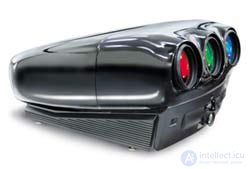
Multimedia projectors based on cathode ray tubes (CRT) have been manufactured for several decades now. But despite the emergence of more modern technologies, in terms of image reproduction quality (resolution, sharpness, color accuracy), acoustic noise level (less than 20 dB), and continuous operation duration (10,000 hours or more), they still have no equal. No other technology yet provides such a deep black level and such a wide dynamic range of image brightness, thanks to which CRT projectors allow details to be distinguished even when displaying darkened scenes. The physical characteristics of the fluorescent coating of the tube screen (see CRT Projector Design) prevent information loss when reproducing video signals of different standards (NTSC, PAL, HDTV, SVGA, XGA, etc.), and the similarity of the manufacturing technology of the tubes used in projectors to television tubes ensures color accuracy without the use of gamma correction algorithms.
Advantages of CRT:
Disadvantages of CRT:
The D-ILA (Direct Drive Image Light Amplifier) technology, developed relatively recently by Huges-JVC, is in fact the first commercial embodiment of the so-called LCOS technology, which, in the opinion of most experts, represents one of the most promising directions in the field of projection equipment development. Like LCD technology, it is based on the properties of liquid crystals, however, instead of conventional transmissive matrices based on amorphous or polycrystalline silicon, it involves the use of reflective-type devices as image formers (see D-ILA Projector Design). In the D-ILA matrix, the light-modulating liquid crystal layer is located on top of a monocrystalline silicon substrate, on which pixel-control electrodes, simultaneously serving as reflective elements, are formed by photolithography. Almost the entire matrix control circuit is located directly in the substrate, which provides this technology with a number of significant advantages compared to LCD panels. D-ILA matrices are simpler to manufacture and, with smaller dimensions, can have a significantly higher resolution. The efficiency of chip area utilization in them reaches 93%, which practically eliminates the appearance of a grid structure on the screen.
| Advantages of D-ILA | Disadvantages of D-ILA |
|
|
|
In multimedia projectors built using LCD (Liquid Crystal Display) technology, the function of the image former is performed by a transmissive-type LCD matrix. In terms of operating principle, such devices resemble ordinary slide projectors (see LCD Projector Design), with the difference that the image projected onto the external screen is formed as the light flux emitted by the lamp passes not through a slide, but through a liquid crystal panel consisting of a multitude of electrically controlled elements - pixels. Depending on the magnitude of the alternating voltage applied to each such element, its transparency changes, and consequently, so does the illumination level of the screen area onto which this pixel is projected.
LCD technology has significantly reduced the cost of projection apparatus, decreased their dimensions, and at the same time increased the light flux they emit (in the most powerful models it reaches 10000 ANSI lumens). It is naturally adapted for reproducing video signals from computer sources, as well as video files stored in digital format. LCD projectors are simple to operate and adjust and retain their settings after transportation. That is precisely why they are widely used in the business sphere for conducting presentations and demonstrating show programs.
| Advantages of LCD | Disadvantages of LCD |
|
|
The digital light processing (DLP) technology underlying any DLP projector is based on developments by Texas Instruments, which created a new type of image former - the digital micromirror device DMD (Digital Micromirror Device). The DMD former is a silicon chip on whose surface hundreds of thousands of controlled micromirrors are placed. Its main advantage compared to other types of image formers lies in its high light efficiency, due to two factors: more efficient use of the working surface of the former (utilization factor - up to 90%) and lower absorption of light energy by the micromirrors operating "in reflection," which also do not require the use of polarizers. For these reasons, as well as the relatively simple solution to the problem of heat dissipation, DLP technology makes it possible to create both powerful projection apparatus with a large light flux (a level of 18000 ANSI lumens has now been achieved) and ultra-miniature projectors (ultraportable, microportable) for mobile users. It is precisely in these product classes that DLP technology dominates today.
To reproduce halftones, the method of pulse-width modulation (PWM) of the signals controlling the switching of the mirrors is used. The more time, within the eye-averaged interval of 1/60 second, a micromirror spends in the "on" state, the brighter the pixel on the screen.

Example of forming an image section with LCD and DLP matrices. Modern DLP projectors are built using schemes with one, two, or three DMD matrices.
| Advantages of DLP | Disadvantages of DLP |
|
|
To some extent, the successors to cathode ray tubes are laser projectors, in which the image is formed by the emission of three (sometimes more) lasers. They are successors because the laser array forms three beams of the same colors, which are then mixed, and the image is created by a very complex focusing and scanning system, which includes a special system of mirrors. In essence, the formation of an image by such a projector is similar to the picture on a CRT television screen - the laser beam "runs across" the projection screen from top to bottom up to 50 times per second, and the human eye perceives the resulting picture as a single whole.
To some extent, the successors to cathode ray tubes are laser projectors, in which the image is formed by the emission of three (sometimes more) lasers. They are successors because the laser array forms three beams of the same colors, which are then mixed, and the image is created by a very complex focusing and scanning system, which includes a special system of mirrors. In essence, the formation of an image by such a projector is similar to the picture on a CRT television screen - the laser beam "runs across" the projection screen from top to bottom up to 50 times per second, and the human eye perceives the resulting picture as a single whole.
Diascopic projection apparatus - images are created by means of diascopic projection, that is, rays of light passing through a light-transmitting medium bearing an image. This is the most common type of analog projection apparatus. These include devices such as: movie projectors, slide projectors, photo enlargers, projection lanterns, overhead projectors, and others.
Episcopic projection apparatus - creates images of opaque objects by means of episcopic projection, that is, projection of reflected light rays. These include episcopes and megascopes.
Epidiascopic projection apparatus (epidiascope) - forms on the screen combined images of both transparent and opaque objects.
Multimedia projector (the term "Digital projector" is also used) - with the emergence and development of digital technologies, this name has come to apply to two, generally speaking, different classes of devices:
A real-time video signal (analog or digital) is fed to the input of the device. The device projects the image onto a screen. An audio channel may also be present.
The device receives a file or set of files (a slideshow) - an array of digital information - from a separate or built-in storage medium, or from a local network. It decodes it and projects the video image onto a screen, possibly reproducing sound as well. In fact, it is a combination of a multimedia player and a projector in one device.
Laser projector - outputs an image using a laser beam.
3D projector - reproduces a three-dimensional image. As a rule, it is a laser type.
Figure 1
There are three main technologies used to manufacture modern multimedia projectors:
LCD (LiquidCrystalDisplay) technology - used in the manufacture of LCD projectors. The principle of this technology is the use of liquid crystals in transmitted light. A light beam is passed through a matrix consisting of hundreds of thousands of colored crystals (three colors are used: blue, red, green), thereby coloring it a certain color. If we need black, the crystal changes position and blocks the light. As a result, we get an image on the screen by controlling the crystals and changing their position to form the image. Because the crystal transmits light even in the closed state, it is not possible to obtain a perfectly black color on LCD projectors, which in turn adversely affects the contrast. To compensate for this drawback, special screens are used that increase image contrast. It is impossible to completely eliminate this drawback, but it should be noted that modern LCD projector manufacturing technologies have minimized it.
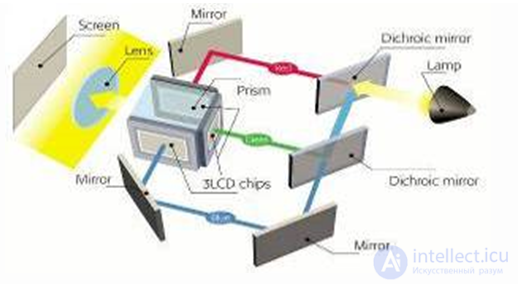
Figure 2
The further development of LCD technology is 3LCD - the same liquid crystal matrices, but here there are three of them. Matrices of three colors, through which light is passed in parallel, each of which controls one base color, resulting in higher color reproduction. Another advantage of this technology is that these matrices are more resistant to prolonged thermal exposure. Therefore, today 3LCD technology is used almost universally, and LCD is already considered outdated.
DLP (DigitalLightProcessing) technology - used in the manufacture of DLP projectors. This technology is currently the most widespread and is a competitor to 3LCD. This technology is based on a device consisting of a multitude of micromirrors - a DMD (DigitalMicromirrorDevice). Under electronic control, the mirrors can change their tilt angle, focusing light onto the screen. To produce black areas of the image, the micromirrors tilt away and direct the light into a light absorber; in other cases the light is directed into the focusing lenses. Each pixel on the screen is the reflection of light from one micromirror. To color the light, it is passed through color filters.
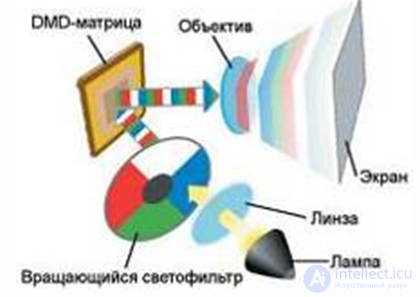
Figure 3
Different manufacturers use different ways of coloring the light in DLP projectors. The most commonly used technology is a color wheel consisting of three colored sectors. Light passes through a colored segment, acquiring a certain color, then is reflected from the mirrors and hits the screen. The color wheel rotates, coloring the light beam a different hue, and the micromirrors direct it onto the projection screen. Thus, as the wheel rotates, the colors replace one another, and accordingly the images on the screen change - red, green, blue. Since the wheel rotates at a very high speed and the image change also happens very quickly, a person does not see the images changing, but perceives a complete color image. Prolonged viewing of such a DLP projector can tire some particularly sensitive people. Also, in such DLP projectors, a so-called rainbow effect is possible - multicolored streaks appear at the edges of the image, which is distracting and interferes with watching a film, etc. The faster the change of images of different colors occurs, the less noticeable the rainbow effect. To eliminate these drawbacks, manufacturers increase the number of segments in the color wheel. The contrast of the image when using DLP technology is better than with 3LCD, because the mirrors reflect the light completely into the light absorber when displaying black areas, and the image looks truly black. High contrast is one of the main advantages of DLP projectors, but to minimize the drawbacks of the technology - eye fatigue and the rainbow effect - manufacturers have to use expensive techniques, which affects the final price of a good DLP device.
There are also other options for coloring light, similar to 3LCD - three color filters and three DMD devices, each of which, independently of the others, reflects light only of its own hue. As a result, there is no image switching, and a finished color image is obtained at the output. Thus, this solution does not have the drawbacks described above, and such an image is very comfortable to watch. Such 3DLP projectors are among the best on the market, but their cost is also quite high.
LCoS (LiquidCrystalonSilicon) technology - used in the manufacture of LCoS projectors, also known as D-ILA or SXRD. This technology is the most advanced today and is based on the principles of 3LCD and DLP. In such projectors, light is reflected from special liquid crystals on silicon. This achieves high image quality, free from the drawbacks of LCD or DLP technologies. LCOS allows the number of pixels to be increased, and therefore high resolution of these matrices is achieved much more easily. But rather complex technologies are used to create such matrices, which greatly affects their cost. LCoS chips are resistant to high radiation and are therefore used in more powerful, higher-brightness projectors - for cinemas and presentations in large halls.
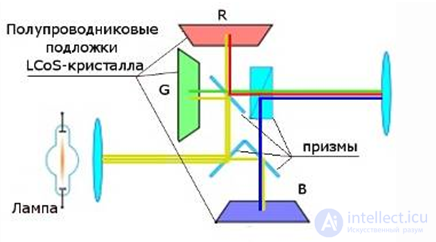
Figure 4
In general, it can be said that all three projection technologies have achieved a high level of implementation and their drawbacks have been minimized, so when comparing projectors, it is impossible to single out one technology or another and put it in the lead. In addition, there are a number of other characteristics that affect quality - these are the electronics processing the input signal, optical elements, the quality of electrical and mechanical parts, and others.
Table 2. The projector does not turn on.
|
Cause |
Solution |
|
No power is coming from the mains. |
Connect the power cord to the power connector on the projector and plug it into an outlet. If the outlet has a switch, make sure it is turned on. |
|
An attempt to turn on the projector during cooling. |
Wait for the cooling process to finish. |
No image.
|
Cause |
Solution |
|
The video signal source is not turned on or is connected incorrectly. |
Turn on the video signal source and check the signal cable connection. |
|
Incorrect connection of the projector to the input signal source. |
Check the connection. |
|
The wrong input signal is selected. |
Select the input signal using the SOURCE button on the projector or on the remote control |
|
The lens cap is closed. |
Open the lens cap. |
Blurry image.
|
Cause |
Solution |
|
The projector lens is incorrectly focused. |
Adjust the lens focus using the focus control |
|
Incorrect relative positioning of the projector and the screen |
Adjust the projection angle and direction, as well as the height, if necessary. |
|
The lens cap is closed. |
Open the lens cap. |
The remote control does not work.
|
Cause |
Solution |
|
The batteries are discharged. |
Replace the batteries. |
|
There is an obstacle between the remote control and the projector. |
Remove the obstacle. |
|
You are too far from the projector. |
Stand no more than 8 meters from the projector. |
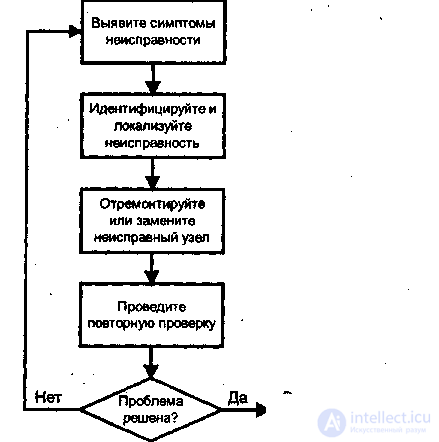
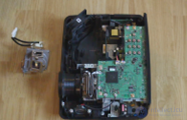
In this practical part, I decided to take apart and show, in pictures, the disassembly of a Benq projector.
BENQ MX505 projector.
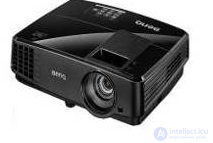
1) Turn the projector over and unscrew 5 screws.

2) Next, remove the top cover of the projector.
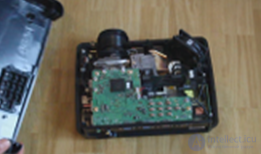
3) And to unscrew the lamp, all we need to do is unscrew the one screw that holds it in place.
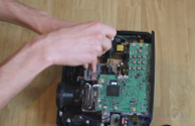
4) Done! The lamp is on the table :)

Comments