
Lecture
Games are a combination of many disciplines, and to create a great gaming experience it is essential that all elements work together harmoniously. This includes not only the gameplay itself, but also visual design, sound, graphics, music, as well as the technical aspects that make the game function. The main task of game design is to design gameplay elements — that is, how the game should function: what tasks the player will perform, what characters will be in the game, and how the player will interact with them.
Game design is responsible for bringing these disparate elements together into a single whole, creating interaction between the visual, audio, and technical components. While visual and technical design focus on how the game looks and how it is implemented, game design focuses on how the player will interact with the game world and its characters, which forms the foundation of an engaging gameplay experience.
The main topics covered within this module:
Game design is the process of creating a game's mechanics, rules, interactions, and goals. At this stage we discuss how the game designer is responsible for shaping the player's experience and the structure of the game, unlike programmers or artists, who work on the technical or visual aspects.
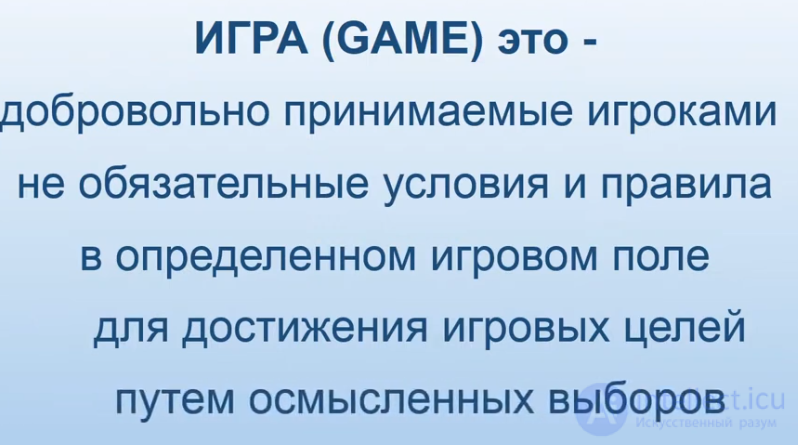
Here we study the key components that make up a game:
Various game genres are explored (for example, platformers, strategy games, role-playing games) along with their unique traits. Each genre imposes its own requirements on level design, mechanics, and player interaction.
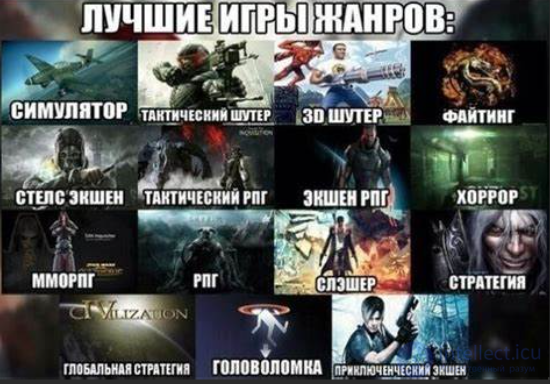
The gaming industry encompasses many different genres and types of games that differ in mechanics, play style, narrative, and level of interaction. Understanding the key types of games and genres is important for creating games that meet the expectations of different groups of players. Let's look at the main genres and their characteristics.
1. Action
A genre based on dynamic mechanics and active interaction between the player and the environment. Action games usually require quick reflexes and dexterity.
Subgenres:
Shooters — games where the main focus is on shooting. They can be first-person (FPS) or third-person (TPS). Example: Call of Duty.
Platformers — games where the player controls a character who jumps over obstacles and fights enemies. Example: Super Mario.
Fighting games — one-on-one or team battles using strikes and combos. Example: Mortal Kombat.
2. Adventure games
Games focused on exploring the world, solving puzzles, and interacting with the story. In such games, the gameplay is less dynamic, with the emphasis placed on exploration and story.
Subgenres:
Point-and-Click — the player controls a character by interacting with the surrounding world using the mouse. Example: Monkey Island.
Quests — the player solves puzzles and completes missions to progress through the story. Example: The Legend of Zelda.
3. Role-playing games (RPG)
Role-playing games focus on creating a character and developing them, which includes leveling up skills, obtaining items, and making decisions that influence the development of the story. Usually, an RPG places importance on a system of interacting with the world through quests and dialogue.
Subgenres:
JRPG (Japanese RPGs) — games created in the tradition of Japanese role-playing games with an emphasis on story and turn-based combat. Example: Final Fantasy.
Action RPG — combine elements of action and RPG with dynamic combat gameplay. Example: Dark Souls.
MMORPG (Massively Multiplayer Online RPG) — multiplayer role-playing games where a large number of players interact with one another in a shared world. Example: World of Warcraft.
4. Simulation
Simulators recreate real or fictional processes, often with a high level of detail. They can be oriented toward either a realistic reproduction of actions or fantastical scenarios.
Subgenres:
Life Simulation — games in which the player manages a character or community, engaging in everyday activities. Example: The Sims.
Flight Simulators — games that simulate controlling an airplane or spacecraft. Example: Microsoft Flight Simulator.
City-building simulators — games in which the player manages the construction and development of a city or settlement. Example: SimCity.
5. Strategy
Strategy games require the player to engage in long-term planning, make tactical decisions, and manage resources. The level of complexity and the number of available decisions make this genre more meditative than active.
Subgenres:
Turn-Based Strategy (TBS) — players take turns making moves, commanding armies or units. Example: Civilization.
Real-Time Strategy (RTS) — all actions take place in real time. Example: StarCraft.
Tower Defense — the player builds defensive structures to protect against waves of enemies. Example: Plants vs. Zombies.
6. Puzzle
Puzzle games focus on logic and problem-solving. Players must think and plan their actions to solve various in-game situations.
Subgenres:
Logic games — the player solves puzzles of varying difficulty in order to progress through the levels. Example: Tetris.
Physics puzzles — games that use object physics to solve problems. Example: Portal.
7. Horror
The goal of horror games is to evoke a feeling of fear or tension in the player. They often include survival elements, where the player must avoid dangers and solve puzzles to progress through the story.
Subgenres:
Survival Horror — games with an emphasis on survival amid a shortage of resources and constant stress. Example: Resident Evil.
Psychological horror — games where tension is created through atmosphere and story, often touching on the inner fears of the characters. Example: Silent Hill.
8. Racing
Racing games are games where the main goal is to control a vehicle and reach the finish line. They can include both realistic and arcade elements.
Subgenres:
Arcade racing — emphasis on speed and fun rather than realism. Example: Mario Kart.
Realistic racing — simulators where the physical characteristics of the cars and tracks matter. Example: Gran Turismo.
9. Sports games
Sports games model real sports, such as soccer, basketball, tennis, and others. Depending on the game, they can range from realistic simulations to arcade versions.
Subgenres:
Traditional sports games — realistic simulations of popular sports. Example: FIFA.
Fantasy sports games — based on fictional sports or with elements of fantasy. Example: Rocket League.
10. Music and Rhythm games
Games where the player needs to follow the rhythm of the music or create it. In such games, success depends on performing actions accurately at a specific time.
Example: Guitar Hero, Dance Dance Revolution.
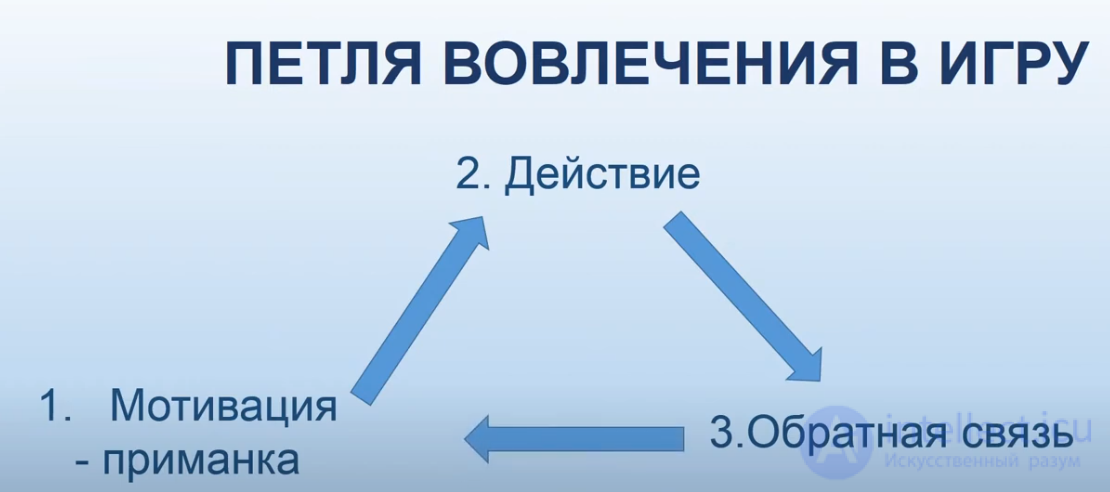
This concept explains how actions occur in a game. The game loop involves a constant sequence of events: the player performs actions, the game responds to them, and the player receives feedback. This helps create a sense of progress and engagement.
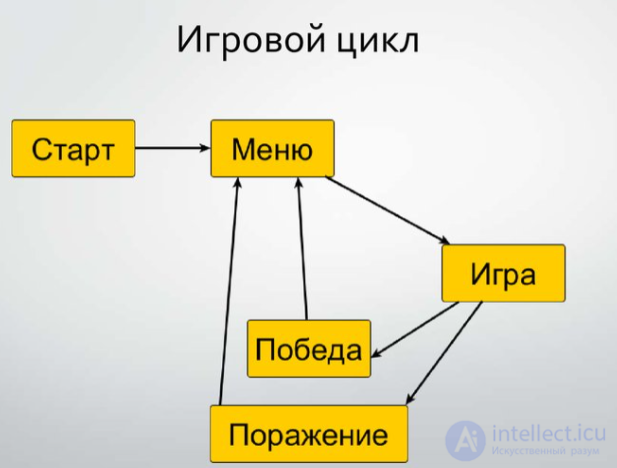
The game loop (gameplay loop, also core gameplay loop ) is the principle by which game designers define the main element of the game mechanics that determines the player's fundamental experience. A single game loop consists of a player action, the result of that action in the game world, the player's reaction to the result, and the game's prompt to repeat a new action.
Repetition is one of the fundamental aspects of a game. When people enjoy something, they want to repeat it. For example, children absolutely love rewatching cartoons over and over, or constantly ask to have the same bedtime story read to them. A similar process occurs for older ages, and this aspect is carried over into the game designer's construction of the game mechanics. During game development, the core gameplay loop is the central building block on which the game is built. It is usually represented in the form of verbs: shoot, jump, check your status, and so on. In the ideal case, the game loop can be described in a few words that reflect the experience the player receives.
If we look at the game Super Mario Bros., its core game loop is «jumping». Here the entire game is based on jumps, through which the hero kills enemies, breaks walls, determines ways of moving around, and much more. At the same time, in the game the experience of each jump is independent of the previous one, and the entire game mechanic revolves around jumping. It is also important that there can be a great many outcomes of a jump, and this gives the game variety.
A more precise approximation of the concept of a game loop is the concept of «30 Seconds of Fun», where the game loop is extended in time from 5−10 seconds to 30 and goes beyond a couple of game mechanics. In this case, development considers several well-developed systems, each of which is based on repetition. The «30 Seconds of Fun» concept is that in this time the player enters the game space, plans a way to proceed (for example, an attack), and carries it out. Meanwhile, the terrain may change, new types of weapons may be presented to the player, the option of melee combat may appear, and so on, but the game loop remains the same.
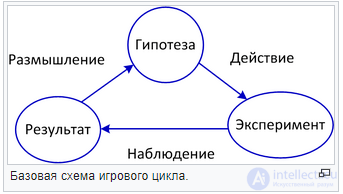
From a scientific point of view, the game loop can be regarded as a sequence of «hypothesis, experiment, and observation of results». In other words, the player has a certain mental model of the game world and a way by which this world can be studied. Accordingly, to study and understand it, one must compare the model of the world they have with the actual game world through game actions (as an experiment), and for a more detailed study one must perform many iterations, thereby carrying out the game loop. At the same time, if the player knows everything about the game world, then it becomes uninteresting to them (i.e., it is important to preserve a certain degree of uncertainty). Thus, by considering the game loop, one can manage the experience the player receives.
Player motivations and behavior are studied in order to understand how to hold their interest and draw them into the gameplay. For example, reward elements, achievements, and increasing difficulty are used.
Game design is a central part of creating video games and is responsible for creating an interactive experience for the player. The most important elements of game design include mechanics, goals, rules, and challenges, which together create engaging and meaningful gameplay. Let's look at these elements in more detail.
Mechanics are the actions available to the player in the game. These are the abilities that allow the player to interact with the game world. It is precisely through mechanics that the player gets a unique gaming experience, and they determine how interesting and varied the gameplay will be. The main types of mechanics include:
It is important that mechanics are not only varied but also remain intuitive to the player, so that the gameplay does not become overloaded and confusing.
Goals are what the player plays for. They can differ depending on the genre of the game and can include short-term and long-term tasks. Goals give meaning to the player's actions and motivate them to advance further through the story. Examples of goals:
Goals can be static (defined from the very beginning) or dynamic (changing over the course of the game), which creates variety and new challenges for the player.
Rules create constraints on the player's actions and form the structure of the game. They set out what can and cannot be done, as well as how various events occur. Without rules, a game would lose its essence, since the absence of boundaries does not create a sense of progress and challenge. Some examples of rules:
Rules must be clearly defined and understandable to the player, otherwise this can cause confusion and frustration.
Challenges are the obstacles and tasks that the player must overcome to achieve their goals. It is important that challenges be balanced: tasks that are too easy will make the game boring, while tasks that are too hard will demotivate the player. Examples of challenges:
Well-balanced challenges allow the player to feel progress and the growth of their skills during play, which enhances the enjoyment of the gameplay.
Game balance is the correct distribution of difficulty, resources, and rewards in a game. It is important for creating a fair and engaging gameplay experience, where the player has the opportunity to overcome challenges, but doing so requires effort.
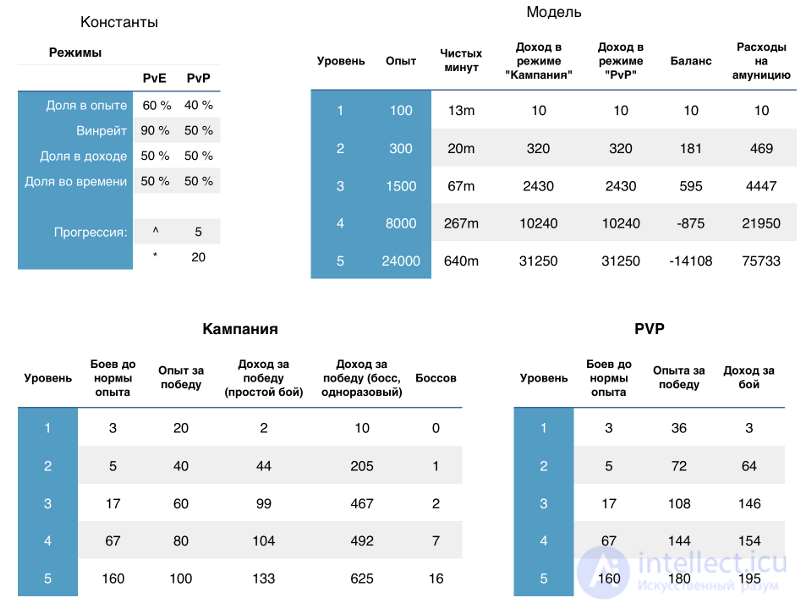
Fig. an example of game balance
We discuss how story and narrative affect the perception of a game. In some genres, such as role-playing games or adventures, narrative plays a key role, while in other genres (for example, puzzles) it can be minimal.
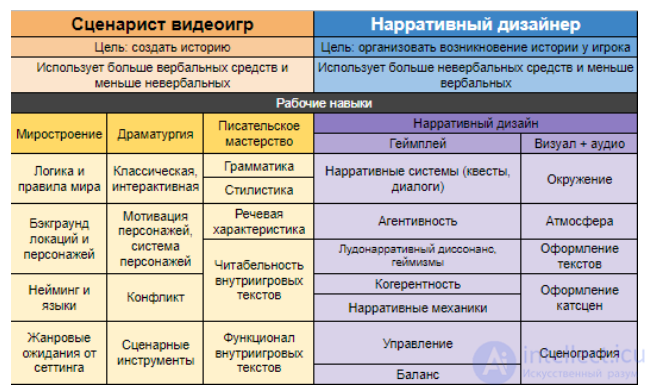
distinguishing the roles of the writer and the narrative designer in the game industry:
The writer creates the content of the story — what will happen in the game world, which events and characters are involved, the dialogue, story lines, and so on. They focus on creating the narrative, its logic, and its sequence.
The narrative designer is responsible for how this story will be conveyed to the player through mechanics, interactions, levels, visual elements, and so on. Their job is to make sure the story is woven organically into the gameplay, making it part of the player's experience.
Example:
Thus, the writer focuses on the content of the sto
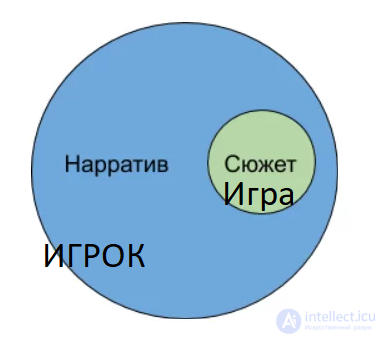
An important concept that explains that the player must feel that they control their actions and influence the course of the game. This sense of control (agency) is one of the reasons why games can be so captivating.
A sense of control and a sense of agency are related, but they are different concepts.
A sense of control is the feeling that a person can influence events or situations in their life. It is associated with the notion that you are able to direct or change the course of things by making decisions or taking actions.
A sense of agency is the feeling that your actions are initiated by you and have cause-and-effect consequences in the world around you. Importantly, agency emphasizes awareness of and responsibility for your actions. That is, a person not only feels in control, but also feels themselves to be the initiator of these actions.
Example:
Thus, control is more of an ability to manage a situation, while agency is the feeling that you yourself initiated the actions that lead to a particular result.
Successful examples of games are analyzed, along with how various game design concepts were applied in them to create a captivating experience.
These topics give a general idea of what game design is and how its elements interact to create engaging gameplay. To be continued in the following lectures.

Comments