
Lecture
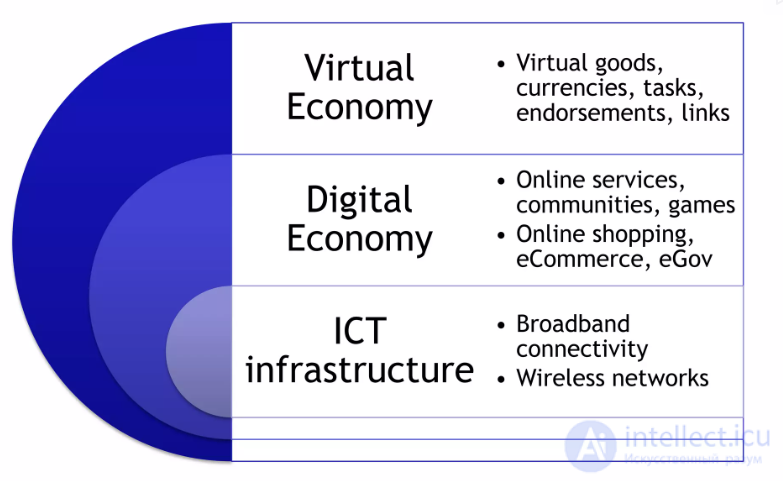
A virtual economy, also called a synthetic economy, is an emerging economic system that arises within persistent virtual worlds, especially online games. This economy is formed through the exchange of virtual goods and services. Unlike the real economy, most players participate in the virtual economy for entertainment and leisure rather than out of necessity. For this reason, many aspects inherent to the real economy that might seem tedious or undesirable (for example, buying food to keep a character alive) are often absent from virtual worlds. However, some users may use the virtual economy to gain real-world benefits. Although the term «virtual economy» originally referred to an economy operating with a virtual currency, it can also encompass transactions in which virtual money is exchanged for real money.
A virtual economy is an economy based on interactive business and on the law of economizing time.
Interactive business is a business built on the joint actions of a business process carried out by a businessperson and a computer.
The high profitability of interactive business is determined by the interaction of two factors: a large amount of revenue from entrepreneurial activity (spanning the entire globe), and a low level of costs for this activity.
Business is any type of activity that generates profit or monetary income.
The virtual economy is a modification of the market economy, functioning on the same principles as the market economy.
The virtual economy is an economy of ultra-high images and ultra-high rating levels. This is connected with the very fierce competition in the virtual economy under conditions of Internet and mobile network use. The virtual economy differs from the traditional market economy and is based on new organizational principles.
The fundamental features of an economy are:
Game monetization – is the process of generating profit from developing and distributing games. Choosing the right monetization model is one of the key factors in a game's success. In this lecture, we will examine the main monetization models, their advantages and disadvantages, as well as the factors to consider when choosing a model. Virtual economies play an important role in modern games, creating dynamic and engaging game worlds. Managing in-game currencies is a key aspect affecting balance and player satisfaction.
Virtual economy
In-game currency
Primary currency
Premium currency
Temporary currency
Virtual economies are widely represented in games of the MUD (multiplayer text-based worlds) and MMORPG (massively multiplayer online games) genres. Especially significant virtual economies develop precisely in MMORPGs. Games belonging to the life simulator genre also exhibit virtual economic systems, where sometimes the most radical steps are taken to integrate the virtual economy with the real world. An example is Second Life, where users are recognized as holding intellectual property rights to the virtual objects they create, and the in-game currency Linden Dollars can be freely exchanged for real money through third-party platforms.
Virtual economies can also exist in browser-based games, such as Virtonomica, where players can spend real money or open their own shops, or as part of emergent gameplay — a game process that develops spontaneously.
Virtual property encompasses any resource controlled by players, including virtual objects, characters, and accounts. Virtual resources may possess a number of characteristics, although not all of them are necessarily present:
These features make virtual economies similar to the real economy, and methods of economic theory are often used to study them.
Synthetic economies that exist in densely populated game worlds usually follow the law of supply and demand rather than developers' decisions about their value. These emergent economic systems create additional opportunities for players that increase the appeal of the game. In a classic virtual economy, goods are exchanged for virtual currency, but this currency is often sold for real money, which opens up the possibility of earning income in the real economy.
Managing virtual economies — is the process of regulating and controlling the economic system within a virtual environment, such as online games, social platforms, or simulations. This management includes developing and maintaining a balance between the supply of and demand for virtual goods and services, controlling virtual currency inflation, as well as implementing mechanisms that encourage the player or user to stay active in the ecosystem.
The main tasks of managing virtual economies:
1. Creating and balancing in-game resources: Game developers control the quantity of resources (for example, gold, items, or currency) available to players in order to prevent inflation or shortages. This is important for maintaining interest in the gameplay and ensuring fairness.
2. Controlling inflation and deflation: As in real economies, virtual economies are subject to changes in the value of currency. Developers can regulate these processes by changing the reward system, adjusting the difficulty of obtaining resources, or introducing new game mechanics.
3. Monetization and microtransactions: Managing a virtual economy often includes developing monetization strategies, such as microtransactions, subscriptions, or premium currency. This helps developers generate profit from their products.
4. Preventing abuse and real-money trading: One of the tasks of management is combating unauthorized trading of virtual goods and currency on secondary markets. This may include implementing anti-cheat systems or policies aimed against illegal trading.
5. Introducing and removing content: New updates or patches can affect the economy by adding new goods, services, or changing the mechanics of existing ones. This requires careful planning to maintain balance.
6. Interacting with players: Virtual economies must be flexible and adapt to the behavior and preferences of users. Feedback from players and analysis of their actions help developers make more informed decisions about future changes to the economy.
7. Stimulating activity
8. Analysis and optimization
Examples of managing a virtual economy:
World of Warcraft
Fortnite
EVE Online
The virtual currency market — is a segment of the economy in which the exchange, purchase, and sale of virtual currencies used in online games, social networks, and other digital platforms takes place. Virtual currency — is digital money that exists only within a virtual environment, such as MMORPGs, mobile applications, or platforms like Second Life.
In this market, users can acquire virtual currency for real money, exchange it for other types of virtual assets, or sell it for real currency on specialized platforms. Virtual currencies are used to purchase in-game items, upgrades, resources, or additional features.
Key features of the virtual currency market:
This market is valued in the billions of dollars and is an important part of the economy of online games and digital platforms.
In 2004, the game World of Warcraft by Blizzard Entertainment was released and quickly gained worldwide popularity. This success strengthened the position of MMORPG-genre games and led to the growth of secondary markets where active trading in virtual currency began. For example, searching for the query «WOW gold» in Google returns numerous sites offering the purchase of in-game currency for real money. The total volume of the market associated with virtual economies and measured in real money exceeds one billion dollars.
In 2001, Brock Pierce and Alan Debonneville founded the company Internet Gaming Entertainment Ltd (IGE), which was engaged not only in selling virtual goods for real money, but also in professional customer support. The company employs an entire staff dedicated to financial matters, technical support, and satisfying customers' requests. They also set up centers in Hong Kong, where low-paid technical specialists farm virtual goods for sale.
This new type of market created a unique economy, blurring the boundaries between the virtual and real worlds. The market recorded transactions in which virtual items were sold for several thousand dollars. Some companies specialized in selling currencies for several games, others — for only one. For example, 43-year-old John Dugger spent 750 dollars on virtual real estate in the game Ultima Online — a sum exceeding his weekly salary. This example demonstrates how virtual economies connect people through the exchange of real money for virtual goods.
Although virtual markets continue to grow, their development is not infinite. The principle of the interchangeability of goods and the absence of a location factor affect the distribution of demand. Despite examples of success, such as Second Life, studies show serious inequality in income distribution within virtual worlds. In 2008, the Gini coefficient in Second Life reached 90.2%, which significantly exceeds the figures of real economies.
A forecast for 2005 made by an IGE representative estimated the global real-money trading market between players at 880 million dollars, while economist Edward Castronova's research in 2004 suggested that sales volumes on the eBay and itemBay platforms would exceed 100 million dollars. According to forecasts, the volume of the global market could reach 2 billion dollars by 2007.
However, starting in 2007, the primary market began to grow faster than the secondary one, as companies introduced new methods of monetization, such as microtransactions, as well as measures against real-money trading in games, for example, in World of Warcraft. The drop in prices caused by competition with companies from mainland China, and the financial crisis of 2007–2008, also slowed the market's development. Developing regions, such as Russia, Eastern Europe, South America, and Southeast Asia, became new centers of growth, although international companies faced difficulties due to the peculiarities of payment systems and language barriers.
For example, the South Korean market is the largest and officially regulated sector of virtual goods trading, where transactions are taxed. In Western countries, the secondary market often remains in the shadows, not facing serious regulation.
For games with active trading, such as Runescape, EVE Online, and Ultima Online, the volume of the secondary market is estimated at approximately 1.1 dollars per day per user. In games with restrictions, such as World of Warcraft, such models are absent, and any estimate of an unregulated, untaxed market remains hypothetical.
Choosing a monetization model – is a complex process that requires careful analysis and planning. A successful monetization model should be balanced, transparent, and beneficial to both developers and players. Virtual economies and the management of in-game currencies — are complex but important aspects of game design. Proper management of these elements can significantly improve the gaming experience and increase revenue from the game.
Managing a virtual economy is a complex and multifaceted process that requires developers to constantly analyze data, maintain balance, and interact with users in order to sustain a healthy economic environment.
Comparative characterization of the fundamental features of the traditional economy and the virtual economy
| Feature |
Traditional economy |
Virtual economy |
|
1. Spatial |
The economy of a district, a country, a group of countries The market as the socio-economic conditions for the sale of a good, in which all participants (sellers and buyers) are equal before an external factor. A market with full symmetry |
The economy of the entire globe, formed by the "World Wide Web" WWW A global market, formed by the global Internet network. An asymmetric market - a market in which one of the participants knows more about the good than another participant |
|
2. Structural |
Sectors of the economy, usually managed and regulated by ministries. Sectors of the national economic complex |
Part of the global economic complex, managed and regulated by holdings and transnational corporations A local market, formed by local Internet networks, as well as by the intranet and extranet |
|
3. Resource-based |
A good that includes a product, real estate, investments. Monetary funds |
An asymmetric market A good that includes primarily intellectual-informational technologies Benefits, i.e. material goods that can be bought for money |
|
4. Technological |
Mass media engaged in advertising Telegraph, telephone, fax, teletype |
The Internet network Networks: intranet and extranet Mobile communications |
The in-game economy requires mechanisms for disposing of currency in order to prevent inflation and maintain balance. The main sinking methods:
Purchasing consumables (Single Use Goods)
Various fees and commissions
Repair and maintenance of items
Betting and gambling mechanics
Upgrading and modifying items (Upgradables)
Loss upon death or defeat
Temporary bonuses and buffs
Elite and cosmetic items
Events and seasonal events
These mechanics help developers control the amount of currency in the game and ensure the stability of the economy.

Comments