
Lecture
In-game purchases have become an integral part of the modern gaming industry. They allow developers to earn additional revenue, while players get to customize their gaming experience. However, this mechanism is controversial: on the one hand, it supports the development of games, while on the other, it sometimes leads to excessive spending by users. In this article, we will look at the main types of in-game purchases, their impact on players, and monetization strategies.
To begin with, let's figure out which in-game purchases users make most often.
To do this, they first classified what players actually pay for.
The chart below shows the popularity of various types of purchases. There are also two types of transactions:
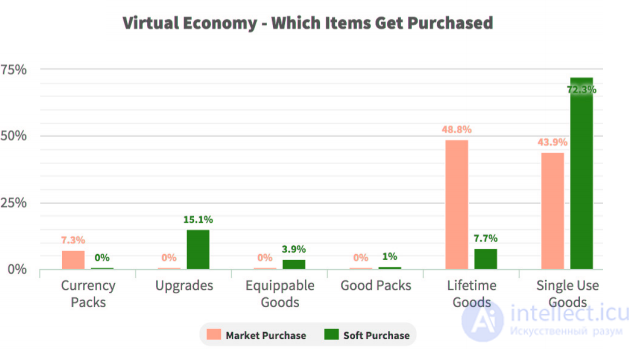
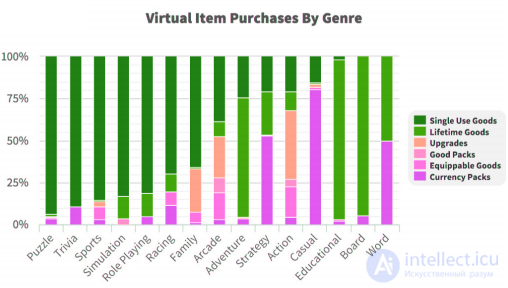
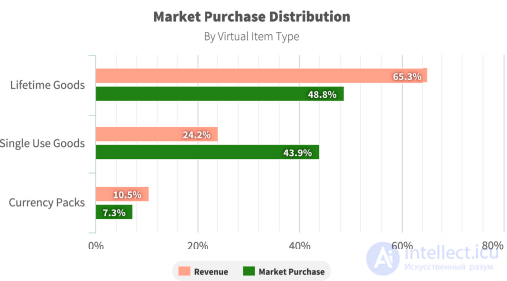
Cosmetic items — do not provide a gameplay advantage but allow you to change the appearance of a character, weapon, or interface (for example, skins in Fortnite, CS:GO).
In-game currency — Purchasing in-game currency in order to buy items within the game. It can be earned through gameplay or acquired for real money. It represents the acquisition of a game-specific form of payment that cannot be exchanged back into real money.
Boosters and accelerators — help you reach in-game goals faster, for example, by increasing the experience or resources you receive.
Downloadable content (DLC) — includes new levels, characters, missions, or game modes. New levels, storylines, or other content available to those who already own the game.
Loot boxes / chests (loot boxes) — random rewards that may contain valuable in-game items. They are compared to gambling, which draws criticism from regulators. A randomly generated collection of in-game content in the form of crates, boxes, card packs, etc.
Subscriptions — give the player access to exclusive content or premium features for a certain period of time.
In-game items. Virtual items acquired through the in-game store or a third-party marketplace. They are used for the visual customization of a character or to provide advantages in the game.
Battle pass. A ranked system available for a certain period of time. Players receive rewards as they progress through the levels or by completing certain quests. It may include pay-to-win options.
Pay-to-win. Allows the player to continue the game in a certain situation or reach a certain level without meeting the initial gameplay requirements.
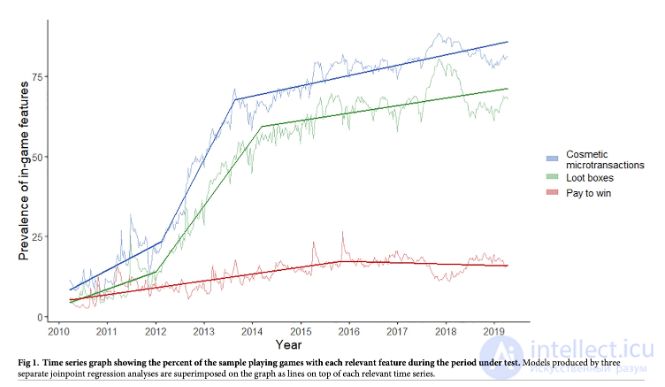
But are these types of microtransactions equally interesting to developers and players? It turns out they are not. Over the past decade, we have witnessed increased interest in "cosmetic" content — purely aesthetic items that provide no gameplay advantages. The results of an analysis of 474 games on the Steam platform released between 2010 and 2019 showed that microtransactions of this kind appeared in 85.8% of games. Offers to buy chests were present in 71.2% of games; for comparison, pay-to-win is available in only 15.9% of games. At the same time, from 2012 to 2014 there was a rapid growth in the popularity of cosmetic content — 20.38% per year. For comparison, microtransactions with pay-to-win elements grew an order of magnitude more slowly — by just 2.1% per year.
Positive aspects:
They expand game content.
They allow players to support their favorite projects.
They provide an opportunity to personalize the gaming experience.
Negative aspects:
They can lead to financial problems for players (especially minors).
In some games they create a "pay-to-win" mechanic, where victory depends on the money invested.
Loot boxes provoke elements of gambling and can be addictive.
Developers use various in-game purchase strategies:
Free-to-Play with microtransactions — the base version of the game is free, but in-game purchases generate revenue.
Premium games with DLC — players first buy the game and can then acquire add-ons.
Gacha system — players receive random rewards, as in collectible card games.
Battle pass — for a fixed sum, players gain access to rewards unlocked during gameplay.
A table with all types of in-game purchases:
|
Name
|
Description
|
Notes
|
Examples
|
|---|---|---|---|
|
Character skins
|
Changing the appearance
of a character (clothing, coloring, looks).
|
Does not affect gameplay.
|
other types of characters (clothing)
|
|
Enemy skins
|
Alternative design
of opponents.
|
Can be used
to change difficulty (if the skin affects perception).
|
-
|
|
Weapon/tool skins
|
Visual change of weapons,
tools, gadgets.
|
Does not change stats.
|
different types of weapons (pistol, rifle, bow, explosives), protection from fire, steam, dagger
|
|
Effects and animations
|
Additional visual
effects (aura, fiery footsteps, glowing strikes).
|
Can be used
as a reward for achievements.
|
|
|
Emotes and gestures
|
Animations of greetings, dances, interactions.
|
Useful for social interactions in multiplayer.
|
|
|
Interface decorations
|
Changing icons, frames, cursors.
|
Completely cosmetic.
|
make the cursor look like a target, make a visible crosshair a paid feature
|
|
Pets/companions
|
Decorative creatures that follow the player.
|
Do not provide gameplay advantages.
|
|
|
Alternative maps/themes
|
Changing the graphic style of locations, interface.
|
Can be combined with seasonal events.
|
new (hidden) levels
|
|
Music and sound packs
|
Alternative sounds, music, voice effects.
|
Completely cosmetic.
|
|
|
Extra health/energy
|
Purchasing extra lives, stamina, energy.
|
Can be Pay-to-Win if poorly balanced.
|
|
|
Weapons and equipment
|
More powerful weapons, armor, gadgets.
|
Can affect balance.
|
|
|
Characters with special abilities
|
Unlocking new heroes with unique skills.
|
Can be used for paid content.
|
unlocking new characters or clothing items
|
|
Boosters/accelerators
|
Temporary bonuses: increased speed, strength, armor.
|
Used in free-to-play games.
|
a temporary pill that makes the hero invulnerable
|
|
Unlocking new levels/modes
|
Access to exclusive zones, missions.
|
Can be a one-time purchase or part of a subscription.
|
unlocking new levels
|
|
Unlocking game mechanics
|
The ability to use new skills, movement styles.
|
Often used in mobile games.
|
|
|
Process automation
|
Bots, auto-farming of resources.
|
Speeds up grinding but can affect balance.
|
|
|
Subscription system (Battle Pass)
|
Access to seasonal rewards, quests.
|
A popular monetization format.
|
|
|
Resources and currency
|
Purchasing in-game currency, crafting materials.
|
Often sold for real money.
|
Purchasing in-game currency
|
|
Skipping waits (skip timers)
|
Speeding up long processes.
|
Found in mobile and free-to-play games.
|
|
Game developers are interested in microtransactions for obvious reasons — the more in-game purchases users make, the more successful the project becomes. However, researchers examine this process from the standpoint of player psychology and behavior, uncovering curious patterns.
The likelihood of making microtransactions depends on a person's basic psychological needs. One of the key ones is autonomy — the ability to make decisions independently. If in real life a player lacks control over their actions, they are more likely to spend money on in-game items, for example, buying yet another chest.
Another important factor is competence, the desire to improve one's skills. As long as the player feels progress in developing their character, the likelihood of purchases remains high. However, once this need is satisfied, interest in further spending declines.
In addition to psychological aspects, the convenience of making purchases plays an important role. If a card is already linked to the game account, the player may spend more than they planned. At the same time, in-game transactions can cause a feeling of guilt, which pushes a person to keep playing but reduces the enjoyment of the gameplay.
Research has shown that microtransactions can be associated with gaming addiction. It has six key signs:
The more signs of addiction a person has, the greater their propensity for in-game spending. Interestingly, this connection does not depend on age but is more common among men.
There is a physiological similarity between in-game purchases and gambling. For example, the reaction to opening chests in FIFA is similar to the thrill of betting — a change in the electrical activity of the skin is observed, accompanied by slight excitement. The more valuable the item from the chest, the stronger this effect, which makes the mechanic similar to winning at a casino.
Betting mechanics and loot boxes in video games generate significant controversy and are regulated differently in different countries. Below are some countries and their approaches to regulating these elements:
Belgium: In 2018, Belgium recognized loot boxes as a form of gambling and banned their use in video games. This decision is based on the fact that loot boxes can cause psychological dependence and lead to uncontrolled spending, especially among young people.
The Netherlands: In 2018, the Netherlands also recognized certain forms of loot boxes as gambling and introduced restrictions on their use. However, in 2022 a court overturned the fines imposed on developers, ruling that loot boxes do not violate local gambling legislation. As a result, the regulation of loot boxes in the country remains a subject of debate and may be revisited in the future.
Germany: Germany has introduced the Oasis control system, which restricts access to certain online games and betting. Many popular casinos and betting services have become unavailable on regulated platforms, which has prompted players to look for alternatives. Politicians continue to discuss the need for further regulation of loot boxes, possibly following Belgium's example.
Norway: In 2022, Norway held public hearings on updating gambling legislation, including a discussion of loot boxes. Although no consensus was reached, the possibility of recognizing loot boxes as a form of lottery and introducing corresponding regulation is being considered.
Spain: In the summer of 2022, Spain's Ministry of Consumer Affairs published a bill aimed at regulating random reward mechanisms in video games. The goal is to protect consumers from potentially exploitative practices and ensure the transparency of such mechanics.
The United Kingdom: In the UK, there is active debate about regulating loot boxes. Although there is no outright ban, measures are being discussed to protect consumers, especially minors, from the potential risks associated with loot boxes.
Russia: In recent months, Russia has been discussing a bill to regulate the video game industry, including possible restrictions on the use of loot boxes. The impetus was complaints about uncontrolled spending by teenagers and comparisons of loot box mechanics to gambling.
In China, strict rules have been introduced to regulate betting mechanics and loot boxes in video games.
The main features include:
A ban on selling loot boxes for real money: Players can only acquire loot boxes with in-game currency earned during gameplay.
Mandatory disclosure of item drop probabilities: Developers are required to publish the exact chances of obtaining various items from loot boxes, ensuring transparency for players.
A limit on the number of loot box purchases per day: Daily limits have been introduced on the number of loot boxes a single player can acquire, in order to prevent excessive spending.
However, despite these measures, some developers find ways to circumvent the established rules. For example, in some games the information about item drop chances may be hidden or hard for users to access.
In addition, in 2024 a bill was discussed to completely ban loot boxes and daily rewards in games; however, after a negative market reaction and major companies losing significant sums, the initiative was postponed, and the responsible official was removed from their post.
Thus, China seeks to control the use of loot boxes and betting mechanics in games, introducing strict regulations to protect users, especially young people, from the potential risks associated with gambling elements in video games.
Thus, approaches to regulating betting mechanics and loot boxes in video games differ significantly by country. Some states introduce strict bans, equating them with gambling; others develop special laws to protect consumers, especially minors, from the potential risks associated with such mechanics.
In-game purchases are an important element of the modern gaming industry that makes it possible to develop projects and brings revenue to developers. However, it is important to maintain a balance between monetization and player comfort, avoiding aggressive strategies that lead to community dissatisfaction. The optimal approach is to offer content that does not affect game balance but makes it more engaging and personalized.

Comments